Burgula Ramakrishna Rao
Lawyer and Congress leader of Hyderabad State. He was among the moderate leaders of the Andhra Mahasabha up to 1941, was arrested in the Quit India satyagraha of 1942 and led a satyagraha batch in May 1947. After the first general elections he became Chief Minister of Hyderabad State in 1952. He took part in the talks of February 1956 that settled the terms for joining Telangana to Andhra, and in October 1956 he was named governor of Kerala.
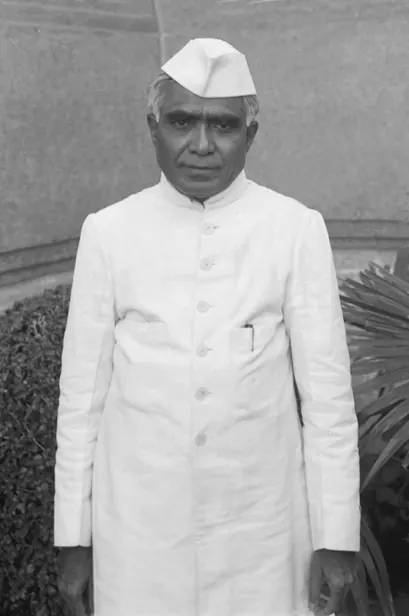
Burgula Ramakrishna Rao was a lawyer and Congress leader in Hyderabad State.12 After the first general elections of 1952 he became the state’s Chief Minister.3 He held that post until Hyderabad State was broken up in 1956, and he was one of the leaders who agreed on the terms for joining Telangana to Andhra.45
The Andhra Mahasabha and the State Congress
Up to 1941 the Andhra Mahasabha of Hyderabad State was led by moderates.1 Sarojini Regani names B. Ramakrishna Rao among them.1 She records an interview with a government officer in which he described the Mahasabha as a non-political library movement.6 The Police Commissioner who was present replied that in Bengal a library movement meant a revolutionary movement.6
In 1938 the Nizam’s government banned the new Hyderabad State Congress.7 According to Regani, the government would lift the ban only if certain leaders gave an assurance about the “Unity Talks” with the Ittehad-ul-Muslimeen party.7 Ramakrishna Rao was one of the leaders named, and the assurance was not given.7
He was among those arrested in Hyderabad in the Quit India satyagraha of 1942.8 On 8 May 1947 he led a batch of five Congressmen who addressed the people in defiance of the rules on public meetings.9 They were protesting because the government had ordered the socialist leader Jayaprakash Narayan to leave Hyderabad.9
In 1947 the State Congress was split into groups.10 Regani names one group as led by B. Ramakrishna Rao, K. V. Ranga Reddy, Chenna Reddy and others.10 At the open session of May 1947, a resolution for launching the freedom struggle was moved by Digambar Rao Bindu and supported by Ramakrishna Rao.10 In January 1948 armed Razakars attacked the village of Bibinagar.11 The Ittehad-ul-Muslimeen president blamed slogans shouted against the Nizam.11 Regani rejects that excuse, citing enquiries made by Ramakrishna Rao and others.11
Chief Minister of Hyderabad State, 1952–1956
After the Police Action of 1948, a military governor ran Hyderabad State, and then a civil chief minister, M. K. Vellodi.3 The first general elections were held in March 1952, and a ministry was formed under B. Ramakrishna Rao.3 The new Hyderabad Legislative Assembly listed him as the member for Shadnagar.12
On 29 March 1952 he replied to the Leader of the Opposition in a debate on a money bill.2 He said he had been in public life for about thirty years.2 He told the House that he had been vice-president of the Comrades’ Association when it began.2 He said he left it when he found that its members belonged to the Communist Party.2
He also said that, as a lawyer, he had defended communist leaders such as Baddam Yella Reddy and Makhdoom Mohiuddin.13 They had been prosecuted by the Nizam’s government.13 He called the communist armed struggle in Telangana a war against the government, not a peasants’ struggle for land.13
He refused the Opposition’s demand that arrest warrants be cancelled before the underground fighters gave up their arms.14 But he promised that the police budget would not be used to suppress any political party that believed in democracy.14
In December 1953 the Assembly went through the Hyderabad Tenancy and Agricultural Lands (Amendment) Bill clause by clause.15 A member said that the Chief Minister was the one guiding the Bill through the House.16 Members argued over how to fix a “family holding”, the area of land on which a farming family could live.16
The end of Hyderabad State, 1955–1956
In 1955 the States Reorganisation Commission recommended that Hyderabad State be broken up by language.17 It proposed that Telangana stay a separate state, called Hyderabad State, until about 1961.18
The government did not adopt this proposal.4 On 20 February 1956, leaders of the two states met at the Hyderabad Guest House in New Delhi.4 The Hyderabad side was B. Ramakrishna Rao, K. V. Ranga Reddy, Chenna Reddy and J. V. Narasinga Rao.4 They agreed on safeguards for Telangana inside one Telugu state, which became known as the Gentlemen’s Agreement.4 The terms are described on the page Andhra State & Andhra Pradesh.
In 1956 a corpus (collection) of Telangana inscriptions came out.5 Its title page names the Government of Andhra Pradesh as publisher, but gives only the year, not the month.5 Its foreword is dated at Hyderabad on 28 October 1956 and signed by B. Ramakrishna Rao as Chief Minister.5 The editor’s preface of 20 October 1956 calls him Chief Minister of Hyderabad and governor-designate (chosen as the next governor) of Kerala.5 Andhra Pradesh was formed a few days later, on 1 November 1956.4
Footnotes
-
Regani, Highlights (1956), p. 181 (archive.org (opens in a new tab)). ↩ ↩2 ↩3
-
Hyderabad Legislative Assembly Debates, 29 March 1952, p. 265 (archive.org (opens in a new tab)). ↩ ↩2 ↩3 ↩4 ↩5
-
Regani, Highlights (1956), p. 234 (archive.org (opens in a new tab)). ↩ ↩2 ↩3
-
Report of the Committee on Telangana Surpluses (1969), p. 5 (archive.org (opens in a new tab)); The History of the Andhra Pradesh Police (1861–1961) (1961), p. 260 (archive.org (opens in a new tab)). ↩ ↩2 ↩3 ↩4 ↩5 ↩6
-
P. Sreenivasachar (ed.), A Corpus of Inscriptions in the Telingana Districts of Andhra Pradesh, Part III (1956), title page, foreword and preface (archive.org (opens in a new tab)). ↩ ↩2 ↩3 ↩4 ↩5
-
Sarojini Regani, Highlights of the Freedom Movement in Andhra Pradesh (1956), p. 180 (archive.org (opens in a new tab)). ↩ ↩2
-
Regani, Highlights (1956), pp. 188–189 (archive.org (opens in a new tab)). ↩ ↩2 ↩3
-
Regani, Highlights (1956), p. 195 (archive.org (opens in a new tab)). ↩
-
Regani, Highlights (1956), pp. 197–198 (archive.org (opens in a new tab)). ↩ ↩2
-
Regani, Highlights (1956), p. 199 (archive.org (opens in a new tab)). ↩ ↩2 ↩3
-
Regani, Highlights (1956), p. 218 (archive.org (opens in a new tab)). ↩ ↩2 ↩3
-
Hyderabad Legislative Assembly Debates: Table of Contents and Index, March–April 1952 session, index of members (archive.org (opens in a new tab)). ↩
-
Hyderabad Legislative Assembly Debates, 29 March 1952, pp. 266–267 (archive.org (opens in a new tab)). ↩ ↩2 ↩3
-
Hyderabad Legislative Assembly Debates, 29 March 1952, pp. 267–268 (archive.org (opens in a new tab)). ↩ ↩2
-
Hyderabad Legislative Assembly Debates, 18 December 1953, p. 249 (archive.org (opens in a new tab)). ↩
-
Hyderabad Legislative Assembly Debates, 18 December 1953, p. 256 (archive.org (opens in a new tab)). ↩ ↩2
-
Report of the States Reorganisation Commission (1955), p. 101 (archive.org (opens in a new tab)). ↩
-
Report of the States Reorganisation Commission (1955), pp. 107–108 (archive.org (opens in a new tab)). ↩
Photos
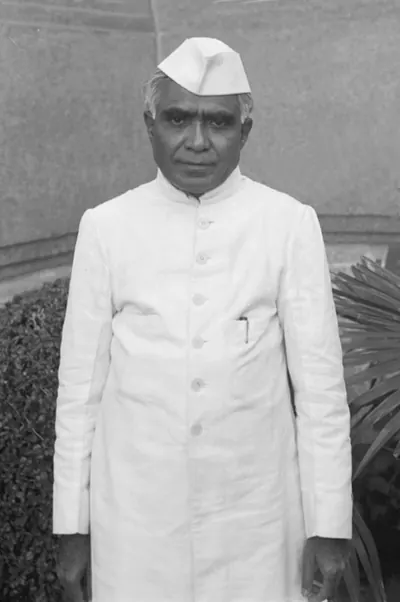 Burgula Ramakrishna Rao, Chief Minister of Hyderabad State (1952)Historic photograph · 1952
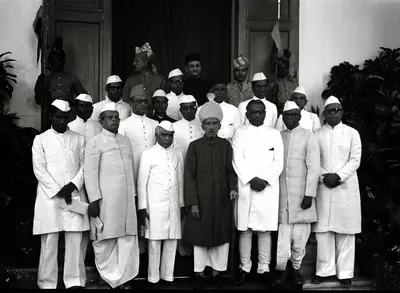 The first elected ministry of Hyderabad State with the Nizam, as identified on Commons (1952)Historic photograph · 1952
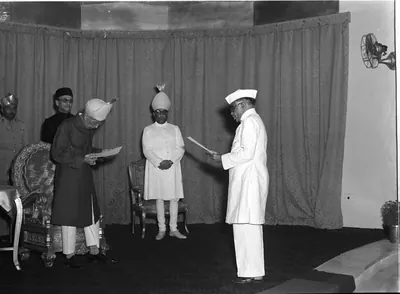 The Nizam administering the oath of office to Burgula Ramakrishna Rao, as identified on Commons (1952)Historic photograph · 1952
References
Notes (0)
Sources (8)
Spotted an error on this page? Tell us
Last updated: