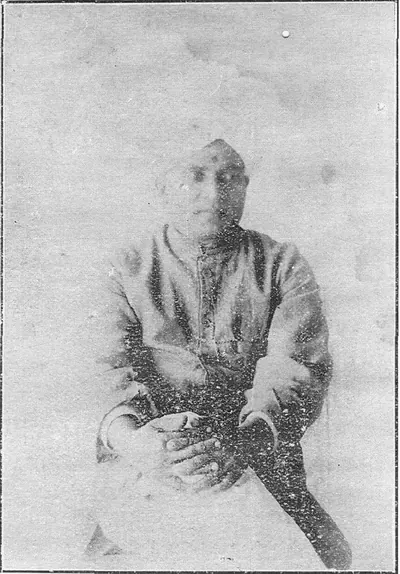
Gidugu Venkata Ramamurti
Telugu scholar of Parlakimidi who led the early 20th-century movement to write books in modern spoken Telugu instead of the old literary style. His opponents, among them Jayanti Ramayya in 1913, fought him through the Andhra Sahitya Parishat, but K. Sitaramaiya wrote in 1943 that he lived to see the universities accept the spoken style. He also learned the Savara language of the Visakhapatnam hills and compiled a Telugu-Savara dictionary (1914).
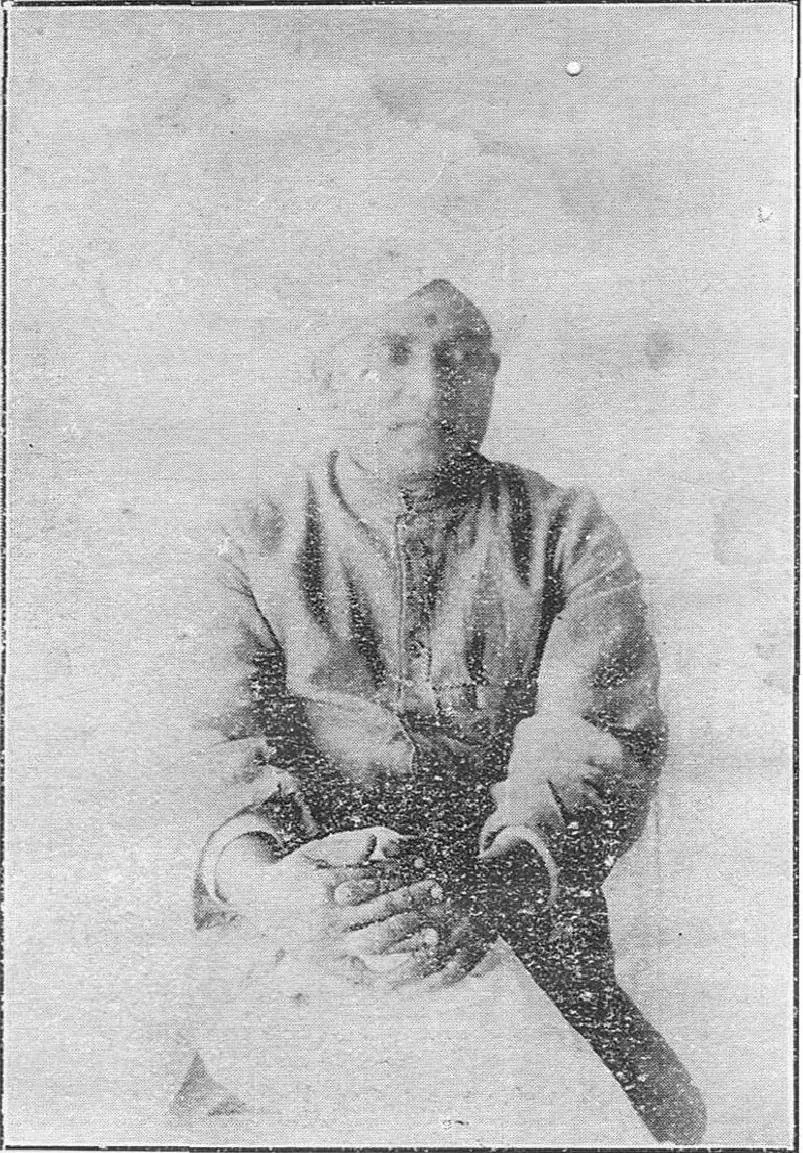
Gidugu Venkata Ramamurti was a Telugu scholar of Parlakimidi (then Parlakimedi).12 In the early 20th century he led the movement to write Telugu books in the modern spoken language.23 At that time Telugu books were written in a literary style far from the language people spoke.4 The movement changed how Telugu was written and taught.56
Scholar and teacher
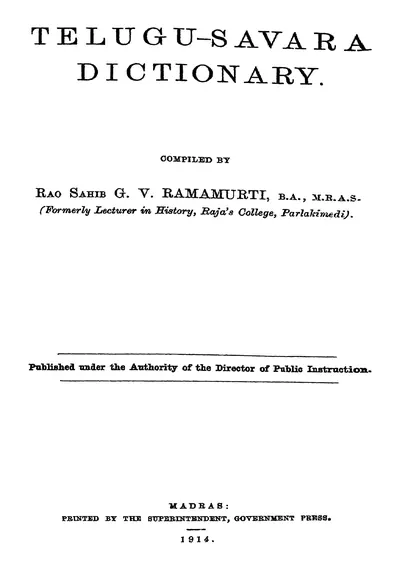
The title page of his Telugu-Savara dictionary (1914) calls him “Rao Sahib G. V. Ramamurti, B.A., M.R.A.S.”.1 It says he was formerly a lecturer in history at the Raja’s College, Parlakimidi.1 P. Chenchiah and Raja M. Bhujanga Rao, in their history of Telugu literature (1928), named him among the leading scholars comparing the Dravidian languages.7
The Savara language
The Savaras are a hill people of the Visakhapatnam (then Vizagapatam) agency.5 K. Sitaramaiya, writing in Hyderabad in 1943, wrote that Ramamurti lived among them and learned their language.5 Until then it was only spoken.5 He made an alphabet for it and wrote several books and a dictionary in it.5
His Telugu-Savara Dictionary was printed at the Government Press in Madras in 1914.1 It was “published under the Authority of the Director of Public Instruction”.1
The spoken-Telugu movement
Chenchiah and Bhujanga Rao called the dispute between the literary and the spoken language “an acrimonious battle of words”.4 They did not name the leaders.4 A pamphlet of the other side does.2
In 1913 Jayanti Ramayya wrote A Defence of Literary Telugu against the new movement.2 He named three men as its leaders:2
- P. T. Sreenivasa Aiyangar of Visakhapatnam
- Gurajada Apparao of Vizianagaram
- “Rao Sahib G V Ramamurti of Parlakimedi”2
Ramayya found Ramamurti clearer about his aims than Apparao.89 Under his plan, Ramayya wrote, “Modern Telugu” would be taught in all schools.9 The literary language and its literature would become optional.9 Ramamurti defined his “Modern Telugu” as the dialect “now current among the educated classes of the Telugu community”.10 Ramayya feared that this would make the old literary language a dead tongue for later generations.10
Sitaramaiya told the story from the other side.311 A book in the spoken style was prescribed as a school textbook, and there was “a great hue and cry”.11 To fight the movement, the orthodox scholars founded the Andhra Sahitya Parishat.11 For a time they seemed to win.11 Ramamurti kept up the fight, with many young supporters, and ran a journal called Tenugu.1112
His method and his success
Ramamurti searched almost the whole of old Telugu literature, Sitaramaiya wrote.11 He listed the forms in old poems that broke the rules of the grammars.11 From this he argued that no fixed grammar could be written for a living language.11 He also showed that living scholars broke their own rules.5
Sitaramaiya wrote that Ramamurti “lived to see his triumph”.5 By 1943, he said, even the universities had to prescribe textbooks in the spoken style (vyavaharika).5 P. T. Raju, in 1944, wrote that Ramamurti’s complete works had been published by the Navya Sahitya Parishat of Guntur.13
Where the sources disagree
- Who led the movement. Jayanti Ramayya, in 1913, named three leaders, including Gurajada Apparao.2 Sitaramaiya presents Ramamurti as the leader, with Gurajada and others joining him.11 Raju names Ramamurti alone against his opponents.14
- How it ended. Ramayya, writing in the middle of the fight, saw the movement as a danger to Telugu.10 Sitaramaiya, thirty years later, saw it as settled in Ramamurti’s favour.56 Raju wrote more cautiously that “both parties have now several writers as followers”.14
Footnotes
-
G. V. Ramamurti (comp.), Telugu-Savara Dictionary (Madras, 1914), title page (archive.org (opens in a new tab)). ↩ ↩2 ↩3 ↩4 ↩5
-
J. Ramayya Pantulu, A Defence of Literary Telugu (1913), p. 6 (archive.org (opens in a new tab)). ↩ ↩2 ↩3 ↩4 ↩5 ↩6 ↩7
-
K. Sitaramaiya, A Hand Book of Telugu Literature (1943), p. 86 (archive.org (opens in a new tab)). Cite-only; paraphrased. ↩ ↩2
-
P. Chenchiah and Raja M. Bhujanga Rao, A History of Telugu Literature (1928), p. 109 (archive.org (opens in a new tab)). ↩ ↩2 ↩3
-
Sitaramaiya, A Hand Book of Telugu Literature (1943), p. 88 (archive.org (opens in a new tab)). Cite-only; paraphrased. ↩ ↩2 ↩3 ↩4 ↩5 ↩6 ↩7 ↩8 ↩9
-
Sitaramaiya, A Hand Book of Telugu Literature (1943), p. 89 (archive.org (opens in a new tab)). Cite-only; paraphrased. ↩ ↩2
-
Chenchiah and Bhujanga Rao, A History of Telugu Literature (1928), p. 111 (archive.org (opens in a new tab)). ↩
-
Ramayya, A Defence of Literary Telugu (1913), p. 7 (archive.org (opens in a new tab)). ↩
-
Ramayya, A Defence of Literary Telugu (1913), p. 8 (archive.org (opens in a new tab)). ↩ ↩2 ↩3
-
Ramayya, A Defence of Literary Telugu (1913), p. 9 (archive.org (opens in a new tab)). ↩ ↩2 ↩3
-
Sitaramaiya, A Hand Book of Telugu Literature (1943), p. 87 (archive.org (opens in a new tab)). Cite-only; paraphrased. ↩ ↩2 ↩3 ↩4 ↩5 ↩6 ↩7 ↩8 ↩9
-
Raju, Telugu Literature (1944), p. 87 (archive.org (opens in a new tab)). Cite-only; paraphrased. ↩
-
Raju, Telugu Literature (1944), p. 86 (archive.org (opens in a new tab)). Cite-only; paraphrased. ↩
-
P. T. Raju, Telugu Literature (1944), p. 80 (archive.org (opens in a new tab)). Cite-only; paraphrased. ↩ ↩2
Photos
References
Notes (0)
Sources (5)
Spotted an error on this page? Tell us
Last updated: