Pingali Surana
Telugu poet of the mid-16th century at the courts of Akavidu and Nandyal in Kurnool district. He wrote the Raghavapandaviyamu, in which every verse tells the stories of both Rama and the Pandavas, and two story-poems: the Kalapurnodayamu, a plot of his own invention, and the Prabhavati Pradyumnamu. Tradition counts him among Krishnadeva Raya's eight court poets, but Subramiah Pantulu and P. T. Raju put him a generation later.
Pingali Surana was a Telugu poet of the middle of the 16th century.12 He wrote three surviving poems, including the Kalapurnodayamu (the birth of Kalapurna), a long verse story whose plot he invented himself.34 P. Chenchiah and Raja M. Bhujanga Rao thought him the leading poet of the later 16th century, for his “daring originality”.5 He is counted among the Ashtadiggajas, the eight poets of Krishnadeva Raya, but the sources doubt that he belonged to that court.61
Family and patrons
G. R. Subramiah Pantulu wrote on the court poets in the Indian Antiquary in 1898.7 He described Surana as a Niyogi Brahmin, son of Amarana and Abbamma, with two brothers, Amalana and Errana.7 Pingali was the family’s house-name, after a village of that name in the Krishna (then Kistna) district.7 Chenchiah and Bhujanga Rao, in their history of Telugu literature (1928), also place the family’s first home at Pingali.5
Surana himself moved south.1 Subramiah Pantulu wrote that he lived at the courts of Akavidu and Nandyal, in Kurnool district, small courts that arose as Vijayanagara broke up.1 He dedicated the Raghavapandaviyamu to Pedda Venkatadri of Akavidu, near Koilkuntla.4 He dedicated the Kalapurnodayamu to Krishnaraja of Nandyal.1 Chenchiah and Bhujanga Rao also name Krishna Raju of Nandyal as his patron, “a contemporary of Sadasivaraya”.53
Dating the poet
Subramiah Pantulu worked out a date from the patrons’ families.14 Krishnaraja of Nandyal was sixth in descent from Aravidu Bukka, and a contemporary of Sadasiva Raya.1 So Subramiah Pantulu put the Kalapurnodayamu about 1560.14 He thought the Raghavapandaviyamu was written earlier, about 1550, when the poet was young.4
His works
Surana names his own earlier works at the start of the Prabhavati Pradyumnamu.4 The poems are:384
- the Garuda Puranamu, which is lost
- the Raghavapandaviyamu, in which each verse can be read as the story of Rama or as the story of the Pandavas
- the Kalapurnodayamu, a comedy of mistaken identities among gods, nymphs and magicians
- the Prabhavati Pradyumnamu, the love story of Pradyumna, son of Krishna, and the demon king’s daughter Prabhavati384
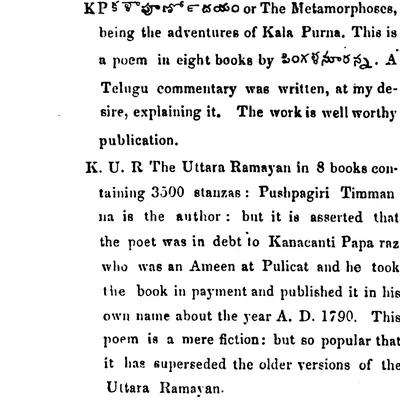
Chenchiah and Bhujanga Rao praised the Raghavapandaviyamu for its “grace and simplicity of style”.3 Subramiah Pantulu called Surana the first to write whole poems in which every verse tells two stories.4 Charles Philip Brown, in 1852, called the Kalapurnodayamu “well worthy publication”.9 He had a Telugu commentary written on it.9 He also noted a later poem by Venkatarya, which seemed to continue its story.10
An invented story
Telugu poets usually built their long poems on a story from the Puranas.3 Chenchiah and Bhujanga Rao stressed that the Kalapurnodayamu was “a story of his own invention”.3 Subramiah Pantulu called it “entirely a product of the poet’s brain”.11 In it two lovers in heaven are copied by two earthly doubles, and the four become confused with one another.38
Chenchiah and Bhujanga Rao saw Surana trying to turn the long poem towards drama.12 He starts in the middle of the story and lets his characters tell it.12 The Prabhavati Pradyumnamu opens with a view of Dwarka seen from Indra’s flying chariot.1211 They noted that he lived at the time of Shakespeare.12 They compared the Kalapurnodayamu to The Comedy of Errors and the Prabhavati Pradyumnamu to Romeo and Juliet.12 P. T. Raju, in 1944, thought these comparisons “misleading”.13
The Prabhavati Pradyumnamu also tells of a troupe of actors.8 Chenchiah and Bhujanga Rao thought it might throw light on how plays were acted and staged in the poet’s time.14
Stories told about him
Subramiah Pantulu repeats a story that Surana married a granddaughter of Allasani Peddana.4 In the story, people laughed at the idle young man, so he went away and came back a scholar.4 Peddana first called a verse of his laboured, then praised it before it was finished.4 Subramiah Pantulu gives this only as “a story current”.4
Where the sources disagree
- Krishnadeva Raya’s court. Tradition counts Surana among Krishnadeva Raya’s eight court poets.6 Subramiah Pantulu found “no records” to show this.1 He thought the mistake came from confusing Krishnadeva Raya with the later Krishnaraja of Nandyal.1 Raju also wrote that Surana did not live in Krishnadeva Raya’s time.152
- Where Nandyal is. Subramiah Pantulu places Nandyal in Kurnool district.1 Raju puts it in Krishna district.2
Footnotes
-
Subramiah Pantulu, Indian Antiquary XXVII (1898), p. 329 (archive.org (opens in a new tab)). ↩ ↩2 ↩3 ↩4 ↩5 ↩6 ↩7 ↩8 ↩9 ↩10 ↩11
-
Raju, Telugu Literature (1944), p. 40 (archive.org (opens in a new tab)). Cite-only; paraphrased. ↩ ↩2 ↩3
-
Chenchiah and Bhujanga Rao, A History of Telugu Literature (1928), p. 78 (archive.org (opens in a new tab)). ↩ ↩2 ↩3 ↩4 ↩5 ↩6 ↩7 ↩8
-
Subramiah Pantulu, Indian Antiquary XXVII (1898), p. 330 (archive.org (opens in a new tab)). ↩ ↩2 ↩3 ↩4 ↩5 ↩6 ↩7 ↩8 ↩9 ↩10 ↩11 ↩12 ↩13
-
Chenchiah and Bhujanga Rao, A History of Telugu Literature (1928), p. 77 (archive.org (opens in a new tab)). ↩ ↩2 ↩3
-
P. Chenchiah and Raja M. Bhujanga Rao, A History of Telugu Literature (1928), p. 72 (archive.org (opens in a new tab)). ↩ ↩2
-
G. R. Subramiah Pantulu, “Discursive Remarks on the Augustan Age of Telugu Literature”, Indian Antiquary XXVII (1898), p. 328 (archive.org (opens in a new tab)). ↩ ↩2 ↩3
-
Chenchiah and Bhujanga Rao, A History of Telugu Literature (1928), p. 79 (archive.org (opens in a new tab)). ↩ ↩2 ↩3 ↩4
-
Charles Philip Brown, A Dictionary, Telugu and English (1852), p. x (archive.org (opens in a new tab)). ↩ ↩2
-
Brown, A Dictionary, Telugu and English (1852), p. xiv (archive.org (opens in a new tab)). ↩
-
Subramiah Pantulu, Indian Antiquary XXVII (1898), p. 331 (archive.org (opens in a new tab)). ↩ ↩2
-
Chenchiah and Bhujanga Rao, A History of Telugu Literature (1928), p. 80 (archive.org (opens in a new tab)). ↩ ↩2 ↩3 ↩4 ↩5
-
Raju, Telugu Literature (1944), p. 41 (archive.org (opens in a new tab)). Cite-only; paraphrased. ↩
-
Chenchiah and Bhujanga Rao, A History of Telugu Literature (1928), p. 114 (archive.org (opens in a new tab)). ↩
-
P. T. Raju, Telugu Literature (1944), p. 35 (archive.org (opens in a new tab)). Cite-only; paraphrased. ↩
Photos
References
Notes (0)
Sources (4)
Spotted an error on this page? Tell us
Last updated: