Venkata Swetachalapati Ranga Rao of Bobbili
Raja and later Maharaja of Bobbili in the Vizagapatam district. He was born in 1862, a younger son of the Raja of Venkatagiri, adopted in 1872 by the Rani of Bobbili, and installed in 1881. He visited England in 1893 and was made K.C.I.E. in 1895. He sat in the Madras Legislative Council for the great landholders, where he spoke against the Tenancy Bill, and he received the title of Maharaja at the close of the nineteenth century. In 1926 he became the first Pro-Chancellor of the Andhra University.
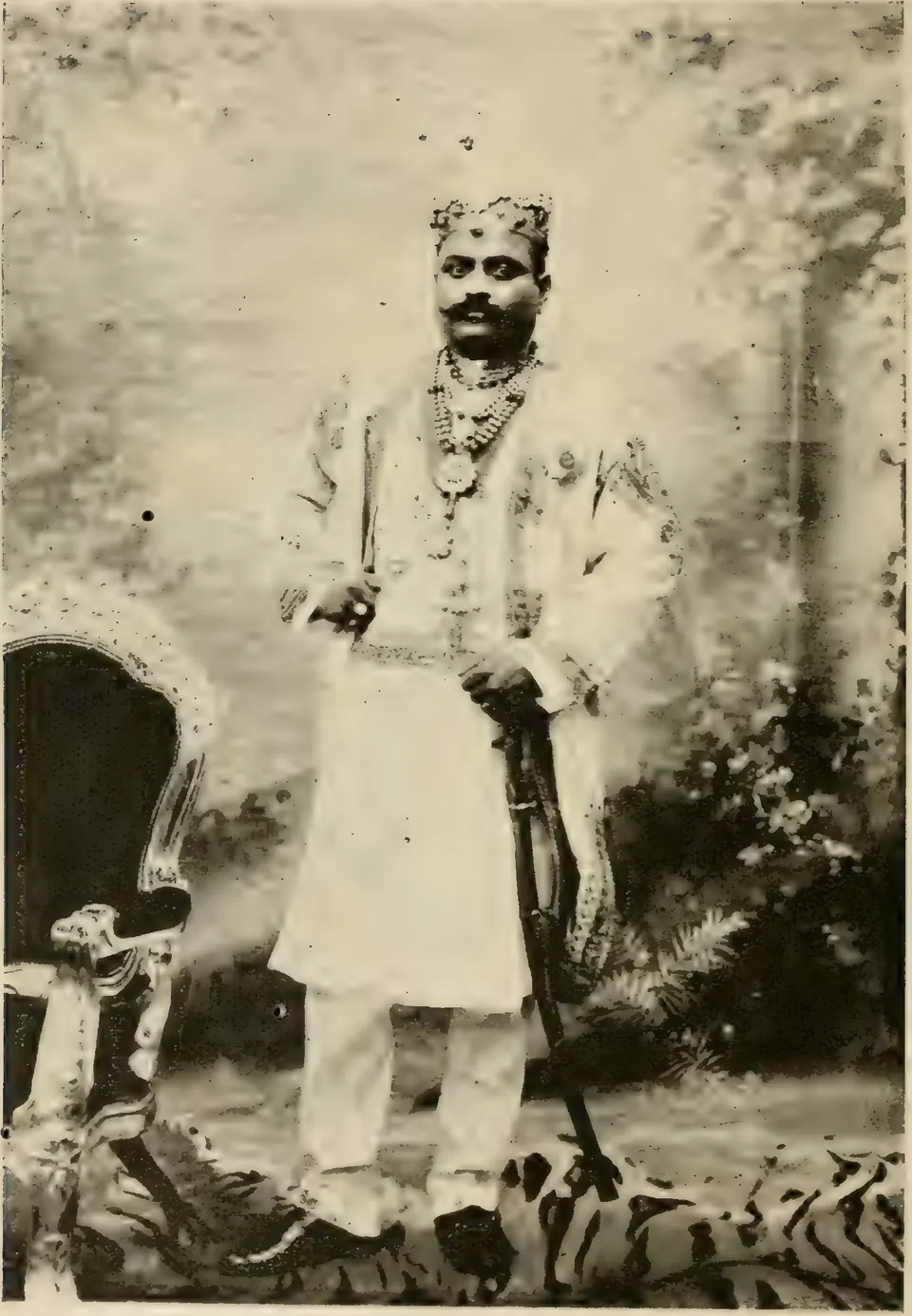
Venkata Swetachalapati Ranga Rao ruled the Bobbili zamindari (estate) from 1881. It covered about 920 square miles in the Visakhapatnam (then Vizagapatam) district, and its peshkash (yearly tribute) was Rs. 95,315.1 Almost everything known of him in the library comes from A. Vadivelu’s Aristocracy of Southern India (1903).1 This book gives admiring portraits of the princes and zamindars (landholders) of the south.1
Vadivelu says he “was born on the 8th September 1862, at Venkatagiri”.2 He was the third son of the Raja of Venkatagiri, and in 1872 the Rani Lakshmi Chellayamma, who had no heir, adopted him.2
His eldest brother became Raja of Venkatagiri, as Rajagopala Krishna Yachendra.3 Two other brothers were adopted into Pithapuram and Jetprole.3 The Bobbili family’s eighteenth-century history, and the siege of 1757, are told on Gopalakrishna Ranga Rao and Bobbili.
Raja of Bobbili
He was taught by an English tutor, J. Marsh, and a Sanskrit pandit.23 In 1877 Visakhapatnam celebrated the Queen’s assumption of the title of Empress.23 At that celebration, Vadivelu says, he sat on the dais with the Maharaja of Vizianagaram, and this ended a long hostility between the two houses.23
A quarrel with his adoptive mother was settled through the Special Commissioner sent to Visakhapatnam during the Rampa rising.4 After this he was installed on 30 November 1881.4
In 1893 he went to England, and according to his own diary as Vadivelu prints it, he was received by the Queen at Windsor.567 He returned to Bobbili on 18 September 1893.567 In memory of the journey he built the Victoria Town Hall there, and Lord Wenlock laid its foundation stone in 1894.567
He “was knighted in 1895”, as K.C.I.E.8 In the famine of 1896–97, Vadivelu writes, he gave Rs. 10,000 to the famine relief fund.9 He fed the poor at Bobbili and spent some Rs. 25,000 on irrigation works.9 The Governor, Sir Arthur Havelock, opened the Town Hall on 21 February 1898 and thanked him for his help.9
In the Legislative Council
When the Maharaja of Vizianagaram’s term in the Governor’s Legislative Council ended, the Governor nominated the Raja to the seat.1011 Havelock called him “a most valuable member of my Legislative Council”.1011 He said the Raja represented the interests of the large landowners of the Madras Presidency.1011
He was renominated in 1898, and after that he “expressed his views more freely than ever against the Tenancy Bill”.12 The title of Maharaja, Vadivelu says, was conferred on him by the Government of India “in the last year of the nineteenth century”.1 He was the only prince of southern India so honoured in the Queen’s lifetime.1
The Andhra University’s list of officers, printed in 1935, names him as its first Pro-Chancellor, from 1926.13 It gives his name as “Maharaja Sri Rao Sir Venkata Sweta Chalapati Ranga Rao Bahadur, Maharaja of Bobbili, G.C.I.E., C.B.E.”13 See British Crown (Madras Presidency).
Footnotes
-
A. Vadivelu, The Aristocracy of Southern India (1903), p. 33, “H. H. the Maharajah of Bobbili” (archive.org (opens in a new tab)). ↩ ↩2 ↩3 ↩4 ↩5
-
Vadivelu, Aristocracy (1903), p. 40 (archive.org (opens in a new tab)). ↩ ↩2 ↩3 ↩4 ↩5
-
Vadivelu, Aristocracy (1903), p. 41 (archive.org (opens in a new tab)). ↩ ↩2 ↩3 ↩4 ↩5
-
Vadivelu, Aristocracy (1903), p. 42 (archive.org (opens in a new tab)). ↩ ↩2
-
Vadivelu, Aristocracy (1903), p. 46 (archive.org (opens in a new tab)). ↩ ↩2 ↩3
-
Vadivelu, Aristocracy (1903), p. 48 (archive.org (opens in a new tab)). ↩ ↩2 ↩3
-
Vadivelu, Aristocracy (1903), p. 52 (archive.org (opens in a new tab)). ↩ ↩2 ↩3
-
Vadivelu, Aristocracy (1903), p. 56 (archive.org (opens in a new tab)). ↩
-
Vadivelu, Aristocracy (1903), p. 58 (archive.org (opens in a new tab)). ↩ ↩2 ↩3
-
Vadivelu, Aristocracy (1903), p. 57 (archive.org (opens in a new tab)). ↩ ↩2 ↩3
-
Vadivelu, Aristocracy (1903), p. 60 (archive.org (opens in a new tab)). ↩ ↩2 ↩3
-
Vadivelu, Aristocracy (1903), p. 61 (archive.org (opens in a new tab)). ↩
-
Andhra University, The Annual Register 1935–36 (1935), p. 51, “Succession Lists of Officers” (archive.org (opens in a new tab)). ↩ ↩2
Photos
References
Notes (0)
Sources (2)
Spotted an error on this page? Tell us
Last updated: