Ananda Gajapati Raju
Maharaja of Vizianagaram, the greatest zamindari of the Madras Presidency, from 1879 (1878 in Maclean's chronology) until his death without children on 23 May 1897. A son of Vijayarama Gajapati Raju III, he held the personal title of Maharaja, sat for many years in the Madras Legislative Council and was made G.C.I.E. in 1892. He maintained the first-grade college at Vizianagaram, and in 1883 he laid the foundation stone of the Town Hall at Madras. His will of 1896 led to a long suit over the succession.
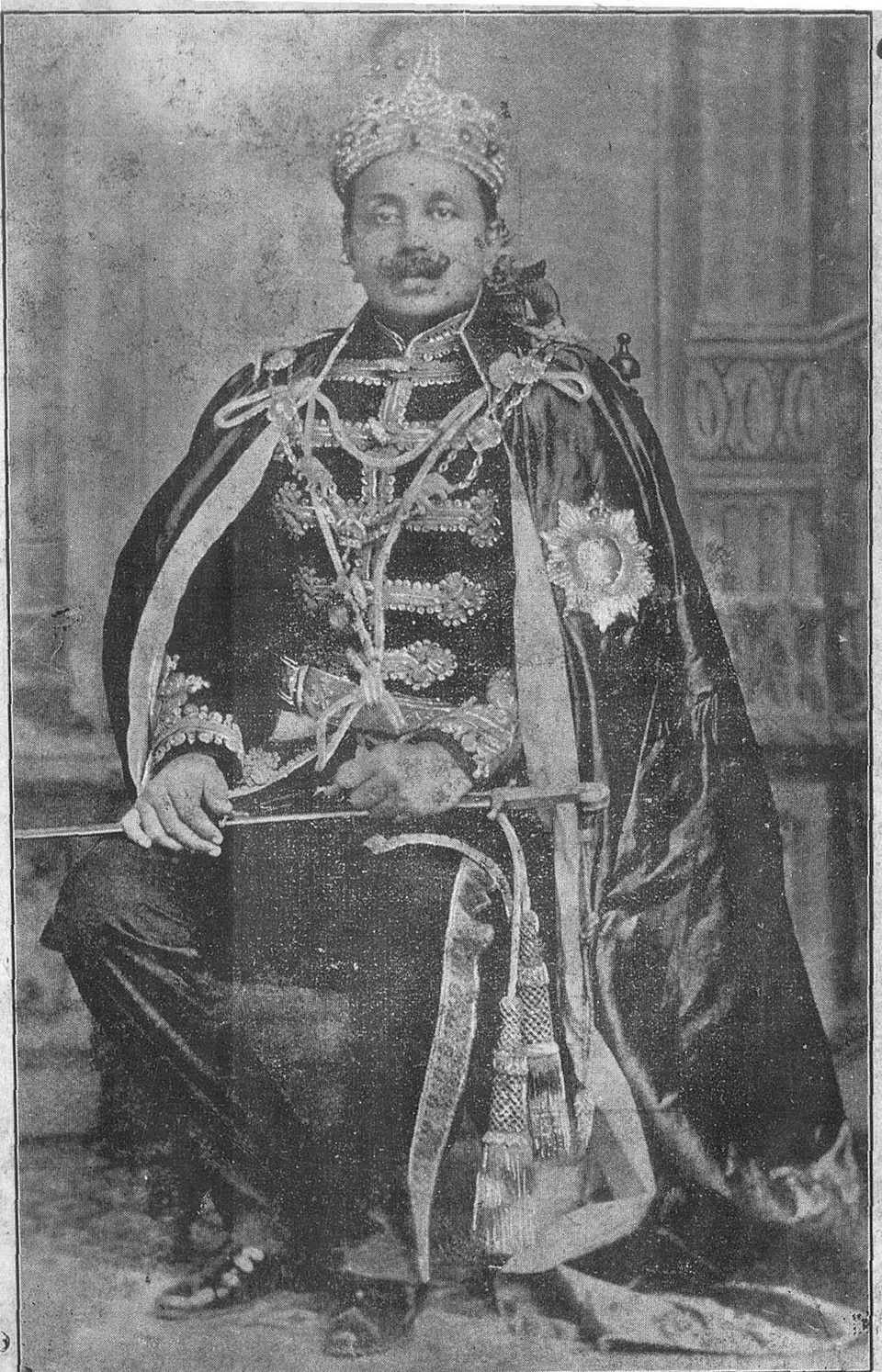
Ananda Gajapati Raju was the head of the Pusapati family of Vizianagaram in the later years of the nineteenth century. At that time the family’s estate paid the largest peshkash (yearly tribute to the government) of any in the Madras Presidency. Francis’s Vizagapatam gazetteer (1907) says that his father was Vijayarama Gajapati Raju III, who held the British honour K.C.S.I. and sat on the Viceroy’s Council.1 The father died in 1879 “and was followed by his only surviving son Ananda Razu”.1
Maclean’s chronology puts the succession in 1878: “The Maharajah of Vizianagram dies, and is succeeded by his son Ananda Raz, the present Maharajah.”2 The family’s earlier history, including Vijayarama Raju II, who fell at Padmanabham in 1794, is told on the Vizianagaram page.
Maharaja
Francis says that Ananda Raju “was also granted the personal title of Maharaja”.1 He adds that Ananda Raju “was a Member of the Madras Legislative Council for many years, and was created a G.C.I.E. in 1892” (a high British honour).1 When his term in the Council ended, A. Vadivelu writes, the Governor nominated the Raja of Bobbili to the seat he had held.3
On 17 December 1883 the foundation stone of the Madras Town Hall was laid “by the Maharajah of Vizianagram”.2 Maclean’s account of the Visakhapatnam (then Vizagapatam) district was written in his time.4 It records that the district’s one first-class college, teaching to the B.A. standard at Vizianagaram, was “entirely maintained by the Maharajah of Vizianagram”.4
C. R. Day’s book on South Indian music (1891) lists the vina player Suryanarayana Rao Pantulu of Sitapur as “Asthana Pandita” (court scholar) in the Maharaja’s service.51 See British Crown (Madras Presidency).
Act II of 1904 declared the estate he held inalienable and impartible, that is, it could not be sold or divided.6 It paid peshkash and road-cess (road tax) of some Rs. 5,82,000, “much more than any other in the Presidency”.6
Death and succession
He died without children on 23 May 1897.1 By a will made in July 1896, he appointed his mother’s brother’s son as his successor.1 His mother adopted this boy in December 1897, and he became Vijayarama Raju IV.1
While the boy was under age, an Indian Civil Servant managed the estate under the Guardians and Wards Act.1 In 1903 four kinsmen of the late Maharaja sued in the Visakhapatnam District Court, questioning the adoption.1 The case was still being heard when Francis wrote.1
Footnotes
-
Francis, Vizagapatam (1907), p. 340 (archive.org (opens in a new tab)). ↩ ↩2 ↩3 ↩4 ↩5 ↩6 ↩7 ↩8 ↩9 ↩10 ↩11
-
C. D. Maclean (ed.), Manual of the Administration of the Madras Presidency, Vol. II (1885), p. 267, chronological annals, 1878 and 1883 (archive.org (opens in a new tab)). ↩ ↩2
-
A. Vadivelu, The Aristocracy of Southern India (1903), p. 57 (archive.org (opens in a new tab)). ↩
-
Maclean, Manual of the Administration, Vol. II (1885), p. 142, Vizagapatam District (archive.org (opens in a new tab)). ↩ ↩2
-
C. R. Day, The Music and Musical Instruments of Southern India and the Deccan (1891), p. 156, list of musicians (archive.org (opens in a new tab)). ↩
-
W. Francis, Madras District Gazetteers: Vizagapatam, Vol. I (1907), p. 338, s.v. Vizianagram (archive.org (opens in a new tab)). ↩ ↩2
Photos
References
Notes (0)
Sources (4)
Spotted an error on this page? Tell us
Last updated: