Duggirala Gopalakrishnayya
Congress leader of Guntur district, called Andhra Ratna. In April 1921 he led most of the people of Chirala and Perala to leave their homes rather than pay the taxes of a new municipality. He ran their camp on panchayat (village council) lines for eleven months and raised the Ramadandu volunteer corps.
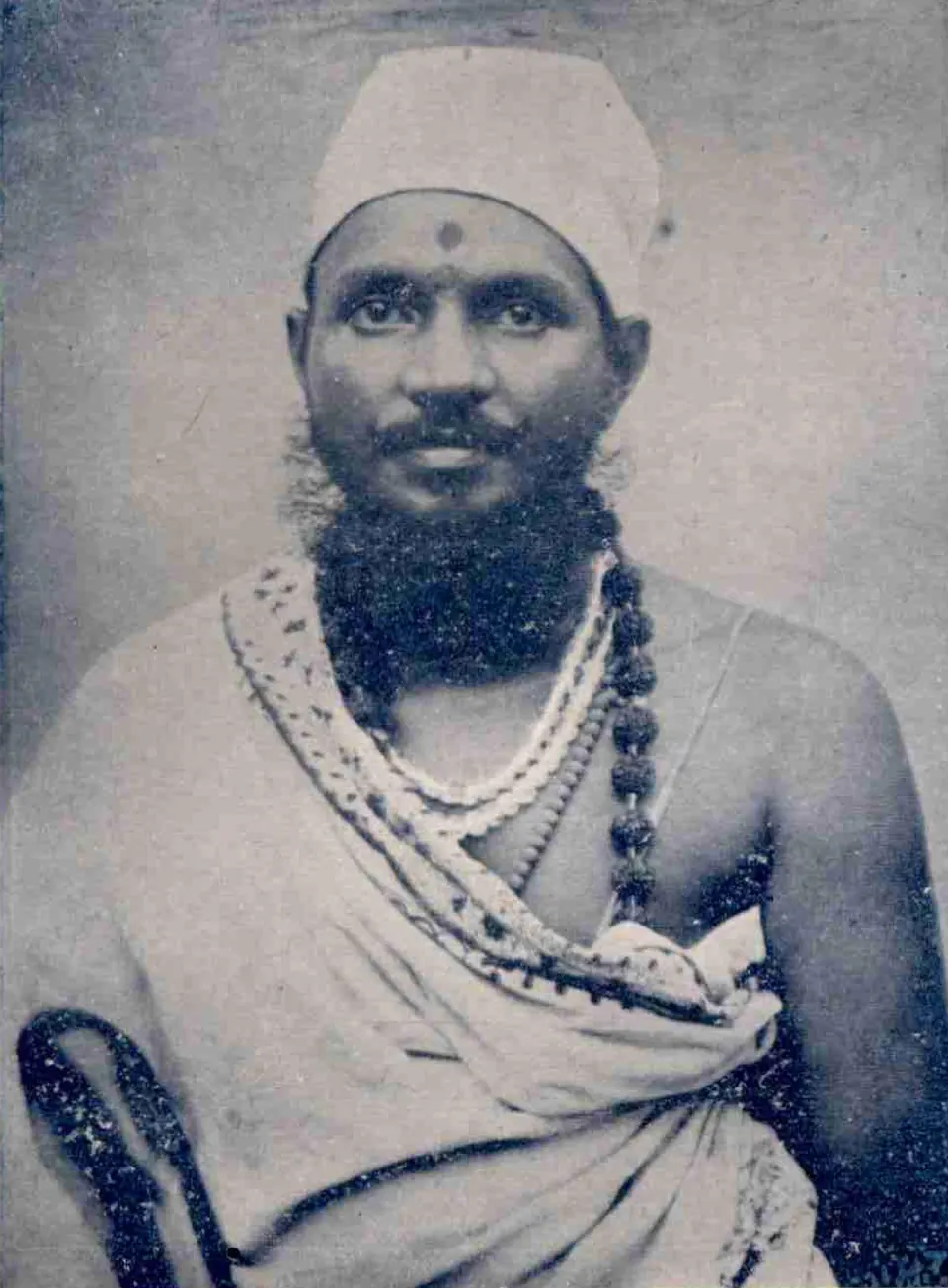
Duggirala Gopalakrishnayya was a Congress leader of Guntur district in the time of Gandhi’s non-cooperation movement.1 In April 1921 he led most of the people of Chirala and Perala out of their town in protest against the taxes of a new municipality.2 Sarojini Regani, the historian of the freedom movement, gives him the title Andhra Ratna.3
Non-cooperation
Gopalakrishnayya was among the Andhra delegates who sided with Gandhi at the special session of the Congress at Calcutta in September 1920.1 That session adopted non-cooperation.1 His volunteer corps, the Ramadandu, was about 500 strong.4 It kept order among the crowds at the meeting of the All India Congress Committee at Vijayawada in March–April 1921.4 Regani’s history notes that it drew the attention of the delegates.4
Chirala and Perala
Chirala and Perala are in Guntur district.5 A union had run them with two neighbouring villages, and its income was about Rs 4,000 a year.5 In 1919 the Madras government decided to make Chirala and Perala a municipality.5 It was constituted on 12 January 1920, and taxation was raised to bring in Rs 33,000 a year.5
Most of the roughly 15,000 people were weavers who earned four to five annas a day.6 Their petitions failed, and the councillors resigned.6 The Minister for Local Administration visited in February 1921. He threatened them with a paid chairman and a punitive police force (extra police paid for by the town as a punishment).6
Gopalakrishnayya then told the people not to pay the taxes.7 The authorities attached and auctioned property, but no bidders came forward.7 About a dozen people, among them an elderly woman, were jailed for refusing to pay.7
On Gandhi’s advice he decided to evacuate the town.2 He wanted to avoid a direct clash and let the municipality wither away.2 At midnight on 25 April 1921, 13,572 of the 15,326 inhabitants left their homes.2 They moved into thatched huts outside the town.2
The camp at Ramnagar
According to Regani, he tried to build a model of village self-government in the camp.8 It had three parts:8
- committees in which every community was represented8
- a parliament of about 200 members drawn from the caste panchayats (caste councils)8
- a headquarters for the Ramadandu, whose volunteers wore red uniforms, at a place called Ramnagar8
For eleven months there was no municipality in Chirala.8 Regani records that Gandhi visited Chirala on 6 April and praised the way the people were carrying on the struggle.8 She does not give the year of this visit.8 The government charged a penal cess (a tax as punishment) on every hut. It said the huts stood on assessed government waste land.9
Arrest and after
In September 1921 Gopalakrishnayya spoke at the Andhra Conference at Berhampur and urged the people to prepare for civil disobedience.10 After these speeches he defied an order under section 144 (an order banning meetings).10 He was arrested, tried for sedition and sentenced to a year’s imprisonment.10 With their leader in jail, the people slowly returned to their homes.10
Regani adds two later echoes of the Chirala experiment.10 Dr Moonje later named the grounds of his military school at Nasik “Ramabhoomi” and its cadets “Ramadandis” in its honour.10 The Chirala municipality was abolished in 1938 under the first Congress ministry, by B. Gopala Reddy.10
Regani judges him a visionary who saw Gandhi as an avatar (incarnation of God).11 He believed in swaraj (self-rule) within the year promised in 1921.11 In her view his camp amounted to a parallel government.11 It went a step further than either the revolutionaries or public opinion of the time were ready to go.11
D. S. R. Rao, a correspondent of The Hindu, visited the camp, and Regani’s account quotes his reports at length.12 The struggle is also described on the page Reform, freedom & people’s movements.
Footnotes
-
Sarojini Regani, Highlights of the Freedom Movement in Andhra Pradesh (1956), p. 69 (archive.org (opens in a new tab)). ↩ ↩2 ↩3
-
Regani, Highlights (1956), p. 84 (archive.org (opens in a new tab)). ↩ ↩2 ↩3 ↩4 ↩5
-
Regani, Highlights (1956), p. 83 (archive.org (opens in a new tab)). ↩
-
Regani, Highlights (1956), p. 72 (archive.org (opens in a new tab)). ↩ ↩2 ↩3
-
Regani, Highlights (1956), p. 83 (archive.org (opens in a new tab)). ↩ ↩2 ↩3 ↩4
-
Regani, Highlights (1956), pp. 83–84 (archive.org (opens in a new tab)). ↩ ↩2 ↩3
-
Regani, Highlights (1956), p. 84 (archive.org (opens in a new tab)). ↩ ↩2 ↩3
-
Regani, Highlights (1956), pp. 85–86 (archive.org (opens in a new tab)). ↩ ↩2 ↩3 ↩4 ↩5 ↩6 ↩7 ↩8
-
Regani, Highlights (1956), p. 86 (archive.org (opens in a new tab)). ↩
-
Regani, Highlights (1956), p. 86 (archive.org (opens in a new tab)). ↩ ↩2 ↩3 ↩4 ↩5 ↩6 ↩7
-
Regani, Highlights (1956), p. 85 (archive.org (opens in a new tab)). ↩ ↩2 ↩3 ↩4
-
Regani, Highlights (1956), pp. 84–86 (archive.org (opens in a new tab)). ↩
Photos
References
Notes (0)
Sources (1)
Spotted an error on this page? Tell us
Last updated: