Dhurjati
Telugu Shaiva poet of Srikalahasti, counted among the eight poets (Ashtadiggajas) of Krishnadeva Raya's court. He wrote the Kalahasti Mahatmyamu, a poem on the holy place of Srikalahasti, and the Kalahastisvara Satakamu, a set of devotional verses to its god. Stories about his loose living go back to a verse about the king's question on the sweetness of his style.
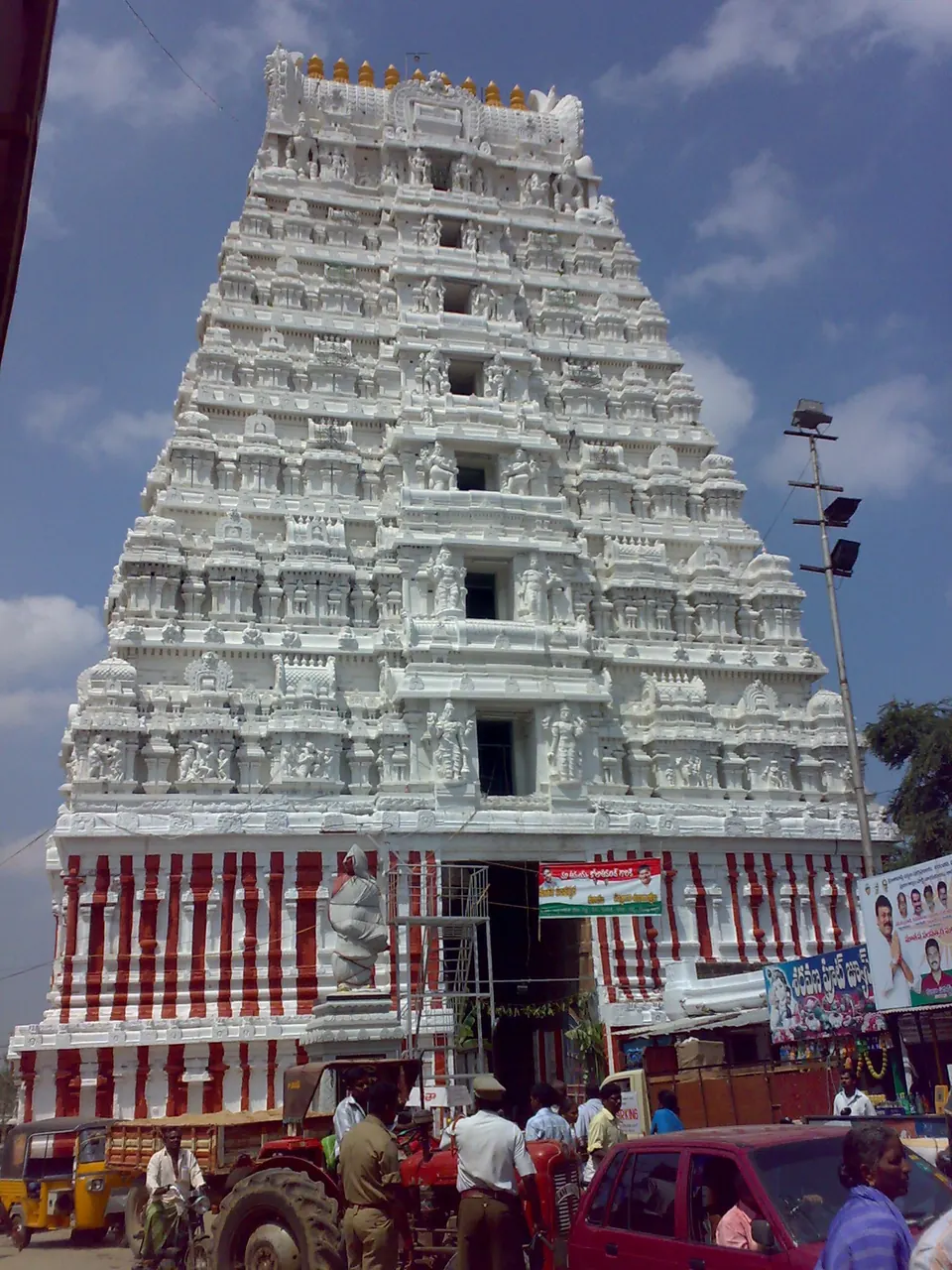
Dhurjati was a Telugu poet of Srikalahasti.12 He is counted among the Ashtadiggajas, the eight poets of the court of Krishnadeva Raya of Vijayanagara.34 He was a devoted worshipper of Shiva.12 His two works both praise the god of the Srikalahasti temple.5
Life
G. R. Subramiah Pantulu wrote on the poets of Krishnadeva Raya’s court in the Indian Antiquary in 1898.2 He described Dhurjati as a Niyogi Brahmin of Pakanadu.2 He was born and brought up at Kalahasti, then in the North Arcot district.2 Because he lived under Krishnadeva Raya, Subramiah Pantulu dated him about 1520–1530.2 He counted Dhurjati among the “extreme Saivas” at a court where the king himself was a Vaishnava.4
P. Chenchiah and Raja M. Bhujanga Rao, in their history of Telugu literature (1928), call him “a staunch Saivite” of the king’s “select circle”.1 P. T. Raju, in 1944, wrote that Kumara Dhurjati, who wrote a chronicle of Krishnadeva Raya’s wars, was his grandson.6
His works
He wrote two works that survive:175
- the Kalahasti Mahatmyamu (the greatness of Kalahasti), a poem on the holy place and its legends
- the Kalahastisvara Satakamu, a satakam (a set of about a hundred verses) addressed to the god of Kalahasti175
Subramiah Pantulu called the first a sthalapurana, a work on the legends of one holy place.2 Dhurjati dedicated it to the god of Kalahasti, not to a king.26 Subramiah Pantulu found the style “elegant and chaste”.2 Charles Philip Brown, in 1852, called it “a very amusing poem in four books, well suited for beginners”.8
Chenchiah and Bhujanga Rao listed the satakam among the most popular devotional satakas.7 Raju thought that modern taste would rank it above the longer poem.6 K. Sitaramaiya, writing in 1943, found in it a kind of confession, in which the poet begs Shiva for mercy.910 He named Dhurjati and Vemana as the models for a large later sataka literature.11
The king’s question
Chenchiah and Bhujanga Rao tell a court story.1 Krishnadeva Raya often wondered at the beauty of Dhurjati’s verse.1 One day he asked the court where this worshipper of Shiva got his “incomparable sweetness of expression”.1 The poets’ answer, in the story, joked that he got it from the lips of the women he visited.110
Chenchiah and Bhujanga Rao took the story to show a man who “managed to combine a reputation for profound piety with considerable looseness of character”.1 Elsewhere they named Dhurjati, with Srinatha and Pinaveerabhadra, among poets “notorious for the riotous life they lived in their youth”.12 Sitaramaiya added that a stray verse of the time says the same.10
Where the sources disagree
The sources differ on these stories about his character.
- Believed. Chenchiah and Bhujanga Rao accepted them, and drew from them a picture of the poet.121 Sitaramaiya also saw something of the poet’s own life in the confessions of the satakam.10
- Doubted. Subramiah Pantulu thought them “highly improbable”.213 He complained that common people liked to tell such tales “even of the most righteous”.2 He noted that the same was said of Tikkana.2
Footnotes
-
Chenchiah and Bhujanga Rao, A History of Telugu Literature (1928), p. 76 (archive.org (opens in a new tab)). ↩ ↩2 ↩3 ↩4 ↩5 ↩6 ↩7 ↩8 ↩9 ↩10 ↩11
-
Subramiah Pantulu, Indian Antiquary XXVII (1898), p. 323 (archive.org (opens in a new tab)). ↩ ↩2 ↩3 ↩4 ↩5 ↩6 ↩7 ↩8 ↩9 ↩10 ↩11 ↩12
-
Chenchiah and Bhujanga Rao, A History of Telugu Literature (1928), p. 72 (archive.org (opens in a new tab)). ↩
-
G. R. Subramiah Pantulu, “Discursive Remarks on the Augustan Age of Telugu Literature”, Indian Antiquary XXVII (1898), p. 299 (archive.org (opens in a new tab)). ↩ ↩2
-
P. T. Raju, Telugu Literature (1944), p. 34 (archive.org (opens in a new tab)). Cite-only; paraphrased. ↩ ↩2 ↩3
-
Raju, Telugu Literature (1944), p. 35 (archive.org (opens in a new tab)). Cite-only; paraphrased. ↩ ↩2 ↩3
-
Chenchiah and Bhujanga Rao, A History of Telugu Literature (1928), p. 99 (archive.org (opens in a new tab)). ↩ ↩2 ↩3
-
Charles Philip Brown, A Dictionary, Telugu and English (1852), p. viii (archive.org (opens in a new tab)). ↩
-
K. Sitaramaiya, A Hand Book of Telugu Literature (1943), p. 41 (archive.org (opens in a new tab)). Cite-only; paraphrased. ↩
-
Sitaramaiya, A Hand Book of Telugu Literature (1943), p. 42 (archive.org (opens in a new tab)). Cite-only; paraphrased. ↩ ↩2 ↩3 ↩4
-
Sitaramaiya, A Hand Book of Telugu Literature (1943), p. 59 (archive.org (opens in a new tab)). Cite-only; paraphrased. ↩
-
P. Chenchiah and Raja M. Bhujanga Rao, A History of Telugu Literature (1928), p. 31 (archive.org (opens in a new tab)). ↩ ↩2
-
Subramiah Pantulu, Indian Antiquary XXVII (1898), p. 324 (archive.org (opens in a new tab)). ↩
Photos
References
Notes (0)
Sources (5)
Spotted an error on this page? Tell us
Last updated: