Society & communities
Castes, communities and tribes, and how social life changed over time, from scholarly sources.
The Telugu country has always been home to many communities. They include cultivators and herders, artisans and traders, labourers and forest peoples.12 From the medieval period they also include Muslims, and later Christians.34 This page follows how the sources describe them and how their place in society changed.
Two cautions apply throughout. The early evidence is mostly inscriptions recording gifts, so it shows donors and organised bodies far more than the poor. The detailed descriptions come mainly from surveys made by colonial and Nizam’s officials between the 1870s and 1930s. These writers ranked communities, judged their “character”, and sometimes explained caste by theories of race that are no longer accepted.5 For example, the 1931 census of Hyderabad traced untouchability to an ancient conquest of dark-skinned peoples by fair-skinned ones.5 This page uses such works for what people did and how they organised themselves, and leaves their rankings aside.
Donors at the stupas
The Buddhist inscriptions of the Krishna valley give the first view of local society.6 At Amaravati, gifts of pillars, slabs and gateways were made by householders (gahapati) and their wives and grandchildren.6 Gifts also came from Buddhist nuns, and from a donor called “the Tamil Kanha” together with his brother and sister.6
One inscription records a pavilion given to the monks by a perfume dealer, the son of a merchant.6 He gave it “with his father, with his mother, with his wife”, and with his brothers, sons, daughters, daughters-in-law and grandchildren.6 Giving was a family act, and merchants and ordinary householders could afford to give.6
At Nagarjunakonda in the 3rd century CE, the pattern was different. J. Ph. Vogel found that the Ikshvaku king Chamtamula was praised for performing Vedic sacrifices.7 But the Buddhist monuments of the capital were paid for by queens and princesses of the royal house. They were led by the king’s sister Chamtisiri.7 The inscriptions also show that the next king married his cousin, Chamtisiri’s daughter.7 See the Nagarjunakonda pillar inscriptions and the Ikshvakus.
The eighteen samayas
Inscriptions of the Kakatiya period describe society as a whole by a set phrase, ashtadasa-praja, “the eighteen peoples”.8 P. V. Parabrahma Sastry points to a later copper-plate grant that lists them.8 They are the four classical varnas (social orders), together with officials, smiths and carpenters, potters, weavers, dyers, oil-pressers, tailors, spinners, pack-carriers, cowherds, hunters, washermen, barbers and others.8 He argues that most of these groups appear in Kakatiya inscriptions too, and that they were defined mainly by occupation.8
Each group could organise itself as a samaya.9 This was a group body with its own customs and elders, and the power to raise dues from its members.9 In 1245 the pack-carriers (perika) of Tripurantakam got the tax on their bullocks excused.9 In 1228 the weavers of the villages around Hanamkonda, Warangal and Mattewada set up a shrine together.9 They threatened members who failed to pay their share with being put out of the samaya.9
Sculptors, oil-pressers, temple servants and even village warriors appear as bodies of the same kind.10 Parabrahma Sastry describes the great merchant guilds as earlier dominated by Jaina traders.11 Now they also counted Reddis, potters, weavers, oil-pressers and cultivators among their members.11
Villages, too, acted through assemblies. In 1292, according to an inscription near Bhuvanagiri, an officer of a local chief had to ask the assemblies of three villages for approval.12 With joined hands, he asked them to approve a tax on the cultivators for a temple.12 At Penumili in Guntur district, a village elder rebuked an officer for imposing unjust dues. The dues were then cancelled.12
Parabrahma Sastry reads such records as showing that village bodies could check local chiefs.12 That is his interpretation of a small number of inscriptions.12 Military service did not belong to one community either. A later chronicle says that each of the 77 bastions of Warangal was held by a Velama commander.13 But Parabrahma Sastry notes commanders of other communities, including Reddis, in the inscriptions.13
The same author observes that Brahmins were already divided into regional groups such as Velanadu, Venginadu, Telangana and Mulikinadu.14 A chronicle of Warangal lists some 27 classes of people living in the capital.14 They range from Brahmins and merchants to weavers of silk and cotton, potters, fishermen, washermen and toddy-tappers.14 Six centuries later, the Godavari gazetteer recorded Telugu Brahmins under very similar regional names: Velinadu, Veginadu, Telaganya, Kasaleya and Murikinadu.15
A merchant’s view of Golconda
In the 17th century, most people of the Golconda kingdom were Hindus who spoke Telugu.3 W. H. Moreland edited Dutch and English reports.3 He found no record of conversion to Islam on a large scale.3 He concluded that most Muslims in the kingdom were of foreign origin. They were merchants at the ports, and soldiers and adventurers who had followed the armies.3 For the court and its Telugu officers, see Vijayanagara & Qutb Shahi.
William Methwold was an English merchant at Machilipatnam in the 1620s. He wrote one of the first outside descriptions of Telugu society.16 He counted 44 “tribes” (castes). Their order, he noted, did not follow wealth.16 He described them like this:16
- Brahmins served as accountants to the Muslim governors, writing on palm leaves. Hindus and Muslims alike consulted them for a lucky hour.
- Komatis were the merchants who gathered cloth from the weavers and sold it at the ports. They also served as money-changers and shopkeepers.
- The Kapus were the most numerous group. They worked the land in the villages, served the wealthy in the towns and guarded the forts.
- Carpenters, masons, founders, goldsmiths and blacksmiths formed one group that married among themselves. Each other craft formed its own group.
- Leather-workers were made to live outside the towns.16
Methwold wrote as a foreign trader.16 Some of his language about the poorest groups is openly scornful.16
Communities in the colonial record
By about 1900, the census gave numbers. In Hyderabad State in 1901, the largest group was the Kapus, the cultivators, at about 26 per cent of the population.1 Next came Malas and Madigas together, at about 14 per cent.1 The Imperial Gazetteer described them as playing “a most important part in the village economy”.1 After them came Gollas (shepherds), Brahmins, Vaisyas (traders), Sales (weavers), Gaundlas (toddy-drawers) and Lambadis or Banjaras.1
In Godavari district, the six largest communities were the Kapus, Malas, Idigas, Madigas, Kammas and Telugu Brahmins.17 In Anantapur the Kapus formed nearly a sixth of the Hindus.18 Next came the Boyas, an old fighting community, and the Madigas.18
Cultivators. The Godavari gazetteer called the Kapus or Reddis the landowning community.19 It thought the Velamas, Telagas and Kammas closely related to them. They would often eat together, but did not marry each other.19
Traders. The Komatis were the trading and money-lending community.20 Their caste goddess, Kanyaka Paramesvari, was said to be a Komati girl of Penugonda. She burned herself rather than marry a king.20 The 102 families who died with her were remembered as the ancestors of the caste’s gotras (lineages).20 In 1907 the fines collected by Komati caste councils were still sent to her temple at Penugonda.20 The Hyderabad survey recorded the same story in Telangana.21
Weavers. The Padma Sales were a large and widespread community of Telugu weavers in Hyderabad State.22 They wove cotton saris and dhotis. The women spun the yarn and prepared the warp.22 They ran their affairs through a caste council under a headman.22 By 1920 many could no longer live by the handloom against imported mill cloth. They had turned to farming, labour, trade or masonry.22
In Anantapur the Devangas, Togatas and Sales were weaving communities.23 Malas wove the coarse cotton cloth that most villagers wore.23 See Crafts & textiles.
Carriers. The Banjaras or Lambadis carried grain, salt and cotton on pack-bullocks.24 They lived in camps called tandas, each under a hereditary naik (headman).24 Siraj ul Hassan, writing for the Nizam’s government, called their work as carriers between remote villages and the markets “invaluable”.24 As railways and roads spread, many settled in the Telugu districts as cultivators and cattle-breeders.24 Banjara women were known for their embroidered skirts and bodices.24
Forest peoples. The Koyas lived along the Godavari, from Bastar to the edge of the delta and south to Khammam.25 They spoke their own Dravidian language and grouped their villages under hereditary heads.25 The Godavari gazetteer noted that traders and moneylenders from the plains cheated them “in every conceivable way”.26 It also passed sweeping judgements on their character, which are not repeated here.26
The hill Reddis lived by shifting (podu) cultivation.27 Chenchus came down to Nellore at the Pongal and Sivaratri festivals to sell bamboo rice and bamboo flutes.28 Some served as watchmen in the Nandikanama pass.28 The Gonds lived in villages of bamboo huts in the hills of Adilabad.29
The 1931 census of Hyderabad counted 511,789 people as tribal “Animists”.30 It noted that Chenchus of the Amrabad hills now carried loads for pilgrims to Srisailam, and were taking up Hindu customs.30
Labourers and leather-workers. The Malas were described as the great community of farm labourers. The Madigas were described as tanners and shoemakers.2 Both were kept apart from other castes. The Godavari gazetteer records that Malas were not allowed to enter Hindu temples.2
In Anantapur, Madigas lived in separate hamlets.31 They could not enter the temples or use the wells of other castes.31 When water was short, they had someone of another caste draw it and pour it into their pots.31
Ritual ties also linked these communities to others.32 Komatis were said to give betel to a Madiga before their weddings, a custom Komatis denied.32 Some Velamas paid for a Mala couple to be married before a wedding in their own family.32
Right hand and left hand
Many communities of the south belonged to one of two rival groups, the “right-hand” and “left-hand” castes.33 Among Telugus, the Malas counted as right-hand and the Madigas as left-hand.33 Processions were the usual cause of clashes.33
At Kurnool in 1871, a Madiga rode on horseback through the main bazaar.33 He wore a red cloth that the police had given him as a reward.33 This set off a riot.33 Afterwards, the two groups agreed which streets each would use.33
J. Cain, a missionary in the Godavari hill country, reported another dispute.34 The right-hand castes there objected to Kamsalas (smiths) being carried in a palanquin at their weddings.34 Divisions of this kind reached into new workplaces.35 At a cotton factory at Adoni, Edgar Thurston found the skilled posts held by Malas. There were three separate wells: for Malas, for Madigas and for the other workers.35
Muslims and Christians
Muslims in the Telugu districts were a minority.36 They were about a tenth of Hyderabad State’s people in 1901, and far fewer in the coastal districts.36 Most spoke Telugu.
In Visakhapatnam (then Vizagapatam) district, the gazetteer found that Muslims of the plains spoke “excellent Telugu”.37 They were on friendly terms with Hindus.37 Hindus made vows at the Muslim shrine (dargah) in Visakhapatnam town and joined in the Muharram observances.37
In Godavari, the Dudekulas were Telugu-speaking Muslims who wore Hindu dress and took Hindu names.38 They worked as musicians and cotton-cleaners.38 In Anantapur, Hindus kept their own Muharram, but a Muslim had to set up the standards for it.39 Hyderabad also drew Muslims from abroad into its service.40 The 1901 census counted 4,291 immigrants from Arabia, 1,195 from Persia and 886 from Afghanistan.40
Christianity grew mainly in the 19th century. In the Krishna country, some Christian villages went back to the French Jesuit missions of the 18th century.4 Christians had arrived at Patibandla after the famine of 1832.4 By the 1880s, most of the cultivators there were Catholic.4
Protestant missions followed:41
- the Lutherans at Rajahmundry, from 1844
- the Canadian Baptists at Kakinada, from 1869
- the Church Missionary Society at Dummagudem, where its converts came mainly from the Koyas and Malas41
In Hyderabad State, the American Baptist Telugu Mission began at Secunderabad in 1875.42 The Wesleyans began in 1880, with a hospital at Medak.42
The Imperial Gazetteer of Madras observed that Indian Christians had increased by 99 per cent since 1871.43 It said most converts came from “the lowest classes of society”.43 It added that they were making good use of education.43
Assertion and change in the 20th century
In 1922 the Madras Government replaced the terms Panchama and Pariah in its records. For Telugus it used Adi-Andhra instead.44 In Hyderabad, the Adi-Hindu Social Service League asked the Nizam’s government to use the name Adi-Hindu. The 1931 census adopted it.44
That census counted the depressed classes at 17 per cent of the population.44 It described the denial of common wells and tanks as a widespread hardship.44 It also recorded divisions among the communities themselves. It noted the League’s volunteers working against drink among labourers.44 The wider reform and political movements of this time are told on Reform, freedom & people’s movements.
The end of the Nizam’s rule changed Hyderabad society quickly. The 1951 census wrote that after the “Police Action” of 1948, life among Muslims was badly disturbed.45 Muslims were about 12 per cent of the population.45
The census named two causes.45 One was revenge by some Hindus for what they had suffered earlier.45 The other was reforms. These were the abolition of the jagir estates (estates held by grant), the disbanding of the Hyderabad army, and the opening of government jobs to all communities.45 The reforms ended Muslims’ near-monopoly of the army and their large share of official posts.45
Footnotes
-
Imperial Gazetteer of India: Hyderabad State (1909), pp. 23–24 (archive.org (opens in a new tab)). ↩ ↩2 ↩3 ↩4 ↩5
-
Hemingway, Godavari (1907), pp. 51, 58–60 (archive.org (opens in a new tab)). ↩ ↩2 ↩3
-
W. H. Moreland (ed.), Relations of Golconda in the Early Seventeenth Century (1931), p. xv (archive.org (opens in a new tab)). ↩ ↩2 ↩3 ↩4 ↩5
-
Gordon Mackenzie, A Manual of the Kistna District (1883), pp. 168, 203 (archive.org (opens in a new tab)). ↩ ↩2 ↩3 ↩4
-
Census of India 1931, Vol. XXIII: H.E.H. the Nizam’s Dominions, Part I: Report (1933), appendix on the depressed classes, p. 41 (archive.org (opens in a new tab)). ↩ ↩2
-
James Burgess, The Buddhist Stupas of Amaravati and Jaggayyapeta (1887), pp. 104–105, inscriptions nos. 39–49 (archive.org (opens in a new tab)). ↩ ↩2 ↩3 ↩4 ↩5 ↩6
-
J. Ph. Vogel, “Prakrit Inscriptions from a Buddhist Site at Nagarjunikonda”, Epigraphia Indica XX (1933), p. 4 (archive.org (opens in a new tab)). ↩ ↩2 ↩3
-
P. V. Parabrahma Sastry, The Kakatiyas of Warangal (1978), p. 180. ↩ ↩2 ↩3 ↩4
-
Parabrahma Sastry, Kakatiyas of Warangal (1978), p. 181. ↩ ↩2 ↩3 ↩4 ↩5
-
Parabrahma Sastry, Kakatiyas of Warangal (1978), p. 182. ↩
-
Parabrahma Sastry, Kakatiyas of Warangal (1978), p. 184. ↩ ↩2
-
Parabrahma Sastry, Kakatiyas of Warangal (1978), pp. 186–187. ↩ ↩2 ↩3 ↩4 ↩5
-
Parabrahma Sastry, Kakatiyas of Warangal (1978), p. 195. ↩ ↩2
-
Parabrahma Sastry, Kakatiyas of Warangal (1978), p. 270. ↩ ↩2 ↩3
-
F. R. Hemingway, Madras District Gazetteers: Godavari, Vol. I (1907), pp. 51–52 (archive.org (opens in a new tab)). ↩
-
William Methwold, “Relation”, in Moreland (ed.), Relations of Golconda (1931), pp. 14–19 (archive.org (opens in a new tab)). ↩ ↩2 ↩3 ↩4 ↩5 ↩6
-
Hemingway, Godavari (1907), p. 51 (archive.org (opens in a new tab)). ↩
-
W. Francis, Madras District Gazetteers: Anantapur (1905), p. 35 (archive.org (opens in a new tab)). ↩ ↩2
-
Hemingway, Godavari (1907), p. 55 (archive.org (opens in a new tab)). ↩ ↩2
-
Hemingway, Godavari (1907), p. 54 (archive.org (opens in a new tab)). ↩ ↩2 ↩3 ↩4
-
Syed Siraj ul Hassan, The Castes and Tribes of H.E.H. the Nizam’s Dominions, Vol. I (1920), p. 343 (archive.org (opens in a new tab)). ↩
-
Siraj ul Hassan, Castes and Tribes (1920), pp. 536, 542–543 (archive.org (opens in a new tab)). ↩ ↩2 ↩3 ↩4
-
Francis, Anantapur (1905), pp. 31, 36 (archive.org (opens in a new tab)). ↩ ↩2
-
Siraj ul Hassan, Castes and Tribes (1920), preface and pp. 15–16, 26–27 (archive.org (opens in a new tab)). ↩ ↩2 ↩3 ↩4 ↩5
-
Hemingway, Godavari (1907), pp. 60–61, 65 (archive.org (opens in a new tab)). ↩ ↩2
-
Hemingway, Godavari (1907), p. 62 (archive.org (opens in a new tab)). ↩ ↩2
-
Hemingway, Godavari (1907), p. 67 (archive.org (opens in a new tab)). ↩
-
John A. C. Boswell, A Manual of the Nellore District (1873), p. 164 (archive.org (opens in a new tab)). ↩ ↩2
-
Siraj ul Hassan, Castes and Tribes (1920), p. 216 (archive.org (opens in a new tab)). ↩
-
Census of India 1931, Vol. XXIII, Part I (1933), p. 233 (archive.org (opens in a new tab)). ↩ ↩2
-
Francis, Anantapur (1905), p. 35 (archive.org (opens in a new tab)). ↩ ↩2 ↩3
-
Hemingway, Godavari (1907), pp. 54–55 (archive.org (opens in a new tab)). ↩ ↩2 ↩3
-
Edgar Thurston and K. Rangachari, Castes and Tribes of Southern India, Vol. IV (1909), p. 295, quoting the Manual of the Kurnool District (1886) (archive.org (opens in a new tab)). ↩ ↩2 ↩3 ↩4 ↩5 ↩6 ↩7
-
Thurston and Rangachari, Castes and Tribes, Vol. III (1909), p. 143 (archive.org (opens in a new tab)). ↩ ↩2
-
Thurston and Rangachari, Castes and Tribes, Vol. IV (1909), p. 294 (archive.org (opens in a new tab)). ↩ ↩2
-
Imperial Gazetteer: Hyderabad (1909), p. 24 (archive.org (opens in a new tab)); Hemingway, Godavari (1907), p. 38 (archive.org (opens in a new tab)). ↩ ↩2
-
W. Francis, Madras District Gazetteers: Vizagapatam, Vol. I (1907), p. 65 (archive.org (opens in a new tab)). ↩ ↩2 ↩3
-
Hemingway, Godavari (1907), p. 39 (archive.org (opens in a new tab)). ↩ ↩2
-
Francis, Anantapur (1905), pp. 29–30 (archive.org (opens in a new tab)). ↩
-
Census of India, 1951, Vol. IX: Hyderabad, Part I-A: Report (1953), p. 83 (archive.org (opens in a new tab)). ↩ ↩2
-
Hemingway, Godavari (1907), pp. 39–42 (archive.org (opens in a new tab)). ↩ ↩2
-
Imperial Gazetteer: Hyderabad (1909), p. 25 (archive.org (opens in a new tab)). ↩ ↩2
-
Imperial Gazetteer of India: Madras, Vol. I (1908), p. 33 (archive.org (opens in a new tab)). ↩ ↩2 ↩3
-
Census of India 1931, Vol. XXIII, Part I (1933), appendix on the depressed classes, p. 41 and following page (archive.org (opens in a new tab)). ↩ ↩2 ↩3 ↩4 ↩5
-
Census of India, 1951, Vol. IX, Part I-A (1953), p. 112 (archive.org (opens in a new tab)). ↩ ↩2 ↩3 ↩4 ↩5 ↩6
Photos
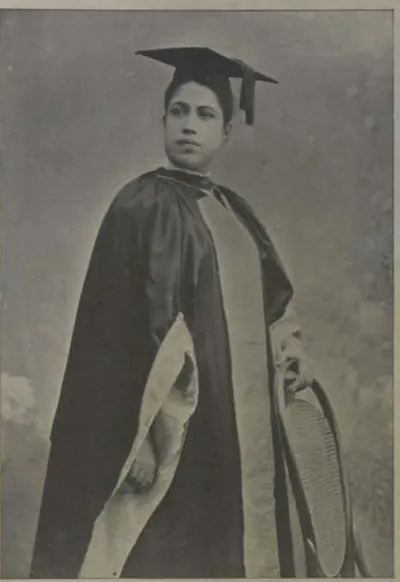 "Miss Edith Boardman, M.D" (Campbell 1898, p. 95)Historic photograph · 1898
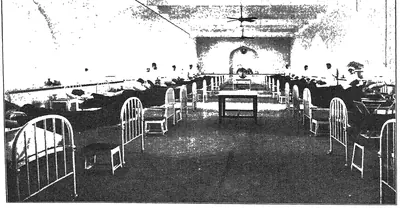 "Surgical Ward No. 1 from the east of Osmania General Hospital" (Mudiraj, Pictorial Hyderabad, 1929)Historic photograph · 1929
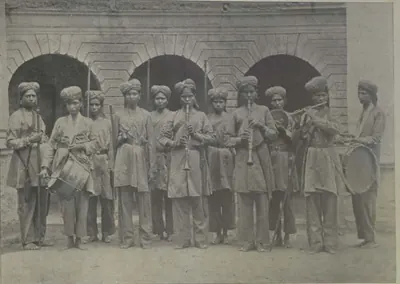 Hyderabad: "Sir Khurshed Jah's Amazon Guards" (Campbell 1898, p. 175)Historic photograph · 1898
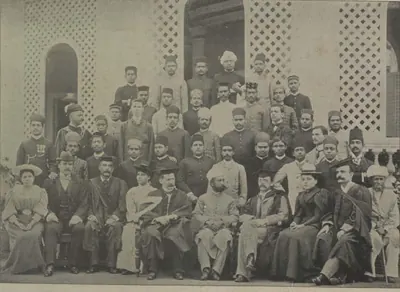 Hyderabad: "Staff and Students, Nizam College" (Campbell 1898, p. 190)Historic photograph · 1898
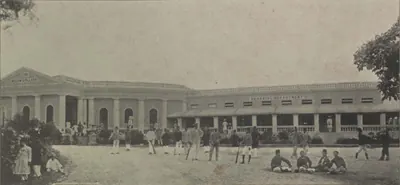 Hyderabad: "The Nizam College" (Campbell 1898, p. 190)Historic photograph · 1898
Related
Dynasties
Mauryas
c. 322 BCE – 184 BCE
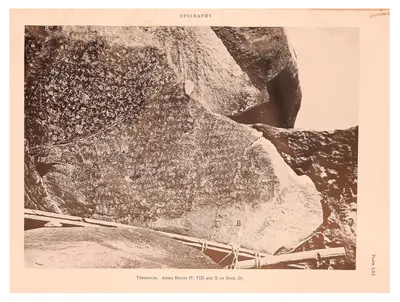
The Mauryan empire of Magadha (c. 322–185 BCE) held part of the Telugu country in the 3rd century BCE. Asoka's edicts at Erragudi and Rajula-Mandagiri in Kurnool district are among the earliest written records found in the region. His conquest of Kalinga reached the coast north of the Godavari.
Satavahanas
c. 200 BCE – 225 CE
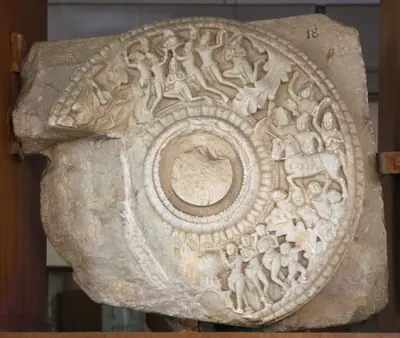
Deccan dynasty, called the Andhras in the Puranas, whose later kings ruled the Krishna valley, the Godavari delta and parts of Rayalaseema in the 2nd and early 3rd centuries CE. Its beginnings, its dates and when it reached the Telugu country are all debated.
Ikshvakus of Vijayapuri
c. 225–350 CE
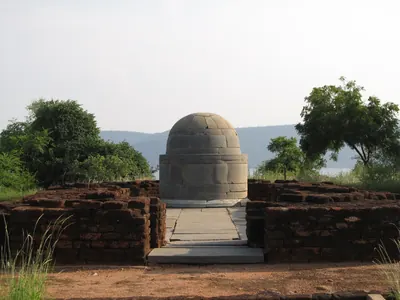
Dynasty of the lower Krishna valley in the 3rd and early 4th centuries CE, with its capital at Vijayapuri in the Nagarjunakonda valley. Four kings are known from Prakrit and Sanskrit inscriptions. The kings performed Vedic sacrifices and built temples to Shiva and Karttikeya, while the royal women endowed the Buddhist monasteries of the capital.

Pallavas
c. 250–900 CE
Dynasty of Kanchi (Kanchipuram) whose kings held the Telugu country south of the Krishna for much of the 4th to 7th centuries CE. Their earliest charters, in Prakrit, were sent from Kanchi to an officer at Dhanyakataka near Amaravati. A later line issued Sanskrit grants of villages in the Guntur and Nellore country from camps such as Palakkada and Dasanapura. The Chalukyas took Vengi and the Guntur country early in the 7th century. But Pallava kings still granted villages in Nellore until about 700, and their vassals held parts of Chittoor and Rayalaseema until the Chola conquest about 900.
Salankayanas of Vengi
c. 300–470 CE
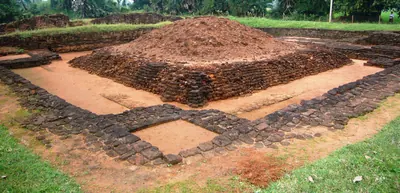
Dynasty of the country between the Krishna and the Godavari in the 4th and 5th centuries CE, ruling from Vengipura, the modern Pedavegi near Eluru. Seven copper-plate grants name seven kings in two lines descended from Hastivarman. Most scholars identify him with the 'Hastivarman of Vengi' of Samudragupta's Allahabad inscription. Their earlier grants are in Prakrit and their later ones in Sanskrit. Their seals bear a bull, and their family god was Chitrarathasvamin.
Vishnukundins
c. 500–630 CE
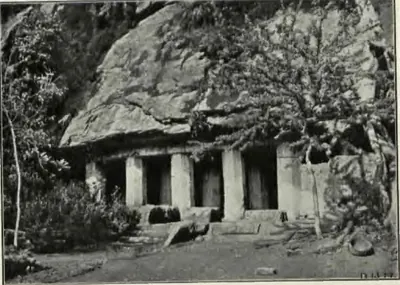
Dynasty of the Krishna–Godavari country that ruled after the Salankayanas and before the Eastern Chalukyas. It is known from a handful of Sanskrit copper-plate grants and one stone inscription. Its kings worshipped the lord of Sriparvata, claimed eleven horse sacrifices for their greatest ruler, Madhavavarman, and married into the Vakataka royal family. Their capital in the later grants was Lendulura (Denduluru near Vengi). Scholars have dated them anywhere from the 4th to the 8th century. Most later reconstructions put the main line in the 6th century and end it with the Chalukya conquest of the early 7th, though D. C. Sircar continued it to about 670.

Eastern Chalukyas of Vengi
c. 615–1077 CE
A branch of the Chalukyas of Badami that ruled Vengi, the coastal country between the lower Godavari and Krishna, from the early 7th century. Its founder, Kubja Vishnuvardhana, was a younger brother of Pulakesin II. The kings fought the Rashtrakutas for two centuries. After about 1000 they were bound to the Cholas by marriage, and in 1070 their heir became the Chola emperor Kulottunga I. Their copper-plate grants record the length of every reign. The first Telugu literary work, Nannaya's Mahabharata, was written at their court in Rajahmundry.

Kakatiyas
c. 1163–1323 CE
Dynasty of Anumakonda (Hanamkonda) and Orugallu (Warangal). The Kakatiyas were Rashtrakuta and then Western Chalukya feudatories from the tenth century. They declared their sovereignty under Rudradeva in 1163, and under Ganapatideva they ruled the Telugu country from Telangana to the coast. Rudramadevi reigned as king under the name Rudradeva, and her grandson Prataparudra fell to the Delhi Sultanate in the 1320s. Their rule rested on allied chiefs, nayaka commanders holding land for military service, and village assemblies. It is remembered for its tanks, its temples, the Motupalli sea-trade edict and its court literature.
Asaf Jahis (Nizams of Hyderabad)
1724–1948 CE
The dynasty of the Nizams of Hyderabad (1724–1948). It was founded by the Mughal viceroy Nizam-ul-Mulk Asaf Jah, who made himself independent in the Deccan after defeating Mubariz Khan at Shakar Kheda in 1724. After his death the French and the English backed rival heirs. The Northern Circars passed to the French in 1753 and to the English in 1766, and the Ceded Districts of Rayalaseema to the East India Company in 1800, leaving Telangana as the Telugu heart of the Nizam's Dominions. Bound to the British by the subsidiary alliance of 1798–1800, the Nizams governed through ministers such as Chandu Lal and Salar Jung I. They assigned Berar to the British in 1853 and leased it in 1902. Mir Osman Ali Khan's reign brought Osmania University and the rebuilding of Hyderabad, and his government ended in September 1948.
People
Asoka
c. 268 BCE – 226 BCE
Third Maurya emperor (3rd century BCE). His edicts at Erragudi and Rajula-Mandagiri in Kurnool district are among the oldest written records found in Andhra Pradesh. His Kalinga war reached the coast north of the Godavari, and his Rock Edict XIII names the Andhras.
Nandivarman I (Salankayana)
c. 370–395 CE
Salankayana king of Vengi, son of Hastivarman and father of Chandavarman and Hastivarman II. A Prakrit grant of his 14th year, found at Kanukollu and published in 1960, is the only record of his own. Its editor dated it to the close of the 3rd century, but D. C. Sircar placed it about the middle of the 4th.
Jayasimha I
c. 633–663 CE
Second Eastern Chalukya king of Vengi (about 633–663), the eldest son of Kubja Vishnuvardhana. Four copper-plate grants of his are known, issued from Udayapura and Asanapura and granting villages in the Krishna–Godavari country to Brahmins. Most later records give him a reign of 33 years, one gives 30, and the scholars who fixed the chronology disagreed over which to follow.
Vishveshvara Shambhu
c. 1250–1261 CE
Shaiva teacher of the Pashupata Golaki monastery, and preceptor (teacher) of the Kakatiya king Ganapatideva and of Rudramadevi. Rudramadevi granted him the village of Mandadam on the Krishna in 1261. There he founded a monastery with a college, a feeding house and a maternity and health home. He also founded monasteries and temples elsewhere in the Telugu country.
Malyala Gunda
c. 1259–1276 CE
General (dandanatha) of the Malyala family under the Kakatiya rulers Ganapatideva and Rudramadevi, known from his inscriptions of 1259 and 1272 at Bothpur in the Mahbubnagar district. They are elaborate Sanskrit poems by the scholar Isvara-suri, and they state that the Kakatiyas were born in the fourth varna. He had died by 1276–77, when his widow Kuppamamba, daughter of Gona Buddhaya, built a temple for his merit.
Sarvaya Papadu (Pap Rai)
c. 1708 CE
Telangana rebel of the early eighteenth century, a toddy-drawer by caste, whom the Mughal historian Khafi Khan calls Pap Rai. From forts at Shahpur in the Bhongir country and at a second stronghold, he plundered the roads and killed Mughal officers. In 1708 he sacked Warangal. He was betrayed, captured and executed, and his head was sent to the emperor's court. Telangana tradition remembers him as Sarvaya Papadu, a Goundla hero who robbed the rich, fed the poor and held Golconda for three hours.
Uyyalawada Narasimha Reddy
1846 CE
Member of a family of former poligars (local chiefs) of Uyyalawada and Nossam, in the Kurnool country. In 1846 he raised the kattubadis (village revenue peons) against the Company's government, looted the Koilkuntla treasury and fought troops at Giddalur. He was captured in October 1846 and hanged at Koilkuntla. The district manuals of 1875 and 1886 tell the story from the government's side.
Kandukuri Veeresalingam
1848–1919 CE
Social reformer, journalist and writer of Rajahmundry (1848–1919). He worked for the education of girls and the remarriage of widows, and conducted the first widow remarriage in the Madras Presidency in 1881. He wrote the early Telugu social novel Rajasekhara Charitramu.
Ramji Gond
c. 1860 CE
Gond leader of the Nirmal country in today's Adilabad district. In 1860 he led Gonds who joined bands of Rohillas against the Nizam's government. The Collector of Nirmal attacked their camp in April 1860; about thirty rebels were killed, among them the Rohilla chief Mian Saheb Khurd, but Ramji escaped. He was later caught, tried and hanged at Nirmal.
Mir Mahbub Ali Khan (Asaf Jah VI)
1869–1911 CE
Nizam of Hyderabad from 1869 to 1911, only son of Afzal-ud-daula. Placed on the throne at the age of two, he grew up under the regency of Salar Jang I and took full powers from the Viceroy Lord Ripon on 5 February 1884. His reign saw the railways, the cotton mills, the code of 1892, the lease of Berar to the British in perpetuity (1902), the purchase of the Falaknuma palace (1897) and the Musi flood of 1908. Remembered in Hyderabad as 'Mahboob Pasha', he died on 31 August 1911.
Chandrayya of Rampa
c. 1879–1881 CE
Leader of hill bands in the Rampa rebellion of 1879–1880 in the Godavari and Visakhapatnam hill tracts, a rising against the exactions of the mansabdar of Rampa, new toddy rules and the police. He burnt the Addatigala police station in 1879, held out for months, and was killed in 1880 or 1881, the sources differ, after being betrayed by another rebel.
Karam Tammanna Dora
1879–1880 CE
One of the chief leaders of the Rampa rebellion of 1879–1880 in the Godavari and Visakhapatnam hill tracts. The police history calls him the chief leader of the rising and says a police officer shot him on 25 July 1880; the Godavari gazetteer has him leading a raid into Visakhapatnam district in October 1880.
Vemuri Ramji Rao
c. 1891–1963 CE
Social worker of Machilipatnam (about 1891–1963) who worked for Dalits and tribal people. He set up a high school and hostel for Dalit students at Machilipatnam. In 1930, when Gandhi was arrested, he gave up the title Rao Saheb and his nominated seat in the Madras Legislative Council in protest. He founded and edited the Telugu weekly Deenabandhu.
Suravaram Pratapa Reddy
1896–1953 CE
Telugu writer, editor and public worker of Hyderabad State, from Alampur taluk of Mahbubnagar district (1896–1953). He founded and edited the Golkonda Patrika from 1925 to 1949, presided over the first Andhra Conference at Jogipet in 1930, and wrote a social history of the Telugu people that won the Sahitya Akademi award.
Alluri Sitarama Raju
1897–1924 CE
Leader of the Rampa or Agency rebellion of 1922–1924 in the hill tracts of the Godavari and Vizagapatam districts. He raided police stations for arms, held out against special police and the Assam Rifles for nearly two years, and was captured and shot dead in May 1924. Government and nationalist accounts differ over his aims and the manner of his death.
Gam Mallu Dora
1900 CE
Koya leader from Battapanukulu in the Visakhapatnam hill tracts (born 1900), one of the two chief lieutenants of Alluri Sitarama Raju in the Rampa rebellion of 1922–1924. He was captured in September 1923, sentenced to death in May 1924, and served his commuted sentence in the Andamans and an internment camp until 1937. In 1952 he was elected to the first Lok Sabha for Visakhapatnam.
Kakani Venkataratnam
1900–1972 CE
Congress leader of Krishna district (1900–1972). He was jailed in the salt satyagraha of 1930 and the civil disobedience of 1932, and detained for three years in the Quit India movement. After independence he was president of the Andhra Pradesh Congress Committee and Minister for Agriculture. He died at Vijayawada on 25 December 1972, during the movement for a separate Andhra State.
N. G. Ranga
1900 CE
Peasant leader and economist from Nidubrolu in Guntur district (born 1900). He organised ryots' associations in Andhra from 1923, founded the Andhra Socialist Party in 1934, ran schools of politics for young workers, and helped found the All India Kisan Sabha. He was jailed for organising rural ryot societies and again in 1942. In 1951 he left the Congress and founded the Krishikar Lok Party, and he sat in the Rajya Sabha from 1952.
Gora (Goparaju Ramachandra Rao)
1902–1975 CE
Teacher, social reformer and atheist of Vijayawada (1902–1975), known as Gora. A science lecturer until 1940, he was jailed in 1943 for celebrating Independence Day and detained twice during the Quit India movement. He worked against untouchability, encouraged his children to marry across caste, edited the Telugu weekly Sangham and the English monthly The Atheist, and wrote Positive Atheism.
Baddam Yella Reddy
1906–1978 CE
Telangana leader from Karimnagar district (1906–1978). He was jailed in the salt satyagraha of 1930 and in the Hyderabad State Congress satyagraha of 1938–39. He led the Andhra Mahasabha in 1946 and was a leader of the Communist Party in Hyderabad during the Telangana armed struggle. Later he sat in the Lok Sabha, the Rajya Sabha and the Andhra Pradesh assembly.
Makhdoom Mohiuddin
1908–1969 CE
Urdu poet, trade union leader and communist of Hyderabad (1908–1969). He was secretary of the Communist Party in Hyderabad State, was jailed in 1944 for a speech, and was named by the Hyderabad government in 1949 as a member of the communists' State Committee during the Telangana armed struggle. From 1957 until his death he led the communist group in the Andhra Pradesh Legislative Council.
Ravi Narayana Reddy
1908 CE
Telangana leader who went to jail in the Hyderabad State Congress satyagraha of 1938. He led the left wing that took control of the Andhra Mahasabha in 1944, and was a leader of the Communist Party in Hyderabad during the Telangana armed struggle. Congress and government sources of the time describe that struggle in sharply different terms.
Arutla Ramachandra Reddy
1909 CE
Worker of the Arya Samaj and the Andhra Mahasabha from Kolanupaka in Nalgonda district, born in 1909. He was beaten in police custody during the Vandemataram movement of 1938, confined to his village in 1945, and held for a year as an undertrial prisoner. The Razakars looted his house in 1947–48. He joined the Communist Party in 1952.
Mir Osman Ali Khan (Asaf Jah VII)
1911–1948 CE
Seventh and last ruling Nizam of Hyderabad (1911–1948), son of Mahbub Ali Khan. He ruled directly from 1914 to 1919 and then through an Executive Council. His reign brought Osmania University (founded by his farman of 1917, with Urdu as the medium of teaching), the Osman Sagar and Himayat Sagar reservoirs built after the Musi flood of 1908, the City Improvement Board, the new High Court and the Osmania General Hospital. His government ended in September 1948, when the Indian Army entered the state and a military governor took charge.
Puchalapalli Sundarayya
1913 CE
Communist leader from Alaganipadu in Nellore district (born 1913). He left his studies for the national movement in 1930, was a member of the Communist Party's Central Committee from 1934, led the left wing of the Andhra Socialist Party, and kept in touch with the Telangana communists during the struggle of 1946–1948. He sat in the Rajya Sabha from 1952.
Komaragiri Narayana Rao
1915–1978 CE
Hyderabad State Congress worker from Khammam (1915–1978). He worked in the Andhra Mahasabha from 1930, joined the State Congress in 1938, and was jailed at Warangal for nine months in the Quit India movement of 1942–43. He later worked for land reform and the Bhoodan movement and wrote books in Telugu and English on Hyderabad.
Renukunta Rami Reddy
1915–1948 CE
Landlord and Andhra Mahasabha worker of Renukunta, in Bhongir taluk of Nalgonda district (born 1915). He trained and led the village's armed squad against the Razakars and the Nizam's police, and was killed when they besieged the village on 4 March 1948 after a fight of about twelve hours. Government, Congress-side and communist sources all record the fight but differ on how he died and how many were killed.
Devulapalli Venkateswara Rao
1917–1984 CE
Communist leader of Nalgonda district (1917–1984) and historian of the Telangana armed struggle. Expelled from Osmania University in the Vandemataram strike, he joined the Communist Party in 1939, led its Nalgonda district committee and joined its state secretariat in March 1948. He sat in the Lok Sabha from 1957 to 1962, later led a revolutionary communist group, and spent long years underground and in jail. His Telugu history of the struggle was published in 1988, after his death.
Arutla Lakshminarasimha Reddy
1918–1976 CE
Lawyer and communist leader from Kolanupaka in Nalgonda district (1918–1976). He organised campaigns against the jagirdars in Nalgonda in 1936–37, led a batch in the Hyderabad State Congress satyagraha of October 1938 and was jailed until April 1939. He joined the Communist Party in 1940, sat on the working committee of the Andhra Mahasabha, and was wanted by the Nizam's government in 1947. He later served in both houses of the Andhra Pradesh legislature.
Arutla Kamala Devi
1921 CE
Communist worker from Bhongir taluk of Nalgonda district, born in 1921. She was general secretary of the Hyderabad Women's Association in 1942–44 and worked underground in the Telangana struggle of 1946–48, organising women against the Razakars. She was later a member of the Hyderabad and Andhra Pradesh legislative assemblies from 1952 to 1967.
Gam Gantam Dora
1922–1924 CE
Koya leader from Battapanukulu in the Visakhapatnam hill tracts, elder brother of Gam Mallu Dora and one of the two chief lieutenants of Alluri Sitarama Raju in the Rampa rebellion of 1922–1924. He kept a small band together after Sitarama Raju's death in May 1924 and was killed by a police patrol on 7 June 1924.
Gottimukkala Gopal Reddy
1926–1948 CE
Communist squad leader from Atmakur in Suryapet taluk of Nalgonda district (born about 1926). A poor farmer's son, he joined the struggle against the Nizam in 1946 and rose to lead a guerrilla squad. He was killed with four companions when soldiers and Razakars surrounded his squad at Patarlapadu (Patarlapahad), in Suryapet taluk, in 1947–48.
Doddi Komaraiah
1946 CE
Young member of the Andhra Mahasabha's village volunteers at Kadavendi, in Jangaon taluk, shot dead during a procession past the house of the deshmukh of Visnur in 1946; P. Sundarayya dates it to 4 July 1946. The two communist histories of the Telangana struggle call him its first martyr and say his death set off a wider rising. They differ on who fired, on his place in the village organisation and on what the police did.
Qasim Razvi
1946–1948 CE
President of the Majlis-e-Ittehad-ul-Muslimeen, the Muslim political party of Hyderabad, from 1946, and leader of its armed volunteers, the Razakars, in 1947–48. He opposed accession to India and responsible government, pressed the Nizam's government in its talks with Delhi, and made speeches in 1948 that the Government of India protested against. Congress-side histories blame the Razakars under him for raids on villages; a US report of August 1948 records his threats against Hindus if India attacked. After the Police Action the Razakars were disbanded and their leaders arrested.
Shoebullah Khan
1948 CE
Editor of the nationalist newspaper Imroze in Hyderabad, which criticised the Razakars. He was shot and attacked with swords on 21 August 1948, a few weeks before the Indian Army entered Hyderabad State. The new government pensioned his widow, and a special tribunal tried the case.
Bandagi (Shaik Bandagi)
before 1942 CE
Muslim farmer of Kamareddygudem, near Devaruppala in Jangaon taluk, who for about ten years fought a land case backed by the deshmukh of Visnur and won it. He was murdered near the village bus stop, in 1942 according to Devulapalli Venkateswara Rao, whose communist history of the Telangana struggle retells an account published in 1945. His grave became a place of an annual urs attended by Hindus and Muslims.
Chakali Ilamma
Washerwoman of Palakurthi, in Jangaon taluk, whose family worked for the Andhra Mahasabha's village sangham against the deshmukh of Visnur in the mid-1940s. Her husband and two sons were jailed in the Palakurthi case, and the deshmukh's men tried to seize the crop of the land she farmed. The two communist histories of the Telangana struggle tell the fight over her crop in different ways; P. Sundarayya calls her a symbol of its first phase.
Chamtisiri
Ikshvaku princess, sister of King Chamtamula and aunt and later mother-in-law of King Virapurushadatta. She was the chief donor of the Buddhist monuments of Vijayapuri (Nagarjunakonda). She gave the pillars of the Great Stupa, an apsidal shrine and a pillared hall beside it, all to the Aparamahavinaseliya school, in the 3rd century CE.
D. Seshagiri Rao
before 1948 CE
Communist organiser of the coal-mine workers of Kothagudem, in Khammam district. He built a party unit and a miners' union there from the early 1940s, went underground in the Telangana struggle, escaped from police custody and joined the armed squads. He was betrayed, caught and shot by the Nizam's police in 1947–48, and the police kept his death secret for months.
Duggirala Gopalakrishnayya
Congress leader of Guntur district, called Andhra Ratna. In April 1921 he led most of the people of Chirala and Perala to leave their homes rather than pay the taxes of a new municipality. He ran their camp on panchayat (village council) lines for eleven months and raised the Ramadandu volunteer corps.
Durgabai Deshmukh
Congress worker in Madras, one of the Telugu leaders who ran the salt satyagraha in the city in 1930. She led women volunteers, made salt at the Santhome beach on 5 May 1930 and was sentenced to a year's simple imprisonment. Sarojini Regani writes that she was held for a time in solitary confinement in Madurai jail.
Gadicherla Harisarvottama Rao
Nationalist journalist who, as a teacher trainee at Rajahmundry, was expelled and barred from government service in 1907 for his part in the Vande Mataram movement. He was jailed in 1908 for an article in his weekly Swaraj, and later led the Home Rule League in Andhra. Regani counts him among the first political prisoners of the movement in Andhra.
Komarraju Lakshmana Rao
Telugu scholar and organiser who, as diwan (chief minister) to the Raja of Munagala, helped open the first Telugu library in Hyderabad in 1901. He founded the Vignana Chandrika Mandali, which published Telugu books on history and science, held Telugu examinations and prize competitions, and began a Telugu encyclopaedia. A Hyderabad history of the freedom movement calls him the first to see the need for close ties between Telangana and the Andhra districts.
Madapati Hanumantha Rao
Leader of the Telugu awakening in Hyderabad State. He was a founder and, from 1922, the secretary of the Nizam Rashtra Andhra Jana Sangham, which worked through libraries, schools and publications and became the Andhra Mahasabha in 1930. He organised the first Hyderabad political conference, held at Kakinada in 1923.
Mailamba
Kakatiya princess, daughter of Mahadeva and sister of Ganapatideva, married to the Natavadi chief Rudra. She built the tank at Bayyaram, a village named after her mother Bayyamamba. Its inscription, found in 1966, is the main source for the early genealogy of the Kakatiyas.
Unnava Lakshminarayana
Lawyer and Congress worker of Guntur. Government intelligence reports named him during the Vandemataram movement; he gave up his legal practice in the non-cooperation movement, and in 1921 he was jailed for a year after going to enquire into the forest troubles of Palnadu. In 1932 the government forbade him, with Unnava Lakshmibayamma and others, to hold a civil disobedience conference.
V. Prabhakar Rao
before 1948 CE
Communist and president of the Andhra Mahasabha's committee in Karimnagar district, from Polampalli in Karimnagar taluk. In 1947–48 he led armed squads against the Nizam's police and the Razakars, and was killed with several companions when police surrounded his squad near Mandapuram, in Huzurabad taluk, in January 1948.
Vattikota Alwar Swamy
Telugu writer and publisher from Nalgonda district who rose from poverty without schooling. In 1938 he founded the Desoddharaka Granthamala, which published small books to spread national feeling. He ran the arrangements for the Andhra Mahasabha's session at Chilkur, became its organising secretary at Bhongir in 1944, and moved from nationalism to the Communist Party.
Places
Adilabad
Town in the forested north of Telangana, also called Edlabad, head of the district formed in 1905 from the old Sirpur Tandur sub-district of the Nizam's Dominions. The Imperial Gazetteer of 1909 describes a thinly peopled, unsurveyed land of forests, Gond villages, cotton and Telugu and Marathi speech, without a railway or metalled road; the census of 1931 records rapid road building there.
Tatikonda
Village among hillocks in the old Warangal district, with two ruined forts, one on the hill and one at its foot. Local tradition ascribes them to the rebel Sarvaya Papadu (Pap Rai) of the early eighteenth century. The census of 1961 recorded his legend here: his last stand of nine months, his betrayal, and the well of his concubine Yerukala Nanchari.
Monuments
Osman Sagar (Gandipet)
c. 1912 CE
Reservoir formed by a dam across the Musi at Gandipet, about ten miles above Hyderabad. It was built after the terrible flood of September 1908, to protect the city from floods and to supply it with water. M. Visvesvaraya drew up the project. Mir Osman Ali Khan laid the foundation stone in 1322 Fasli (1912–13), and the lake was named after him. Mudiraj (1929) gives the cost as Rs 58,40,000. A sister dam on the Isi formed the Himayat Sagar, completed in 1924–25.
Osmania University
1918 CE
University at Hyderabad founded by Mir Osman Ali Khan's farman of 26 April 1917 and established by charter in 1918, the first in India to teach through an Indian language, Urdu, with English compulsory. Its translation bureau put the college textbooks into Urdu. In the 1930s the university moved to a new campus at Adikmet, where the Arts College was built at a sanctioned cost of Rs 27,13,000. In 1938 students who sang Vande Mataram in a hostel were expelled.
Osmania General Hospital
c. 1925 CE
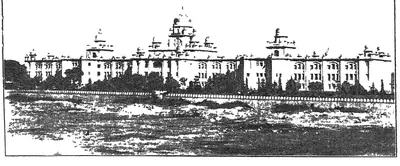
The main hospital of Hyderabad State. According to the Nizam's administration report, it was completed in the year 1924–25 at a cost of Rs 20,56,535 against an estimate of Rs 21,22,500. Mudiraj's Pictorial Hyderabad (1929) called it one of the best equipped hospitals in India. In 1932–33 Mir Osman Ali Khan opened its X-ray department, and it trained the state's assistant surgeons.
Falaknuma Palace
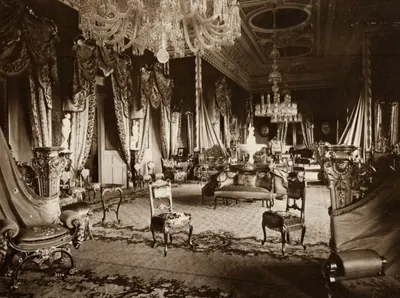
Palace on a hill south of the old city of Hyderabad. The minister Sir Vikar-ul-Umara built it, at a cost said to have been 35 lakhs of rupees, and the Nizam Mahbub Ali Khan bought it in 1897. Campbell (1898) describes its Grecian front of Corinthian columns, its marble vestibule and staircase, and its Louis XIV reception room. The Imperial Gazetteer (1909) thought no building in Hyderabad equalled it. Viceroys stayed there on their visits, and Mir Osman Ali Khan gave his birthday banquets there.
Inscriptions
Memorial pillar of Chamtamula, Nagarjunakonda
c. 273 CE
A carved pillar found near Stupa 9 at Nagarjunakonda, with a Prakrit inscription. It records that the sisters, mothers and queens of the dead Ikshvaku king Chamtamula raised it in the reign of his son Virapurushadatta. Vogel dated it to the king's 20th year. Sircar re-read the date as the cyclic year Vijaya, 273–74, the earliest known use of the cyclic year in Indian inscriptions.
Ellore plates of Devavarman
c. 345 CE
A Prakrit copper-plate grant of the 13th year of the Salankayana king Devavarman, issued from Vengipura. It is addressed to the villagers of Elura (Ellore, now Eluru), and gives twenty nivartanas of land and house sites to a Brahmin. E. Hultzsch edited it in 1908, and it gave the dynasty its modern name, 'the Salankayana Maharajas of Vengipura'.
Kanukollu plates of Nandivarman I
c. 350 CE
Prakrit copper-plate grant of the 14th year of the Salankayana king Nandivarman I, issued from Vengipura and found at Kanukollu in the Krishna delta. It gives a village as an agrahara (Brahmin village) to a Brahmin learned in the four Vedas of the Rathakara community. Its editor dated it to the close of the 3rd century, and D. C. Sircar to about the middle of the 4th.
Vilavatti grant of Simhavarman
c. 446 CE
Sanskrit copper-plate grant issued from Paddukkara in the tenth year of the Pallava king Simhavarman, son of the crown prince Vishnugopa. It gives the village of Vilavatti in Mundarashtra, with the taxes due from it, to the Brahman Vishnusarman. It was found about 1928 at Vavveru in the Kovur taluk of Nellore, and C. R. Krishnamacharlu edited it in 1938. It lists the dues of craftsmen and traders and bears the earliest clear Pallava bull on its seal.
Niduparu grant of Jayasimha I
c. 633–663 CE
A Sanskrit copper-plate grant of the second Eastern Chalukya king, Jayasimha I Sarvasiddhi, issued from Asanapura. It gives the village of Niduparu, near the royal residence of Ganderu, to the Brahmin Katisarman, whose grandfather belonged to the college (ghatika) of Asanapura. It was examined in 1916–17, and E. Hultzsch edited it in 1926. Ganderu has been identified with Kanteru and Niduparu with Nidamarru, both in Guntur taluk.
Gudivada plates of Jayasimha I (three grants)
c. 659 CE
Three Sanskrit copper-plate grants of the second Eastern Chalukya king, Prithivi-Jayasimha-Vallabha I. They were kept by a landholding family at Gudivada in the old Sarvasiddhi taluk of Visakhapatnam district, and M. Somasekhara Sarma edited them in 1960. All concern land at or near Gudivada (Kulivataka or Kudivada) in the Plakki district. The first, of the king's 18th year, is dated by seasons and fortnights, and the editor worked it out as 12 February 659. The journal's editor doubted his conclusions and took the third grant for a later copy, perhaps a forgery.
Ipur plates of Vishnuvardhana III
c. 709–746 CE
Sanskrit copper-plate grant of the Eastern Chalukya king Vishnuvardhana III (reigned about 709–746), dated in his 23rd year. It records a gift of a field in Jalayuru, in the Plolnandu district near Pithapuram, and a house site with a flower garden. Prithivipothi, daughter of Maghinduvaraja, made the gift. The plates were kept at Ipur in Tenali taluk with two Vishnukundin grants. E. Hultzsch edited them in 1926, and he took the lady for a queen and her father for the Pallava king Mahendravarman III.
Chevuru plates of Amma I
c. 918–925 CE
Three undated copper plates of the Eastern Chalukya king Amma I (reigned about 918–925). They were dug up about 1928 in a ruined mud house at Chevuru in the Kaikalur taluk of Kistna district, and B. Ch. Chhabra edited them. They were issued at the first-feeding ceremony of the infant prince Vijayaditya (Beta-Vijayaditya V). They make the warrior Vemaraja headman of the village of Umikili for a fixed tribute of eight gold gadyanakas. Their boundaries are in Telugu.
Kaluchumbarru grant of Amma II
c. 945–970 CE
Five Sanskrit copper plates, with a closing passage in Telugu, of the Eastern Chalukya king Amma II, also called Vijayaditya VI (crowned 945, reigned 25 years). At the request of Chamekamba, a lady of the Pattavardhika family and a lay disciple of the Jain teacher Arhanandin, the king gives the village of Kaluchumbarru in the Attilinandu district to Arhanandin. The gift was for repairs to the dining-hall of the Jain temple called Sarvalokasraya-Jinabhavana. The plates were Sir Walter Elliot's and are in the British Museum, and where they were found is not known.
Teki plates of Rajaraja-Chodaganga
c. 1086 CE
A Sanskrit copper-plate edict of Chodaganga, surnamed Rajaraja, dated in the 17th year of the reign. Chodaganga was a son of the Chola-Chalukya emperor Kulottunga I and viceroy of Vengi. A cultivator found the plates at Teki in the Godavari delta in 1901. The edict confers honours at weddings on the Teliki families, hereditary servants of the Eastern Chalukyas said to have come from Vijayavata (Vijayawada). E. Hultzsch used it to revise the order of the viceroys of Vengi under Kulottunga I.
Sayampeta inscription of Dharma-ravu (1464)
1464 CE
A Telugu inscription of April 1464 on a pillar near Sayampeta, north-east of Warangal. In it Dharma-ravu, a great-grandson of the Recherla chief Anapota Nayaka, gives the villages of Muccerla and Mada to the god Tiruvengalesvara and to Brahmin donees. The cultivators attached to their shares go with the gift.
Khanapur plates of Madhavavarman
An incomplete Sanskrit copper-plate grant of a Maharaja Madhavavarman, found in 1927 at Khanapur in Satara district, Maharashtra. It gives a village on the Krishna near Karad to two Brahmins. Its first plate, which would have named the dynasty, is lost. V. V. Mirashi and Y. R. Gupte, who edited it in 1956, gave it to the Vishnukundin Madhavavarman I because of the sacrifices and the imperial title it claims. They took it as proof of a Vishnukundin empire reaching into Maharashtra.
References
Notes (0)
Sources (16)
Spotted an error on this page? Tell us
Last updated: