Kankanti Paparaju
Telugu poet of the 18th century whose Uttara Ramayanamu, a mixed verse-and-prose telling of the last part of the Rama story, became the best-known Telugu version of it. C. P. Brown recorded in 1852 that the real author was another poet, Pushpagiri Timmanna, and that Paparaju, an official at Pulicat, had taken the book in payment of a debt about 1790. Chenchiah and Bhujanga Rao also credit him with an early play, the Vishnumaya Vilasamu.
Kankanti Paparaju is the name on a famous Telugu Uttara Ramayanamu, the story of Rama after his return to Ayodhya.12 By the 19th century it had pushed the older Telugu versions of that story aside.2 But Charles Philip Brown, the English scholar of Telugu, recorded a story that Paparaju was not its real author.2 He is also named as the author of one of the first Telugu plays.3
The Uttara Ramayanamu
The Uttara Ramayana is the last part of the Rama story.1 It tells of his reign, the birth of his sons and his death.1 P. Chenchiah and Raja M. Bhujanga Rao, in their history of Telugu literature (1928), list three Telugu versions.1 Tikkana wrote one wholly in verse, Kachavibhudu one in couplets, and “Karmkanti Paparaju” one in champu, a mix of verse and prose.1
William Taylor catalogued the manuscripts of the old College at Madras in 1860.4 He described a copy of the “Uttara Ramayanam, by Kaukati papu raju”.4 It begins with the sage Agastya’s visit to Rama, and goes on to the family and birth of Ravana.4 The copy was missing parts of some cantos.4
Brown’s story of the authorship
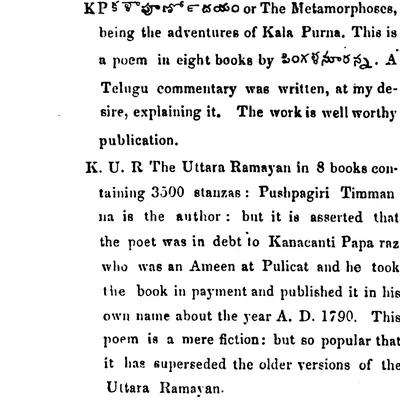
Brown described the poem in the list of books quoted in his Telugu dictionary of 1852.2 He counted eight books and 3,500 verses.2 He wrote that “Pushpagiri Timmanna is the author”.2 He reported what was said about how the poem got another name:2
- Timmanna owed money to “Kanacanti Papa raz”, an ameen (revenue official) at Pulicat
- Paparaju took the book in payment of the debt
- he published it in his own name, about the year 17902
Brown called the poem “a mere fiction”, but “so popular that it has superseded the older versions”.2 In another entry he called Pushpagiri Timmanna “a modern poet, of great eminence”, who wrote a Dasavatara and the Uttara Ramayan.5 “Neither work is in his own name”, he added.5
A play
Chenchiah and Bhujanga Rao counted only a few early Telugu plays.3 After Vinukonda Vallabharaya’s Kridabhiramamu of the Kakatiya age, they wrote, the next plays came in the 18th century.3 They named Balasarasvati’s Rangakaumudi and “Karmkanti Papa Raju’s Vishnu Maya Vilasa”.3
Where the sources disagree
- Who wrote the Uttara Ramayanamu. Chenchiah and Bhujanga Rao and Taylor give it to Paparaju without comment.14 Brown says it was written by Pushpagiri Timmanna and only published under Paparaju’s name.25
- Who wrote the Vishnumaya Vilasamu. In one chapter Chenchiah and Bhujanga Rao give this play to Paparaju.3 In another they give a play of that name to Nutanakavi Suranna, at the end of the 17th century.6
Footnotes
-
P. Chenchiah and Raja M. Bhujanga Rao, A History of Telugu Literature (1928), p. 54 (archive.org (opens in a new tab)). ↩ ↩2 ↩3 ↩4 ↩5 ↩6
-
Charles Philip Brown, A Dictionary, Telugu and English (1852), p. x (archive.org (opens in a new tab)). ↩ ↩2 ↩3 ↩4 ↩5 ↩6 ↩7 ↩8 ↩9 ↩10
-
Chenchiah and Bhujanga Rao, A History of Telugu Literature (1928), p. 114 (archive.org (opens in a new tab)). ↩ ↩2 ↩3 ↩4 ↩5
-
William Taylor, A Catalogue Raisonnée of Oriental Manuscripts in the Library of the (late) College, Fort Saint George, Vol. II (1860), p. 612, No. 418 (archive.org (opens in a new tab)). ↩ ↩2 ↩3 ↩4 ↩5
-
Brown, A Dictionary, Telugu and English (1852), p. xi (archive.org (opens in a new tab)). ↩ ↩2 ↩3
-
Chenchiah and Bhujanga Rao, A History of Telugu Literature (1928), p. 90 (archive.org (opens in a new tab)). ↩
Photos
References
Notes (0)
Sources (3)
Spotted an error on this page? Tell us
Last updated: