Kancherla Gopanna (Bhakta Ramadas)
A Telugu devotee of Rama, remembered as Ramadas. He was a revenue officer who spent government money on the Rama temple at Bhadrachalam on the Godavari and was imprisoned for it. In the legend, he was freed when Rama and Lakshmana paid his debt to the king. He is credited with the Dasarathi Sataka and with devotional songs. Writers of the nineteenth and early twentieth centuries make him a nephew of Madanna and an officer of Abul Hasan Qutb Shah. The Godavari district gazetteer of 1907 places him about 1725 under the Nizams.
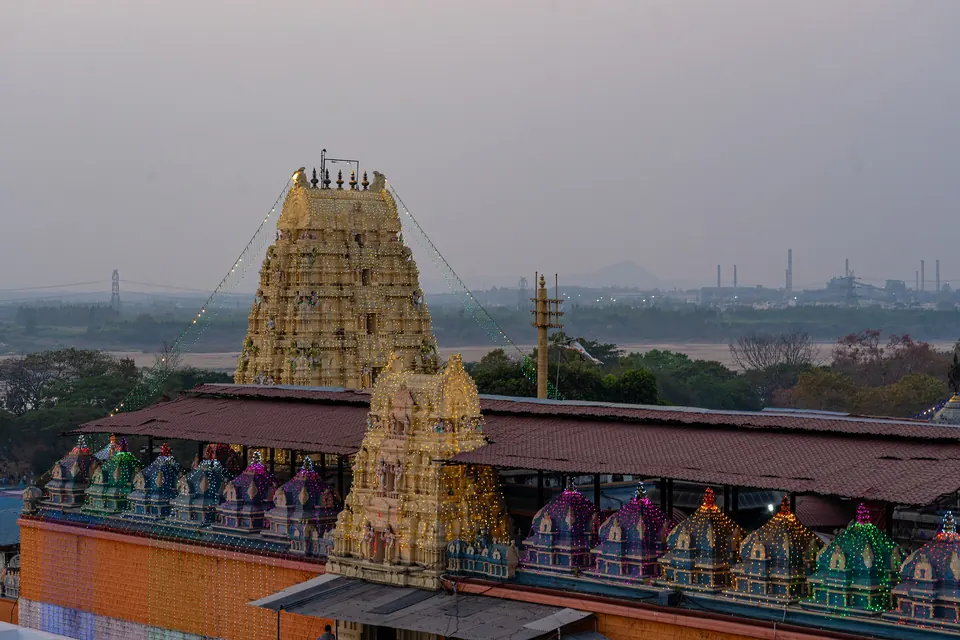
Kancherla Gopanna, known as Ramadas, is the hero of one of the best-loved Telugu devotional legends.123 He was a revenue officer who spent the king’s money on the temple of Rama at Bhadrachalam on the Godavari, and he was thrown into prison.123 He was set free when Rama and his brother Lakshmana themselves paid the debt.123
The written sources used here agree on the legend but not on his date.123 Two of them make him a nephew of Madanna, the Brahmin minister of Abul Hasan Tana Shah of Golconda.123 A third places him about 1725, a generation after the fall of the Qutb Shahi kingdom.123
Bhadrachalam
The Imperial Gazetteer of 1908 describes Bhadrachalam as a place of pilgrimage on the left bank of the Godavari, about a hundred miles above Rajahmundry.4 There “stands an ancient temple of Ramachandra, surrounded by twenty-four smaller pagodas”.4
The Godavari district gazetteer of 1907 explains the name as “the hill of Bhadra”.3 Bhadra was a saint who lived there when Rama passed through in search of Sita.3 The gazetteer records the legend that the first shrine was built by a bairági (ascetic) who carved a rough image of Rama.3
The country around the temple was linked with the story of the Ramayana.5 The gazetteer notes “many legendary associations” with Ravana’s capture of Sita.5
The story in the sources
The earliest of these accounts is in Gordon Mackenzie’s manual of the Krishna (then Kistna) district (1883).1 He tells it as “another legend of this period”, the reign of Abul Hasan.1 A peshkar is a revenue officer. In Mackenzie’s words, “Madanna Pantulu had a nephew, Gópanna, who was appointed Péshkar of the Kammamett Táluq, which includes the village of Bhadráchellam on the Godávari”.1
Gopanna was so devoted to Rama “that he assumed the name of Rámdás”.1 He “set to work to improve the temple of Ráma at Bhadráchellam, using freely the public money that came into his hands”.1 When the spending reached some lakhs of rupees, he was called to account and thrown into a dungeon.1
Mackenzie then gives the miracle as the ballads tell it.1 Two soldiers came to the sleeping king at Hyderabad with a great weight of treasure.1 They poured it on the floor, asked for a release for Gopanna’s debt, and vanished.1 In the morning the money was found to be the exact sum, and “the king knew that it was Ráma and Lakshmana who had brought the treasure”.1 He released Rámdás and gave the temple the revenues of several villages, which it still held.1
Mackenzie adds that the legend “is told in a printed book of ballads entitled Rámdás Khaidu (imprisonment of Rámdás)”.16 The ballads are “sung by many devout Hindus with much feeling”.16 People especially admired the verse in which Rámdás laments his imprisonment.16
Jadunath Sarkar wrote an appendix on Madanna in 1930.2 He gives the same identification, on information from Professor K. V. Rangaswami Aiyangar.2 “Their nephew Gopanna, surnamed Ramdas Swami, was appointed revenue collector at Bhadrachalam”.2 But he “fearlessly spent six lakhs of pagodas of Government money in building halls, shrines and corridors for the god Ram”.2
He was arrested and tortured by royal order.2 He was released “through the miraculous interposition of Ram and Lakshman”.2 They “appeared in the guise of men and paid up the deficit to the Sultan on behalf of their devotee, who is now worshipped as a saint”.2
A later date
The Godavari district gazetteer of 1907, describing Bhadrachalam, puts the story in a different century.3 After the legendary beginnings of the shrine, it says, “more authenticated history commences about 1725”.3 That was “when Ráma Dás, an official of the Nizam’s government, was sent to collect the revenues of this taluk”.3
Instead of sending the money, he spent it on enlarging the shrine and building towers.3 His superiors had him carried to Hyderabad, “where he died after an imprisonment of twelve years”.3
The gazetteer gives the miracle as tradition.3 Rama and Lakshmana “appeared before the then Nizam in person” and paid his ransom.3 He returned to Bhadrachalam, “where he disappeared and became one with the god”.3
The gazetteer names the man who next held his office, Tumu Lakshminarasimha Rao.3 He sent part of the revenue each year and spent the rest on finishing the work.3
The gazetteer does not give its evidence for the date of 1725.312 Mackenzie and Sarkar give none for the family link with Madanna.312 Neither account rests on a document of Gopanna’s own time quoted in these works.312
The poet
Gopanna is remembered as a poet as well as a devotee.78 P. Chenchiah and Raja M. Bhujanga Rao wrote a history of Telugu literature in 1928.78 They list the “Dásarathi Sataka” among the most popular devotional satakas (poems of a hundred verses).78 They describe it as “by Kancherla Gopanna, the celebrated Rama Bhakta of Bhadrachellam and a disciple of Kabir”.78
The Godavari gazetteer says that his adventures are the subject of a book of Telugu poems, “called the Ráma Dás kírtana, which is widely known throughout the country”.3 The Telugu bards (bhagavatas) often sang its songs at social gatherings throughout South India.3
Footnotes
-
Gordon Mackenzie, A Manual of the Kistna District (1883), p. 37 (archive.org (opens in a new tab)). ↩ ↩2 ↩3 ↩4 ↩5 ↩6 ↩7 ↩8 ↩9 ↩10 ↩11 ↩12 ↩13 ↩14 ↩15 ↩16 ↩17 ↩18 ↩19 ↩20 ↩21 ↩22 ↩23
-
Jadunath Sarkar, History of Aurangzib, Vol. IV (2nd ed., 1930), p. 421 (archive.org (opens in a new tab)). ↩ ↩2 ↩3 ↩4 ↩5 ↩6 ↩7 ↩8 ↩9 ↩10 ↩11 ↩12 ↩13 ↩14 ↩15 ↩16
-
Hemingway, Godavari, Vol. I (1907), p. 261 (archive.org (opens in a new tab)). ↩ ↩2 ↩3 ↩4 ↩5 ↩6 ↩7 ↩8 ↩9 ↩10 ↩11 ↩12 ↩13 ↩14 ↩15 ↩16 ↩17 ↩18 ↩19 ↩20 ↩21 ↩22 ↩23 ↩24
-
Imperial Gazetteer of India: Madras, Vol. I (1908), p. 164 (archive.org (opens in a new tab)). ↩ ↩2
-
F. R. Hemingway, Madras District Gazetteers: Godavari, Vol. I (1907), p. 258 (archive.org (opens in a new tab)). ↩ ↩2
-
Mackenzie, Kistna District (1883), p. 38 (archive.org (opens in a new tab)). ↩ ↩2 ↩3
-
P. Chenchiah and Raja M. Bhujanga Rao, A History of Telugu Literature (1928), p. 99 (archive.org (opens in a new tab)). ↩ ↩2 ↩3 ↩4
-
Chenchiah and Bhujanga Rao, A History of Telugu Literature (1928), p. 100 (archive.org (opens in a new tab)). ↩ ↩2 ↩3 ↩4
Photos
References
Notes (0)
Sources (5)
Spotted an error on this page? Tell us
Last updated: