Swami Ramananda Tirtha
Leader of the Hyderabad State Congress, which the Nizam's government banned before it could meet in 1938. He was imprisoned in its satyagrahas of 1938, 1940 and 1942. As its president from 1946 he led the 'Join Indian Union' movement for Hyderabad's accession to India, which ended with the integration of the state in 1948.
Swami Ramananda Tirtha was a leader of the Hyderabad State Congress.12 As its president from 1946, he led the “Join Indian Union” satyagraha for Hyderabad’s accession to India.23
The banned State Congress, 1938
By 1938 some Hyderabad leaders had come to feel that every Hindu demand for responsible government was being dismissed as communal. They wanted a secular political organisation to carry on the struggle. According to Sarojini Regani’s history of the freedom movement, Swami Ramananda Tirtha decided to take up the work of forming a Hyderabad State Congress.1 He made this decision after the Latur session of the Maharashtra Conference.1
He came to Hyderabad on 9 June 1938.4 By July he had formed a provisional (temporary) committee and enrolled about 1,200 members.4
The general meeting called for 9 September never took place. On 8 September the Nizam’s government, under Sir Akbar Hydari, declared that it had no objection to a non-communal political body without outside affiliations (links). It had concluded, however, that the proposed State Congress would in reality be communal and subversive (aimed against the government).4 So it banned the State Congress as an unlawful association.4
Talks to have the ban lifted failed, and the State Congress began a satyagraha on 24 October 1938.5 Regani names Ramananda Tirtha as its first “dictator” (leader in charge), and records his arrest with others. Eighteen batches, about 400 satyagrahis in all, offered themselves for arrest before the campaign was suspended on 24 December 1938 on Gandhi’s advice. Gandhi asked the government to recognise the State Congress.6 Hydari released the prisoners but kept the ban.6
Individual satyagraha and Quit India
With Gandhi’s permission Ramananda Tirtha offered individual satyagraha again on 11 September 1940, and was imprisoned. Regani reports his explanation.7 The State Congress did not exist as an organisation, but its members claimed the right to spread its ideals as individuals.7 Their minimum demand was the lifting of the ban and full civil liberties.7
In August 1942 he met Gandhi before the Bombay meeting of the All India Congress Committee, and obtained his consent for Hyderabad to take part in the Quit India movement.8 Expecting arrest, he sent G. S. Melkote a letter of demands to be signed and sent to the Nizam.8 He was arrested as soon as he reached Nampally station.8
The ‘Join Indian Union’ movement, 1946–1948
The ban was lifted in April 1946.2 A resolution of the All-India States People’s Conference named Ramananda Tirtha president of the reconstituted State Congress.2 He was elected president at its open session in May 1947, though the party was divided between his group and one led by B. Ramakrishna Rao, K. V. Ranga Reddy and others.9
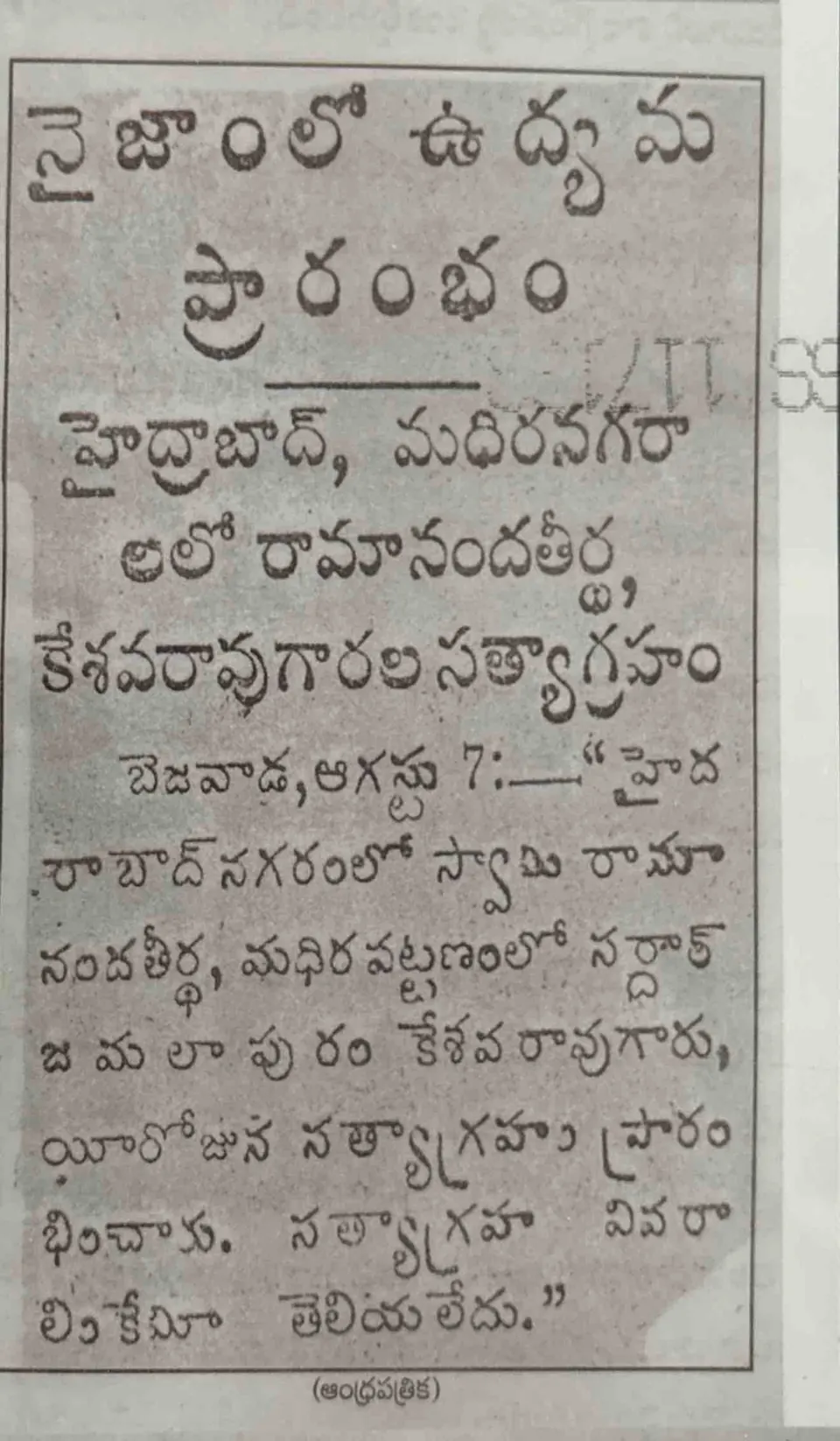
To press for accession to India, the State Congress set up action committees, with a central office in Bombay and zonal offices at Vijayawada and Gadag.10 It also set up border camps around the state.10 At independence the Nizam declared that Hyderabad would remain independent of both India and Pakistan.10 On 7 August 1947 Ramananda Tirtha launched the “Join Indian Union” satyagraha. On 15 August the State Congress hoisted in Sultan Bazaar the Indian flag that Nehru had personally given him.3 He was arrested with other leaders.3
He was released, with the other Congress prisoners, before the standstill agreement between Hyderabad and India was signed on 29 November 1947.11 He rejected a government proposal for a legislature with three-quarters of its seats for Muslims.12 In Delhi he told Gandhi that, faced with the Razakars and the violent methods of the communists, the State Congress might sometimes have to use force in self-defence.12
After consulting K. M. Munshi he wrote to the Nizam, asking him to grant responsible government and accede to India.12 He received no reply.12 Back in Hyderabad he demanded at a press conference that the question of accession be settled by a plebiscite (a vote of the people) under international supervision.13 He was imprisoned again.13
Regani’s account is written from the side of the Congress. The Nizam’s government regarded the State Congress, from its formation, as a communal and subversive body.14 The Ittehad-ul-Muslimeen opposed any change that would weaken Muslim power in the state.14 The integration of Hyderabad in September 1948 is described on the page Reform, freedom & people’s movements.
Footnotes
-
Sarojini Regani, Highlights of the Freedom Movement in Andhra Pradesh (1956), p. 187 (archive.org (opens in a new tab)). ↩ ↩2 ↩3
-
Regani, Highlights (1956), p. 197 (archive.org (opens in a new tab)). ↩ ↩2 ↩3 ↩4
-
Regani, Highlights (1956), p. 202 (archive.org (opens in a new tab)). ↩ ↩2 ↩3
-
Regani, Highlights (1956), p. 188 (archive.org (opens in a new tab)). ↩ ↩2 ↩3 ↩4
-
Regani, Highlights (1956), pp. 188–189 (archive.org (opens in a new tab)). ↩
-
Regani, Highlights (1956), pp. 189–190 (archive.org (opens in a new tab)). ↩ ↩2
-
Regani, Highlights (1956), p. 192 (archive.org (opens in a new tab)). ↩ ↩2 ↩3
-
Regani, Highlights (1956), p. 194 (archive.org (opens in a new tab)). ↩ ↩2 ↩3
-
Regani, Highlights (1956), p. 199 (archive.org (opens in a new tab)). ↩
-
Regani, Highlights (1956), pp. 199–201 (archive.org (opens in a new tab)). ↩ ↩2 ↩3
-
Regani, Highlights (1956), p. 211 (archive.org (opens in a new tab)). ↩
-
Regani, Highlights (1956), p. 212 (archive.org (opens in a new tab)). ↩ ↩2 ↩3 ↩4
-
Regani, Highlights (1956), pp. 215–216 (archive.org (opens in a new tab)). ↩ ↩2
-
Regani, Highlights (1956), pp. 188, 193, 204 (archive.org (opens in a new tab)). ↩ ↩2
Photos
References
Notes (0)
Sources (1)
Spotted an error on this page? Tell us
Last updated: