Akbar Hydari (Nawab Hyder Nawaz Jung)
Hyderabad official and minister under Mir Osman Ali Khan. As Secretary in the Education Department he proposed in 1917 the university that became Osmania University, teaching in Urdu. He was Finance Member of the Executive Council from 1919 into the 1930s, President of the state railway board after the state bought the railway, and chairman of a committee of the princes' ministers on the federal plan in 1934–35. By 1938 he headed the government, which banned the new Hyderabad State Congress that year; he was also Chancellor of Osmania University.
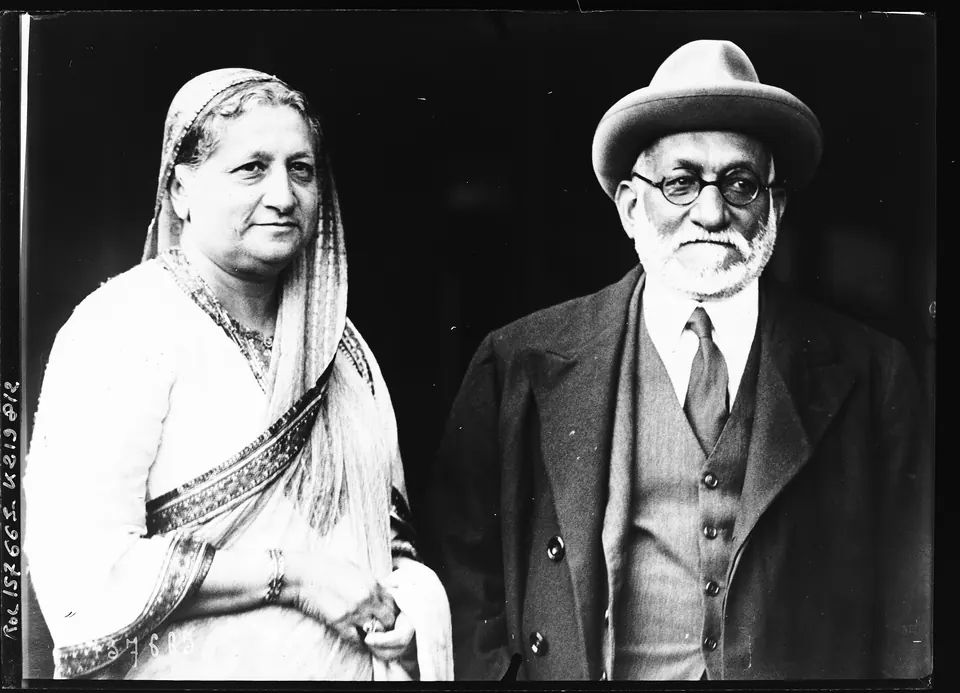
Akbar Hydari was one of the leading officials of Hyderabad State under the last Nizam, Mir Osman Ali Khan. He proposed the founding of Osmania University in 1917.1 He then ran the state’s finances for many years and, by 1938, headed its government.23
The names he went by
The sources call him by two names.14 The census of 1931 calls him “Mr. A. Hydari (now Nawab Sir Hydar Nawaz Jung Bahadur)”.1 The administration report for 1342 Fasli (1932–33) names the Finance Member as “Sir Akbar Hydari Nawab Hyder Nawaz Jung Bahadur”.4
The university plan, 1917
According to the census of 1931, Hydari was Secretary to the government in the Education Department in 1917.1 Early that year he sent the Nizam a memorandum on higher education.1 He argued that students learned badly through a foreign language.1 He proposed a new university teaching in Urdu.1
Critics objected that most people of the state spoke other languages, and that there were no Urdu textbooks.5 Hydari answered the second point by proposing a bureau of translation attached to the university.5 The Nizam approved the plan.5
Finance Member
The Nizam formed an Executive Council in November 1919.6 K. Krishnaswamy Mudiraj’s Pictorial Hyderabad (1929) lists “Nawab Sir Hyder Nawaz Jung Bahadur” as its Member for Finance.2 Mudiraj also praises “Sir Akbar Hydari, the Finance Minister” for his interest in archaeology.7
The administration reports show him at work in these years.89
- In 1924–25 the Nizam sent him to receive the Viceroy, Lord Reading, on a visit to the Ajanta and Ellora caves.8
- On 1 April 1930 the state bought the Nizam’s Guaranteed State Railway from its company.10 By 1932–33 Hydari was President of the railway’s board.9
- In 1932–33 he still held the finance portfolio.4
Spokesman on the federal plan
The administration report for 1344 Fasli (1934–35) shows him as President of the state’s External Relations Committee.11 He chaired a committee of ministers of the princely states.11 It met in Bombay in December 1934 and in Delhi in January 1935 to study the proposed federation of India.11 Its views were sent in a letter from Hydari to Sir Bertrand Glancy.12
Head of the government, 1938
By 1938, according to Sarojini Regani’s history of the freedom movement, Hydari was Prime Minister.3 She writes from the Congress side.3 On 8 September 1938, she says, his government banned the new Hyderabad State Congress as communal, the day before its first general meeting.3 Later he released the jailed satyagrahis (civil-disobedience volunteers) at Gandhi’s request, but kept the ban.13 On 4 April 1940, she writes, he told Gandhi that communal tension was the greatest problem in Hyderabad.14
The administration report for 1347 Fasli (1937–38) calls him “the Right Honourable Sir Akbar Hydari”.15 As Chancellor of Osmania University he presided over its convocation that year.15 See Swami Ramananda Tirtha and the Movements page.
Footnotes
-
Census of India 1931, Vol. XXIII, Part I (1933), p. 216 (archive.org (opens in a new tab)). ↩ ↩2 ↩3 ↩4 ↩5 ↩6 ↩7
-
Mudiraj, Pictorial Hyderabad (1929), p. 239 (archive.org (opens in a new tab)). ↩ ↩2
-
Sarojini Regani, Highlights of the Freedom Movement in Andhra Pradesh, p. 188 (archive.org (opens in a new tab)). ↩ ↩2 ↩3 ↩4
-
Administration Report, 1342 Fasli (1932–33) (1935), p. 118 (archive.org (opens in a new tab)). ↩ ↩2 ↩3
-
Census of India 1931, Vol. XXIII, Part I (1933), p. 217 (archive.org (opens in a new tab)). ↩ ↩2 ↩3
-
K. Krishnaswamy Mudiraj, Pictorial Hyderabad, Vol. I (1929), p. 233 (archive.org (opens in a new tab)). ↩
-
Mudiraj, Pictorial Hyderabad (1929), p. 297 (archive.org (opens in a new tab)). ↩
-
Report on the Administration of H.E.H. the Nizam’s Dominions, 1924–25 (1926), General Summary, p. i (archive.org (opens in a new tab)). ↩ ↩2
-
Report on the Administration of H.E.H. the Nizam’s Dominions for 1342 Fasli (1932–33) (1935), p. 85 (archive.org (opens in a new tab)). ↩ ↩2
-
Census of India 1931, Vol. XXIII: H.E.H. the Nizam’s Dominions, Part I: Report (1933), p. 32 (archive.org (opens in a new tab)). ↩
-
Report on the Administration of H.E.H. the Nizam’s Dominions, 1344 Fasli (1934–35) (1938), p. 145 (archive.org (opens in a new tab)). ↩ ↩2 ↩3
-
Administration Report, 1344 Fasli (1934–35) (1938), p. 146 (archive.org (opens in a new tab)). ↩
-
Regani, Highlights of the Freedom Movement, p. 190 (archive.org (opens in a new tab)). ↩
-
Regani, Highlights of the Freedom Movement, p. 191 (archive.org (opens in a new tab)). ↩
-
Administration Report, 1347 Fasli (1937–38) (1940), p. 177 (archive.org (opens in a new tab)). ↩ ↩2
Photos
References
Notes (0)
Sources (7)
Spotted an error on this page? Tell us
Last updated: