Sultan Quli Qutb-ul-Mulk
Persian-born officer of the Bahmani sultanate who governed Telingana from Golconda. He conquered much of Telangana and the Krishna–Godavari coast, and founded the Qutb Shahi dynasty. He was assassinated in 1543. According to the Golconda chronicle, he was killed at prayer in the mosque of Golconda fort. According to Ferishta, a slave killed him while he was examining jewels.
Sultan Quli was the founder of the Qutb Shahi kingdom of Golconda. He came to the Deccan from Persia and rose in the service of the Bahmani sultans. He governed their eastern province of Telangana (then Telingana) for many years before ruling it in his own name. The Golconda chronicle translated by Briggs says that he held power in Telangana for sixty years, sixteen of them as governor and forty-four as king.1
Origins
The historian Ferishta says Sultan Quli was a Turkoman, born at Hamadan in Persia, who arrived in the Deccan as a young man.2 The Golconda chronicle gives a fuller account, which it says was taken down from Sultan Quli’s own words.3 In it he says he was born at Saadabad near Hamadan.3 His family belonged to the Kara Koyunlu Turkomans, who had lost power in Persia to a rival clan.3
He first visited the Deccan as a boy with an uncle.3 Later, fearing for his life at home, he returned with horses and presents for the Bahmani king Mahmud Shah.3 The king kept him at court.3
The Golconda chronicle names his father as Uwais Quli, son of Pir Quli.4 It traces the line back through the Kara Koyunlu chiefs to Kara Yusuf.4 Bilgrami likewise calls him the son of Uwais Quli.5
The French jeweller Tavernier visited Golconda in the 17th century and heard the same story.6 He wrote that the first king of Golconda was a Shia “descended from an ancient family of Turcomans” of the Hamadan country.6
In Bahmani service
Ferishta says the young Sultan Quli joined the king’s Turkish bodyguard and became a secretary in a government office.2 The chronicle credits him with defending Mahmud Shah during a night attack on the palace at Bidar.7 He was rewarded with the title Qutb-ul-Mulk.7 He was then made governor of Telangana.8
The dates differ between sources:59
- Bilgrami puts the palace attack in AH 892 (1486; AH is the Islamic way of counting years), the governorship in 1493, and a grant of Golconda, Warangal and other districts as a personal estate in 1495.5
- The Kistna district manual puts the attack in 1490, and the governorship with the estates in 1495.9
Golconda became his seat. A note in Briggs’s translation says the place was renamed Muhammadnagar after the Bahmani king Muhammad Shah, Sultan Quli’s patron.10 Bilgrami gives its earlier name as Mankal.10
Bilgrami credits Sultan Quli with the walls of the fort, its Jami Masjid and a royal palace.11 Haig, writing in 1907, says he “had already replaced the old Hindu mud fort with a substantial fortress of stone”.12
Wars in Telangana and on the coast
The Golconda chronicle describes a long series of campaigns, though without fixed dates. He took Rajakonda and Devarakonda, and fought Krishnadeva Raya of Vijayanagara near Pangal. He drove out a former Bahmani officer who had seized Elgandal and Malangur, and he fought the Imad Shahi sultan of Berar.13
His main opponent in the east was Sitapati of Khammam, called Shitab Khan in Persian, who held Warangal and Bellamkonda.14 Sitapati gathered the chiefs of the region and the Gajapati king of Orissa against him.14 The chronicle says Sultan Quli defeated their combined army near Palanchinur.14
He then took Kondapalli, Eluru (then Ellore) and Rajahmundry.14 He made a treaty that fixed the Godavari as his frontier with Orissa.14 A pillar inscription at Warangal confirms that Sitapati, a Hindu chief, had taken that fort in January 1504.15
Robert Sewell compared this account with Vijayanagara and Portuguese sources.16 He concluded that the chronicle’s story, though told as one series of events, “really covers a period of at least twenty-one years”.16 This period ran from the beginning of Sultan Quli’s reign in 1512 to the death of Ismail Adil Shah in 1534.16 So, Sewell wrote, the story could not be dated in detail.16
Bilgrami, using other Persian manuscripts, dates the war with Shitab Khan to 1519–1525.17 He dates the conquest of Kondapalli, Rajahmundry and Eluru to 1526–27.17 South of the Krishna, Sultan Quli besieged Kondavidu more than once against Vijayanagara forces. The Kistna manual places a final capture around 1536.18
In a siege of Kovilkonda against Ismail Adil Shah of Bijapur, Sultan Quli received a sword cut that took off part of his nose and cheek. The chronicle says this disfigured him for the rest of his life.19 Ferishta gives the same story of his son Jamshid.19
King of Golconda
Ferishta dates Sultan Quli’s independence to AH 918 (1512).20 Haig and Sewell follow him in giving 1512.1221
Bilgrami argued for AH 924 (1518), from the inscription over the Jami Masjid in Golconda fort.22 This inscription, dated 924, names the Bahmani king Mahmud Shah as reigning sovereign, and Sultan Quli only as “Qutbul Mulk”.22
The chronicle says that once the other Bahmani governors had taken royal titles, his officers urged him to do the same.23 He was then proclaimed king as Sultan Quli Qutb Shah.23 The chronicle also says that when Mahmud Shah died, the other governors proclaimed their independence.24 It dates his death to AH 912 (1507).24 Sultan Quli, it says, “still continued his allegiance to the shadow of royalty which remained”.24
Hirananda Sastri, writing in 1932, quoted the Burhan-i Ma’asir on an earlier date.25 It says that already in AH 903 (1497) “Quli Qutb” had brought the chiefs of Telangana under him.25 It adds that he had added Warangal and Kovilkonda to his possessions.25
According to Ferishta, he brought Persian customs to his court, including the playing of the royal band five times a day.2 He filled the offices of government with men from his own country.2 He had the public prayers read in the name of the twelve Imams, the Shia form. The chronicle quotes him as saying that he had held this faith since his youth in Persia.26
Death
The chronicle says Sultan Quli was nearly ninety when he turned to making his capital beautiful. On 2 Jumada II AH 950 (September 1543) he was struck down while kneeling at prayer in the principal mosque of Golconda. The killer was the commander of the fort, acting for Sultan Quli’s son Jamshid. Jamshid had been imprisoned in the fort for plotting against his elder brother, whom their father had named as heir.27
The inscription on his tomb calls him “the Martyr” and gives the same date.28 Bilgrami takes the wording as confirming the assassination.28 Bilgrami gives his age as 99, on the authority of a later Qutb Shahi history.29
Ferishta tells the death differently. In his account, Jamshid, “who had long been wishing for his father’s death”, persuaded one of his slaves to stab the king while he was examining some jewels.30 Jamshid then killed the slave himself, so that his part in the crime should not become known.30 Ferishta says Sultan Quli had reigned for nearly thirty-three years.30
His domed tomb stands on a raised terrace among the Qutb Shahi tombs, about half a mile north of the fort.31 Bilgrami says he built it in his lifetime, together with a bath-house for washing the bodies of the royal dead.32 His tomb inscription names him Bar Malik, “the great Malik”.33 According to Bilgrami, this was the name by which people of the Deccan knew him.33
Family
According to the Golconda chronicle, Sultan Quli had six sons and four daughters.34 The sons were:34
- Haidar Khan, who died in his father’s lifetime34
- Qutb-ud-din, his chosen heir, whom Jamshid had blinded34
- Yar Quli Jamshid, who succeeded him34
- Abdul Karim, who rebelled and was put to death34
- Daulat Khan, “called the Mad Prince”34
- Ibrahim, who succeeded Jamshid34
Ferishta names only three sons, Jamshid, Haidar and Ibrahim.30
In the chronicle, Haidar Khan commanded a wing of his father’s army in the battle against the Gajapati’s forces.35 He killed the raja’s nephew with his own hand.35 A note by Briggs says that “it is from this Prince, Heidurabad, or, as it is usually written, Hydurabad, derives its name” (that is, Hyderabad).35 The Kistna manual repeats this.36 The chronicle also dates the birth of his youngest son, Ibrahim Qutb Shah, to AH 936 (1530).37
Footnotes
-
Golconda chronicle, in Muhammad Qasim Ferishta, tr. John Briggs, History of the Rise of the Mahomedan Power in India, Vol. III (1829), p. 377 (archive.org (opens in a new tab)). ↩
-
Ferishta, tr. Briggs, Rise of the Mahomedan Power, Vol. III (1829), pp. 321–323 (archive.org (opens in a new tab)). ↩ ↩2 ↩3 ↩4
-
Briggs, Rise of the Mahomedan Power, Vol. III (1829), pp. 339–342 (archive.org (opens in a new tab)). ↩ ↩2 ↩3 ↩4 ↩5 ↩6
-
Briggs, Rise of the Mahomedan Power, Vol. III (1829), pp. 339–340 (archive.org (opens in a new tab)). ↩ ↩2
-
Syed Ali Asgar Bilgrami, Landmarks of the Deccan (1927), p. 194 (archive.org (opens in a new tab)). ↩ ↩2 ↩3
-
Jean-Baptiste Tavernier, tr. V. Ball, Travels in India, Vol. I (1889), p. 160 (archive.org (opens in a new tab)). ↩ ↩2
-
Briggs, Rise of the Mahomedan Power, Vol. III (1829), pp. 343–344 (archive.org (opens in a new tab)). ↩ ↩2
-
Briggs, Rise of the Mahomedan Power, Vol. III (1829), p. 345 (archive.org (opens in a new tab)). ↩
-
Gordon Mackenzie, A Manual of the Kistna District (1883), p. 24 (archive.org (opens in a new tab)). ↩ ↩2
-
Briggs, Rise of the Mahomedan Power, Vol. III (1829), p. 353, note (archive.org (opens in a new tab)); Bilgrami, Landmarks (1927), p. 194 (archive.org (opens in a new tab)). ↩ ↩2
-
Bilgrami, Landmarks (1927), p. 108 (archive.org (opens in a new tab)). ↩
-
T. W. Haig, Historic Landmarks of the Deccan (1907), p. 181 (archive.org (opens in a new tab)). ↩ ↩2
-
Briggs, Rise of the Mahomedan Power, Vol. III (1829), pp. 354–360 (archive.org (opens in a new tab)). ↩
-
Briggs, Rise of the Mahomedan Power, Vol. III (1829), pp. 360–364 (archive.org (opens in a new tab)). ↩ ↩2 ↩3 ↩4 ↩5
-
Hirananda Sastri, Shitab Khan of Warangal (1932), pp. 3–4, 13 (archive.org (opens in a new tab)). ↩
-
Robert Sewell, A Forgotten Empire (Vijayanagar) (1900), pp. 132–135 (archive.org (opens in a new tab)). ↩ ↩2 ↩3 ↩4
-
Bilgrami, Landmarks (1927), p. 195 (archive.org (opens in a new tab)). ↩ ↩2
-
Mackenzie, Kistna District (1883), pp. 26–28 (archive.org (opens in a new tab)). ↩
-
Briggs, Rise of the Mahomedan Power, Vol. III (1829), pp. 368–371 and note (archive.org (opens in a new tab)). ↩ ↩2
-
Ferishta, tr. Briggs, Rise of the Mahomedan Power, Vol. III (1829), p. 323 (archive.org (opens in a new tab)). ↩
-
Sewell, A Forgotten Empire (1900), p. 132 (archive.org (opens in a new tab)). ↩
-
Bilgrami, Landmarks (1927), pp. 111, 114 (archive.org (opens in a new tab)). ↩ ↩2
-
Briggs, Rise of the Mahomedan Power, Vol. III (1829), pp. 353–354 (archive.org (opens in a new tab)). ↩ ↩2
-
Briggs, Rise of the Mahomedan Power, Vol. III (1829), pp. 351–352 (archive.org (opens in a new tab)). ↩ ↩2 ↩3
-
Sastri, Shitab Khan of Warangal (1932), p. 15 (archive.org (opens in a new tab)). ↩ ↩2 ↩3
-
Briggs, Rise of the Mahomedan Power, Vol. III (1829), p. 353 (archive.org (opens in a new tab)). ↩
-
Briggs, Rise of the Mahomedan Power, Vol. III (1829), pp. 376–378 (archive.org (opens in a new tab)). ↩
-
Bilgrami, Landmarks (1927), pp. 113, 115 (archive.org (opens in a new tab)). ↩ ↩2
-
Bilgrami, Landmarks (1927), pp. 113, 115 (archive.org (opens in a new tab)). ↩
-
Ferishta, tr. Briggs, Rise of the Mahomedan Power, Vol. III (1829), pp. 323–324 (archive.org (opens in a new tab)). ↩ ↩2 ↩3 ↩4
-
Imperial Gazetteer of India: Hyderabad State (1909), p. 114 (archive.org (opens in a new tab)). ↩
-
Bilgrami, Landmarks (1927), pp. 115–117 (archive.org (opens in a new tab)). ↩
-
Bilgrami, Landmarks (1927), p. 115 (archive.org (opens in a new tab)). ↩ ↩2
-
Briggs, Rise of the Mahomedan Power, Vol. III (1829), pp. 377–378 (archive.org (opens in a new tab)). ↩ ↩2 ↩3 ↩4 ↩5 ↩6 ↩7 ↩8
-
Briggs, Rise of the Mahomedan Power, Vol. III (1829), pp. 363–364 and note (archive.org (opens in a new tab)). ↩ ↩2 ↩3
-
Mackenzie, Kistna District (1883), p. 27 note (archive.org (opens in a new tab)). ↩
-
Briggs, Rise of the Mahomedan Power, Vol. III (1829), p. 371 (archive.org (opens in a new tab)). ↩
Photos
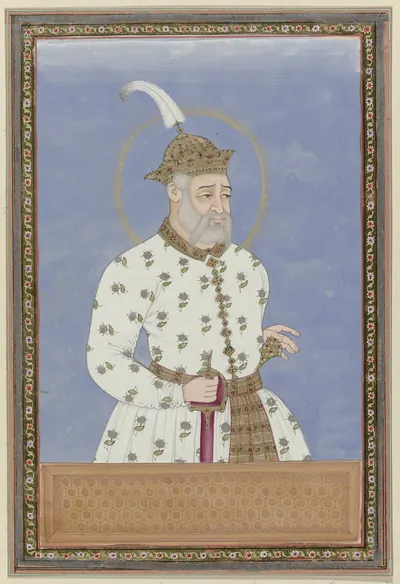 Bara Malik (Sultan Quli): Deccani portrait, c. 1686, from an album in the Rijksmuseum (RP-T-00-3186-19A); Dutch title: "Portrait of Bara Malik; he was first vizier of the sultan who ruled the city of Bidar; later he became ruler of Golconda and founded Golconda"Other · c. 1686
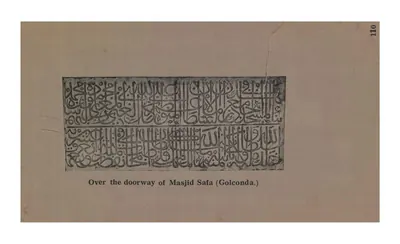 Inscription over the doorway of Masjid Safa, Golconda Fort (Bilgrami 1927, p. 110)Inscription rubbing · 1927
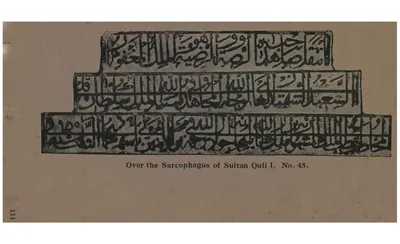 Inscription over the sarcophagus of Sultan Quli I (No. 45), Golconda (Bilgrami 1927, p. 111)Inscription rubbing · 1927
Related
Dynasties
References
Notes (0)
Sources (8)
Spotted an error on this page? Tell us
Last updated: