Halebidu
Village in the Belur taluk of Hassan district, Mysore (now Karnataka), the site of Dorasamudra (Dvarasamudra), capital of the Hoysala kings from the 12th century until it was sacked by Malik Kafur's army in 1311 and destroyed by a Tughluq army later. Its unfinished double temple of Hoysalesvara, with friezes of elephants, lions, horsemen and scenes from the Ramayana, and the lost Kedaresvara temple were described by James Fergusson and James Burgess.
Halebidu, or Halebid, is a village in the Belur taluk of the old Mysore state, now in Karnataka.1 It stands on the site of Dorasamudra, the capital of the Hoysala kings.12
The capital
B. Lewis Rice (1909) wrote that the Hoysala capital was Dorasamudra, “now Halebid in Belur taluq”.1 In Sanskrit it was Dvarasamudra or Dvaravatipura.1 James Fergusson’s history, revised by James Burgess in 1910, says that King Vishnuvardhana moved the capital there from Belur about 1135.2
The city remained the capital until the Delhi armies came.2 In 1311 Malik Kafur’s army appeared before the fort of “Dhur Samundar”, as the Persian writers called it.3 Rice wrote that it was sacked, rebuilt by 1316, and destroyed completely by a later army of Muhammad Tughluq.4
The temples
Fergusson and Burgess describe two great temples.56
- Kedaresvara. A small star-shaped shrine of Siva, built by Vira Ballala and one of his queens, probably about 1219.5 It was covered with sculpture “of the very best class of Indian art”.5 By 1910 it had fallen into “a shapeless mound”.5
- Hoysalesvara. A double temple with two shrines of Siva, each with its own pillared hall and a pavilion for the bull Nandi.6 Its building was probably stopped by the Muslim conquest of 1311.6
The Hoysalesvara temple stands on a terrace five to six feet high.7 Its walls carry long bands of carving.7 At the bottom is a frieze of some 2,000 elephants.7 Above come lions, scrolls, horsemen, and a long series of scenes from the Ramayana.7 Rice noted a pillar beside this temple that records the death of the prince Lakshma and his followers when Ballala II died in 1220.8
Footnotes
-
B. Lewis Rice, Mysore and Coorg from the Inscriptions (1909), p. 96 (archive.org (opens in a new tab)). ↩ ↩2 ↩3 ↩4
-
James Fergusson, rev. James Burgess, History of Indian and Eastern Architecture, Vol. I (1910), p. 437 (archive.org (opens in a new tab)). ↩ ↩2 ↩3
-
S. Krishnaswami Aiyangar, South India and her Muhammadan Invaders (1921), p. 93 (archive.org (opens in a new tab)). ↩
-
Rice, Mysore and Coorg from the Inscriptions (1909), p. 107 (archive.org (opens in a new tab)). ↩
-
Fergusson and Burgess, History of Indian and Eastern Architecture I (1910), pp. 442–443 (archive.org (opens in a new tab)). ↩ ↩2 ↩3 ↩4
-
Fergusson and Burgess, History of Indian and Eastern Architecture I (1910), p. 444 (archive.org (opens in a new tab)). ↩ ↩2 ↩3
-
Fergusson and Burgess, History of Indian and Eastern Architecture I (1910), pp. 445–446 (archive.org (opens in a new tab)). ↩ ↩2 ↩3 ↩4
-
Rice, Mysore and Coorg from the Inscriptions (1909), p. 104 (archive.org (opens in a new tab)). ↩
Photos
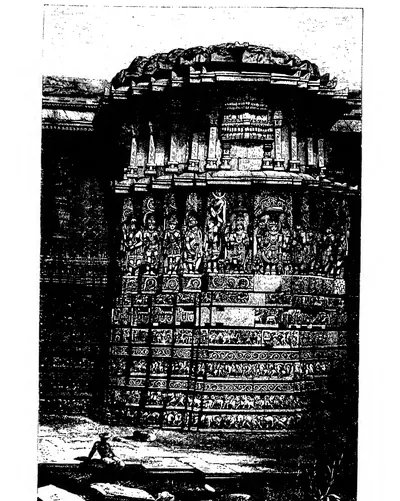 "Central Pavilion, Halebid, East Front": the great temple at Halebidu (Fergusson and Burgess 1910, woodcut 263)Drawing · 1910
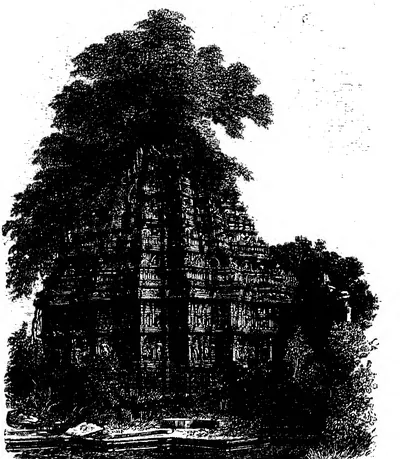 "Kedaresvara, Halebid": the ruined Hoysala temple at Halebidu, built probably about 1219 (Fergusson and Burgess 1910, woodcut 260)Drawing · 1910
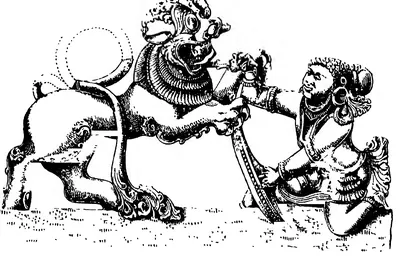 "Sala and the Tiger": the Hoysala crest, after the legend of Sala killing a tiger (Rice 1909, plate facing p. 95)Drawing · 1909
References
Notes (0)
Sources (3)
Spotted an error on this page? Tell us
Last updated: