Lesson 12
Hijri, Fasli and chronograms
The Persian and Arabic inscriptions of Golconda and Hyderabad, and the revenue papers of the Nizams and of the Madras government, do not use the Saka era. Instead they count years in the Hijri era, in the years of a king’s reign, or in the Fasli “harvest” year, and sometimes they hide the year in a phrase.1 This lesson explains each system and shows how to convert it, step by step, with examples from the inscriptions on this site. For the Saka era and the sixty-year cycle, see Dates and eras. For reading the inscriptions themselves, see Persian and Arabic inscriptions.
The Hijri year
The Hijri (AH) era counts from Muhammad’s flight from Mecca to Medina. Sewell and Dikshit’s Indian Calendar (1896) dates the flight to the evening of 15 July 622 by astronomical reckoning. The usual chronological reckoning makes Friday 16 July 622 the first day. The era was introduced by the Caliph Umar.2
The Hijri year is purely lunar. It has twelve months that are alternately 30 and 29 days long, 354 days in all. Eleven times in every thirty years an extra day is added to the last month, making a year of 355 days.3
| No. | Month | Days | Days to end of month |
|---|---|---|---|
| 1 | Muharram | 30 | 30 |
| 2 | Safar | 29 | 59 |
| 3 | Rabi-ul awwal | 30 | 89 |
| 4 | Rabi-ul akhir (Rabi-us sani) | 29 | 118 |
| 5 | Jumada’l awwal | 30 | 148 |
| 6 | Jumada’l akhir (Jumada-s sani) | 29 | 177 |
| 7 | Rajab | 30 | 207 |
| 8 | Sha’ban | 29 | 236 |
| 9 | Ramazan | 30 | 266 |
| 10 | Shawwal | 29 | 295 |
| 11 | Zi-l-ka’da | 30 | 325 |
| 12 | Zi-l-hijja | 29 (30 in leap years) | 354 (355) |
Months and their lengths from Sewell and Dikshit, Art. 163.4
Because the Hijri year is about eleven days shorter than the solar year, its New Year’s Day moves backwards through the seasons and goes all the way round in about 33 years.3 C. P. Brown pointed out the same thing in 1863: the first month, Muharram, “gradually travels back through all the English months”.5
Three practical warnings:
- The Muslim day begins at sunset. A Hindu almanac therefore enters the first day of a Muslim month against the next Hindu day, which begins at sunrise.6
- A month begins when the new moon is first seen. Depending on where it was observed, a month could begin a day earlier in one place than in another. Sewell and Dikshit warn that “no universal rule can be made”.7
- Different tables can disagree by a day. Sewell and Dikshit show that two published almanacs put the same Hijri date one day apart.8
So a converted Hijri date can be a day out unless the record also names the weekday.
A quick estimate
Sewell and Dikshit note that 32 Christian years are almost exactly 33 Hijri years.9 Since the era began in 622, you can make a rough estimate:
CE year ≈ AH year − (AH year ÷ 33) + 622
Try it on the Golconda fort mosque, dated 924 AH:10 924 ÷ 33 is about 28, so 924 − 28 + 622 = 1518. For the Jami Masjid, 1006 AH:11 1006 ÷ 33 is about 30, so 1006 − 30 + 622 = 1598. The estimate is close, but a Hijri year almost always runs across two Christian years, so for anything more exact you need the table.
The exact method: use the table
Sewell and Dikshit’s Table XVI gives the first day of every Hijri year from AD 300 to 1900, with its weekday.12 To convert a full date:13
- Find the first day of the year in Table XVI.
- Add the days of the months already past. Use the right-hand column of the month table above.
- Add the day of the month minus one.13
- Count forward that many days from the first day of the year. For the weekday, count forward the same number of days from the weekday given in the table. In the table’s numbering, 0 is Saturday, 1 Sunday, 2 Monday and so on up to 6, Friday.
Worked example: a lady’s epitaph of 1622
Yazdani read the epitaph on the grave of Khadija in the Mir-ka-Daira cemetery at Hyderabad as recording her death “on the 10th of Jumada I, 1031 A.H.”.14
- Table XVI: 1031 AH began on Tuesday 6 November 1621.15
- Jumada I is the fifth month. The four months before it have 118 days.4
- The date is the 10th, so add 10 − 1 = 9. In total, 118 + 9 = 127 days after 6 November 1621.
- Count forward. 30 days take you to 6 December, 61 to 6 January, 92 to 6 February and 120 to 6 March (February 1622 has 28 days). Seven more days bring you to 13 March 1622. 127 days is 18 weeks and 1 day, so the weekday moves on one day, from Tuesday to Wednesday.
Yazdani gives exactly this: “Wednesday, 13th March 1622 A.D.”.14
Old Style and New Style
Up to 1165 AH, Table XVI gives the dates in the English reckoning of the time, the Julian “Old Style”. Catholic Europe changed to the Gregorian “New Style” in 1582, but England only did so in 1752. To get the New Style date, add 10 days for the years 991–1111 AH and 11 days for 1112–1165 AH.16 Khadija’s 13 March 1622 (Old Style) is therefore 23 March 1622 in the New Style.
Hijri years that straddle two Christian years
Editors often give just the Christian year in which a Hijri year began. Take the Jami Masjid. The year 1006 AH began on 4 August 1597 and 1007 AH on 25 July 1598 (Old Style).15 So “1006 AH” means some day between August 1597 and July 1598. That is why Yazdani writes 1597 and Haig writes 1597–98.1117 By contrast, 924 AH, the date of the Golconda mosque, began on 13 January 1518 and ended on 2 January 1519, so 1518 is almost certainly right.18
Regnal years (juloos)
Some Persian documents count the years of the Mughal emperor’s reign (juloos, “taking his seat” on the throne). Brown says that several of these give no Hijri date at all, so you first have to find out when the reign began.19 Brown quotes an older account according to which Aurangzeb ordered his reign to be dated from the first day of Ramazan 1069 AH, “which is the 13th of May, A.D. 1659”.20 On the main gate of the Mecca Masjid in Hyderabad, the words “the year 32” are such a regnal year, which Bilgrami equates with 1100 AH (1688).21
The Fasli year
The Fasli (from fasl, harvest) is a revenue year. Sewell and Dikshit describe it as introduced, “as some say”, by Akbar. It came from the Hijri year and bore the same number, but began in July. They put its starting point at 963 AH (1556), when the two numbers were the same; from then on the Fasli was counted in solar years, so it fell steadily behind the Hijri.22 Brown found that “as reckoned by the Hindus”, 1800 was 1216 AH but Fasli 1209, and that by 1850 the gap had grown to seven years.23 In Brown’s experience, the Fasli alone was used in business, while Muslims used the Hijri in correspondence. Dates engraved in Arabic numerals on seals, he says, “are always Hejri, never Fasli”.24
When does the Fasli year begin?
It depends on where the document comes from.
- Madras. The Fasli year originally began on the first day of the solar month Adi. About 1800 the government fixed it at 13 July, and in 1855 it moved the start to 1 July.2225 Brown, writing in 1863, still describes it as beginning on 1 Adi, “the fourteenth of July”.26
- Bombay and the Deccan. In parts of Bombay the Fasli year begins when the sun enters the nakshatra (lunar mansion) Mrigasirsha, which in the 1890s was about 5 or 6 June. Sewell and Dikshit treat the same reckoning as the “Fasali of the Dakhan”.2227
- Bengal and north India. Here the Fasli year has become luni-solar and begins in the month Asvina (September–October). It is about two and a quarter years behind the southern Fasli.2227
Converting a southern Fasli year
Sewell and Dikshit give an example: Fasli 1302 began on 5 June 1892 in Bombay and on 1 July 1892 in Madras.27 That gives a simple rule for the Madras and Deccan Fasli:
From the Fasli New Year to 31 December: CE = Fasli + 590. From 1 January to the day before the next New Year: CE = Fasli + 591.
Check it against other records:
- Brown: Fasli 1209 matched 1800, and Fasli 1239 is “A.D. 1830”.2326 Both fit +591, that is, the January–June part of the year.
- The Imperial Gazetteer of 1909, on Hyderabad State’s laws, writes “1304 Fasli (1894)” and “1310 Fasli (1900–1)”.28
Both sources warn that Fasli dates are often loosely stated. Sewell and Dikshit call the reckoning “often found to be loose and unreliable”.22 Brown found clerks marking a date as Hijri when it should be Fasli, “and vice versâ”.26
The Shahur or Sur year
Under Maratha rule a related reckoning was used, called the Sur-san, Shahur-san or Arabi-san. It begins on the same day as the Deccan Fasli but is nine years behind it. It parted company with the Hijri in 1344, when 745 AH began on 15 May, and has been solar since. To convert it to a Christian year, add 599.29 Brown noticed a column for “The Arabic year Soorsun” in Bombay tables.30
Chronograms and the abjad numbers
A chronogram hides a year in a phrase. Every letter of the Arabic alphabet has a number, in the order called abjad. The order is learnt as eight nonsense words: abjad hawwaz hutti kalaman sa’fas qarashat sakhaz zazigh. Hughes explains that the order follows the Hebrew alphabet up to 400, and that the six remaining letters were added by the Arabs.31
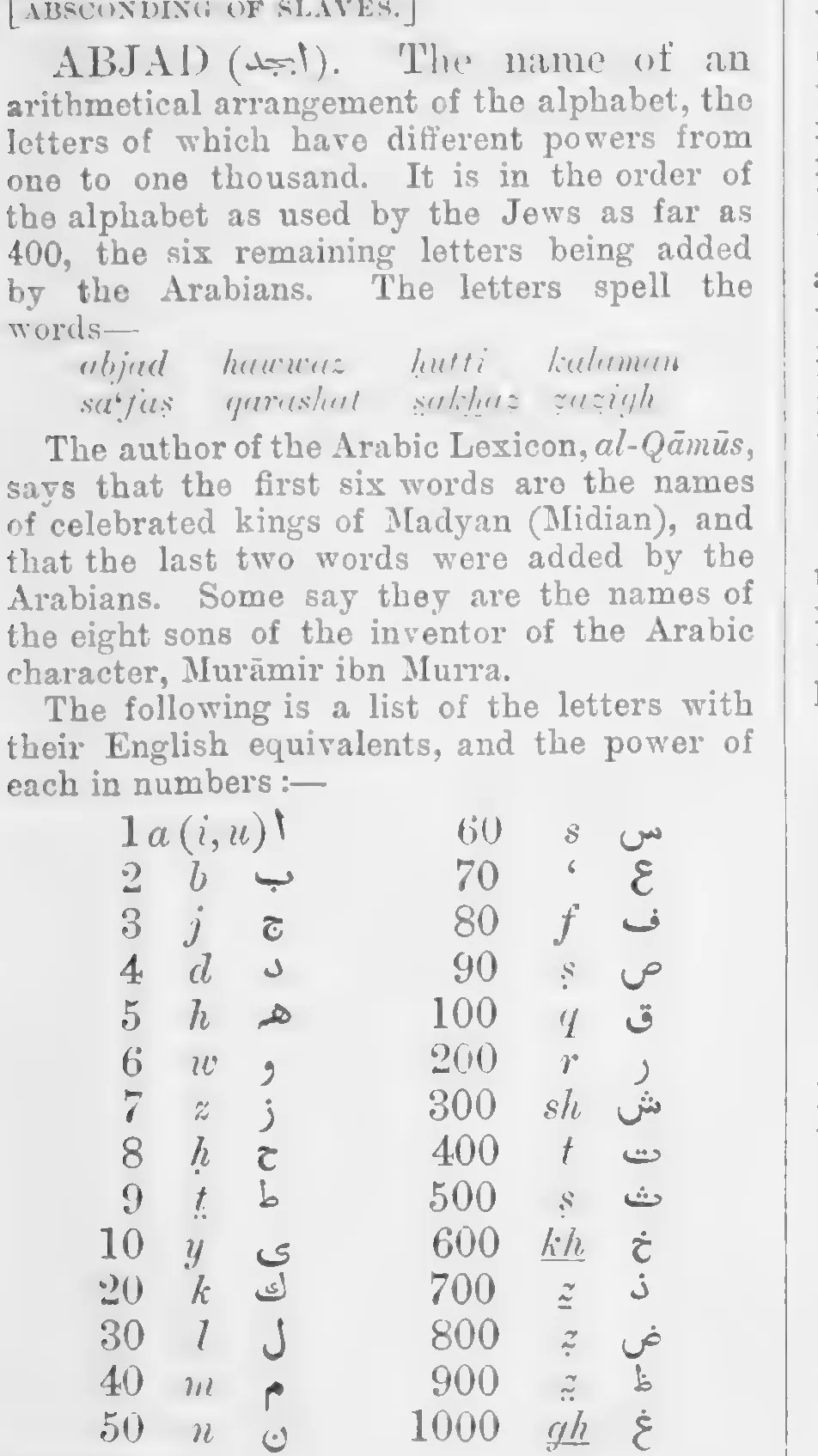
| 1 ا a | 2 ب b | 3 ج j | 4 د d | 5 ه h | 6 و w | 7 ز z | 8 ح ḥ | 9 ط ṭ |
|---|---|---|---|---|---|---|---|---|
| 10 ی y | 20 ک k | 30 ل l | 40 م m | 50 ن n | 60 س s | 70 ع ’ | 80 ف f | 90 ص ṣ |
| 100 ق q | 200 ر r | 300 ش sh | 400 ت t | 500 ث s | 600 خ kh | 700 ذ z | 800 ض ẓ | 900 ظ ẓ |
| 1000 غ gh |
Values from Hughes, A Dictionary of Islam (1885), p. 3.31
How to read a chronogram:
- Find the phrase. It is usually introduced by words like “when I asked for its date, the invisible voice said…”.32
- Write down the value of every letter and add them up. Hughes’s list gives only the 28 Arabic letters. The examples in these lessons have been chosen so that you do not need the extra Persian letters.
- Count a doubled letter twice. Yazdani explains that a letter written once but marked as doubled (mushaddad), like the lam of ‘Abdullah, is counted twice.33
The trick was used in speech as well as on stone. A Maratha Brahman told Brown in 1851 that the fall of Baji Rao happened in the year “Thti Thti Thti” (“Fie, fie, fie!”). Brown worked it out as T = 400, H = 5 and U = 6, which makes 411, and three times 411 is 1233 AH, which he equated with 1817.34 Brown also found Hijri years written out as Arabic number words in Telugu or Kannada script, such as “sittu, sabaain alaf”, that is 6 + 70 + 1000 = 1076 AH.34 The lesson on Persian and Arabic inscriptions works through the chronogram of the Jami Masjid, which gives 1006.
Try it yourself
1. A saint’s death. Bilgrami says that Husain Shah Wali, who built the Husain Sagar tank, died on “14th Jamadi Sani 1030 A.H.” and adds “(1620 A.D.)”.35 Jamadi Sani is Jumada’l akhir, the sixth month. Use the steps above to find the exact date and weekday. Does Bilgrami’s 1620 fit?
Answer
- 1030 AH began on Thursday 16 November 1620 (Table XVI).15
- The five months before Jumada’l akhir have 148 days.4
- Add 14 − 1 = 13: 148 + 13 = 161 days.
- Count forward from 16 November 1620: 30 days take you to 16 December, 61 to 16 January 1621, 92 to 16 February, 120 to 16 March, 151 to 16 April, and 10 more to 26 April 1621 (Old Style). 161 days is exactly 23 weeks, so the weekday is again Thursday.
The death fell in 1621. Bilgrami’s “1620” is the Christian year in which 1030 AH began. That is a common shortcut, but this date comes late in the Hijri year. In the New Style, add 10 days: 6 May 1621.16
2. A revenue year. Suppose a Madras revenue account of the 1840s is headed “Fasli 1250”. At that time the Madras Fasli year began on 13 July.25 Between which dates did the revenue year run?
Answer
Fasli 1250 + 590 = 1840, so the year ran from 13 July 1840 to 12 July 1841. It began on 13 July because the 1 July start was only introduced in 1855.2225 Check: Fasli 1302 began in July 1892, 52 years later.27
Footnotes
-
Brown, Carnatic Chronology (1863), Preface, p. iv (archive.org (opens in a new tab)), pp. 30–32 (archive.org (opens in a new tab)). ↩
-
Robert Sewell and Sankara Balkrishna Dikshit, The Indian Calendar (1896), p. 101, Art. 161 (archive.org (opens in a new tab)). ↩
-
Sewell and Dikshit, The Indian Calendar (1896), p. 102, Art. 162 (archive.org (opens in a new tab)). ↩ ↩2
-
Sewell and Dikshit, The Indian Calendar (1896), p. 102, Art. 163, table “Muhammadan Months” (archive.org (opens in a new tab)). ↩ ↩2 ↩3
-
Charles Philip Brown, Carnatic Chronology (1863), p. 30 (archive.org (opens in a new tab)). ↩
-
Sewell and Dikshit, The Indian Calendar (1896), pp. 102–103, Art. 164 (archive.org (opens in a new tab)). ↩
-
Sewell and Dikshit, The Indian Calendar (1896), p. 103, Arts. 165–166 (archive.org (opens in a new tab)). ↩
-
Sewell and Dikshit, The Indian Calendar (1896), p. 104, Example 2 (archive.org (opens in a new tab)). ↩
-
Sewell and Dikshit, The Indian Calendar (1896), p. 102, note (archive.org (opens in a new tab)). ↩
-
Syed Ali Asgar Bilgrami, Landmarks of the Deccan (1927), p. 111 (archive.org (opens in a new tab)). ↩
-
G. Yazdani, “Inscriptions of the Qutb Shahi Kings in Hyderabad City and Suburbs”, Epigraphia Indo-Moslemica 1917–18 (1921), p. 44, n. 7 (archive.org (opens in a new tab)). ↩ ↩2
-
Sewell and Dikshit, The Indian Calendar (1896), p. 102, Art. 163 (archive.org (opens in a new tab)). ↩
-
Sewell and Dikshit, The Indian Calendar (1896), p. 104, Art. 169, Rule 1 (archive.org (opens in a new tab)); weekday numbering from Table XVI, col. 2, p. cxxxiii (archive.org (opens in a new tab)). ↩ ↩2
-
Yazdani, Epigraphia Indo-Moslemica 1917–18 (1921), p. 46 (archive.org (opens in a new tab)). ↩ ↩2
-
Sewell and Dikshit, The Indian Calendar (1896), Table XVI, p. cxxxiv (archive.org (opens in a new tab)). ↩ ↩2 ↩3
-
Sewell and Dikshit, The Indian Calendar (1896), p. 103, Art. 168 (archive.org (opens in a new tab)); Table XVI, head-note ii, p. cxxxii (archive.org (opens in a new tab)). ↩ ↩2
-
T. W. Haig, “Inscriptions in Hyderabad and Golconda”, Epigraphia Indo-Moslemica 1907–08 (1909), p. 29 (archive.org (opens in a new tab)). ↩
-
Sewell and Dikshit, The Indian Calendar (1896), Table XVI, p. cxxxiii (archive.org (opens in a new tab)). ↩
-
Brown, Carnatic Chronology (1863), p. 32 (archive.org (opens in a new tab)). ↩
-
Brown, Carnatic Chronology (1863), pp. 30–31 (archive.org (opens in a new tab)). ↩
-
Bilgrami, Landmarks of the Deccan (1927), p. 37 (archive.org (opens in a new tab)). ↩
-
Sewell and Dikshit, The Indian Calendar (1896), p. 44 (archive.org (opens in a new tab)). ↩ ↩2 ↩3 ↩4 ↩5 ↩6
-
Brown, Carnatic Chronology (1863), p. 30 (archive.org (opens in a new tab)). ↩ ↩2
-
Brown, Carnatic Chronology (1863), p. 30 (archive.org (opens in a new tab)), p. 31 (archive.org (opens in a new tab)). ↩
-
Sewell and Dikshit, The Indian Calendar (1896), p. 32, Art. 52 (archive.org (opens in a new tab)). ↩ ↩2 ↩3
-
Brown, Carnatic Chronology (1863), p. 31 (archive.org (opens in a new tab)). ↩ ↩2 ↩3
-
Sewell and Dikshit, The Indian Calendar (1896), p. 44 (archive.org (opens in a new tab)), p. 45 (archive.org (opens in a new tab)). ↩ ↩2 ↩3 ↩4
-
Imperial Gazetteer of India, Provincial Series: Hyderabad State (1909), p. 53 (archive.org (opens in a new tab)), p. 54 (archive.org (opens in a new tab)). ↩
-
Sewell and Dikshit, The Indian Calendar (1896), p. 45 (archive.org (opens in a new tab)). ↩
-
Brown, Carnatic Chronology (1863), p. 34 (archive.org (opens in a new tab)). ↩
-
Thomas Patrick Hughes, A Dictionary of Islam (1885), p. 3, s.v. “Abjad” (archive.org (opens in a new tab)). ↩ ↩2
-
Yazdani, Epigraphia Indo-Moslemica 1917–18 (1921), p. 50 (archive.org (opens in a new tab)). ↩
-
Yazdani, Epigraphia Indo-Moslemica 1917–18 (1921), p. 50, n. 1 (archive.org (opens in a new tab)). ↩
-
Brown, Carnatic Chronology (1863), p. 30 (archive.org (opens in a new tab)). ↩ ↩2
-
Bilgrami, Landmarks of the Deccan (1927), p. 110 (archive.org (opens in a new tab)). ↩
References
Notes (0)
Sources (7)
Spotted an error on this page? Tell us
Last updated: