Lesson 10
Persian and Arabic inscriptions
From the sixteenth century, the rulers of Golconda and Hyderabad put up inscriptions in Persian and Arabic, and the Hijri dates in them become a new kind of evidence. C. P. Brown noticed this as early as 1863: “After the year A.D. 1500 we meet with several inscriptions in Arabic or Persian.”1 This lesson shows how to find your way around one: where it is placed, how it is set out, which script it uses, who wrote it, and how to work out its date. You do not need to read Persian to follow it. You only need to recognise a few patterns and use one table of letter values. Dates in the Hijri and Fasli eras are explained in the next lesson, Hijri, Fasli and chronograms.
Where you find them
Most of the inscriptions published from Hyderabad and Golconda are on mosques, tombs, gates and other royal buildings.23 Here are the main places, each with an example from the site:
- Over the entrance of a mosque. The door of the Jami Masjid of Hyderabad has a three-line Persian poem on a slab of black basalt.4 The oldest Qutb Shahi mosque, in Golconda fort, has a tablet over its gateway dated 924 AH (1518).5
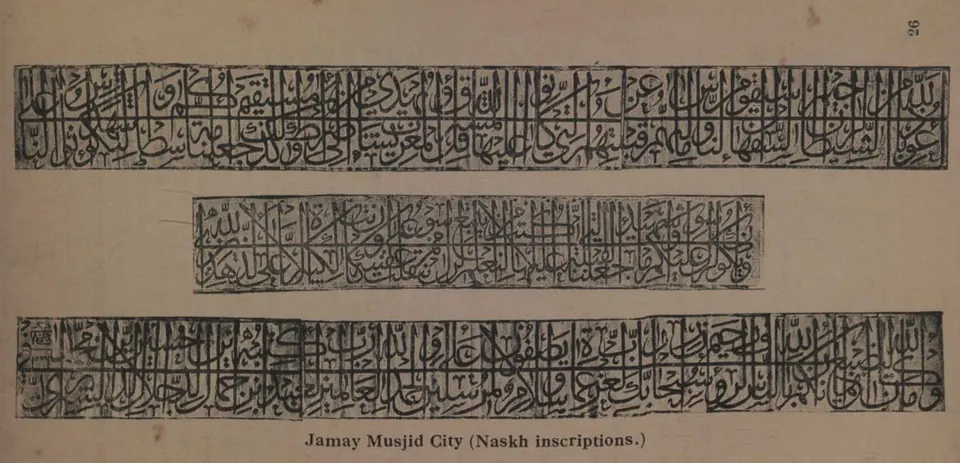
- In the prayer niche (mihrab). Here you usually find verses of the Quran in Arabic. In the Jami Masjid they are Quran II, 137–138, followed by the calligrapher’s name and the year 1006.6
- On graves. The grave of Khadija in the Mir-ka-Daira cemetery in Hyderabad is covered with religious texts. They are arranged in an order: one text on the head tablet, others on the top slab, and three bands running round the sides. Her epitaph is in the first band.7
- On gates, walls and tank pavilions. The western wall of Golconda fort has a slab with medallions giving two dates. One is the year the wall was repaired, the other the year the inscription was fixed.8 Two towers on the dam of Ma Saheba’s tank carry nearly identical Persian tablets.9
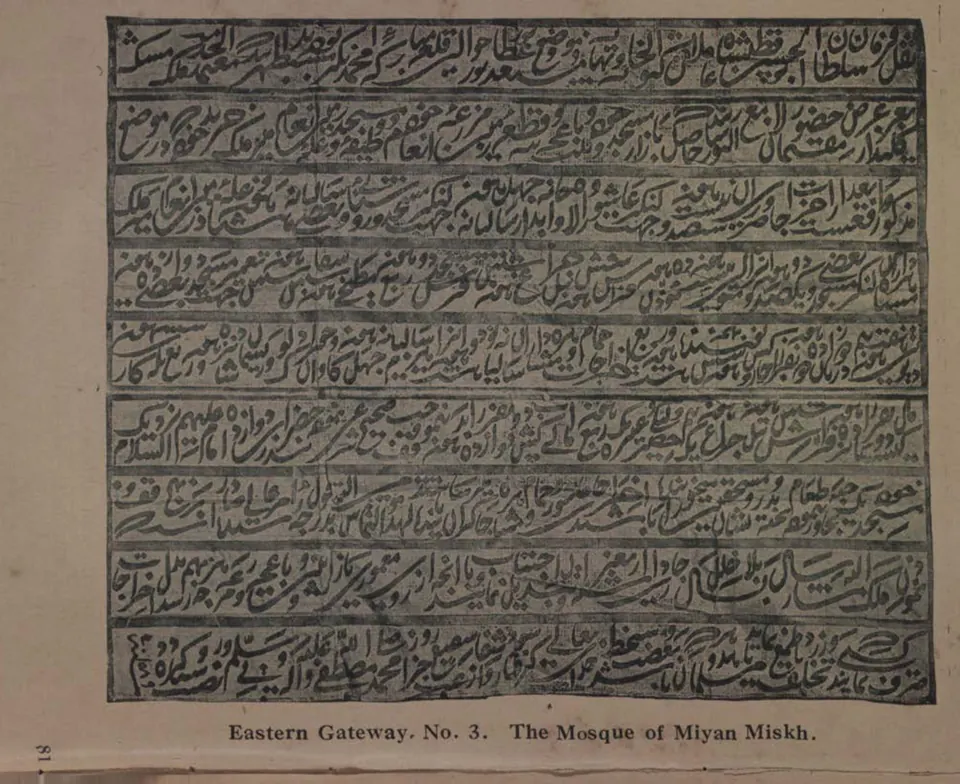
- Copies of royal orders. The gateways of Miyan Mishk’s tomb carry, cut in stone, copies of farmans (decrees) of King Abul Hasan. They list the revenues set aside for the tomb and mosque down to the wages of the sweepers.10
How an inscription is set out
Work through a Persian building inscription in this order:
- An opening phrase or verse of praise. It may praise God or the king. Musa Khan’s tablet in the Toli Masjid opens with the words “For whom is the Kingdom today? For God, the One, the All-powerful.”11
- Couplets of verse. Each line is a couplet made of two half-lines (hemistichs), and in the printed editions you will see the halves separated by a star. Editors name the metre: Hazaj for the Jami Masjid poem, Ramal and Mutaqarib for the two Toli Masjid inscriptions.12
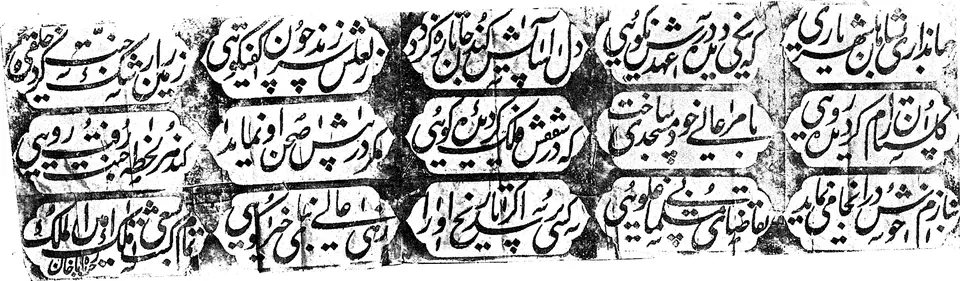
- The builder and the reigning king. The Jami Masjid poem praises the king without naming him, but it names the minister who saw to the building, Aminu-l-Mulk.13
- The date. It may be written in figures, or hidden in a chronogram (see below), or both. Musa Khan’s tablet gives a chronogram and then writes “year 1082” in figures as well.11
- The signature. A last line often says “written by” a calligrapher: “Completed by the efforts of Malik Aminu-l-Mulk. Written by Baba Khan.”14
The scripts
The editors use five names for the styles of writing on these buildings. In 1921 G. Yazdani said that the chief interest of the Qutb Shahi inscriptions lay “in the variety and elegance of their scripts”.2
- Naskh. The ordinary book hand. Yazdani called the ornamental kind seen on two of these inscriptions good specimens of the “ornamental Naskh”. The tank tablets of Ma Saheba are in a Naskh “of a very fine type”.159
- Thulth. Yazdani says that the ornamental Naskh, “in a simple form, assumed the name of Thulth”.2 Bilgrami describes many Qutb Shahi gravestones and prayer niches as “Thulth”.16
- Tughra. When that ornamental writing became “intricate and pictorial”, Yazdani says, it was called Tughra.2 The prayer niche of Rahim Khan’s mosque has the Throne Verse in “Tughra of an extremely fine type”, signed by Mir Ali.17
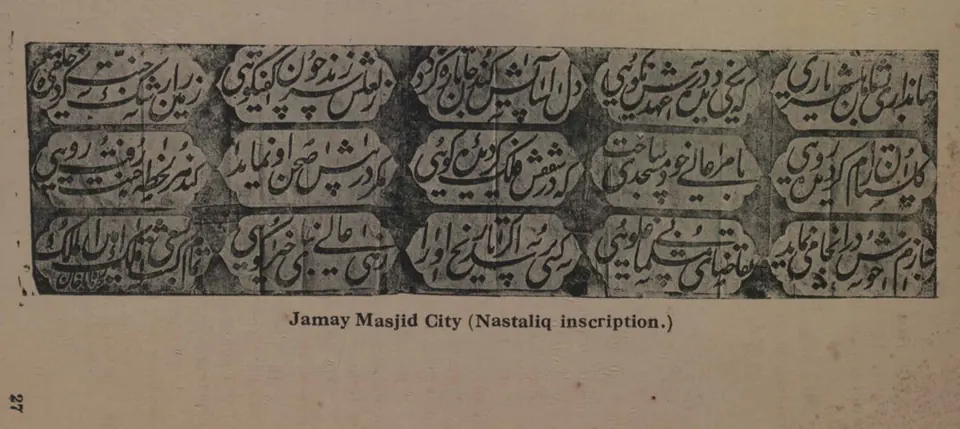
- Nasta’liq. The flowing Persian hand of poetry. Yazdani judged Baba Khan’s inscription over the Jami Masjid door “perhaps the finest example of the Nasta’liq script in the Deccan”.2 The Toli Masjid verses of 1043 AH are also Nasta’liq.18
- Shikasta (“broken”). Yazdani says it grew out of Nasta’liq but “through the vagaries of the calligraphist’s fancy, assumed most subtle forms, and in some cases became absolutely illegible”. He adds that it was nevertheless the popular script of India from the sixteenth century onwards.2 His fine example is the farman over the eastern gateway of Miyan Mishk’s tomb. Bilgrami calls it “the broken or current Persian hand”.19
There is also Kufic, the old angular Arabic script. Bilgrami knew only one specimen in Golconda or Hyderabad: a chapter of the Quran on the sarcophagus of Prince Mirza Muhammad Amin, dated 1004 AH.20
Script or style? Scholars do not always use these names in the same way. Bilgrami says the Jami Masjid prayer niche is “in Tughra or Tauqia style and Thulth script”. He treats Thulth as the script and Tughra as the way it is arranged.21 Yazdani calls the Rahim Khan niche Tughra, while Bilgrami calls the same niche Thulth.1722 When you see a script name in a caption, take it as one editor’s description, not a fixed label.
Telling them apart: a looking exercise
Put the two Jami Masjid rubbings side by side. The first is Baba Khan’s Nasta’liq door inscription. The second is the Quranic band of the prayer niche, which Bilgrami’s plate labels Naskh and his text calls Thulth.21 Then look at the Shikasta farman from Miyan Mishk’s tomb, and at the circular inscription over the tomb’s eastern doorway. In that circle, the names of the twelve Imams sit in small lobes round a central verse.23 You will soon start to notice the difference between the stacked, interlaced lines of the ornamental hands and the more open, flowing lines of the Persian verse.
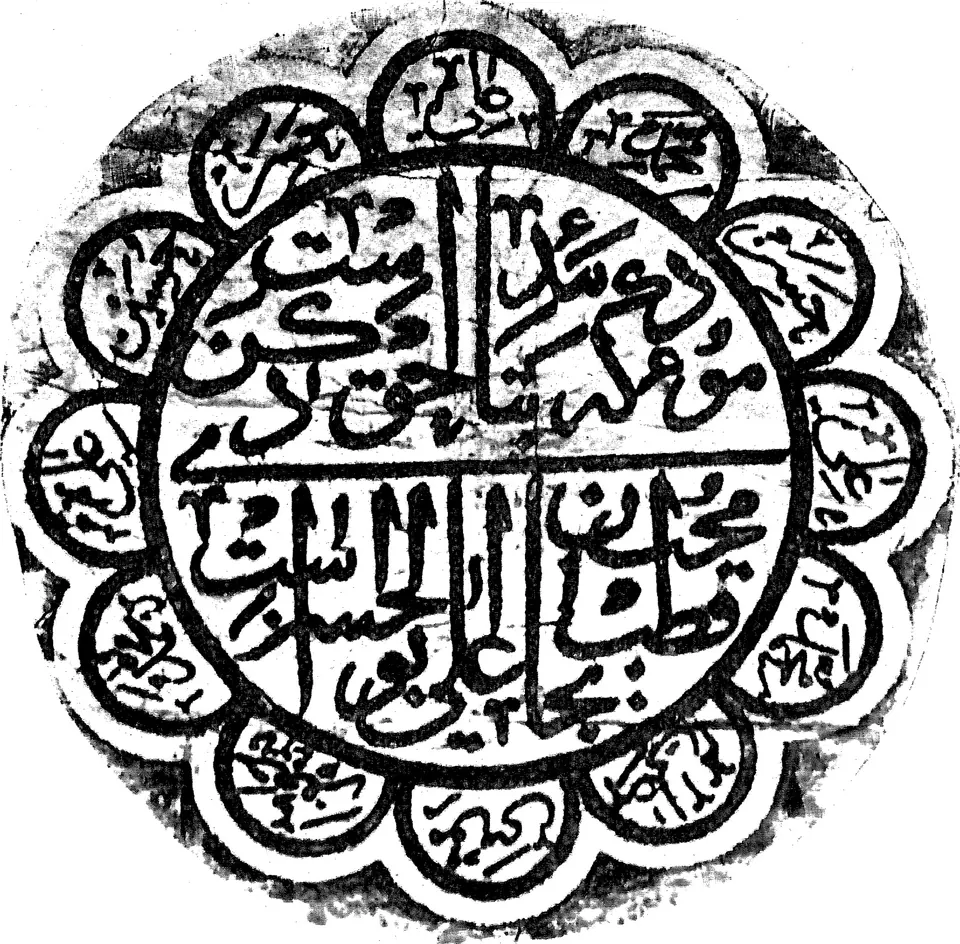
Who wrote them
Many of these inscriptions are signed, so we know a number of calligraphers by name.
- Baba Khan wrote the Jami Masjid door inscription. Yazdani thought he “seems to have been a Persian artist”.13
- Jalalu-d-din Muhammad of Shiraz signed the prayer-niche inscription of the same mosque in 1006 AH. Bilgrami argued that the name should be read the other way round, as Jamaluddin Husain son of Jalaluddin Muhammad.621
- Lutfullah al-Husaini at-Tabrezi wrote the Nasta’liq tablet of the Toli Masjid in 1043 AH.18
- Mir Ali signed the Throne Verse in Rahim Khan’s mosque. Bilgrami adds that he was a contemporary of two other calligraphers named Ali.22
- Abdul Karim inscribed the enamel tile panel above the Golconda mosque tablet in 927 AH.5
- Ismail, son of Arab of Shiraz, signed an inscription of 1079 AH.24
Bilgrami names three famous calligraphists of Ibrahim Qutb Shah’s time: Muhammad of Isphahan, Ismail son of Arab of Shiraz, and Taqiuddin Muhammad Salih of Bahrain. He says most of the Naskh and Thulth inscriptions on Qutb Shahi buildings were their work. In a note he records that Mulla Arab of Shiraz was said to write 1,000 or 1,500 couplets a day.25
Calligraphers also copied one another. The prayer-niche inscription of the Jami Masjid, dated 1006 AH, is letter for letter the same as one in the great mosque at the Golconda tombs dated 1077 AH. Yazdani took the later one to be a copy, and remarked that Indian calligraphers sometimes copied their masters’ names as well.26
Beyond the Qutb Shahis
The same habits continue under later rulers.
- Bahmani overlordship. The Golconda fort mosque of 924 AH was built by Sultan Quli, “entitled Qutbul Mulk”, in the reign of the Bahmani king Mahmud Shah. It is the oldest Qutb Shahi mosque.5
- Mughal. On the main gate of the Mecca Masjid, the words “the year 32” give a regnal year of Aurangzeb. Bilgrami equates it with 1100 AH (1688).27 Dating by the years of a reign (juloos) is explained in the next lesson.
- Asaf Jahi. The Badshahi Ashur Khana in Hyderabad has Qutb Shahi inscriptions in Tughra on enamelled tiles, and beside them a later one dating a repair by the chronogram “Our Asaf Jah repaired it”, 1178 AH (1764).28 Chronograms were still being composed for the Nizams’ deaths: Sikandar Jah’s in 1244 AH (1828) and Mahboob Ali Khan’s in 1329 AH (1911).29
Editors disagree
Even good editions differ. T. W. Haig, who first published the Jami Masjid door inscription in 1909, left out half of the fifth line and half of the sixth.30 Yazdani’s edition of 1921 corrected this. In 1927 Bilgrami printed his own reading and pointed out a word that Yazdani had missed.31 Before you rely on a translation, check which edition it comes from.
Worked example: the date of the Jami Masjid
The last couplet of Baba Khan’s poem says, in Yazdani’s translation: “Should any one ask the date of its erection say, ‘How excellent is this lofty and beneficent building.’”32 The quoted words are a chronogram (tarikh): a phrase whose letters, counted as numbers, add up to the year.33 Each Arabic letter has a number in the system called abjad.34 Yazdani simply notes that “the chronogram gives the year 1006 A.H. corresponding to 1597 A.D.”35 Let us check it.
Step 1. Find the words. The second half of line 7 in Yazdani’s text reads زهی عالی بنای خیر گوئی. The last word, go’i, means “say” and stands outside the quotation marks in his translation. The chronogram is therefore the four words zihi ‘ali bina-i khair.3532
Step 2. Give each letter its value from the abjad table in Hughes’s Dictionary of Islam (1885).34
| Word | Letters and values | Total |
|---|---|---|
| زهی zihi | ز 7 + ه 5 + ی 10 | 22 |
| عالی ‘ali | ع 70 + ا 1 + ل 30 + ی 10 | 111 |
| بنای bina-i | ب 2 + ن 50 + ا 1 + ی 10 | 63 |
| خیر khair | خ 600 + ی 10 + ر 200 | 810 |
Step 3. Add them up. 22 + 111 + 63 + 810 = 1006, the year Yazdani gives.
Step 4. Turn it into a Christian date. The year 1006 AH began on Thursday 4 August 1597 (Old Style) and the next year began on 25 July 1598.36 This is why Yazdani writes 1597 while Haig writes 1597–98.3537 The next lesson shows how to do this step.
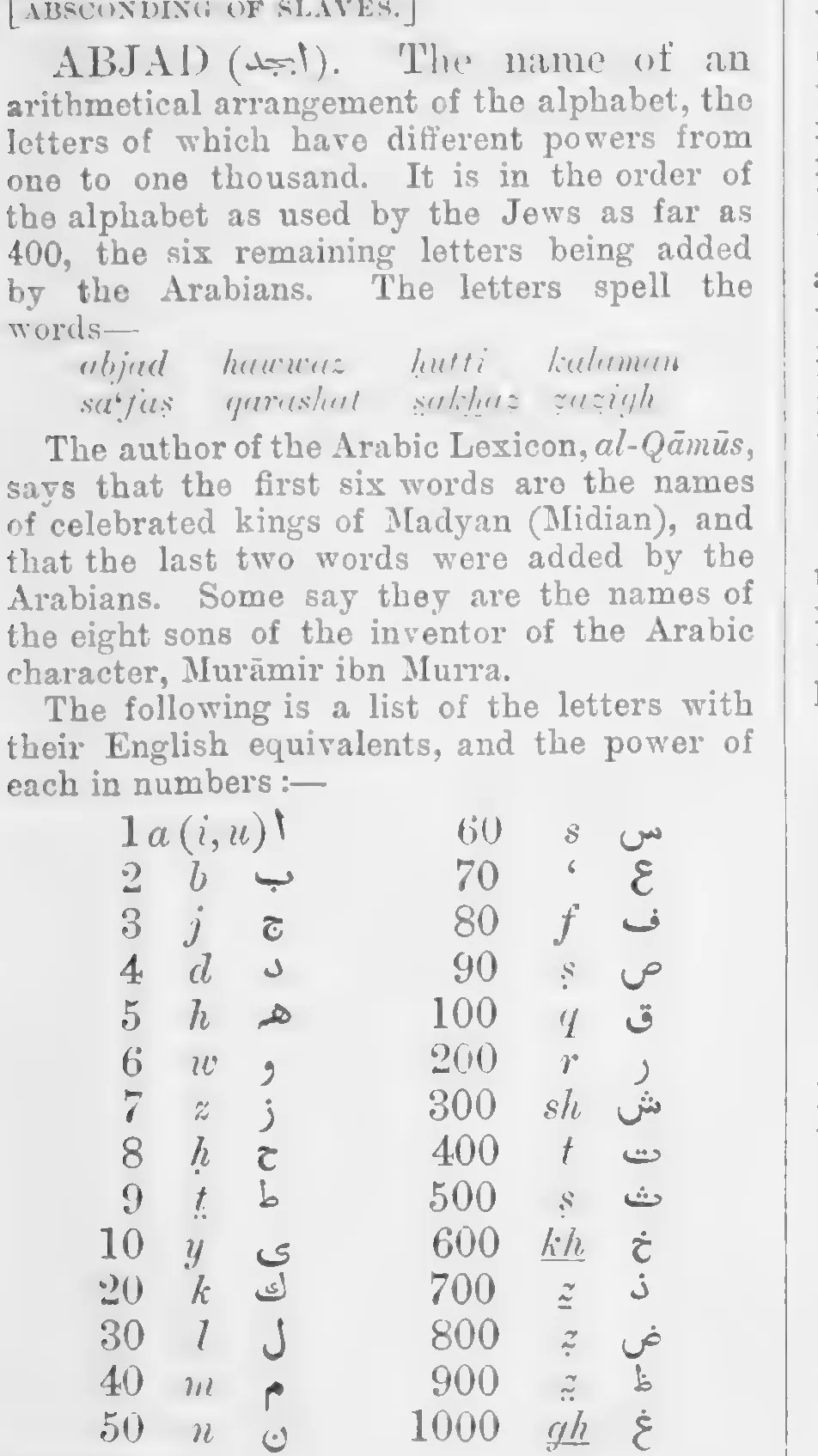
Try it yourself
The rubbing below shows the inscription that Musa Khan, a dignitary of the court of King Abdullah Qutb Shah, put up in the Toli Masjid at Hyderabad.38 The second couplet says that a voice from the unseen gave the chronogram of the mosque. In Yazdani’s translation it is “Built the mosque in the name of God”. In Persian it is the second half of the last line, بنا کرد مسجد بنام خدا (bina kard masjid ba-nam-i khuda).11 Using the abjad table, work out the year. Then look at the end of the last line on the rubbing: what is written there in figures?
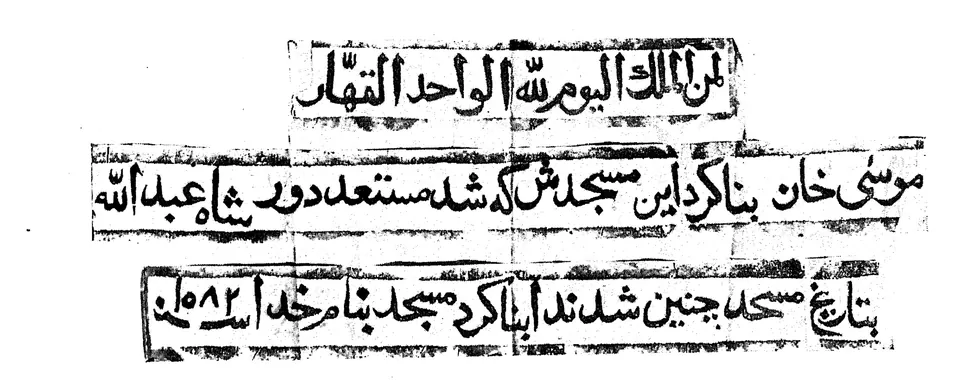
Answer
| Word | Letters and values | Total |
|---|---|---|
| بنا | ب 2 + ن 50 + ا 1 | 53 |
| کرد | ک 20 + ر 200 + د 4 | 224 |
| مسجد | م 40 + س 60 + ج 3 + د 4 | 107 |
| بنام | ب 2 + ن 50 + ا 1 + م 40 | 93 |
| خدا | خ 600 + د 4 + ا 1 | 605 |
53 + 224 + 107 + 93 + 605 = 1082. The letter values are from Hughes’s table.34 Yazdani reads the date as “1082 A.H. = 1671 A.D.”, and his Persian text ends with the figures “year 1082” (sana ۱۰۸۲), which you can see at the end of the last line of the rubbing.11 The year 1082 AH began on 30 April 1671 (Old Style).39
Footnotes
-
Charles Philip Brown, Carnatic Chronology (1863), Preface, p. iv (archive.org (opens in a new tab)). ↩
-
Yazdani, Epigraphia Indo-Moslemica 1917–18 (1921), p. 43 (archive.org (opens in a new tab)). ↩ ↩2 ↩3 ↩4 ↩5 ↩6
-
Bilgrami, Landmarks of the Deccan (1927), list of inscriptions in the contents, PDF p. 29 (archive.org (opens in a new tab)). ↩
-
G. Yazdani, “Inscriptions of the Qutb Shahi Kings in Hyderabad City and Suburbs”, Epigraphia Indo-Moslemica 1917–18 (1921), p. 44 (archive.org (opens in a new tab)). ↩
-
Syed Ali Asgar Bilgrami, Landmarks of the Deccan (1927), p. 110 (archive.org (opens in a new tab)), p. 111 (archive.org (opens in a new tab)). ↩ ↩2 ↩3
-
Yazdani, Epigraphia Indo-Moslemica 1917–18 (1921), p. 45 and Pl. XVI (archive.org (opens in a new tab)). ↩ ↩2
-
Yazdani, Epigraphia Indo-Moslemica 1917–18 (1921), p. 46 (archive.org (opens in a new tab)). ↩
-
Bilgrami, Landmarks of the Deccan (1927), p. 133 (archive.org (opens in a new tab)). ↩
-
Yazdani, Epigraphia Indo-Moslemica 1917–18 (1921), p. 47 (archive.org (opens in a new tab)). ↩ ↩2
-
Yazdani, Epigraphia Indo-Moslemica 1917–18 (1921), p. 51 (archive.org (opens in a new tab)), p. 54 (archive.org (opens in a new tab)). ↩
-
Yazdani, Epigraphia Indo-Moslemica 1917–18 (1921), p. 50 and Pl. XX (a) (archive.org (opens in a new tab)); plate (archive.org (opens in a new tab)). ↩ ↩2 ↩3 ↩4
-
Yazdani, Epigraphia Indo-Moslemica 1917–18 (1921), p. 44, n. 3 (archive.org (opens in a new tab)); p. 50 and n. 3 (archive.org (opens in a new tab)). ↩
-
Yazdani, Epigraphia Indo-Moslemica 1917–18 (1921), p. 44 (archive.org (opens in a new tab)). ↩ ↩2
-
Yazdani, Epigraphia Indo-Moslemica 1917–18 (1921), p. 45 (archive.org (opens in a new tab)). ↩
-
Yazdani, Epigraphia Indo-Moslemica 1917–18 (1921), p. 43, on Pls. XVI and XVIII a (archive.org (opens in a new tab)). ↩
-
Bilgrami, Landmarks of the Deccan (1927), p. 127 (archive.org (opens in a new tab)), p. 133 (archive.org (opens in a new tab)). ↩
-
Yazdani, Epigraphia Indo-Moslemica 1917–18 (1921), p. 48 (archive.org (opens in a new tab)). ↩ ↩2
-
Yazdani, Epigraphia Indo-Moslemica 1917–18 (1921), p. 50 and Pl. XIX (a) (archive.org (opens in a new tab)). ↩ ↩2
-
Yazdani, Epigraphia Indo-Moslemica 1917–18 (1921), p. 51 (archive.org (opens in a new tab)); Bilgrami, Landmarks of the Deccan (1927), p. 81 (archive.org (opens in a new tab)). ↩
-
Bilgrami, Landmarks of the Deccan (1927), p. 127 (archive.org (opens in a new tab)). ↩
-
Bilgrami, Landmarks of the Deccan (1927), p. 28 and n. 1 (archive.org (opens in a new tab)); plate facing p. 26 (archive.org (opens in a new tab)). ↩ ↩2 ↩3
-
Bilgrami, Landmarks of the Deccan (1927), p. 58 (archive.org (opens in a new tab)). ↩ ↩2
-
Yazdani, Epigraphia Indo-Moslemica 1917–18 (1921), p. 52 and Pl. XXIII (a) (archive.org (opens in a new tab)); Bilgrami, Landmarks of the Deccan (1927), p. 81 (archive.org (opens in a new tab)). ↩
-
Bilgrami, Landmarks of the Deccan (1927), p. 170 (archive.org (opens in a new tab)). ↩
-
Bilgrami, Landmarks of the Deccan (1927), p. 125 and n. 2 (archive.org (opens in a new tab)). ↩
-
Yazdani, Epigraphia Indo-Moslemica 1917–18 (1921), p. 45 (archive.org (opens in a new tab)). ↩
-
Bilgrami, Landmarks of the Deccan (1927), p. 37 (archive.org (opens in a new tab)). ↩
-
Bilgrami, Landmarks of the Deccan (1927), p. 21 (archive.org (opens in a new tab)), p. 23 (archive.org (opens in a new tab)). ↩
-
Bilgrami, Landmarks of the Deccan (1927), p. 38 (archive.org (opens in a new tab)), p. 39 (archive.org (opens in a new tab)). ↩
-
Yazdani, Epigraphia Indo-Moslemica 1917–18 (1921), p. 44, n. 6 (archive.org (opens in a new tab)); T. W. Haig, “Inscriptions in Hyderabad and Golconda”, Epigraphia Indo-Moslemica 1907–08 (1909), pp. 28–29 (archive.org (opens in a new tab)). ↩
-
Bilgrami, Landmarks of the Deccan (1927), p. 27 and notes (archive.org (opens in a new tab)). ↩
-
Yazdani, Epigraphia Indo-Moslemica 1917–18 (1921), p. 45, translation line 7 (archive.org (opens in a new tab)). ↩ ↩2
-
Charles Philip Brown, Carnatic Chronology (1863), p. 30 (archive.org (opens in a new tab)); Yazdani, Epigraphia Indo-Moslemica 1917–18 (1921), p. 50, n. 1 (archive.org (opens in a new tab)). ↩
-
Thomas Patrick Hughes, A Dictionary of Islam (1885), p. 3, s.v. “Abjad” (archive.org (opens in a new tab)). ↩ ↩2 ↩3
-
Yazdani, Epigraphia Indo-Moslemica 1917–18 (1921), p. 44, text line 7 and n. 7 (archive.org (opens in a new tab)). ↩ ↩2 ↩3
-
Robert Sewell and Sankara Balkrishna Dikshit, The Indian Calendar (1896), Table XVI, p. cxxxiv (archive.org (opens in a new tab)). ↩
-
Haig, Epigraphia Indo-Moslemica 1907–08 (1909), p. 29 (archive.org (opens in a new tab)). ↩
-
Yazdani, Epigraphia Indo-Moslemica 1917–18 (1921), p. 49 (archive.org (opens in a new tab)). ↩
-
Sewell and Dikshit, The Indian Calendar (1896), Table XVI, p. cxxxiv (archive.org (opens in a new tab)). ↩
References
Notes (0)
Sources (6)
Spotted an error on this page? Tell us
Last updated: