Jami Masjid inscription, Hyderabad
A Persian verse inscription of AH 1006 (1597) over the door of the Jami Masjid near the Charminar. The mosque was built in the reign of Muhammad Quli Qutb Shah under the minister Aminu-l-Mulk, and the inscription is signed by the calligrapher Baba Khan.
The Jami Masjid (“congregational mosque”) of Hyderabad stands a short way north-east of the Charminar.1 It was one of the first buildings put up by Muhammad Quli Qutb Shah in his new capital.2 The Golconda chronicle translated by Briggs mentions it together with the Charminar as the king’s “elegant musjid” in the middle of the city.3 Over its entrance door is a Persian verse inscription.4 It is dated by a chronogram (a date hidden in the letters of a phrase) to AH 1006 (1597; AH is the Islamic way of counting years).4
The building
When G. Yazdani described the mosque around 1920, houses and shops crowded round it.2 He reached it through a doorway in the pillar-and-lintel style and a narrow lane.2 The prayer hall is a double hall, 72 ft 6 in by 32 ft 6 in.2 It opens by seven arches onto a paved courtyard 74 by 70 feet, with a cistern at its north-eastern corner.2
The Imperial Gazetteer of 1909 dates the mosque to 1596 and notes the ruins of a Turkish bath in the courtyard.5 Bilgrami says the mosque cost two lakhs of rupees and once had a school, a monastery and a bath attached. He adds that it was much repaired by Mir Abbas Ali Khan, an official of the Nizam who died in AH 1230 (1815).6
The door inscription
The inscription is carved in three lines on a slab of black basalt over the entrance.7 Bilgrami measured the slab at about 7 by 2 feet.8 It is Persian verse in the hazaj metre.7 It praises the king without naming him.7 But it names the minister under whose care the mosque was built, Aminu-l-Mulk, and the calligrapher, Baba Khan.7
Yazdani says Aminu-l-Mulk held the office of Mir Jumla (chief minister) before Mir Muhammad Amin of Astarabad.7 Aminu-l-Mulk had made his name in putting down the rebellions of local Hindu chiefs in the middle of the reign.7 Yazdani took Baba Khan to be a Persian artist.7
In Yazdani’s translation the king “by his own exalted order … built a mosque, below the roof of which heaven revolves like a ball”.9 The last line gives the chronogram “How excellent is this lofty and beneficent building”.9 It is followed by the words “Completed by the efforts of Malik Aminu-l-Mulk. Written by Baba Khan.”9 The letters of the chronogram add up to AH 1006.10 Yazdani converts this to 1597.10 T. W. Haig, who first published the inscription in 1909, gives 1597–98.10
The three editors read some lines differently. Haig’s version left out the second half of the fifth line and the first half of the sixth.11 Yazdani reads the sixth line as a boast that the pre-eminence of Islam is proved in the mosque.12 Haig’s shorter text has the king inviting all to accept Islam.12 Bilgrami, writing in 1927, offered his own corrections to two words of Yazdani’s text.8
The calligraphy
Yazdani regarded the door inscription as “the finest example of the Nasta’liq script in the Deccan”.13 He singled it out among the Qutb Shahi inscriptions of Hyderabad for its elegance.13
The prayer-niche inscription
A second inscription is carved along the sides and top of the prayer niche (mihrab). It quotes verses 137–138 of the second chapter of the Quran in an ornamental Naskh script. It gives the year 1006 and the name of the calligrapher, a man of Shiraz. Yazdani read the name as Jalalu-d-din Muhammad, son of Jamalu-d-din Husain.14 Bilgrami argued that the two names should be the other way round.14
Both scholars noticed that the lettering is the same as the inscription in the prayer niche of the great mosque at the Qutb Shahi tombs near Golconda, dated AH 1077.15 They concluded that the later calligrapher had copied this one, seventy-one years older.15
Footnotes
-
Bilgrami, Landmarks (1927), p. 26 (archive.org (opens in a new tab)). ↩
-
G. Yazdani, “Inscriptions of the Qutb Shahi Kings in Hyderabad City and Suburbs”, Epigraphia Indo-Moslemica 1917–18 (1921), pp. 43–44 (archive.org (opens in a new tab)). ↩ ↩2 ↩3 ↩4 ↩5
-
Golconda chronicle, in Muhammad Qasim Ferishta, tr. John Briggs, History of the Rise of the Mahomedan Power in India, Vol. III (1829), p. 452 (archive.org (opens in a new tab)). ↩
-
Yazdani, Epigraphia Indo-Moslemica 1917–18 (1921), p. 44, note (archive.org (opens in a new tab)). ↩ ↩2
-
Imperial Gazetteer of India: Hyderabad State (1909), p. 116 (archive.org (opens in a new tab)). ↩
-
Syed Ali Asgar Bilgrami, Landmarks of the Deccan (1927), pp. 28–29 (archive.org (opens in a new tab)). ↩
-
Yazdani, Epigraphia Indo-Moslemica 1917–18 (1921), p. 44 (archive.org (opens in a new tab)). ↩ ↩2 ↩3 ↩4 ↩5 ↩6 ↩7
-
Bilgrami, Landmarks (1927), pp. 27–28 (archive.org (opens in a new tab)). ↩ ↩2
-
Yazdani, Epigraphia Indo-Moslemica 1917–18 (1921), p. 45 and pl. XVII a (archive.org (opens in a new tab)). ↩ ↩2 ↩3
-
Yazdani, Epigraphia Indo-Moslemica 1917–18 (1921), p. 44, note (archive.org (opens in a new tab)); T. W. Haig, “Inscriptions in Hyderabad and Golconda”, Epigraphia Indo-Moslemica 1907–08 (1909), p. 29 (archive.org (opens in a new tab)). ↩ ↩2 ↩3
-
Yazdani, Epigraphia Indo-Moslemica 1917–18 (1921), p. 44, notes (archive.org (opens in a new tab)). ↩
-
Yazdani, Epigraphia Indo-Moslemica 1917–18 (1921), p. 45 (archive.org (opens in a new tab)); Haig, Epigraphia Indo-Moslemica 1907–08 (1909), pp. 28–29 (archive.org (opens in a new tab)). ↩ ↩2
-
Yazdani, Epigraphia Indo-Moslemica 1917–18 (1921), p. 43 (archive.org (opens in a new tab)). ↩ ↩2
-
Yazdani, Epigraphia Indo-Moslemica 1917–18 (1921), p. 45 and pl. XVI (archive.org (opens in a new tab)); Bilgrami, Landmarks (1927), p. 28 and note (archive.org (opens in a new tab)). ↩ ↩2
-
Yazdani, Epigraphia Indo-Moslemica 1917–18 (1921), p. 45 (archive.org (opens in a new tab)); Bilgrami, Landmarks (1927), p. 29 (archive.org (opens in a new tab)). ↩ ↩2
Photos
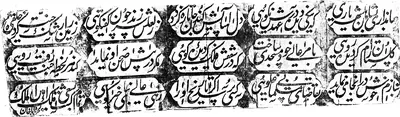 "Inscription over the doorway of the Jami' Masjid, Hyderabad City" (Epigraphia Indo-Moslemica 1917-18, Pl. XVII (a) (PDF p. 75))Inscription rubbing · 1921
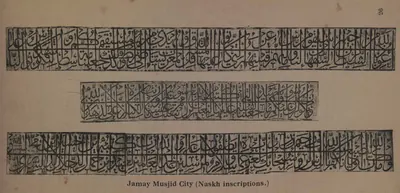 Naskh inscription, Jamay Masjid, City (Hyderabad) (Bilgrami 1927, p. 26)Inscription rubbing · 1927
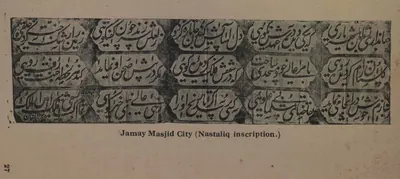 Nastaliq inscription, Jamay Masjid, City (Hyderabad) (Bilgrami 1927, p. 27)Inscription rubbing · 1927
References
Notes (0)
Sources (5)
Spotted an error on this page? Tell us
Last updated: