Lesson 11
Reading dates: eras, the sixty-year cycle and regnal years
Most inscriptions of the Telugu country tell you exactly when they were made, but they do it in their own way. Instead of “25 November 1289” you will read something like “Saka 1211, the year Virodhi, the twelfth day of the bright half of Margasira, a Friday”.1 This lesson takes such a date apart piece by piece, shows how each piece is counted, and then works through real dates from inscriptions on this site. For Persian and Arabic inscriptions, which count years from the Hijra, see Hijri, Fasli and chronograms.
Year converter
Convert the year of an inscription to the Common Era. Every step shows the rule and the page it comes from.
The parts of a Hindu date
A full date in a medieval inscription can have up to six parts. Not every record gives all of them.
| Part | What it counts | Example (Palampet, 1213) |
|---|---|---|
| Era year | Years from a fixed starting point, usually the Saka era | Saka 1135 |
| Cycle year | One of sixty named years | Srimukha |
| Month | One of twelve lunar months | Madhu, that is, Chaitra |
| Fortnight (paksha) | Bright (waxing) or dark (waning) half of the month | bright half |
| Lunar day (tithi) | The day of the fortnight, 1 to 15 | 8th |
| Weekday (vara) and star (nakshatra) | Day of the week; the lunar mansion the moon was in | Sunday; Pushya |
The example is the grant recorded on the Palampet pillar of the Ramappa temple. Its editor, L. D. Barnett, found that these details all agree with Sunday, 31 March 1213.2 When so many independent details fit one day, a historian can be confident of the date. When they do not fit, something is wrong: a misreading, a copying error, or occasionally a forgery.
The eras
The Saka era
The Saka era is the one you will meet most often. Sewell and Dikshit, the authors of the standard handbook, wrote that it was used over the whole of India, and in most of southern India it was used alone.3 A. C. Burnell found that it became the usual way of dating inscriptions only from about the tenth century; before that, Saka dates can be two or three years out from the usual reckoning.4
To change a Saka year into a year of the Common Era, add 78 or 79. Which one you add depends on two things.
- Expired or current? An Indian year can be counted like a person’s age (the number of years completed) or like a page number (the year now running). Sewell and Dikshit explain that a “current” Saka year is one more than the “expired” one for the same twelve months.5 Expired years were the usual practice. The word for “expired” (gata, atita) was often left out, so you cannot always tell from the words alone which the writer meant.56
- Which month? The Saka year began in spring, with the first day of the bright half of Chaitra, but the Common Era year begins on 1 January.7 Before 1752 January fell in the lunar months Pausha, Magha or Phalguna.8
Putting these together, with an expired Saka year: add 78 for the months from Chaitra to the end of December, and 79 from January to the end of Phalguna.9 With a current year, subtract one more. The step-by-step guide below explains the conversion.
Kali and Vikrama
The Kali era starts in 3102 BCE. Burnell found it rare in South Indian inscriptions, and thought its appearance in a supposedly ancient record a reason to doubt the record.10 A Kali year is a Saka year plus 3179.11
The Vikrama era (57 BCE) was the usual era of northern India, and Burnell called it “all but unknown in S. India (except in the Deccan)”.12 Saka year 0 matches Vikrama 135 if the Vikrama year begins with Chaitra, and 134 or 135 if it begins in Karttika or Ashadha.1113
The Chalukya era
The Western Chalukya king Vikramaditya VI (Tribhuvanamalla) began an era of his own, which ran, by Sewell and Dikshit’s account, from Saka 998 (1076 CE) to Saka 1084 (1162 CE). Its year 0 matches Saka 998–99 current.14 Burnell thought these Chalukya eras too uncertain to be worth discussing.15 Old tables can disagree here: C. P. Brown’s Cyclic Tables of 1850 put the first year of a “Chalukya era” at Saka 938 (1016 CE).16 If you meet a Chalukya-era date, check it against a modern edition rather than trusting an old table.
Kollam
The Kollam (Quilon) era began in 824–825 CE. Burnell knew it only in the southern Tamil country and Travancore, so you are unlikely to meet it in the Telugu country.17
Years of a king’s reign
Many records give no era at all, only the year of the reigning king. The Nandamapundi grant of the Eastern Chalukya king Rajaraja I closes: “This order was made in the prosperous thirty-second year of (our) reign of victory”.18 A regnal year is only as good as our knowledge of when the reign began.
The oldest records, of the Satavahanas and Ikshvakus, add a special kind of calendar. G. Bühler explained that in Asoka’s time the official year was divided into three seasons of four months each, and that “the same division occurs in all the official documents of the Andhra kings”.19 Four months make eight fortnights, so a date names the season, the fortnight within it and the day. At Jaggayyapeta the gift was made “on the 10th day of the 8th fortnight of the rainy season, in the 20th year of the king Purisadata”.20 Inscriptions often abbreviate these words: Bühler lists gi or gri for summer, va for the rains, he for winter, pa for fortnight and di for day.21
Such a date tells you the season and the year of the reign, but not the year of the Common Era. That has to be worked out from other evidence, and scholars still argue over it, as the Nagarjunakonda example below shows.2022
The sixty-year cycle
Each year also has a name, taken in turn from a list of sixty that begins with Prabhava.23 C. P. Brown noticed in 1863 that people were “punctilious as to the Title, and care little for its numeral”, and advised that in every enquiry the first thing to settle is the name of the year.24
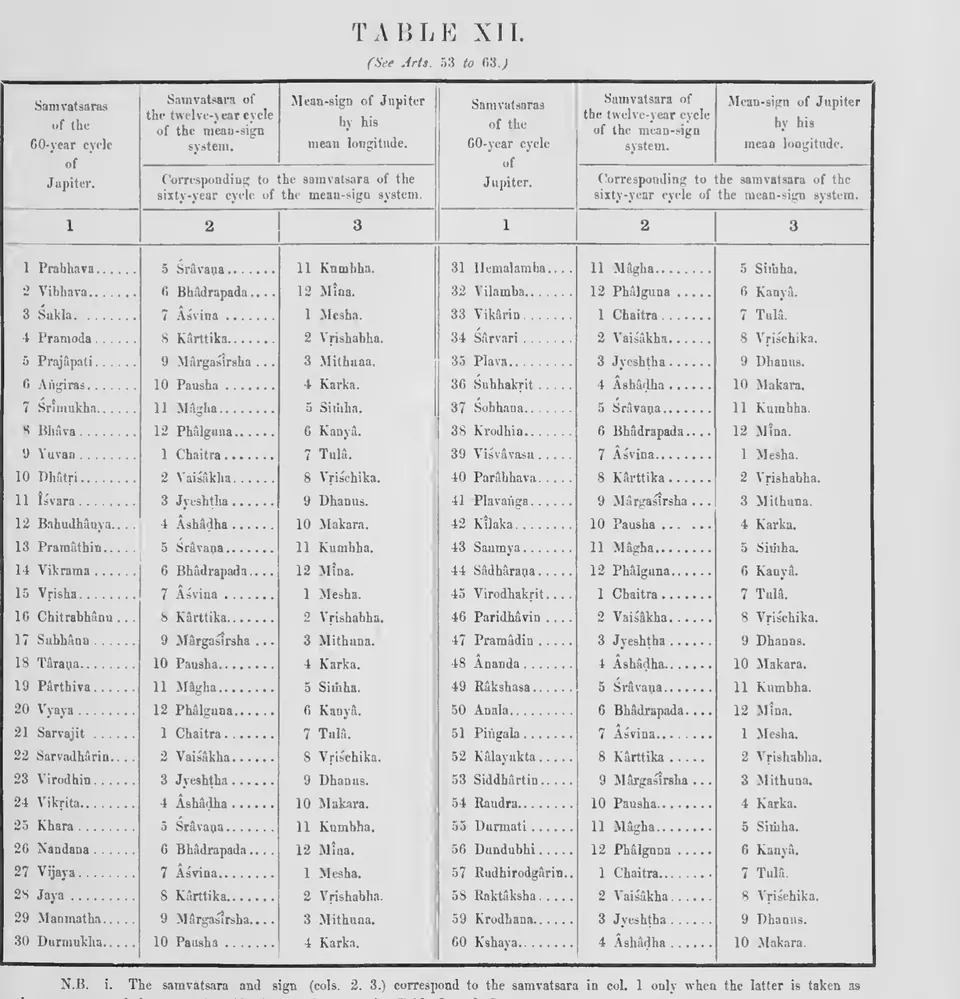
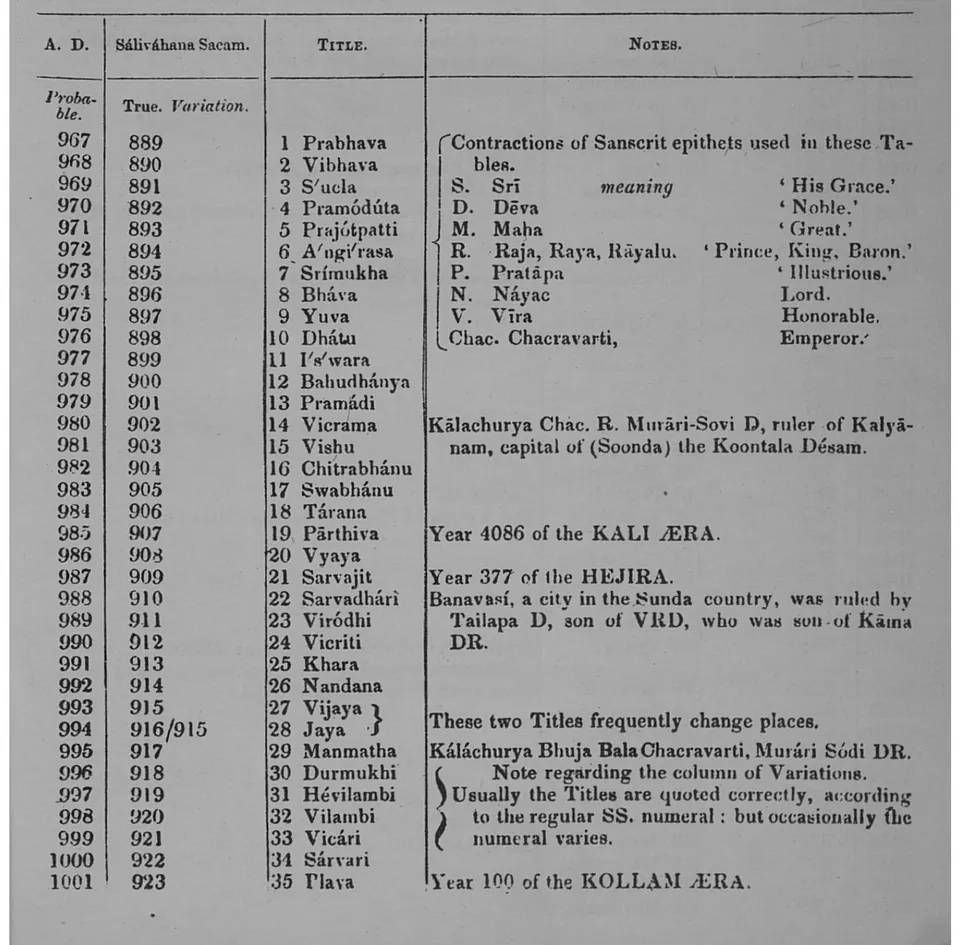
The names in the second column follow Sewell and Dikshit’s Table XII. The third column gives the Telugu-style spellings that Brown printed in his Cyclic Tables.2325 Burnell warned that the names are “often much varied” in inscriptions, so expect other spellings.26
| No. | Name (Sewell and Dikshit) | Brown (1850) |
|---|---|---|
| 1 | Prabhava | Prabhava |
| 2 | Vibhava | Vibhava |
| 3 | Sukla | S’ucla |
| 4 | Pramoda | Pramóduta |
| 5 | Prajapati | Prajótpatti |
| 6 | Angiras | A’ngírasa |
| 7 | Srimukha | Srímukha |
| 8 | Bhava | Bháva |
| 9 | Yuvan | Yuva |
| 10 | Dhatri | Dhátu |
| 11 | Isvara | I’s’wara |
| 12 | Bahudhanya | Bahudhánya |
| 13 | Pramathin | Pramádi |
| 14 | Vikrama | Vicrama |
| 15 | Vrisha | Vishu |
| 16 | Chitrabhanu | Chitrabhánu |
| 17 | Subhanu | Swabhánu |
| 18 | Tarana | Tárana |
| 19 | Parthiva | Párthiva |
| 20 | Vyaya | Vyaya |
| 21 | Sarvajit | Sarvajit |
| 22 | Sarvadharin | Sarvadhári |
| 23 | Virodhin | Viródhi |
| 24 | Vikrita | Vicriti |
| 25 | Khara | Khara |
| 26 | Nandana | Nandana |
| 27 | Vijaya | Vijaya |
| 28 | Jaya | Jaya |
| 29 | Manmatha | Manmatha |
| 30 | Durmukha | Durmukhi |
| 31 | Hemalamba | Hévilambi |
| 32 | Vilamba | Vilambi |
| 33 | Vikarin | Vicári |
| 34 | Sarvari | Sárvari |
| 35 | Plava | Plava |
| 36 | Subhakrit | Subhacrit |
| 37 | Sobhana | Sóbhacrit |
| 38 | Krodhin | Kródhi |
| 39 | Visvavasu | Visvávas |
| 40 | Parabhava | Parábhava |
| 41 | Plavanga | Plavanga |
| 42 | Kilaka | Kílaca |
| 43 | Saumya | Saumya |
| 44 | Sadharana | Sádháraná |
| 45 | Virodhakrit | Viródhicrit |
| 46 | Paridhavin | Parídhávi |
| 47 | Pramadin | Pramádícha |
| 48 | Ananda | A’nanda |
| 49 | Rakshasa | Ráxasa |
| 50 | Anala | Nala |
| 51 | Pingala | Pingala |
| 52 | Kalayukta | Kálayucti |
| 53 | Siddharthin | Siddhárthi |
| 54 | Raudra | Raudri |
| 55 | Durmati | Durmati |
| 56 | Dundubhi | Dundubhi |
| 57 | Rudhirodgarin | Rudiródgári |
| 58 | Raktaksha | Ractáxi |
| 59 | Krodhana | Kródhana |
| 60 | Kshaya | Xaya (also Axaya, Acshaya) |
Brown also noted that the 27th and 28th names, Vijaya and Jaya, “frequently change places”.25
Southern and northern reckoning
In origin the cycle followed the planet Jupiter. A “year of Jupiter” is about 361 days, a little shorter than a solar year, so every 85 or 86 years one name has to be skipped to keep in step. This is called expunging a year.27 Northern India kept doing this. In the south the skipping stopped from about Saka 828–831 (905–909 CE), and from then on each name simply stayed with one ordinary year.28 The two reckonings have drifted apart: Brown gave 1627 CE as Prabhava, the first year, in the south but Dhatu, the tenth, in the north, and by 1896 Sewell and Dikshit put the northern cycle twelve names ahead of the southern.2928
For inscriptions of the Telugu country after the early tenth century, use the southern rule, which Sewell and Dikshit give:
Add 11 to the current Saka year and divide by 60. The remainder, counting Prabhava as 1, is the cycle year.28
A remainder of 0 means the 60th year, Kshaya. With an expired Saka year, first add one to make it current.
Burnell offered a check that is easy to remember: in the south, the first year of every cycle falls in a Common Era year ending in 7, such as 907 or 967.30 Brown’s table agrees, with 967 CE as Prabhava.31
For dates before about 900, and for northern records, the cycle followed Jupiter, and the name has to be worked out from that planet’s mean motion. Sewell and Dikshit give rules for this, but the result depends on which astronomical textbook the writer followed, so treat it as approximate.32
Months, fortnights and days
The Telugu country used lunar months that run from one new moon to the next (the amanta system). Northern India ends the month at full moon instead (purnimanta), so the dark fortnight that opens a northern month belongs to the previous month in the south.33 Each month is named after the sign of the zodiac the sun enters during it: the month in which the sun enters Aries (Mesha) is Chaitra, and so on.34
| No. | Month | Can overlap parts of |
|---|---|---|
| 1 | Chaitra | February to May |
| 2 | Vaisakha | March to June |
| 3 | Jyeshtha | April to July |
| 4 | Ashadha | May to August |
| 5 | Sravana | June to September |
| 6 | Bhadrapada | July to October |
| 7 | Asvina | August to November |
| 8 | Karttika | September to December |
| 9 | Margasirsha | October to January |
| 10 | Pausha | November to February |
| 11 | Magha | December to March |
| 12 | Phalguna | January to April |
The names, their order and the last column follow Sewell and Dikshit’s Table II. A lunar month never fills all of those European months: it overlaps parts of two of them, and which two depends on the year.35 Before 1752, January fell in Pausha and Magha, or in Magha and Phalguna.8
- Fortnight. The bright half (sukla or suddha, popularly sudi, and in inscriptions often just su) is the waxing moon; the dark half (krishna, bahula or vadya, popularly vadi or badi) is the waning moon.36
- Tithi. A lunar day is the time the moon takes to gain 12 degrees on the sun. There are thirty in a month, numbered 1 to 15 in each half, and a tithi can start at any hour of the day or night.37
- Weekday. The seven days are named as in Europe, after the sun, moon and five planets, and a day begins at sunrise.38 Brown explained that a weekday was added to make clear which day was meant, since a tithi may begin on one day and end on the next.39
- Nakshatra. The moon’s path is divided into 27 “lunar mansions”, and the moon passes through about one a day.40
Eclipses
Grants were often made at an eclipse, because a gift made then was thought to earn great merit. An eclipse is therefore a strong check on a date.41 The Nandamapundi grant was made “on the occasion of a lunar eclipse” in Rajaraja’s 32nd year. F. Kielhorn worked out that this year ran from about 16 August 1053 to 16 August 1054, and that only one lunar eclipse falls in that window: Sunday, 28 November 1053, the full moon of Margasirsha, Saka 975 expired.42 Sewell and Dikshit add a caution from the scholar Hermann Jacobi: the eclipses named in inscriptions were often calculated in advance by astrologers, not actually seen.41
Converting a date, step by step
- Find the era year and decide whether it is expired or current. If the record gives a cycle year, it settles the question (see step 2).
- Check the cycle year. Make the Saka year current, add 11, divide by 60, and compare the remainder with the table above.28
- Note the month. For a date before 1752: from Chaitra to Margasirsha, add 78 to the expired Saka year; in Magha and Phalguna, add 79. Pausha straddles 1 January, so it may be either.98
- For the exact day, you need the month, fortnight and tithi, and ideally the weekday. Sewell and Dikshit give three methods: two quick ones that are always within a day or two, and a full method that gives the exact day.43 Editors normally do this for you, so look for the date in the edition.
- Regnal years need the accession date of the king, which comes from other records.
Worked examples from this site
Hanamkonda, 1163
The opening Telugu lines of the Thousand Pillar Temple inscription read, in J. F. Fleet’s edition, Saka-varshamulu 1084 vunemti Chitrabhanu-samvatsara Magha su 13. Fleet translated: “on Vaddavara the thirteenth day of the bright fortnight of (the month) Magha of the Chitrabhanu samvatsara, the Saka year 1084 being current”.4445
- Cycle check: Saka 1084 expired is 1085 current. 1085 + 11 = 1096. 1096 ÷ 60 leaves 16. Year 16 is Chitrabhanu, as the inscription says. Brown’s table agrees: it shows Chitrabhanu at Saka 964 (1042 CE), and two cycles later, 120 years on, Saka 1084 is again Chitrabhanu.3128
- So the number 1084 counts expired years. Fleet called it “current”; by Sewell and Dikshit’s rule, the cycle name points the other way.4528 This is exactly the kind of question the cycle year helps to settle.
- Month: Magha comes after 1 January, so add 79: 1084 + 79 = 1163 CE.98
- The day: the 13th of the bright half of Magha. P. V. Parabrahma Sastry gives it as 19 January 1163.46
Motupalli, 1244–45
The Motupalli pillar ends with verses saying that Ganapatideva set it up “in the Saka year eleven hundred and sixty-six, named Krodhin”.47 Check: 1167 + 11 = 1178, remainder 38, Krodhin. No month is given, so the year can only be 1166 + 78 = 1244 or 1166 + 79 = 1245. Its editor, E. Hultzsch, wrote exactly that: Saka 1166 expired, “This year corresponds to A.D. 1244-45”.48
Ganapesvaram, 1231
The Ganapesvaram inscription dates the consecration of the temple to the “tithi of Gauri” in the bright half of Vaisakha, Saka 1153, the year Khara.49 Check: 1154 + 11 = 1165, remainder 25, Khara. Vaisakha is before January, so 1153 + 78 = 1231. S. B. Dikshit himself worked out the day for the editor: the third tithi ended on Monday 7 April 1231 and the fourth on Tuesday 8 April, which is why the site gives “7 or 8 April”.49
Nagarjunakonda: when a year has no era
The Ikshvaku inscriptions at Nagarjunakonda give only regnal years and seasons. Inscription F, for example, is dated in the 14th year of King Mathariputa, “the 6th fortnight of winter, the 13th day”.50 J. Ph. Vogel read the date of the memorial pillar of Chamtamula as the 20th year of Virapurushadatta.51 D. C. Sircar, working from better impressions, read the same words as the cycle year Vijaya. He found that only one Vijaya year in the period fitted, 273–74 CE, and used a second Vijaya year, 333–34, in a record of Ehuvula Chamtamula to argue that the dynasty lasted until about the middle of the 4th century.22 A single reading of a single word moved the dating of a whole dynasty.
Pitfalls
- The number may be wrong. Brown found that the Saka number in documents “sometimes is true, sometimes false”, usually by no more than three years, while the cycle name was given carefully.24
- Expired or current is often unstated.5
- Early dates are loose. Burnell thought a fairly exact chronology possible only after the tenth century.4
- Dates in words. From the tenth century dates are written in “significant words”, as when the Palampet verse gives the year as “earth, moon, worlds, arrows” (1135).5253 See Numbers in inscriptions.
Try it yourself
- The Palampet pillar is dated Saka 1135, the year Srimukha, in Chaitra.2 Check the cycle year, and find the year of the Common Era.
- The Chandupatla inscription is dated Saka 1211, the year Virodhi, in the bright half of Margasira.1 Does the cycle year fit? In which year of the Common Era was it written?
- The Myakadoni inscription is dated on “the first day of the first (fortnight of) the second month of Winter in the eighth year” of Siri-Pulumavi.54 Can you convert this to a year of the Common Era?
Answers
- 1135 + 1 = 1136 current; 1136 + 11 = 1147; 1147 ÷ 60 leaves 7, which is Srimukha. Chaitra is before January, so 1135 + 78 = 1213. Barnett gives Sunday, 31 March 1213.2
- 1212 + 11 = 1223; 1223 ÷ 60 leaves 23, which is Virodhi, so it fits. Margasira is before January, so 1211 + 78 = 1289. P. V. Parabrahma Sastry, who published the record, worked the day out as Friday, 25 November 1289.1
- No. The date gives a month of the season, a fortnight and a day in the 8th year of the king’s reign, but no era. Its year in the Common Era depends on when Pulumavi began to reign, which has to be worked out from other evidence.5419
Footnotes
-
Gajjala Vasanta Lakshmi (ed.), Epigraphia Telanganica, Vol. 3 (2023), pp. 81–82, No. 94, reprinting P. V. Parabrahma Sastry, “Did Kakati Rudramadevi die on the battlefield?” (1974); paraphrased. ↩ ↩2 ↩3
-
L. D. Barnett (ed.), Inscriptions at Palampet and Uparpalli (1919), p. 2 (archive.org (opens in a new tab)). ↩ ↩2 ↩3
-
Robert Sewell and S. B. Dikshit, The Indian Calendar (1896), p. 42, Art. 71 (archive.org (opens in a new tab)). ↩
-
A. C. Burnell, Elements of South-Indian Palaeography (1878), p. 72 (archive.org (opens in a new tab)). ↩ ↩2
-
Sewell and Dikshit, The Indian Calendar (1896), p. 40, Art. 70 (archive.org (opens in a new tab)). ↩ ↩2 ↩3
-
Burnell, Elements of South-Indian Palaeography (1878), pp. 72–73 (archive.org (opens in a new tab)). ↩
-
Sewell and Dikshit, The Indian Calendar (1896), p. 31, Art. 52 (archive.org (opens in a new tab)). ↩
-
Sewell and Dikshit, The Indian Calendar (1896), p. 42, “The Christian era” (archive.org (opens in a new tab)). ↩ ↩2 ↩3 ↩4
-
Sewell and Dikshit, The Indian Calendar (1896), p. 58, Art. 104, examples 3 and 4 (archive.org (opens in a new tab)); Table II, Part iii, p. cvi (archive.org (opens in a new tab)). ↩ ↩2 ↩3
-
Burnell, Elements of South-Indian Palaeography (1878), p. 71 (archive.org (opens in a new tab)). ↩
-
Sewell and Dikshit, The Indian Calendar (1896), Table II, Part iii, p. cvi (archive.org (opens in a new tab)). ↩ ↩2
-
Burnell, Elements of South-Indian Palaeography (1878), p. 73 (archive.org (opens in a new tab)). ↩
-
Sewell and Dikshit, The Indian Calendar (1896), p. 41, “The Vikrama era” (archive.org (opens in a new tab)). ↩
-
Sewell and Dikshit, The Indian Calendar (1896), p. 46, “The Chalukya era” (archive.org (opens in a new tab)). ↩
-
Burnell, Elements of South-Indian Palaeography (1878), p. 75 (archive.org (opens in a new tab)). ↩
-
Charles Philip Brown, Cyclic Tables of Hindu and Mahomedan Chronology (1850), p. 2, note at 1016 A.D. (archive.org (opens in a new tab)). ↩
-
Burnell, Elements of South-Indian Palaeography (1878), p. 73 (archive.org (opens in a new tab)). ↩
-
F. Kielhorn, “Nandamapundi Grant of Rajaraja I”, Epigraphia Indica IV (1897), p. 303 (archive.org (opens in a new tab)). ↩
-
G. Bühler, note in James Burgess, The Buddhist Stupas of Amaravati and Jaggayyapeta (1887), p. 131, n. 2 (archive.org (opens in a new tab)). ↩ ↩2
-
Burgess, The Buddhist Stupas of Amaravati and Jaggayyapeta (1887), p. 111, translation by G. Bühler (archive.org (opens in a new tab)). ↩ ↩2
-
G. Bühler, Indian Palaeography, tr. J. F. Fleet (1904), p. 91, § 35 E (archive.org (opens in a new tab)). ↩
-
D. C. Sircar, “More Inscriptions from Nagarjunikonda”, Epigraphia Indica XXXV (1963–64), p. 1 (archive.org (opens in a new tab)) and p. 6 (archive.org (opens in a new tab)); paraphrased. ↩ ↩2
-
Sewell and Dikshit, The Indian Calendar (1896), p. 32, Art. 53 (archive.org (opens in a new tab)), and Table XII, p. cxxi (archive.org (opens in a new tab)). ↩ ↩2
-
Charles Philip Brown, Carnatic Chronology (1863), Preface, p. ii (archive.org (opens in a new tab)). ↩ ↩2
-
Brown, Cyclic Tables (1850), pp. 1–2 (archive.org (opens in a new tab)). ↩ ↩2
-
Burnell, Elements of South-Indian Palaeography (1878), pp. 73–74 (archive.org (opens in a new tab)). ↩
-
Sewell and Dikshit, The Indian Calendar (1896), p. 33, Art. 54 (archive.org (opens in a new tab)). ↩
-
Sewell and Dikshit, The Indian Calendar (1896), p. 37, Art. 62 (archive.org (opens in a new tab)). ↩ ↩2 ↩3 ↩4 ↩5 ↩6
-
Brown, Carnatic Chronology (1863), p. 26 (archive.org (opens in a new tab)). ↩
-
Burnell, Elements of South-Indian Palaeography (1878), p. 74, n. 3 (archive.org (opens in a new tab)). ↩
-
Brown, Cyclic Tables (1850), p. 1, at 967 A.D. (archive.org (opens in a new tab)), and p. 2, at 1042 A.D. (archive.org (opens in a new tab)). ↩ ↩2
-
Sewell and Dikshit, The Indian Calendar (1896), pp. 33–35, Arts. 56–59 (archive.org (opens in a new tab)). ↩
-
Sewell and Dikshit, The Indian Calendar (1896), p. 4, Art. 13 (archive.org (opens in a new tab)), and Table II, Part i, p. ciii (archive.org (opens in a new tab)). ↩
-
Sewell and Dikshit, The Indian Calendar (1896), p. 5, Art. 14 (archive.org (opens in a new tab)). ↩
-
Sewell and Dikshit, The Indian Calendar (1896), Table II, Part ii, p. civ, cols. 1 and 7 (archive.org (opens in a new tab)); p. 58, Art. 103 (archive.org (opens in a new tab)). ↩
-
Sewell and Dikshit, The Indian Calendar (1896), p. 4, Art. 11 (archive.org (opens in a new tab)); su as in J. F. Fleet’s text of the Hanamkonda inscription, Indian Antiquary XI (1882), p. 12, line 7 (archive.org (opens in a new tab)). ↩
-
Sewell and Dikshit, The Indian Calendar (1896), p. 3, Art. 7 (archive.org (opens in a new tab)); p. 31, Art. 52 (archive.org (opens in a new tab)). ↩
-
Sewell and Dikshit, The Indian Calendar (1896), p. 2, Art. 5 (archive.org (opens in a new tab)). ↩
-
Brown, Carnatic Chronology (1863), p. 27 (archive.org (opens in a new tab)). ↩
-
Sewell and Dikshit, The Indian Calendar (1896), p. 3, Art. 8 (archive.org (opens in a new tab)). ↩
-
Sewell and Dikshit, The Indian Calendar (1896), p. 23, Art. 40a (archive.org (opens in a new tab)). ↩ ↩2
-
Kielhorn, “Nandamapundi Grant of Rajaraja I” (1897), p. 303 (archive.org (opens in a new tab)). ↩
-
Sewell and Dikshit, The Indian Calendar (1896), pp. 1–2, Arts. 1–2 (archive.org (opens in a new tab)). ↩
-
J. F. Fleet, “Sanskrit and Old-Canarese Inscriptions, No. CXVIII”, Indian Antiquary XI (1882), p. 12, text lines 6–7 (archive.org (opens in a new tab)). ↩
-
Fleet, “Sanskrit and Old-Canarese Inscriptions, No. CXVIII” (1882), p. 16, translation of lines 6–8 (archive.org (opens in a new tab)). ↩ ↩2
-
P. V. Parabrahma Sastry, The Kakatiyas of Warangal (1978), p. 74; paraphrased. ↩
-
E. Hultzsch, “Motupalli Pillar-Inscription of Ganapatideva”, Epigraphia Indica XII (1914), p. 197, verses 28–29 (archive.org (opens in a new tab)). ↩
-
Hultzsch, “Motupalli Pillar-Inscription of Ganapatideva” (1914), p. 189 (archive.org (opens in a new tab)). ↩
-
E. Hultzsch, “Ganapesvaram Inscription of the Time of Ganapati”, Epigraphia Indica III (1894–95), p. 84, with S. B. Dikshit’s remarks (archive.org (opens in a new tab)). ↩ ↩2
-
J. Ph. Vogel, “Prakrit Inscriptions from a Buddhist Site at Nagarjunikonda”, Epigraphia Indica XX (1933), p. 23, translation of inscription F (archive.org (opens in a new tab)). ↩
-
J. Ph. Vogel, “Additional Prakrit Inscriptions from Nagarjunikonda”, Epigraphia Indica XXI (1931–32), p. 64 (archive.org (opens in a new tab)); paraphrased. ↩
-
Burnell, Elements of South-Indian Palaeography (1878), p. 77 (archive.org (opens in a new tab)). ↩
-
Barnett, Inscriptions at Palampet and Uparpalli (1919), p. 11, verse 47 (archive.org (opens in a new tab)). ↩
-
V. S. Sukthankar, “A New Andhra Inscription of Siri-Pulumavi”, Epigraphia Indica XIV (1917–18), p. 155 (archive.org (opens in a new tab)). ↩ ↩2
References
Notes (0)
Sources (17)
Spotted an error on this page? Tell us
Last updated: