Ghulam Rasul Khan (Nawab of Kurnool)
The last Nawab of Kurnool, who ruled from 1823 to 1839. He was a younger son of Alif Khan II. He followed his brother Munawwar Khan after another brother, Muzaffar Khan, was imprisoned for murder. The Kurnool manual describes his rule as greedy and his habits as wasteful. At a time of reports of a Wahhabi plot against the British, the Madras government learnt that he was repairing his forts and secretly gathering cannon and military stores. It sent a commission with troops in 1839. He gave up the fort, his unpaid Rohilla and Arab troops were fired on, and he was sent away to Trichinopoly, where a servant murdered him. His jagir was taken over and his family given pensions.
Ghulam Rasul Khan was the last of the Pathan Nawabs of Kurnool.12 The Imperial Gazetteer calls him “the last of the Nawabs”.12 It says that in 1838 he “was found to be engaged in treasonable preparations on an extensive scale”.12 The Kurnool manual is more careful: “the charge against the Nabob of harbouring designs against the Government was not proved”.12 Muhammad Burhanuddin’s history of the Carnatic and Kurnool (1905), written with the help of his family, argues that he was deposed unjustly. See the Nawabs of Kurnool.
Succession, 1823
Ghulam Rasul Khan was a younger son of Alif Khan.3 The Kurnool manual calls him the sixth son and his father’s favourite.3 It names the eldest son, Munawwar Khan, as the rightful heir.3 His father had tried to make him heir in 1810.34 But the Company put the eldest brother back in place, and he ruled from 1815 to 1823.34
When Munawwar Khan was dying, the choice of the next ruler fell on another brother, Muzaffar Khan.5 “Muzaffar was then at Adoni, but before leaving the British territory he murdered his wife at Adoni and was made prisoner”.5 He died in the fort of Bellary in 1879, after fifty-six years in prison.5
Ghulam Rasul Khan, “who had been destined by his father Aluf Khan for the musnud in preference to his eldest son, was now raised to the throne”.5 (Musnud means throne.) Burhanuddin prints Lord Amherst’s letter of 15 October 1824.6 It accepts his accession “to the Musnud of your hereditary state of Kurnool”.6 See Alif Khan II, Adoni and Bellary.
His government
The manual judges him harshly: “Ghulam Rasul proved to be a man of weak mind, infatuated folly and extravagance”.5 His “sole object was to extort the utmost possible revenue from the country”.5
He took back inams (rent-free lands) and brought back the tax his brother had ended.5 Under the Nandyal tank, half the crop had been the rule, but he demanded two-thirds.5 He added 5,000 rupees to the yearly demand of the village of Nannur “because a horse for which he had paid that sum happened to die there”.5 A grain monopoly drove merchants from the country, “especially the town of Kurnool”.5
He spent heavily on women and on glassware, jewels and other foreign goods, “so that the money paid for them was all lost to his country”.5 The manual adds: “In this respect he differed from his father, who spent all the money among his own subjects”.5
The inquiry of 1839
He “repaired his fortifications and collected immense quantities of military stores and cannon, which he caused to be transported to Kurnool under fictitious names”.52 At that time reports were going round of a Wahabi plot against the British.52 So the secret gathering of stores “excited the suspicion of the Government”.52
A commission was sent to Kurnool.52 Its members were Blane, of the Civil Service, and Colonel Steel, the Military Secretary.52 Troops from Bellary went with them under Colonel Dyce.52
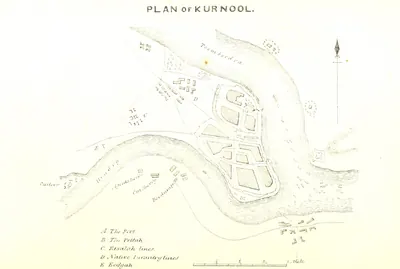
The commissioners reached Kurnool in September 1839.2 After some days of talks with the diwan (minister) and the Nawab’s brother, they required him to hand over the fort.2 On 18 October he left it for Jalapur, a village about a mile away, “dressed in a thin shirt”.2
There his Rohilla and Arab troops, unpaid for months, surrounded him and demanded their pay.2 After three hours’ warning the British troops opened fire.2 They killed about a hundred of the troops.2 Two British officers were killed and two badly wounded.2
Burhanuddin quotes the commissioners’ reports.7 He says that the Nawab gave up the fort and district of his own will, “in full confidence of an acquittal”.7 In their final report the commissioners cleared him of every charge “with the exception of the secret accumulation of military stores”.7 For that they found no motive but “the insane fancy of a monomaniac” (a man with one mad idea).7
Burhanuddin quotes them as finding “no clue or trace” of letters with enemies of the British.8 They thought that a letter said to be from the Nawab to the Nizam’s foster-brother, Mubariz-ud-daula, was a forgery.8 He also quotes the Court of Directors: “if he be really mad it would be obviously unjust to punish his family for his misfortune”.9
Exile and annexation
The Nawab was sent to Tiruchirappalli (then Trichinopoly).2 The manual says that there “it is remarkable that he began to attend a Christian chapel”.2 Then “one day, while returning from it, he was assassinated by his own servant, whom he had the day before charged with theft”.2
His jagir (land grant) was taken over, together with the smaller jagirs of his nobles and relatives.2 The family was given a pension of 2,22,651 rupees a year.2 By 1886 this had fallen to 55,893 rupees.2
He had ruled four taluks: Ramallakota, Nandikotkur, Nandyal and Sirvel.110 A Commissioner and then an Agent governed them until 1858.110 In that year they were joined with taluks from Kadapa (then Cuddapah) and Bellary to form the Kurnool district.110
Burhanuddin wrote in 1905 that the Nawab’s only surviving male descendant was his grandson Muhammad Daud Khan.1112 He lived at Kurnool on a small pension in “one of the houses of his late grandfather”.1112 The building had cost “upwards of three lacs of rupees” and was falling into ruin.1112 See Kurnool.
Footnotes
-
Imperial Gazetteer of India, Provincial Series: Madras, Vol. I (1908), p. 407 (archive.org (opens in a new tab)). ↩ ↩2 ↩3 ↩4 ↩5 ↩6 ↩7
-
Narahari Gopalakristnamah Chetty, A Manual of the Kurnool District (1886), p. 41 (archive.org (opens in a new tab)). ↩ ↩2 ↩3 ↩4 ↩5 ↩6 ↩7 ↩8 ↩9 ↩10 ↩11 ↩12 ↩13 ↩14 ↩15 ↩16 ↩17 ↩18 ↩19 ↩20 ↩21 ↩22 ↩23
-
Chetty, Kurnool District (1886), p. 38 (archive.org (opens in a new tab)). ↩ ↩2 ↩3 ↩4 ↩5
-
Chetty, Kurnool District (1886), p. 39 (archive.org (opens in a new tab)). ↩ ↩2
-
Chetty, Kurnool District (1886), p. 40 (archive.org (opens in a new tab)). ↩ ↩2 ↩3 ↩4 ↩5 ↩6 ↩7 ↩8 ↩9 ↩10 ↩11 ↩12 ↩13 ↩14 ↩15 ↩16 ↩17 ↩18
-
Muhammad Burhanuddin Siddiqui, The Carnatic & Kurnool, their Last Muhammedan Rulers (Madras, 1905), p. 71 (archive.org (opens in a new tab)). ↩ ↩2
-
Burhanuddin, The Carnatic & Kurnool (1905), p. 73 (archive.org (opens in a new tab)). ↩ ↩2 ↩3 ↩4
-
Burhanuddin, The Carnatic & Kurnool (1905), p. 79 (archive.org (opens in a new tab)). ↩ ↩2
-
Burhanuddin, The Carnatic & Kurnool (1905), p. 75 (archive.org (opens in a new tab)). ↩
-
An Account of the Kurnool District, based on an Analysis of Statistical Information relating thereto (Madras, 1889), p. 1 (archive.org (opens in a new tab)). ↩ ↩2 ↩3
-
Burhanuddin, The Carnatic & Kurnool (1905), p. 76 (archive.org (opens in a new tab)). ↩ ↩2 ↩3
-
Burhanuddin, The Carnatic & Kurnool (1905), p. 77 (archive.org (opens in a new tab)). ↩ ↩2 ↩3
Photos
References
Notes (0)
Sources (4)
Spotted an error on this page? Tell us
Last updated: