Adoni
Hill-fort town in the Kurnool district. It was a Vijayanagara stronghold, which Bijapur besieged in 1535–37 and took in 1568. Its Bijapur governor Siddi Masud Khan built the Jama Masjid in 1666–67. He held the last Bijapur stronghold in the western Telugu country, and gave it up to Aurangzeb's army after Bijapur fell. The Mughals renamed it Imtiyazgarh, 'Distinction Fort'. Under Farrukhsiyar and his successors it was a Mughal mint for small gold coins of the southern pattern. From 1756 it was the jagir (land grant) of Basalat Jang, the Nizam's brother. Tipu Sultan besieged it in 1786, took its guns when the garrison left, destroyed its walls, and gave it back at the peace of 1787. In 1800 the Nizam ceded it to the East India Company in exchange for his districts north of the Tungabhadra.
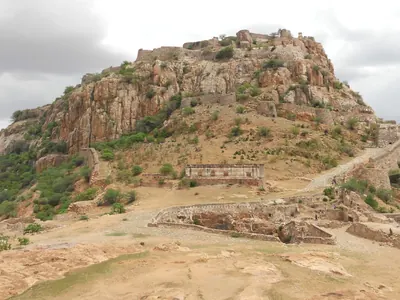
Adoni is a town in the west of the Kurnool district, below a cluster of rocky hills crowned by the ruins of its fort.1 It was a stronghold of the Vijayanagara kings, and from 1568 it was held by Muslim rulers until it was ceded to the East India Company in 1800.12
In 1904 Adoni belonged to the Bellary district.1 The Bellary gazetteer calls it “a place of much historical interest”.1 For the Vijayanagara kings, the gazetteer says, it was “perhaps the finest stronghold” of the country.1 Ferishta wrote that its kings thought it could not be taken, and all helped to make it “a convenient asylum” (a safe refuge) “for their families”.3 See the Adil Shahis of Bijapur.
Bijapur’s fortress
The first Bijapur attack came in 1535–37. Ibrahim Adil Shah I sent his minister Asad Khan against Adoni.451 According to Ferishta, the fort was “on the point of surrendering” when Rama Raya’s brother Venkatadri came to rescue it.45 The campaign ended in a treaty.451
After the battle of 1565, the fort was held by “one of the principal officers of the late Ramraj”.36 This officer had made himself independent when his master died.36 In AH 976 (1568; AH is the Islamic way of counting years), Ali Adil Shah I sent his general Ankus Khan against it.36 Ankus Khan’s long blockade (a siege that cuts off all supplies) made the fort submit.36
The Bellary gazetteer says that from then on, “the place continued to be a Muhammadan possession until it was ceded to the Company in 1800”.27 It adds that “the present town of Adoni is apparently not older than the Musalman occupation in 1568”.27 Ferishta records a rebel governor of Adoni, Ghalib Khan, whom the regent Dilawar Khan blinded.89 He also records a siege by a Karnatak chief, which was lifted in 1595–96.89
The gazetteer names two governors in particular.2 Malik Rahiman Khan “held the post for twenty-seven years, from 1604 to 1631”, and his tomb stands on the fort hill.2 Siddi Masud Khan was governor from 1662 to 1687, and regent of Bijapur from 1678.2
Masud built a well with an inscription below the lowest gate of the fort, and a new bastion.210 He also built the Jama Masjid in the town.210 Its Persian verses give the date AH 1079 (1666–67).210 His diwan (chief minister) Venkanna Pant dug the great well in the town, which is named after him.210
The Mughal conquest
The sources differ on how and when Adoni passed to the Mughals. Grant Duff, the historian of the Marathas, says that the Mughals came after Bijapur and Golconda fell.1112 Prince Azam and Ghazi-ud-din then “marched against Adonee, still in possession of Musaood Khan, formerly regent of Beejapoor”.1112 Masud, “considering resistance as altogether hopeless”, gave up the lands he held.1112 He refused to enter the imperial service and died forgotten.1112
The Bellary gazetteer gives the date as 1687.213 It records a local tradition that Ghazi-ud-din Khan forced Masud to surrender by aiming his guns at the Jama Masjid.213
Jadunath Sarkar used the official history of Aurangzeb’s reign.1415 He says that Firuz Jang was sent against Adoni on 25 January 1688.1415 Sarkar writes that “at last on 6th August 1688, Siddi Masaud was induced to capitulate”, that is, he was persuaded to surrender.1415 His fort was occupied and renamed Imtiaz-garh, and Masud was made a Mughal noble.1415
The Kurnool district manual names the Mughal commander as Ghiyas-ud-din Khan.16 It says that he took Adoni from Masaud Khan and then went on to take Kurnool.16 See the Mughals in the Telugu country and Kurnool.
Imtiyazgarh
The Mughals gave the fort a new name. Lane-Poole wrote a catalogue of the British Museum coins in 1892.17 He explains that a mint name long misread as Karrah is really Imtiyaz-garh, “Distinction Fort”.17 He cites Mr. C. J. Rodgers for the view that this was “a name given by Aurangzib to Adwani, the Adoni of the maps, a little north of Guti”.17
Whitehead (1914) agrees that “Imtiyazgarh was the Mughal name for Adoni in Southern India”.18 He records a rupee of Aurangzeb from this mint.18 He also records a half-rupee of Aurangzeb on which the mint name still appears “in its original form of Adoni”.18
From the reign of Farrukhsiyar (1713–19), the mint struck a small gold coinage on the pattern of the southern hun (a gold coin). Lane-Poole describes these “very small” coins, which weighed about 51 to 53 or 22 grains.191720 He says they resemble “other small issues of Southern India”.191720 He names Imtiyazgarh and Gooty as their mints in the Deccan.191720 He lists issues from Imtiyazgarh under Farrukhsiyar, Muhammad Shah and Alamgir II.191720
The British Museum’s coin of Farrukhsiyar from this mint is from the third year of his reign.21 Irvine counted eight coins of Farrukhsiyar from the mints of the Hyderabad (then Haidarabad) province in the great collections, and one of them was from Adoni.22 See Gooty.
A Mughal post
Adoni appears in the chronicles as a halting place for Mughal armies in the south. In 1695 the defeated army of Khanazad Khan was “reclothed and newly furnished” there.23 According to Sarkar, this was done “by the gifts and forced contributions from the officers and residents of Adoni”.23
In 1721 Mubariz Khan, the subahdar (governor) of Hyderabad, persuaded Nizam-ul-Mulk to turn back from the road to Delhi.24 Nizam-ul-Mulk marched to Adoni instead, against the Afghan chiefs of the south.24
Basalat Jang, Haidar Ali and Tipu Sultan
In 1756, the Bellary gazetteer says, the Subadar (governor) of the Deccan granted Adoni as a jaghir (land grant) to his brother Basalat Jang.13 Basalat Jang died in 1782, and he is buried in a tomb west of the town.13 His son Mahabat Jung was appointed governor.13
Basalat Jang also held the Guntur Circar (district) for his life.252627 In 1779, “threatened by Haidar Ali”, he agreed to rent it to the Company and to take English troops.252627 An English detachment marched towards Adoni through the passes of Kadapa (then Cuddapah), but Haidar’s men turned it back.252627 Haidar’s light troops then “laid waste the territory of Adwani up to the gates of the capital”.252627 See Mysore under Haidar Ali and Tipu Sultan and Bellary.
Tipu Sultan was at war with the Marathas and the Nizam.28 In 1786 he marched suddenly on Adoni, “the strong frontier post of Nizam Ali south of the Toombuddra” (the Tungabhadra).28 His reason, he said, was that it held the family of Basalat Jang and Mahabat Jung.28 On the way he camped at Lepakshi.29
Mahabat Jung first offered money, and then defended the breaches (gaps in the walls).303132 He drove back Tipu’s assault “with great slaughter”.303132 When the river began to rise, the allies took away the women and the garrison.303132 Tipu found the guns still mounted, and the arsenal and storehouses full.303132 The palace was “in the exact state of a mansion ready furnished for the reception of a royal establishment”.303132
Tipu expected to have to give the place back.3233 So he “immediately removed the guns and stores to Gooty and Bellary, and effectually destroyed the fortifications”.3233 The Bellary gazetteer adds that “the place was never afterwards a military post”.33
Adoni was given back to the Nizam at the peace early in 1787.34 On the day the terms were settled, Tipu ordered his commander there to round up five to seven thousand people from the country.34 They were for his “Assud Ulahee” corps.34
By the treaty of 12 October 1800, the Nizam ceded (handed over) his gains from Tipu to the Company.35 He kept his new districts north of the Tungabhadra.35 In exchange he gave the Company “the district of Adoni, together with whatever other territory His Highness may be possessed of … to the south of the Toombuddrah”.35 In 1804 a plot failed to seize the forts of Gooty and Adoni for Basalat Jang’s son, Kudrat Ullah Khan.36 See Gooty.
Footnotes
-
W. Francis, Madras District Gazetteers: Bellary (1904), p. 195 (archive.org (opens in a new tab)). ↩ ↩2 ↩3 ↩4 ↩5 ↩6 ↩7
-
Francis, Bellary (1904), p. 196 (archive.org (opens in a new tab)). ↩ ↩2 ↩3 ↩4 ↩5 ↩6 ↩7 ↩8 ↩9 ↩10 ↩11 ↩12
-
Ferishta, tr. Briggs, Vol. III (1829), p. 134 (archive.org (opens in a new tab)). ↩ ↩2 ↩3 ↩4 ↩5
-
Muhammad Qasim Ferishta, tr. John Briggs, History of the Rise of the Mahomedan Power in India, Vol. III (1829), p. 85 (archive.org (opens in a new tab)). ↩ ↩2 ↩3
-
Ferishta, tr. Briggs, Vol. III (1829), p. 86 (archive.org (opens in a new tab)). ↩ ↩2 ↩3
-
Ferishta, tr. Briggs, Vol. III (1829), p. 135 (archive.org (opens in a new tab)). ↩ ↩2 ↩3 ↩4
-
Francis, Bellary (1904), p. 199 (archive.org (opens in a new tab)). ↩ ↩2
-
Ferishta, tr. Briggs, Vol. III (1829), p. 157 (archive.org (opens in a new tab)). ↩ ↩2
-
Ferishta, tr. Briggs, Vol. III (1829), p. 187 (archive.org (opens in a new tab)). ↩ ↩2
-
Francis, Bellary (1904), p. 200 and notes (archive.org (opens in a new tab)). ↩ ↩2 ↩3 ↩4
-
James Grant Duff, A History of the Mahrattas, Vol. I (1826), p. 345 (archive.org (opens in a new tab)). ↩ ↩2 ↩3 ↩4
-
Grant Duff, History of the Mahrattas, Vol. I (1826), p. 346 (archive.org (opens in a new tab)). ↩ ↩2 ↩3 ↩4
-
Francis, Bellary (1904), p. 197 (archive.org (opens in a new tab)). ↩ ↩2 ↩3 ↩4 ↩5
-
Jadunath Sarkar, History of Aurangzib, Vol. IV (2nd ed., 1930), p. 459 and note (archive.org (opens in a new tab)). ↩ ↩2 ↩3 ↩4
-
Sarkar, Aurangzib IV (1930), p. 460 (archive.org (opens in a new tab)). ↩ ↩2 ↩3 ↩4
-
Narahari Gopalakristnamah Chetty, A Manual of the Kurnool District (1886), p. 29 (archive.org (opens in a new tab)). ↩ ↩2
-
Lane-Poole, Coins of the Moghul Emperors (1892), p. lxxviii (archive.org (opens in a new tab)). ↩ ↩2 ↩3 ↩4 ↩5 ↩6 ↩7
-
R. B. Whitehead, Catalogue of Coins in the Panjab Museum, Lahore, Vol. II: Coins of the Mughal Emperors (1914), pp. l–li (archive.org (opens in a new tab)). ↩ ↩2 ↩3
-
Lane-Poole, Coins of the Moghul Emperors (1892), p. lxxvii (archive.org (opens in a new tab)). ↩ ↩2 ↩3 ↩4
-
Stanley Lane-Poole, The Coins of the Moghul Emperors of Hindustan in the British Museum (1892), p. lviii (archive.org (opens in a new tab)). ↩ ↩2 ↩3 ↩4
-
Lane-Poole, Coins of the Moghul Emperors (1892), p. 183, No. 900a, and pl. XXII (archive.org (opens in a new tab)). ↩
-
William Irvine, ed. Jadunath Sarkar, Later Mughals, Vol. I (1922), p. 400 (archive.org (opens in a new tab)). ↩
-
Jadunath Sarkar, History of Aurangzib, Vol. V (1924), p. 119 (archive.org (opens in a new tab)). ↩ ↩2
-
Irvine, Later Mughals, Vol. II (1922), p. 139 (archive.org (opens in a new tab)). ↩ ↩2
-
C. U. Aitchison, A Collection of Treaties, Engagements and Sanads, Vol. IX (4th ed., 1909), p. 3 (archive.org (opens in a new tab)). ↩ ↩2 ↩3 ↩4
-
Mark Wilks, Historical Sketches of the South of India, Vol. II (1817), p. 236 (archive.org (opens in a new tab)). ↩ ↩2 ↩3 ↩4
-
Wilks, Historical Sketches, Vol. II (1817), p. 237 (archive.org (opens in a new tab)). ↩ ↩2 ↩3 ↩4
-
Wilks, Historical Sketches, Vol. II (1817), p. 546 (archive.org (opens in a new tab)). ↩ ↩2 ↩3
-
Francis, Anantapur Gazetteer (1905), p. 172 (archive.org (opens in a new tab)). ↩
-
Wilks, Historical Sketches, Vol. II (1817), p. 547 (archive.org (opens in a new tab)). ↩ ↩2 ↩3 ↩4 ↩5
-
Wilks, Historical Sketches, Vol. II (1817), p. 548 (archive.org (opens in a new tab)). ↩ ↩2 ↩3 ↩4 ↩5
-
Wilks, Historical Sketches, Vol. II (1817), p. 549 (archive.org (opens in a new tab)). ↩ ↩2 ↩3 ↩4 ↩5 ↩6 ↩7
-
Francis, Bellary (1904), p. 198 (archive.org (opens in a new tab)). ↩ ↩2 ↩3
-
Wilks, Historical Sketches, Vol. II (1817), p. 559 (archive.org (opens in a new tab)). ↩ ↩2 ↩3
-
Aitchison, Treaties, Vol. IX (1909), p. 69, treaty of 12 October 1800, Article 6 (archive.org (opens in a new tab)). ↩ ↩2 ↩3
-
W. Francis, Madras District Gazetteers: Anantapur (1905), p. 24 (archive.org (opens in a new tab)). ↩
Photos
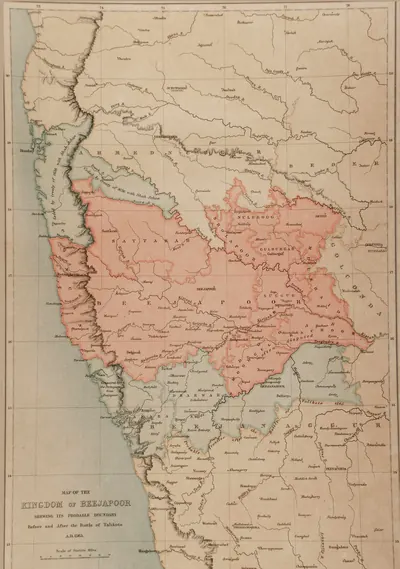 "Map of the Kingdom of Beejapoor, shewing its probable boundary before and after the Battle of Talikota, A.D. 1565" (Taylor and Fergusson, Architecture at Beejapoor, 1866, facing p. 1)Map · 1866
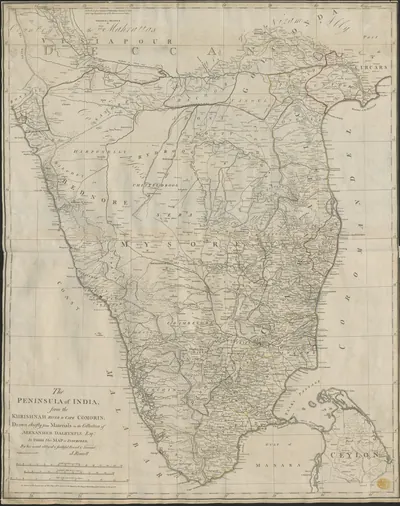 James Rennell, "The Peninsula of India, from the Khrishnah River to Cape Comorin" (London, 1788), British Library Maps K.Top.115.65.1: the Mahrattas, Visiapour, Adoni, Gooty, Golconda and the CircarsMap · 1788
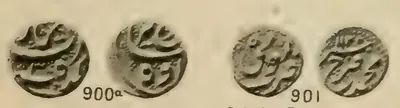 Small gold coins of Farrukhsiyar from the Deccan mints of Imtiyazgarh (Adoni), regnal year 3, and Guti (Gooty), AH 1128 (Lane-Poole 1892, Nos. 900a and 901, pl. XXII)Coin · 1892
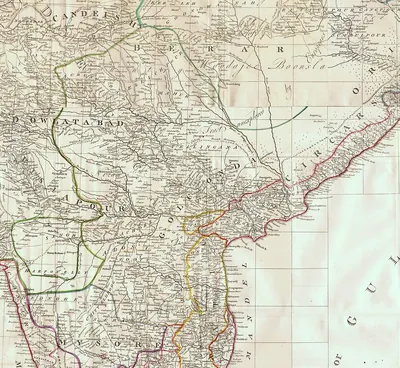 The Deccan in James Rennell's "Map of Hindoostan, or the Mogul Empire" (London, 1788): detail with Golconda, Telingana, Visiapour, Adoni, Dowlatabad, Berar and the CircarsMap · 1788
Related
People
Ibrahim Adil Shah I
c. 1535–1558 CE
Fourth Adil Shahi sultan of Bijapur (r. 1535–1558), a younger son of Ismail Adil Shah. Invited by Bhoj Tirmal of Vijayanagara, he entered the Vijayanagara capital in 1535. His general Asad Khan then besieged Adoni, the first Bijapur attack on the fortress, which Ferishta says ended in a negotiated peace. In 1551–52 he lost Raichur and Mudgal to Aliya Rama Raya.
Ali Adil Shah I
c. 1558–1580 CE
Fifth Adil Shahi sultan of Bijapur (r. 1558–1580). He was first an ally of Aliya Rama Raya, but then joined the league of Deccan sultans that defeated and killed Rama Raya in January 1565. Afterwards he won back Raichur and Mudgal, took Adoni in 1568 and turned south against the Aravidu kings, besieging Penukonda. The date and details of that siege are disputed. He was the husband of Chand Bibi.
Ibrahim Adil Shah II
1580–1627 CE
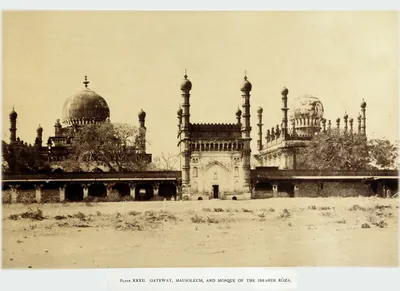
Sixth Adil Shahi sultan of Bijapur (r. 1580–1627), nephew and successor of Ali Adil Shah I, called Jagat Guru. He was the patron of the historian Ferishta and the builder of the Ibrahim Rauza. In his reign Bijapur held Adoni against a siege of 1595–96. Early in the seventeenth century it took Kurnool from the last Hindu chief of the town. Heras places Ferishta's account of a failed Bijapur siege of Penukonda in these years.
Siddi Masud Khan
c. 1662–1688 CE
Abyssinian noble of Bijapur. By the Bellary gazetteer's count he was governor and jagirdar (land-grant holder) of Adoni from 1662 to 1687. From 1678 he was regent of the kingdom for the boy-king Sikandar Adil Shah. He built the Jama Masjid of Adoni, which its inscriptions date to AH 1079 (1666–67). Driven from the capital, he held Adoni as the last Bijapur stronghold in the Telugu country. He surrendered it to the Mughals, in 1688 according to Sarkar.
Sikandar Adil Shah
1672–1686 CE
Ninth and last Adil Shahi sultan of Bijapur (r. 1672–1686). He came to the throne as a small boy and reigned under regents: Khawas Khan, Bahlol Khan, and the Abyssinian Siddi Masud, jagirdar (land-grant holder) of Adoni. In his reign Shivaji marched through the Kurnool country to take Bijapur's Karnatak forts (1677), and the Raichur doab was ceded to the Marathas. Aurangzeb took Bijapur on 12 September 1686. Sikandar died a prisoner in 1700.
Haidar Ali
1761–1782 CE
A soldier who made himself master of Mysore in 1761 and ruled it until he died in December 1782. In the Telugu country he took Penukonda and Madakasira from the Maratha Morari Rao in 1762. He won back Gurramkonda through his brother-in-law Mir Sahib in 1768, took Bellary in 1775 and took Gooty from Morari Rao in 1776. In 1779 he conquered the Nawab of Cuddapah, and the Nawab of Kurnool and the poligars of the Bellary and Anantapur country paid him tribute. His invasion of the Carnatic in 1780 began the Second Mysore War.
Nizam Ali Khan (Asaf Jah II)
1761–1803 CE
Fourth son of Nizam-ul-Mulk Asaf Jah I. He pushed aside his brother Salabat Jang in 1761–62 and ruled the Deccan until his death at Hyderabad in 1803. In his reign the Northern Circars passed to the East India Company (1766, Guntur in 1788). The Nizam joined the British against Tipu Sultan, was defeated by the Marathas at Kharda (1795) and accepted a permanent subsidiary force (1798). To pay for it he gave up his Mysore gains, the later Ceded Districts of Rayalaseema (1800). He is the first Nizam buried at the Mecca Masjid.
Tipu Sultan
1782–1799 CE
Son of Haidar Ali and ruler of Mysore from December 1782 until he was killed at the fall of Seringapatam on 4 May 1799. As a young commander he took Gurramkonda back from the Marathas in 1773–74. As Sultan he held Gooty, Gurramkonda, Cuddapah, Bellary and the Anantapur country. He gave Gooty and Gurramkonda the new names Faiz Hisar and Zafarabad and struck copper coins at both. He besieged Adoni in 1786 and seized the poligars of Rayadurg and Harpanahalli. By the treaty of 1792 he gave up Cuddapah, Gurramkonda, Bellary and Tadpatri to the Nizam. The rest of his Telugu districts went to the Nizam after his death and were ceded to the East India Company in 1800.
Ghulam Rasul Khan (Nawab of Kurnool)
1823–1839 CE
The last Nawab of Kurnool, who ruled from 1823 to 1839. He was a younger son of Alif Khan II. He followed his brother Munawwar Khan after another brother, Muzaffar Khan, was imprisoned for murder. The Kurnool manual describes his rule as greedy and his habits as wasteful. At a time of reports of a Wahhabi plot against the British, the Madras government learnt that he was repairing his forts and secretly gathering cannon and military stores. It sent a commission with troops in 1839. He gave up the fort, his unpaid Rohilla and Arab troops were fired on, and he was sent away to Trichinopoly, where a servant murdered him. His jagir was taken over and his family given pensions.
Asad Khan Lari
before 1549 CE
Turkish officer of Bijapur (died 1549), born Khusrau Aqa. He held Belgaum as a jagir (land grant) and was the chief minister and army commander of Ismail and Ibrahim I Adil Shah. In 1535–37 he led the first Bijapur attack on Adoni. He besieged the fort and surprised the camp of Venkatadri, Rama Raya's brother, who had come to relieve it.
Monuments
References
Notes (0)
Sources (13)
Spotted an error on this page? Tell us
Last updated: