Kurnool
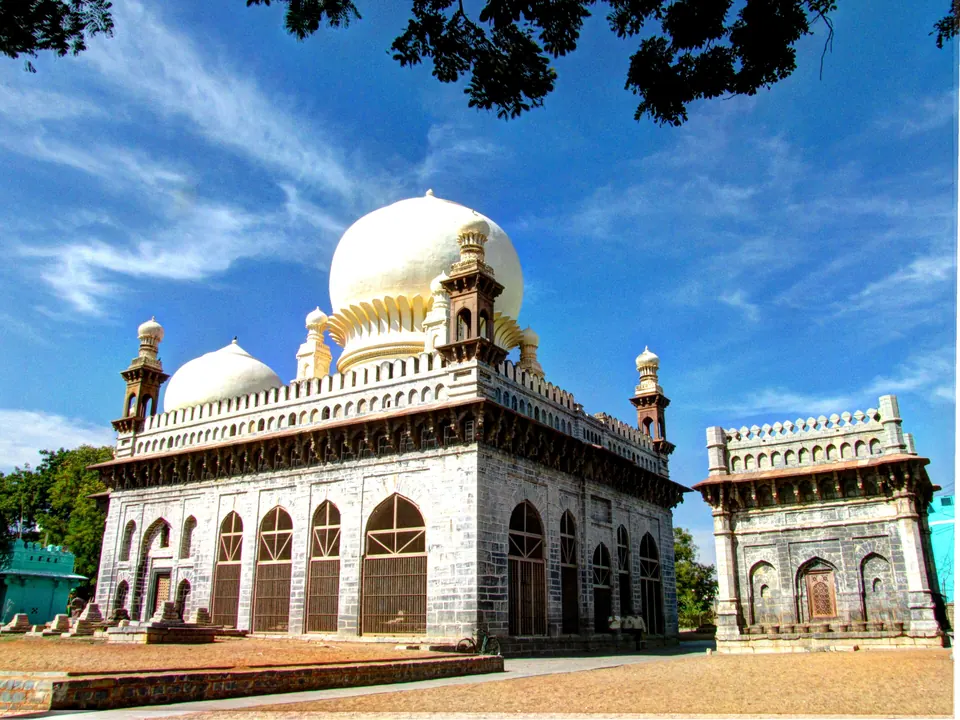
Walled town where the Handri meets the Tungabhadra, the headquarters of the Kurnool district. Tradition says its fort was built in Achyuta Raya's time. Early in the seventeenth century the Bijapur general Abdul Wahab took it from Gopala Raja, a grandson of Aliya Rama Raya. It was then governed from Bijapur until the Mughal conquest of 1686–88. The two-domed tomb of Abdul Wahab (1618) is its chief old building. From the Mughal conquest until 1839 Kurnool was the seat of the Pathan Nawabs of Kurnool. The French stormed the fort in 1751. In 1839 the last Nawab gave it up to a British commission, and the town became the headquarters of a British district. From 1 October 1953 Kurnool was the capital of the new Andhra State, and its Legislative Assembly met there. In November 1953 the Assembly debated moving the capital, but the resolution was lost. Andhra Pradesh, formed on 1 November 1956, had Hyderabad as its capital.
Kurnool is an old walled town where the Handri river meets the Tungabhadra.1 It was ruled in turn by Vijayanagara, Bijapur, the Mughals and its own Pathan Nawabs, until the last Nawab gave up the fort to the British in 1839.234 It became the headquarters of the Kurnool district of the Madras Presidency.5 From 1953 to 1956 it was the capital of the Andhra State.67 This page covers the town’s history under Vijayanagara and Bijapur, the Mughal conquest and the Nawabs. See also the Mughals in the Telugu country and the Nawabs of Kurnool.
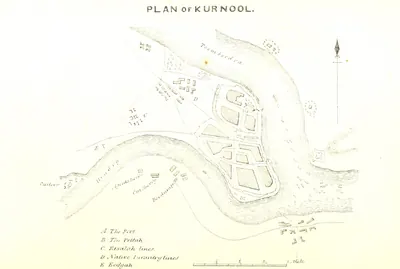
The district manual of 1886 says that Kurnool lies “on a tongue of land” (a narrow point of land) “at the confluence of the Tungabhadra and Handri”.1 It calls Kurnool “an ancient walled town, said to have been built in the eleventh century”.1
Vijayanagara
The manual records a local tradition about the town’s early history.82 According to it, Kurnool once belonged to “the estate of Yusuf Savai”, the founder of the Bijapur kingdom.82 Later the Vijayanagara king sent Rama Raja to take it.82 This Rama Raja was the grandfather of the Rama Raja who fell in 1565.82 He drove out Yusuf’s agents and held Kurnool as a fief (land held in return for service).82
The manual also says that “the fort of Kurnool was built” in the time of Achyuta Raya.2 The Imperial Gazetteer repeats that the fort is said to have been built by him.5 The manual names Rama Raja and his brothers Erra Timma Raja and Venkatadri as “all jaghiredars of Kurnool”, that is, holders of land grants there.9 See Yusuf Adil Khan, Achyutaraya and Aliya Rama Raya.
Bijapur
After 1565, the manual says, Bijapur received “among other provinces, the Doab, Adoni, and Nandyal”, but did not occupy them at once.910 For “nearly sixty years after the battle of Talikota”, the district “appears to have been a scene of confusion and anarchy”.910 Kurnool was left “in the hands of the native ruler, Sri Ranga Raja, a nephew of Rama Raja”.910
At the beginning of the seventeenth century, the Bijapur general Abdul Wahab Khan besieged the town.11 It was then held by Gopala Raja, a grandson of Rama Raja.11 Troops from Venkatapati of Penukonda came to help Gopala Raja.11 But at last he fled “through the northern gate of the fort still known as Gopal Darvaja”.11 Henry Heras placed the conquest shortly after a failed Bijapur siege of Penukonda, in the reign of Ibrahim Adil Shah II.1213
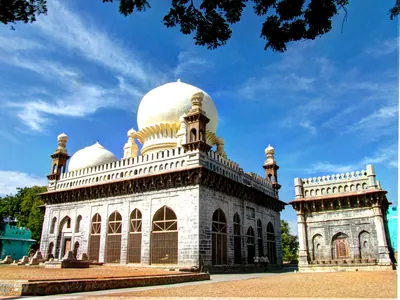
Abdul Wahab governed for about sixteen years.3 He died in 1618 and was buried in a tomb on the Handri.3 His brother Muhammad succeeded him.3 After that, “the country continued to be governed by deputies from Bijapur till the downfall of that kingdom in 1686”.3 See the tomb of Abdul Wahab.
About 1660, Kurnool was the government and jagir (land grant) of the Abyssinian officer Siddi Jauhar.1415 He withdrew there after his failure against Shivaji at Panhala in 1660, and he rebelled in 1662.1415
Jadunath Sarkar describes the Abyssinian nobles of Bijapur as “ruling over the eastern province, viz., the Karnul district and a part of the Raichur Doab”.161718 He says that Ali Adil Shah II forced the “refractory” (disobedient) Abyssinian officers of the north-east province (Karnul) “back into submission”.161718
In 1677 Shivaji crossed the Krishna on his way to Srisailam and the Karnatak.19 He crossed “at the Nivritti Sangam where the Bhavanashi flows into it, 24 miles north-east of Karnul”.19 The manual dates the visit to 1674.3 It says that Shivaji forced Ananda Rao, the deshmukh (hereditary revenue officer) of Kurnool, to pay him three lakhs of rupees.3 See the Adil Shahis of Bijapur.
The Mughal conquest
According to the manual, Bijapur fell in 1686, and the Mughal commander Ghiyas-ud-din Khan took Adoni from Masud Khan.3 He then “proceeded to Kurnool, which he took and named Kammur Nagar”.3 He appointed Raja Bhima Singh to manage the district.3 Later the Kurnool country was given as a jagir to the Afghan general Daud Khan Panni.3
Sarkar says that Firuz Jang was sent on 25 January 1688 “to conquer the district of Karnul and the fort of Adoni”.20 See Adoni.
The Nawabs
After the Mughal conquest Kurnool was the seat of the Pathan Nawabs until 1839.34 Kirkpatrick wrote a sketch of “the Patan Principality of Kurnool” in 1811.2122 He notes that the Persian historian Mir Husain said the town’s name came from its fine cotton cloth.2122 Mir Husain explained Kundnool as “fine spun, clear thread”.2122 He thought Kurnool “not less celebrated … for the beauty of its women than for that of its muslins”.2122
Kirkpatrick says that Ibrahim Khan seized the fort in 1715.2122 Ibrahim Khan rebuilt the citadel (inner fort) in masonry (stone or brick), and improved the town.2122 Before this, the citadel wall “appears to have consisted only of mud”.2122
The manual says that floods on the Handri and the Tungabhadra carried away part of the walls in 1750.2324 On 15 March 1751, the French and the army of Salabat Jang “came to Kurnool and carried the fort by assault”.2324 They massacred the people of the town.2324 See the Nawabs of Kurnool and Himmat Bahadur Khan.
After the Nawab Alif Khan died, a British force from Bellary besieged the fort.25 About 4,000 men held it for his son, Muzaffar Khan.25 The British batteries (groups of guns) opened fire on 14 December, and the fort surrendered the next day.25
A British commission was looking into the last Nawab’s secret collection of cannon and stores.426 In 1839 the Nawab, Ghulam Rasul Khan, gave up the fort to the commission and moved to Jalapur, about a mile away.426 The jagir was annexed (taken over).426 The territory was then governed from Kurnool by a Commissioner, and then by an Agent.426 It became a Collectorate (an ordinary district under a Collector) in 1858.426
Muhammad Burhanuddin wrote in 1905 that the Nawab’s grandson still lived at Kurnool, in “one of the houses of his late grandfather”.2728 The house had cost “upwards of three lacs of rupees” to build, and it was “crumbling down”.2728 See Ghulam Rasul Khan.
Capital of the Andhra State, 1953–1956
In March 1953 the Prime Minister announced the plan for a new Andhra State.29 Its capital, even a temporary one, was to be inside its own territory.29 The Andhra members of the legislature were to choose the site.29 The Andhra State was inaugurated on 1 October 1953, with Kurnool as its capital.6
According to the police history, the offices of the Inspector-General of Police and other police heads began work at Kurnool on that day.6 A Deputy Superintendent of Police for traffic in Kurnool town was appointed from 15 October 1953.6 On 15 February 1954 the Kurnool police district was split into Kurnool Urban and Kurnool Rural.30
The first Andhra Legislative Assembly met in the Assembly Chamber at Kurnool on 23 November 1953.31 N. Venkatramaiya was elected its Speaker that day.32 On 24 March 1954 the Deputy Chief Minister, Neelam Sanjiva Reddy, answered a question about tents for government officials at Kurnool.33 He said that putting up the tents had cost Rs. 1,40,600.33
The capital debate of November 1953
On 30 November 1953 the Assembly at Kurnool debated a resolution on the capital.34 L. Lakshmana Das moved it.34 It asked that the temporary capital stay at Kurnool until 1 October 1956.34 After that, Visakhapatnam was to become the permanent capital.34
Members moved many amendments.35 Most of them wanted the capital in the Guntur–Vijayawada area, some as early as April 1954.35 Two asked that no more money be spent on buildings at Kurnool.36 One proposed Nellore.37 Another asked for the capital to move to Vijayawada–Guntur while the state still worked for Visalandhra, a single Telugu state with Hyderabad as its capital.37 One member cited the report of Justice K. N. Wanchoo in support of the Guntur–Vijayawada area.38 The Speaker ruled out of order an amendment that would have named Hyderabad instead of Visakhapatnam.38
The House then voted on an amendment to keep the temporary capital at Kurnool only until 1 April 1956.39 It was carried by 61 votes to 58, with 20 members neutral.39 The Chief Minister, Tanguturi Prakasam, voted for it.39 Another amendment was carried after the ministers said they would take no further part.40 It asked that the Andhra offices still in Madras be moved to Guntur–Vijayawada before January 1954.40 The resolution in its amended form was then put to the vote and lost.40
The last years as capital
The Assembly went on meeting at Kurnool.4142 In April 1955 the Speaker put off question hour because the seating in the chamber was not ready.41 The official reports of these debates were printed at the Andhra Government Press, Kurnool.43
On 25 November 1955 the Assembly at Kurnool discussed the report of the States Reorganisation Commission.43 The Chief Minister, B. Gopala Reddi, moved the government’s motion.43 It asked the Government of India to join Telangana and Andhra at once, instead of waiting until 1961.43 It wanted Hyderabad to be the seat of the government and the High Court.43
Andhra Pradesh was formed on 1 November 1956, with Hyderabad city as its capital.7 The story of the new state is told on the page Andhra State & Andhra Pradesh.
Old remains
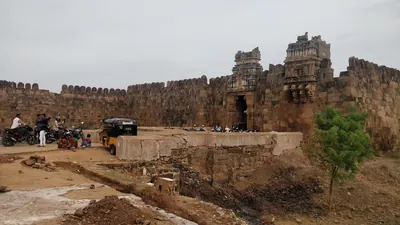
The manual lists the town’s antiquities (old remains).4445 They are the tomb of Abdul Wahab, the remains of Gopala Raja’s palace, and “the fort gate now converted into a hospital room and the town walls”.4445 The suburb of Jorapuram, south of the Handri, takes its name from Jora, a sister of Abdul Wahab, the manual says.4445
Footnotes
-
Narahari Gopalakristnamah Chetty, A Manual of the Kurnool District (1886), p. 223 (archive.org (opens in a new tab)). ↩ ↩2 ↩3
-
Chetty, Kurnool District (1886), p. 25 (archive.org (opens in a new tab)). ↩ ↩2 ↩3 ↩4 ↩5 ↩6 ↩7
-
Chetty, Kurnool District (1886), p. 29 (archive.org (opens in a new tab)). ↩ ↩2 ↩3 ↩4 ↩5 ↩6 ↩7 ↩8 ↩9 ↩10 ↩11 ↩12
-
Chetty, Kurnool District (1886), p. 41 (archive.org (opens in a new tab)). ↩ ↩2 ↩3 ↩4 ↩5 ↩6 ↩7
-
Imperial Gazetteer of India: Madras, Vol. I (1908), p. 426 (archive.org (opens in a new tab)). ↩ ↩2
-
The History of the Andhra Pradesh Police (1861–1961) (1961), p. 250 (archive.org (opens in a new tab)). ↩ ↩2 ↩3 ↩4
-
History of the Andhra Pradesh Police (1961), p. 260 (archive.org (opens in a new tab)). ↩ ↩2
-
Chetty, Kurnool District (1886), p. 24 (archive.org (opens in a new tab)). ↩ ↩2 ↩3 ↩4 ↩5
-
Chetty, Kurnool District (1886), p. 26 (archive.org (opens in a new tab)). ↩ ↩2 ↩3 ↩4
-
Chetty, Kurnool District (1886), p. 27 (archive.org (opens in a new tab)). ↩ ↩2 ↩3
-
Chetty, Kurnool District (1886), p. 28 (archive.org (opens in a new tab)). ↩ ↩2 ↩3 ↩4
-
Heras, The Aravidu Dynasty of Vijayanagara, Vol. I (1927), p. 336 (archive.org (opens in a new tab)). ↩
-
Henry Heras, The Aravidu Dynasty of Vijayanagara, Vol. I (1927), p. 337 and note 1 (archive.org (opens in a new tab)). ↩
-
James Grant Duff, A History of the Mahrattas, Vol. I (1826), p. 178 (archive.org (opens in a new tab)). ↩ ↩2
-
Grant Duff, History of the Mahrattas, Vol. I (1826), p. 182 (archive.org (opens in a new tab)). ↩ ↩2
-
Jadunath Sarkar, History of Aurangzib, Vol. IV (2nd ed., 1930), p. 151 (archive.org (opens in a new tab)). ↩ ↩2
-
Sarkar, Aurangzib IV (1930), p. 156 and note (archive.org (opens in a new tab)). ↩ ↩2
-
Sarkar, Aurangzib IV (1930), p. 157 (archive.org (opens in a new tab)). ↩ ↩2
-
Jadunath Sarkar, Shivaji and his Times (2nd ed., 1920), p. 337 (archive.org (opens in a new tab)). ↩ ↩2
-
Sarkar, Aurangzib IV (1930), p. 459 and note (archive.org (opens in a new tab)). ↩
-
William Kirkpatrick (tr.), Select Letters of Tippoo Sultan (1811), Appendix G, p. li, notes 2–3 (archive.org (opens in a new tab)). ↩ ↩2 ↩3 ↩4 ↩5 ↩6 ↩7
-
Kirkpatrick, Select Letters of Tippoo Sultan (1811), Appendix G, p. lv (archive.org (opens in a new tab)). ↩ ↩2 ↩3 ↩4 ↩5 ↩6 ↩7
-
Chetty, Kurnool District (1886), p. 32 (archive.org (opens in a new tab)). ↩ ↩2 ↩3
-
Chetty, Kurnool District (1886), p. 33 (archive.org (opens in a new tab)). ↩ ↩2 ↩3
-
Chetty, Kurnool District (1886), p. 39 (archive.org (opens in a new tab)). ↩ ↩2 ↩3
-
Imperial Gazetteer: Madras, Vol. I (1908), p. 407 (archive.org (opens in a new tab)). ↩ ↩2 ↩3 ↩4 ↩5
-
Muhammad Burhanuddin Siddiqui, The Carnatic & Kurnool, their Last Muhammedan Rulers (Madras, 1905), p. 76 (archive.org (opens in a new tab)). ↩ ↩2
-
Burhanuddin, The Carnatic & Kurnool (1905), p. 77 (archive.org (opens in a new tab)). ↩ ↩2
-
“Prime Minister’s Statement on Andhra”, 25 March 1953, printed in Madras Legislative Assembly Debates, 2 April 1953, appendix, pp. 823–825 (archive.org (opens in a new tab)). ↩ ↩2 ↩3
-
History of the Andhra Pradesh Police (1961), pp. 250–251 (archive.org (opens in a new tab)). ↩
-
Andhra Legislative Assembly Debates, 23 November 1953, p. 1 (archive.org (opens in a new tab)). ↩
-
Andhra Legislative Assembly Debates, Vol. I (1953), “Principal Officers” (archive.org (opens in a new tab)). ↩
-
Andhra Legislative Assembly Debates, 24 March 1954, p. 178 (archive.org (opens in a new tab)). ↩ ↩2
-
Andhra Legislative Assembly Debates, 30 November 1953, pp. 347–348 (archive.org (opens in a new tab)). ↩ ↩2 ↩3 ↩4
-
Andhra Legislative Assembly Debates, 30 November 1953, pp. 363–365 (archive.org (opens in a new tab)). ↩ ↩2
-
Andhra Legislative Assembly Debates, 30 November 1953, p. 365 (archive.org (opens in a new tab)). ↩
-
Andhra Legislative Assembly Debates, 30 November 1953, p. 366 (archive.org (opens in a new tab)). ↩ ↩2
-
Andhra Legislative Assembly Debates, 30 November 1953, p. 367 (archive.org (opens in a new tab)). ↩ ↩2
-
Andhra Legislative Assembly Debates, 30 November 1953, pp. 412–415 (archive.org (opens in a new tab)). ↩ ↩2 ↩3
-
Andhra Legislative Assembly Debates, 30 November 1953, pp. 428–429 (archive.org (opens in a new tab)). ↩ ↩2 ↩3
-
Andhra Legislative Assembly Debates, 26 April 1955, p. 121 (archive.org (opens in a new tab)). ↩ ↩2
-
Andhra Legislative Assembly Debates, 3 April 1956, p. 139 (archive.org (opens in a new tab)). ↩
-
Andhra Legislative Assembly Debates, 25 November 1955, title page and pp. 1–2 (archive.org (opens in a new tab)). ↩ ↩2 ↩3 ↩4 ↩5
-
Chetty, Kurnool District (1886), p. 224 (archive.org (opens in a new tab)). ↩ ↩2 ↩3
-
Chetty, Kurnool District (1886), p. 225 (archive.org (opens in a new tab)). ↩ ↩2 ↩3
Photos
Related
Dynasties
People
Yusuf Adil Khan (Yusuf Adil Shah)
c. 1489–1510 CE
Founder of the Adil Shahi dynasty of Bijapur (r. about 1489–1510). He was a foreign-born officer of the Bahmani kings who governed the province of Bijapur with the title Adil Khan. He declared his independence in AH 895 (1489–90). In 1493 he defeated the Vijayanagara regent Timmaraja and took Mudgal and Raichur. This began a century of war over the Raichur doab.
Ibrahim Adil Shah II
1580–1627 CE
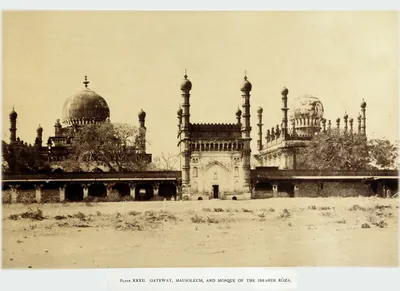
Sixth Adil Shahi sultan of Bijapur (r. 1580–1627), nephew and successor of Ali Adil Shah I, called Jagat Guru. He was the patron of the historian Ferishta and the builder of the Ibrahim Rauza. In his reign Bijapur held Adoni against a siege of 1595–96. Early in the seventeenth century it took Kurnool from the last Hindu chief of the town. Heras places Ferishta's account of a failed Bijapur siege of Penukonda in these years.
Muhammad Adil Shah
1627–1656 CE
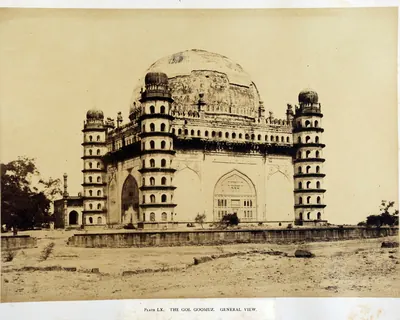
Seventh Adil Shahi sultan of Bijapur (r. 1627–1656), called Mahmud in some histories, and the builder of the Gol Gumbaz. He made peace with Shah Jahan in 1636 and then sent his armies into the Karnatak, with Shahji Bhonsle among the commanders. Bijapur took Jinji and Vellore, Penukonda (1652, by a Mackenzie manuscript) and the uplands of the Bellary and Anantapur country. It divided the Karnatak with Golconda's minister Mir Jumla.
Shivaji
c. 1627–1680 CE
Founder of the Maratha kingdom (died 1680), crowned at Raigarh in 1674. In the Telugu country he is remembered for his Karnatak expedition of 1677. He made an alliance with Abul Hasan Qutb Shah of Golconda, and the king and his ministers Madanna and Akkanna received him at Hyderabad with great ceremony. He made a pilgrimage to Srisailam, crossed the Krishna near Kurnool and sent his army south through the Cuddapah country to Jinji. On the way home he took the fort of Bellary. In 1680 Bijapur gave him its rights over the Bellary and Anantapur country.
Ali Adil Shah II
1656–1672 CE
Eighth Adil Shahi sultan of Bijapur (r. 1656–1672). Aurangzeb invaded the kingdom when he came to the throne, claiming that he was not Muhammad Adil Shah's son. His reign saw the rise of Shivaji and the rebellion of Siddi Jauhar, the Abyssinian governor of Kurnool. Royal campaigns brought the Kurnool province and the Raichur country back under control, before the Mughal treaties of 1666–68 cut down the kingdom.
Siddi Masud Khan
c. 1662–1688 CE
Abyssinian noble of Bijapur. By the Bellary gazetteer's count he was governor and jagirdar (land-grant holder) of Adoni from 1662 to 1687. From 1678 he was regent of the kingdom for the boy-king Sikandar Adil Shah. He built the Jama Masjid of Adoni, which its inscriptions date to AH 1079 (1666–67). Driven from the capital, he held Adoni as the last Bijapur stronghold in the Telugu country. He surrendered it to the Mughals, in 1688 according to Sarkar.
Sikandar Adil Shah
1672–1686 CE
Ninth and last Adil Shahi sultan of Bijapur (r. 1672–1686). He came to the throne as a small boy and reigned under regents: Khawas Khan, Bahlol Khan, and the Abyssinian Siddi Masud, jagirdar (land-grant holder) of Adoni. In his reign Shivaji marched through the Kurnool country to take Bijapur's Karnatak forts (1677), and the Raichur doab was ceded to the Marathas. Aurangzeb took Bijapur on 12 September 1686. Sikandar died a prisoner in 1700.
Himmat Bahadur Khan (Nawab of Kurnool)
1733–1751 CE
Pathan Nawab of Kurnool from 1733 to 1751. The Kurnool manual calls him Himayat Khan, and Kirkpatrick's sketch of the family calls him Bahadur Khan or Himmat Bahadur. The Marathas overran his country in 1741. In 1750 Nasir Jang called him to his camp, and he joined the Pathan Nawabs of Cuddapah and Savanur in the plot with the French that ended in Nasir Jang's murder near Jinji. Several historians say that he fired the shot. Early in 1751 the three Nawabs turned on the new Nizam, Muzaffar Jang, near Rayachoti. Himmat Bahadur killed him with a javelin and was cut down. Salabat Jang and Bussy then stormed Kurnool and took his sons to Hyderabad.
Ranmast Khan (Munawwar Khan, Nawab of Kurnool)
1752–1792 CE
Pathan Nawab of Kurnool from 1752 to 1792, the brother of Himmat Bahadur Khan, called Ranmast Khan and Munawwar Khan. His brother died, and the French stormed Kurnool in 1751. He came back from Arcot and raised troops with money from the Nawab of Cuddapah and the help of the deshmukh of Kurnool. In 1752 he won back his capital from the Nizam's officer and the raja of Gadwal. He paid tribute to the Nizam and, from 1769 or about 1775, to Haidar Ali. Local tradition says he paid Haidar after a holy man's attempt to frighten Haidar failed. Tipu Sultan pressed him for unpaid tribute. His son Alif Khan led his horsemen with the Nizam's army against Tipu in 1790–92, and he died in 1792.
Abdul Halim Khan (Nawab of Cuddapah)
1761–1779 CE
The last Pathan Nawab of Cuddapah. He ruled Cuddapah and Sidhout from 1761 until Haidar Ali conquered him in 1779. A Telugu account translated by C. P. Brown says he was freed from prison in the fort of Sidhout in 1761 and became ruler when the Nawab Mohsin Khan left. Gribble says he followed his uncle, whom he calls Mahasim Khan. He paid Haidar money in 1769 and sent him horsemen in 1776, but he sided with the Nizam's general against him. In 1779 Haidar and Mir Sahib defeated his Pathan horsemen near Duvvur, took Cuddapah and forced him to surrender at Sidhout. He died a prisoner at Seringapatam, and his sister became Haidar's wife as Bakhshi Begum.
Haidar Ali
1761–1782 CE
A soldier who made himself master of Mysore in 1761 and ruled it until he died in December 1782. In the Telugu country he took Penukonda and Madakasira from the Maratha Morari Rao in 1762. He won back Gurramkonda through his brother-in-law Mir Sahib in 1768, took Bellary in 1775 and took Gooty from Morari Rao in 1776. In 1779 he conquered the Nawab of Cuddapah, and the Nawab of Kurnool and the poligars of the Bellary and Anantapur country paid him tribute. His invasion of the Carnatic in 1780 began the Second Mysore War.
Tipu Sultan
1782–1799 CE
Son of Haidar Ali and ruler of Mysore from December 1782 until he was killed at the fall of Seringapatam on 4 May 1799. As a young commander he took Gurramkonda back from the Marathas in 1773–74. As Sultan he held Gooty, Gurramkonda, Cuddapah, Bellary and the Anantapur country. He gave Gooty and Gurramkonda the new names Faiz Hisar and Zafarabad and struck copper coins at both. He besieged Adoni in 1786 and seized the poligars of Rayadurg and Harpanahalli. By the treaty of 1792 he gave up Cuddapah, Gurramkonda, Bellary and Tadpatri to the Nizam. The rest of his Telugu districts went to the Nizam after his death and were ceded to the East India Company in 1800.
Alif Khan II (Nawab of Kurnool)
1792–1815 CE
Pathan Nawab of Kurnool from 1792 to 1815. He was the third son of Ranmast (Munawwar) Khan, and the Kurnool manual calls him Aluf Khan. He put down his elder brother Hasan Ali Khan, led 1,400 horse for the Nizam at Kharda in 1795 and refused Tipu Sultan's claim to tribute. In 1800 the Nizam handed the Kurnool tribute to the East India Company. Alif Khan denied that it was owed but agreed to pay of his own will. In 1804 the payment was fixed at a lakh and a quarter of Gadwal rupees for eight years and a lakh after that, with 500 horse and 500 foot soldiers. He tried to make his favourite son, Ghulam Rasul, his heir and imprisoned the eldest, whom a Company force freed in 1813. His rule was remembered as harsh.
Ghulam Rasul Khan (Nawab of Kurnool)
1823–1839 CE
The last Nawab of Kurnool, who ruled from 1823 to 1839. He was a younger son of Alif Khan II. He followed his brother Munawwar Khan after another brother, Muzaffar Khan, was imprisoned for murder. The Kurnool manual describes his rule as greedy and his habits as wasteful. At a time of reports of a Wahhabi plot against the British, the Madras government learnt that he was repairing his forts and secretly gathering cannon and military stores. It sent a commission with troops in 1839. He gave up the fort, his unpaid Rohilla and Arab troops were fired on, and he was sent away to Trichinopoly, where a servant murdered him. His jagir was taken over and his family given pensions.
Uyyalawada Narasimha Reddy
1846 CE
Member of a family of former poligars (local chiefs) of Uyyalawada and Nossam, in the Kurnool country. In 1846 he raised the kattubadis (village revenue peons) against the Company's government, looted the Koilkuntla treasury and fought troops at Giddalur. He was captured in October 1846 and hanged at Koilkuntla. The district manuals of 1875 and 1886 tell the story from the government's side.
Ghulam Muhammad Ali Khan of Banganapalle
1848–1868 CE
Jagirdar of Banganapalle from 1848 to 1868, called Ghulam Ali Khan in the treaties and in the family history. A grandson of Mansur-ud-daula, he was adopted by his uncle Husain Ali Khan and married to his daughter. In 1848 the Madras government handed back the jagir after clearing the family's debts, but Husain Ali Khan died before his sanad (grant) was issued. Ghulam Ali Khan received the sanad of 1849, with civil and criminal jurisdiction short of the death penalty. In 1862 he received the Crown's sanad permitting succession under Muslim law. He was made a Companion of the Star of India and died on 7 October 1868.
Fateh Ali Khan, Nawab of Banganapalle
1868–1905 CE
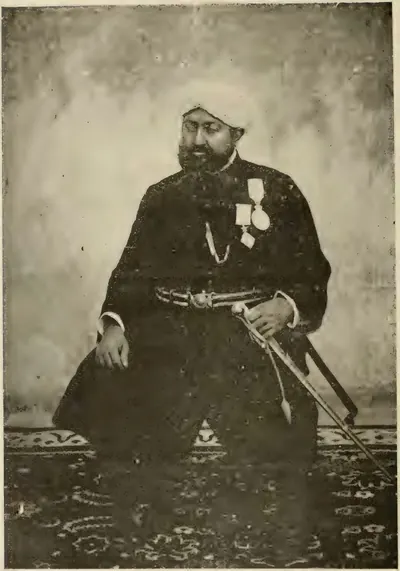
Ruler of Banganapalle from 1868 to 1905, and its first ruler to hold the hereditary title of Nawab, granted in 1876. He was born in 1848, a nephew and son-in-law of Ghulam Muhammad Ali Khan. The Madras government accepted him over the claims of his uncle's widow and of a son-in-law. He was made a Companion of the Star of India. He reorganised the State's courts, police, jail and dispensary, and borrowed three lakhs of rupees from the government in 1877. In January 1905 he was removed from the direct running of the State for bad government, and he died three months later.
Abdul Wahab Khan
before 1618 CE
Abyssinian general of Bijapur who took Kurnool from Gopala Raja, a grandson of Aliya Rama Raya, early in the seventeenth century. He governed it for about sixteen years as the first Bijapur governor of the town. He died in AH 1028 (1618) and is buried in the two-domed tomb on the bank of the Handri at Kurnool.
Anwar-ud-din Khan
before 1749 CE
Nawab of the Carnatic (Arcot) from 1744 until he was killed at the battle of Ambur in 1749, and the founder of the family of the later Nawabs, the Walajahs. He was an officer of Nizam-ul-Mulk. From 1725 to 1741 he governed the Ellore and Rajahmundry country in the Telugu north, and then the Nizam gave him Arcot. His sons Mahfuz Khan and Muhammad Ali fought beside him at Ambur against Chanda Sahib, Muzaffar Jang and the French. Muhammad Ali escaped to Trichinopoly and, with English support, won his claim to the Nawabship.
Kala Venkata Rao
Congress organiser from Amalapuram in the Godavari district. He left his B.Sc. studies at Machilipatnam in the non-cooperation movement of 1920–21 and was jailed then. He was among the leaders banned from public work in 1932, was sentenced in the satyagraha of 1940–41, and on 29 July 1942 drafted the Andhra Congress instructions known as the Kurnool circular.
Neelam Sanjiva Reddy
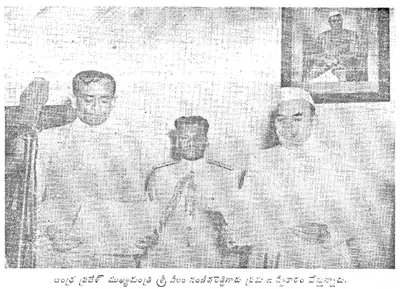
Congress leader and member for Kalahasti in the Andhra Legislative Assembly. He was Deputy Chief Minister of the Andhra State at Kurnool from 1953 to 1956 and one of the Andhra leaders who agreed the terms for the union with Telangana in February 1956. On 1 November 1956 he was sworn in as the first Chief Minister of Andhra Pradesh, and he was still Chief Minister in 1958.
Raghoji Bhonsle I
before 1753 CE
Maratha chief of Berar and Nagpur, the Sena Sahib Subha of the Maratha state. In 1740 he led the great Maratha army into the Carnatic. On its way south it defeated the Nawabs of Kurnool and Cuddapah, and it killed the Nawab of Arcot and took Trichinopoly in 1741. In 1753 the Nizam Salabat Jang made peace with him by giving up land that both sides claimed. Grant Duff dates his death to March 1753. The Vizagapatam gazetteer credits 'the Marathas under Ragoji Bhonsla' with the raid on the Northern Circars in 1754.
Siddi Jauhar (Salabat Khan)
before 1662 CE
Abyssinian officer of Bijapur who held Kurnool as his government and jagir (land grant) under Ali Adil Shah II. Given the title Salabat Khan, he besieged Shivaji in Panhala in 1660. Suspected of letting him escape, he withdrew to Kurnool, rose against the king in 1662 and was killed by his own followers. His son-in-law was Siddi Masud of Adoni.
Tanguturi Prakasam
Barrister and Congress leader of the Telugu districts of Madras. He chaired the Madras meeting against the Rowlatt Bills in 1919, gave up his practice during non-cooperation, led the salt satyagraha in Madras city in 1930 and became Revenue Minister in 1937. He later served as Chief Minister of Madras and then as the first Chief Minister of the Andhra State. His ministry sat at Kurnool, and it fell after a vote of no confidence in November 1954.
Monuments
References
Notes (0)
Sources (16)
Spotted an error on this page? Tell us
Last updated: