Bellary (Ballari)
Fort and town on the plain south of the Tungabhadra, now in Karnataka. It was once the head of one of the Ceded Districts. Its poligars held it under Vijayanagara and Bijapur. Shivaji took it in 1678, and in the eighteenth century it paid tribute to Basalat Jang of Adoni. Haidar Ali was beaten off from it in 1768 or 1769. He seized it in 1775 after driving off Basalat Jang's army, and built its present upper and lower forts. Tipu Sultan lost it to the Nizam in 1792, and the Nizam ceded it to the East India Company in 1800.
Bellary is a fort and town on the plain south of the Tungabhadra.1 It lies outside the Telugu districts of today.2 But from 1800 it was the centre of the Ceded Districts, and their troops were posted there to subdue the poligars (local chiefs).2 See Mysore under Haidar Ali and Tipu Sultan.
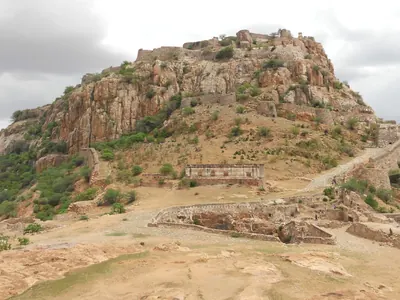
Bellary stands on a wide plain of black cotton soil. Two bare granite hills overlook it, the Fort Hill and the Face Hill. The Face Hill is “so called from the resemblance of certain rocks on its summit to a human face”. The Imperial Gazetteer of Madras (1908) describes the fortress.1 It has “an upper citadel on the rock, the top of which is 1,976 feet above the sea, and a lower enclosure at the foot”.1 The citadel (inner fort) is “guarded by three lines of strong fortifications”.1 It has reservoirs in the clefts of the rock, and “only one way up”.1
The poligars of Bellary
The Bellary gazetteer (1904) follows two Mackenzie manuscripts.3 It names the first poligar as a Kuruba called Baluda Hanumappa Nayak.3 He seems to have held office under the Vijayanagara kings.3 Then he received Bellary from the Sultan of Bijapur, in return for a tribute and the service of 3,000 peons (foot soldiers).3
About 1678 Shivaji took the fort after a siege of 27 days.34 It was then held by a poligar’s widow, and he gave it back to her when she agreed to pay tribute.34 See Shivaji.
The poligars won back their authority about 1692.4 Ramappa ruled until 1764.4 In his time, the town paid tribute to Adoni, “which had been granted in jaghir” (as a land grant) “to Basálat Jang, brother of Salábat Jang”.4 See Adoni.
Haidar Ali
In 1768, the gazetteer says, Haidar Ali tried to take the place by assault, but he “was beaten off with great loss and retreated”.4 Wilks places the attack during Haidar’s tour of 1769.5 He says that the poligar was “a dependency of Adwani, the jageer of Basalut Jung”.5 Haidar was short of time, so he accepted “the promise only of future contribution”.5
In 1775 the poligar Doddappa refused to pay his tribute to Basalat Jang.46 He declared “that he had transferred his allegiance to Haidar Ali”.46 Basalat Jang sent his minister Bojeraj with the French officer Lally to besiege him.46
Haidar marched from Srirangapatna (then Seringapatam) in five days.78 He routed the besiegers, and Bojeraj was killed.78 Then Haidar turned the besiegers’ own batteries (guns) on the fort.78 Wilks writes that “Hyder’s garrison was introduced into the place on the 8th day after his march from Seringapatam”.78
Haidar kept the place, and the gazetteer says that “it was he who built the present upper and lower forts as they now are”.6 Both gazetteers record a tradition that a French adventurer in Haidar’s camp designed the forts.69 In the story, Haidar later found that the Face Hill commanded (overlooked) the fort.69 So he hanged the Frenchman near the gate.69
The Bellary gazetteer notes that the same story is told of other forts of Haidar and Tipu.6 It adds that the tomb near the east gate, shown as the Frenchman’s, is older than the fort and of Muslim style.6 J. R. Henderson lists two rough, undated copper paisas struck at Bellary among the doubtful coins of Haidar.10 He notes that “no other coins of this mint” are known.10
Tipu Sultan and the cession
In 1786 Tipu Sultan carried the guns and stores of Adoni to Gooty and Bellary, before destroying Adoni’s walls.11 The gazetteer says that “Tipu held the fort, until his defeat in 1792, when it became the property of the Nizam”.6
The treaty of Srirangapatna lists “Bulkarykoor, etc., 2 Talooks” among the Nizam’s districts.1213 The schedule of 1800 enters them as “Bulhary and Kurkoor”.1213 The gazetteer says that the treaty of 1790 had named the chiefs of Bellary, Rayadurg and Harpanahalli among the poligars to be left in their districts.2 In 1792 part of the Bellary district went to the Nizam, and the rest followed in 1799.2 In 1800 the Nizam ceded the district to the Company.9
Munro wrote in 1801 that Bellary was “a poor place and was almost desolate before the arrival of the troops”.39 The gazetteer says that the town, as distinct from its fort, was only a hundred years old in 1904.39 It became the district headquarters only in 1840.39 See Haidar Ali.
Footnotes
-
Imperial Gazetteer of India, Provincial Series: Madras, Vol. I (1908), p. 454 (archive.org (opens in a new tab)). ↩ ↩2 ↩3 ↩4 ↩5
-
W. Francis, Madras District Gazetteers: Bellary (1904), p. 46 (archive.org (opens in a new tab)). ↩ ↩2 ↩3 ↩4
-
Francis, Bellary (1904), p. 216 (archive.org (opens in a new tab)). ↩ ↩2 ↩3 ↩4 ↩5 ↩6 ↩7 ↩8 ↩9
-
Francis, Bellary (1904), p. 217 (archive.org (opens in a new tab)). ↩ ↩2 ↩3 ↩4 ↩5 ↩6 ↩7 ↩8 ↩9
-
Mark Wilks, Historical Sketches of the South of India, Vol. II (1817), p. 131 (archive.org (opens in a new tab)). ↩ ↩2 ↩3
-
Francis, Bellary (1904), p. 218 (archive.org (opens in a new tab)). ↩ ↩2 ↩3 ↩4 ↩5 ↩6 ↩7 ↩8 ↩9 ↩10
-
Wilks, Historical Sketches, Vol. II (1817), p. 165 (archive.org (opens in a new tab)). ↩ ↩2 ↩3 ↩4
-
Wilks, Historical Sketches, Vol. II (1817), p. 166 (archive.org (opens in a new tab)). ↩ ↩2 ↩3 ↩4
-
Imperial Gazetteer: Madras, Vol. I (1908), p. 455 (archive.org (opens in a new tab)). ↩ ↩2 ↩3 ↩4 ↩5 ↩6 ↩7
-
J. R. Henderson, The Coins of Haidar Ali and Tipu Sultan (Madras Government Museum, 1921), p. 2 (archive.org (opens in a new tab)). ↩ ↩2
-
Wilks, Historical Sketches, Vol. II (1817), p. 549 (archive.org (opens in a new tab)). ↩
-
Aitchison, Treaties, Vol. IX (1909), p. 215 (archive.org (opens in a new tab)). ↩ ↩2
-
C. U. Aitchison, A Collection of Treaties, Engagements and Sanads, Vol. IX (4th ed., 1909), p. 76, schedule to the treaty of 1800 (archive.org (opens in a new tab)). ↩ ↩2
Photos
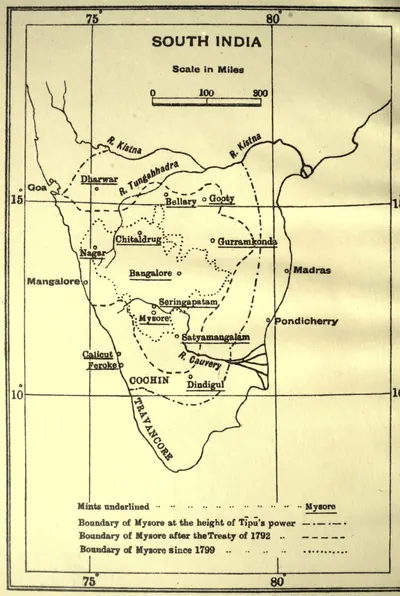 "Mints of Haidar Ali and Tipu Sultan": map with the boundaries of Mysore at the height of Tipu's power, after 1792 and after 1799 (Henderson 1921, frontispiece)Map · 1921
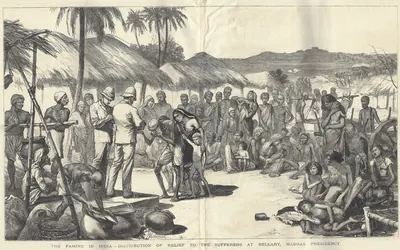 "The Famine in India—Distribution of Relief to the Sufferers at Bellary, Madras Presidency": wood engraving after Herbert Johnson in The Graphic, 20 October 1877Drawing · 1877
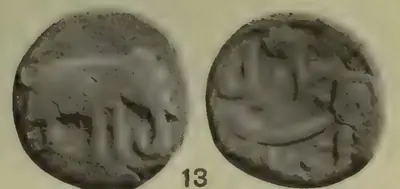 Copper paisa of the Bellary mint, listed among the doubtful coins of Haidar Ali (Henderson 1921, pl. I, No. 13)Coin · 1921
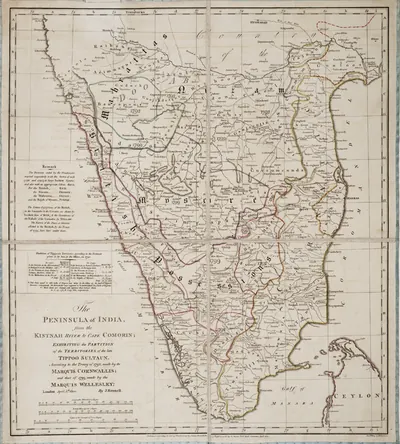 James Rennell, "The Peninsula of India ... exhibiting the partition of the territories of the late Tippoo Sultaun, according to the treaty of 1792 ... and that of 1799" (London, 1800), Royal Museums Greenwich K1047Map · 1800
Related
People
Haidar Ali
1761–1782 CE
A soldier who made himself master of Mysore in 1761 and ruled it until he died in December 1782. In the Telugu country he took Penukonda and Madakasira from the Maratha Morari Rao in 1762. He won back Gurramkonda through his brother-in-law Mir Sahib in 1768, took Bellary in 1775 and took Gooty from Morari Rao in 1776. In 1779 he conquered the Nawab of Cuddapah, and the Nawab of Kurnool and the poligars of the Bellary and Anantapur country paid him tribute. His invasion of the Carnatic in 1780 began the Second Mysore War.
Sir Thomas Munro
1761–1827 CE
Sir Thomas Munro (1761–1827) was a Scottish soldier and administrator. As the first Principal Collector of the Ceded Districts of Rayalaseema, from 1800 to 1807, he put down the poligars (local military chiefs) and made the ryotwari settlement with each cultivator. He became Governor of Madras in 1820. He died in office at Pattikonda, then in the Bellary district, on 6 July 1827. In the Ceded Districts he was remembered with ballads and as a 'father'.
Tipu Sultan
1782–1799 CE
Son of Haidar Ali and ruler of Mysore from December 1782 until he was killed at the fall of Seringapatam on 4 May 1799. As a young commander he took Gurramkonda back from the Marathas in 1773–74. As Sultan he held Gooty, Gurramkonda, Cuddapah, Bellary and the Anantapur country. He gave Gooty and Gurramkonda the new names Faiz Hisar and Zafarabad and struck copper coins at both. He besieged Adoni in 1786 and seized the poligars of Rayadurg and Harpanahalli. By the treaty of 1792 he gave up Cuddapah, Gurramkonda, Bellary and Tadpatri to the Nizam. The rest of his Telugu districts went to the Nizam after his death and were ceded to the East India Company in 1800.
Ghulam Rasul Khan (Nawab of Kurnool)
1823–1839 CE
The last Nawab of Kurnool, who ruled from 1823 to 1839. He was a younger son of Alif Khan II. He followed his brother Munawwar Khan after another brother, Muzaffar Khan, was imprisoned for murder. The Kurnool manual describes his rule as greedy and his habits as wasteful. At a time of reports of a Wahhabi plot against the British, the Madras government learnt that he was repairing his forts and secretly gathering cannon and military stores. It sent a commission with troops in 1839. He gave up the fort, his unpaid Rohilla and Arab troops were fired on, and he was sent away to Trichinopoly, where a servant murdered him. His jagir was taken over and his family given pensions.
References
Notes (0)
Sources (5)
Spotted an error on this page? Tell us
Last updated: