Jamalapuram Keshava Rao
Hyderabad State Congress leader from Khammam district (1908–1953). He left a government clerk's post to join the State Congress, was jailed in the satyagraha of 1938–39 and again in the campaign for joining India in 1947–48, and was a member of its Action Committee. He was later nominated to the Constituent Assembly.
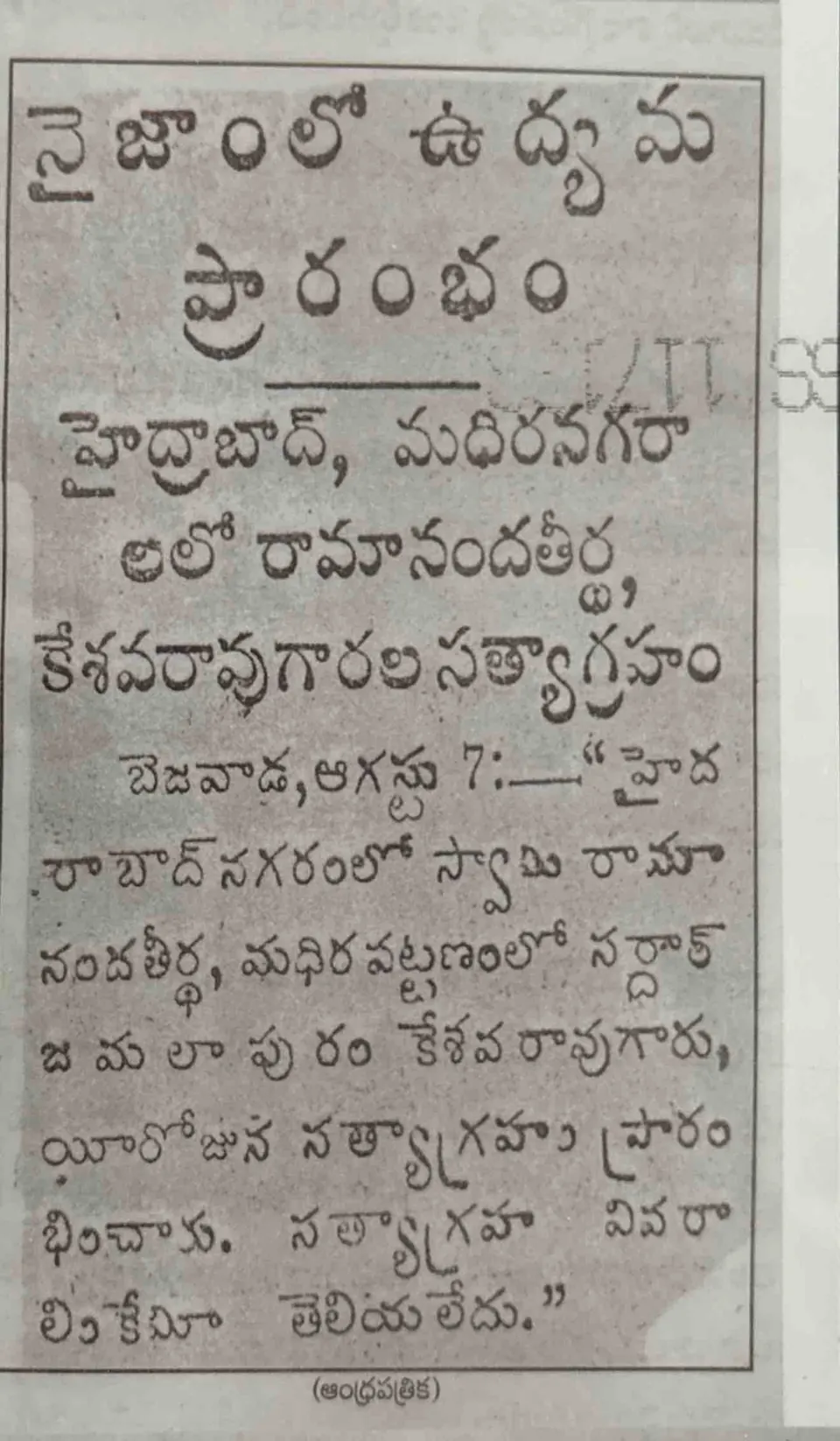
Jamalapuram Keshava Rao was a leader of the Hyderabad State Congress from Khammam district.1 He was born on 2 September 1908 at Yerrupalem, in Madhira taluk.1 He went to jail in 1938 and again in 1947 for opposing the Nizam’s government.1 The Who’s Who of Freedom Struggle in Andhra Pradesh (1980) says he was popularly called “the Sardar” of Hyderabad State.1
The State Congress satyagraha, 1938–1939
He was the son of Venkatarama Rao and passed the Intermediate examination.1 He worked as a clerk in the office of the District Collector, Hyderabad.1 He resigned this post to join the State Congress movement.1
In 1938 the Nizam’s government banned the new Hyderabad State Congress.1 Keshava Rao offered satyagraha (non-violent protest by breaking a law and accepting arrest) against the ban.1 He was held in the Central Jail, Warangal, from 7 December 1938 until his release on 10 April 1939.1 The Who’s Who adds that he took part in the Quit India movement of 1942 and was imprisoned.1
The Andhra Mahasabha, 1945–1946
From 1945 he was one of the leaders of the Nationalist wing of the Andhra Mahasabha.1 He presided over its conference at Kandi in 1946.1
The campaign for joining India, 1947–1948
After India became independent, the Nizam’s government said Hyderabad would stay independent.2 Sarojini Regani writes that the State Congress was then split into two groups.2 Keshava Rao supported the group of Swami Ramananda Tirtha.2
The State Congress named him to its Working Committee and its Committee of Action.3 On 15 August 1947 the State Congress hoisted the Indian flag in Sultan Bazar, Hyderabad.4 Regani names him among the leaders arrested in this connection.4
The Who’s Who says he was convicted under two laws.1 He received a month’s simple imprisonment and a fine of Rs. 100, and two years’ rigorous imprisonment.1 He served his terms in the Warangal and Nizamabad jails.1 In 1947 the Razakars (the armed volunteers of the Ittehad-ul-Muslimeen) looted his house at Yerrupalem.1
Later years
The Who’s Who says the President of India nominated him to the Constituent Assembly.1 It also says he worked for the library movement and against untouchability.1 He died on 29 March 1953.1
Where the sources disagree
The Who’s Who (1980), a state government book edited by Sarojini Regani, and her own Highlights of the Freedom Movement (1956) differ on the date of his arrest in 1947:14
- The Who’s Who (1980) says he was arrested on 7 August 1947.1
- Highlights of the Freedom Movement links his arrest to the hoisting of the Indian flag on 15 August 1947.4
Footnotes
-
Sarojini Regani (ed.), Who’s Who of Freedom Struggle in Andhra Pradesh, Vol. II (1980), p. 89 (archive.org (opens in a new tab)). ↩ ↩2 ↩3 ↩4 ↩5 ↩6 ↩7 ↩8 ↩9 ↩10 ↩11 ↩12 ↩13 ↩14 ↩15 ↩16 ↩17 ↩18 ↩19 ↩20 ↩21 ↩22
-
Sarojini Regani, Highlights of the Freedom Movement in Andhra Pradesh (1956), p. 199 (archive.org (opens in a new tab)). ↩ ↩2 ↩3
-
Regani, Highlights (1956), p. 200 (archive.org (opens in a new tab)). ↩
-
Regani, Highlights (1956), p. 202 (archive.org (opens in a new tab)). ↩ ↩2 ↩3 ↩4
Photos
References
Notes (0)
Sources (2)
Spotted an error on this page? Tell us
Last updated: