Muddupalani
Telugu woman poet of Thanjavur in the 18th century, author of the Radhika Santvanamu (the consoling of Radha), a love poem in four cantos. She says she was skilled in music, poetry and dance. Kandukuri Veeresalingam, who placed her at Thanjavur about 1760, admired her verse but found it too frank; Chenchiah and Bhujanga Rao called it indecent.
Muddupalani was a Telugu woman poet who lived at Thanjavur (then Tanjore) in the 18th century.12 She wrote the Radhika Santvanamu (the consoling of Radha), a love poem in four cantos.13 Veeresalingam counted her among the very few women who wrote long poems in Telugu verse.1 Her poem was praised for its skill and blamed for its frankness about love.42
Life
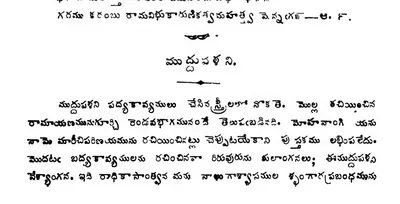
Kandukuri Veeresalingam wrote about her in the third part of his Andhra Kavula Charitramu (lives of the Telugu poets).1 He called her a vesyangana, a courtesan.1 The prose colophon of her poem names her mother, Muttyalu.4 From the colophon, Veeresalingam judged that Muttyalu was a concubine of Pratapasimha, the Maratha ruler of Thanjavur.4
Pratapasimha died in 1765, Veeresalingam wrote.4 So Muddupalani was living at Thanjavur about 1760.4 She says in the poem that she was skilled in music, poetry and dance.4 See Marathas.
The Radhika Santvanamu
The poem has four cantos, and is also called the Iladeviyamu.14 Charles Philip Brown, in 1852, counted 650 verses.3 He described its author as “an actress at Tanjore”.3 In his view the poem was modelled on an older work, the Radha Madhava Samvadam.3
Veeresalingam thought her verse sweet and well made, and her knowledge of Sanskrit and Telugu good.4 He admitted some faults, but said that men’s poetry had them too.4 But he found many passages too frank for a woman to write, or for women to hear.4
Where the sources disagree
The sources differ on her place at the court and on her poem.
- Her place at court. P. Chenchiah and Raja M. Bhujanga Rao, in their history of Telugu literature (1928), call her “a courtesan of Pratapa Sinha”.5 K. Sitaramaiya, in 1943, calls her a poet attached to Pratapasimha’s court.6 Veeresalingam says it was her mother who was the king’s concubine.4
- Her poem. Chenchiah and Bhujanga Rao praised her “flowing, felicitous rhymes”, but wrote that the poem was “marred by bad taste and utter lack of decency”.2 Veeresalingam granted her skill, and linked the poem’s frankness to her birth in a community of courtesans.4 P. T. Raju, in 1944, simply named her among the women poets who “deserve mention”.7
Footnotes
-
Kandukuri Veeresalingam, Andhra Kavula Charitramu, Part III (1911), p. 100 (archive.org (opens in a new tab)). ↩ ↩2 ↩3 ↩4 ↩5 ↩6
-
Chenchiah and Bhujanga Rao, A History of Telugu Literature (1928), p. 104 (archive.org (opens in a new tab)). ↩ ↩2 ↩3
-
Charles Philip Brown, A Dictionary, Telugu and English (1852), p. x (archive.org (opens in a new tab)). ↩ ↩2 ↩3 ↩4
-
Veeresalingam, Andhra Kavula Charitramu, Part III (1911), p. 101 (archive.org (opens in a new tab)). ↩ ↩2 ↩3 ↩4 ↩5 ↩6 ↩7 ↩8 ↩9 ↩10 ↩11 ↩12
-
P. Chenchiah and Raja M. Bhujanga Rao, A History of Telugu Literature (1928), p. 92 (archive.org (opens in a new tab)). ↩
-
K. Sitaramaiya, A Hand Book of Telugu Literature (1943), p. 57 (archive.org (opens in a new tab)). Cite-only; paraphrased. ↩
-
P. T. Raju, Telugu Literature (1944), p. 42 (archive.org (opens in a new tab)). Cite-only; paraphrased. ↩
Photos
References
Notes (0)
Sources (5)
Spotted an error on this page? Tell us
Last updated: