Thanjavur (Tanjore)
City in the Kaveri delta of the Tamil country, the capital of the Chola king Rajaraja I. His great Rajarajesvara temple, begun at the end of the 10th century and finished about 1012, carries the inscriptions in which he claims the conquest of Vengai-nadu, the Eastern Chalukya country of the Telugu coast.
Thanjavur, called Tanjore by the British, was the capital of the Chola kings of the late 10th and early 11th centuries.1 Its great temple was built by Rajaraja I.23 The temple’s inscriptions record his claim to have conquered the Eastern Chalukya country of the Telugu coast.4
Rajaraja’s capital
The Godavari District Gazetteer (1907) describes Rajaraja I as the king “who had laid the foundations of a great Chola empire with its capital at Tanjore”.1 It then tells of his conquest of the Eastern Chalukya country.1 In the Larger Leiden plates, Rajaraja’s order granting a village to a Buddhist monastery is dated at Tanjavur.5 See the Larger Leiden plates.
The great temple
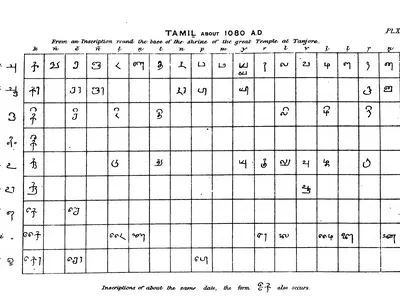
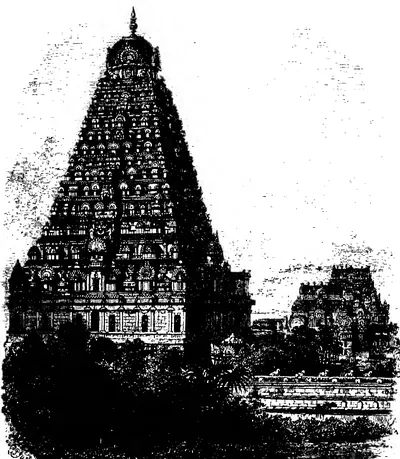
James Fergusson’s history, revised by James Burgess in 1910, describes the “great Pagoda” at Thanjavur.6 Its main tower rises in thirteen storeys above a base 82 feet square.2 Long inscriptions in old Tamil cover the base of the central shrine.2 They record gifts made by Rajaraja and his elder sister Kundavai to “the stone temple of Rajarajesvara”, which he had built.23 Fergusson and Burgess thought the temple was begun about the end of the 10th century and finished about 1012.3
E. Hultzsch published these inscriptions from 1891.4 The great inscription of Rajaraja’s 26th year opens with his conquests, beginning with “Vengai-nadu, Ganga-padi, Tadigai-padi, Nulamba-padi”.4
Coins
Walter Elliot wrote in 1886 that copper coins bearing the name of Raja Raja “are met with every day”.7 He added that “one find within my own knowledge in Tanjore yielded upwards of 4000”.7
Footnotes
-
F. R. Hemingway, Madras District Gazetteers: Godavari, Vol. I (1907), p. 20 (archive.org (opens in a new tab)). ↩ ↩2 ↩3
-
Fergusson and Burgess, History of Indian and Eastern Architecture I (1910), p. 363 (archive.org (opens in a new tab)). ↩ ↩2 ↩3 ↩4
-
Fergusson and Burgess, History of Indian and Eastern Architecture I (1910), p. 364 (archive.org (opens in a new tab)). ↩ ↩2 ↩3
-
E. Hultzsch, South-Indian Inscriptions, Vol. II, pt. I (1891), p. 8 (archive.org (opens in a new tab)). ↩ ↩2 ↩3
-
K. V. Subrahmanya Aiyer, “The Larger Leiden Plates (of Rajaraja I)”, Epigraphia Indica XXII (1933–34, publ. 1938), pp. 222–224 (archive.org (opens in a new tab)). Paraphrased. ↩
-
James Fergusson, rev. James Burgess, History of Indian and Eastern Architecture, Vol. I (1910), p. 362 (archive.org (opens in a new tab)). ↩
-
Walter Elliot, Coins of Southern India (1886), p. 133 (archive.org (opens in a new tab)). ↩ ↩2
Photos
Related
Dynasties
People
Rajaraja I (Chola)
c. 985–1014 CE
Chola king of Tanjore (Thanjavur) from 985, the founder of the Chola empire, whose inscriptions claim the conquest of Vengai-nadu, the Eastern Chalukya country of Vengi. About 999 he helped the Eastern Chalukya prince Saktivarman I back to the throne of Vengi, and he married his daughter Kundavadevi to Saktivarman's brother Vimaladitya. This began the alliance that made the Eastern Chalukyas Chola vassals and, two generations later, Chola emperors. Inscriptions of his reign are found at Kalahasti, and a Vaidumba chief ruled under him in the Nellore country.
Rajendra I (Chola)
c. 1012–1043 CE
Chola king from 1012, son of Rajaraja I and founder of Gangaikondacholapuram. As a prince he defeated the Eastern Chalukya Vimaladitya, his sister's husband, and set up a pillar of victory on Mahendragiri. As king he fought the Western Chalukya Jayasimha II and claimed Kollippakkai (Kolanupaka). His general marched to the Ganges while he himself waited on the Godavari, in a campaign that Krishna Sastri dated to 1028. His daughter Ammangadevi married the Eastern Chalukya Rajaraja Narendra and was the mother of Kulottunga I.
Chemakura Venkatakavi
Telugu poet of the 17th century at the court of Raghunatha Nayaka of Thanjavur. He wrote the Vijayavilasamu, on Arjuna's three marriages, and the Sarangadhara Charitramu, a tragic tale of a prince falsely accused. His style was so admired that it was named after him, 'Chemakura paka', and some count the Vijayavilasamu among the five great Telugu poems.
Kshetrayya
Telugu poet and composer of padams, love songs on Radha and Krishna, sung by dancers and musicians across South India. K. Sitaramaiya and P. T. Raju place him in the 17th century, at the time of Vijayaraghava Nayaka of Thanjavur. C. R. Day in 1891 called him the most popular composer of padams.
Muddupalani
Telugu woman poet of Thanjavur in the 18th century, author of the Radhika Santvanamu (the consoling of Radha), a love poem in four cantos. She says she was skilled in music, poetry and dance. Kandukuri Veeresalingam, who placed her at Thanjavur about 1760, admired her verse but found it too frank; Chenchiah and Bhujanga Rao called it indecent.
Raghunatha Nayaka of Thanjavur
Telugu Nayaka ruler of Thanjavur (then Tanjore) in the early 17th century, himself a poet in Telugu and Sanskrit and a writer on music. His court began the 'Southern school' of Telugu literature: his own Valmiki Charitramu was an early Telugu prose work, and Chemakura Venkatakavi wrote the Vijayavilasamu there. Poems by his son, his minister and a woman poet of his court describe his wars for the Vijayanagara throne.
Tyagaraja
Telugu singer, poet and composer of Tiruvaiyaru in Thanjavur district, whose devotional songs (kritis and kirtanas) to Rama are sung all over South India. C. R. Day in 1891 dated him about 1820–1840 and H. A. Popley in 1921 about 1800–1850, while P. T. Raju placed him in the 18th century. Chenchiah and Bhujanga Rao called him the greatest gift of Thanjavur to Telugu literature.
Vijayaraghava Nayaka of Thanjavur
Telugu Nayaka ruler of Thanjavur (then Tanjore), son of Raghunatha Nayaka, and himself an author of Telugu plays, among them a Raghunathabhyudayamu in praise of his father. K. Sitaramaiya and P. T. Raju name him as the patron of the song-composer Kshetrayya. A Telugu chronicle of the Thanjavur kings tells how he refused a marriage alliance with the Nayaka of Madurai and died fighting when Madurai's army stormed Thanjavur.
References
Notes (0)
Sources (5)
Spotted an error on this page? Tell us
Last updated: