Tirupati Venkata Kavulu
Pair of Telugu poets, Tirupati Sastri and Venkata Sastri, who wrote together in the early 20th century. They were famous for satavadhanam, composing verse on a hundred subjects at once before an audience, and for plays on the Mahabharata such as Pandavavijayamu. Writers of the old school, they translated the Devi Bhagavatam and Arnold's Light of Asia, and trained many later poets.
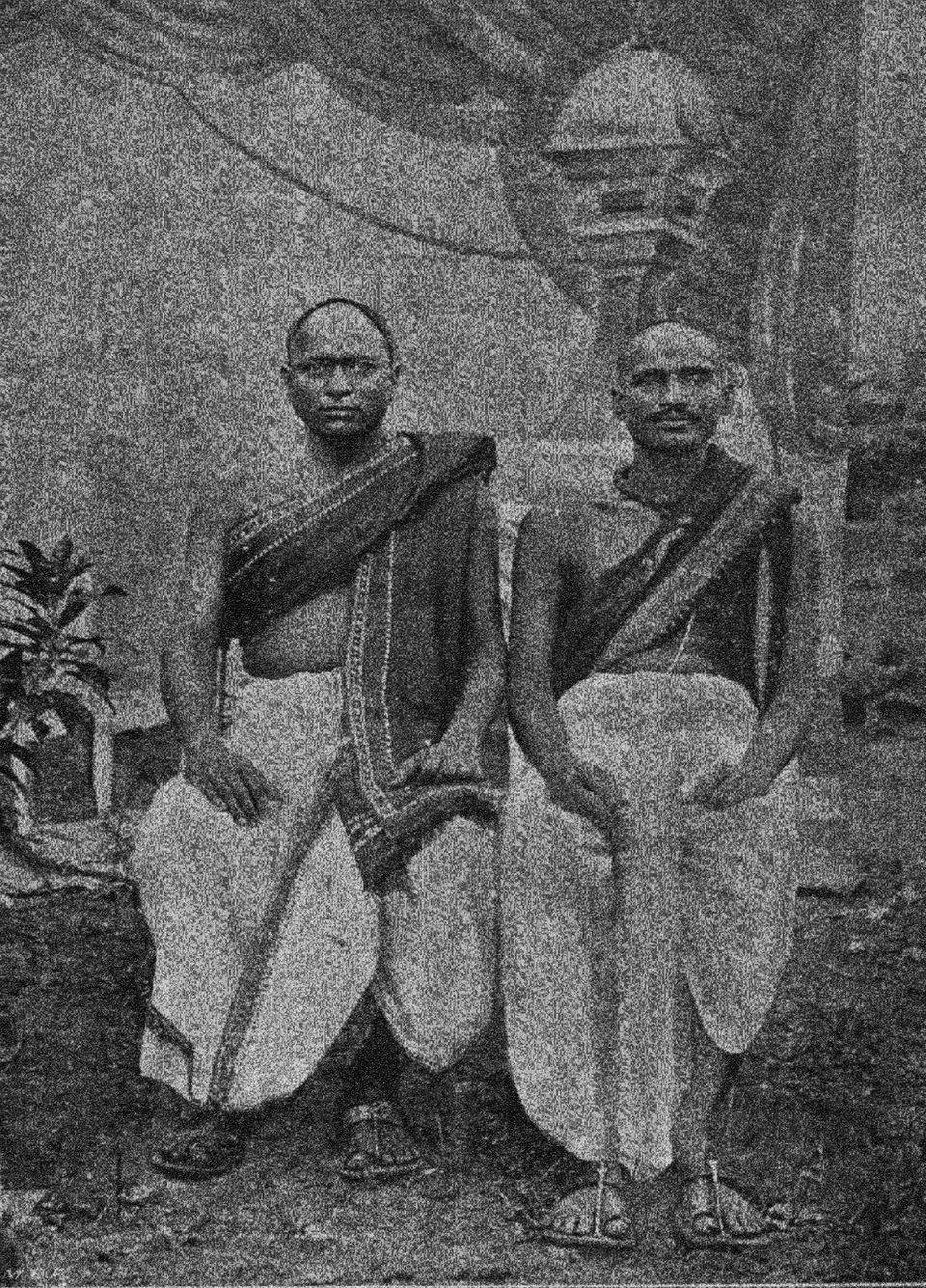
The Tirupati Venkata Kavulu were two Telugu poets who wrote as one: Tirupati Sastri and Venkata Sastri.1 Chenchiah and Bhujanga Rao, writing in 1928, list them among the leading poets of their own day.2 They wrote in the old forms of Telugu poetry, but in a style easier than the old court verse.23 P. T. Raju, in 1944, wrote that they were largely responsible for the revival of Telugu poetry.1
Two poets as one
K. Sitaramaiya, writing in Hyderabad in 1943, describes them as “twin poets”, pupils of the same teacher.3 They worked in such harmony, he wrote, that it is almost impossible to tell which of them wrote what.3 They brought many everyday words into serious poetry, and used them well.3 They wrote “thousands of pages of poetry” in many styles.3
One of them, Venkata Kavi, was a Telugu teacher at a high school in Machilipatnam (then Masulipatam).4 Sitaramaiya says many young men studied with him and became poets themselves.4 When Venkata Kavi turned sixty, his admirers presented him with a golden anklet.4
Satavadhanam
The pair were masters of satavadhanam.3 Sitaramaiya explains the feat.3 The poet makes verses for a hundred questioners on a hundred subjects of their choice, one line at a time, keeping all of them in mind.3 At the end he recites any verse asked for, by its number.3 He wrote that Ramarajabhushana was said to have been great at this in Vijayanagara times, and that the Tirupati Venkata Kavulu revived it.34 See Ramarajabhushana.
They could also hold conversations in verse.4 Their verse exchanges at the courts of rajas were printed in a volume, Nanaraja Sandarsanamu (visits to many kings).4 Raju wrote that “hundreds flock to hear their witty, learned and entertaining discourses”.1
Their works
Their works named in these sources include:5461
- a Telugu Devi Bhagavatam, which Chenchiah and Bhujanga Rao in 1928 called recently published
- Buddhacharitramu, their Telugu version of Edwin Arnold’s Light of Asia
- Sravananandamu, a love poem that Sitaramaiya says was very widely read
- Pandavavijayamu and other plays on the Mahabharata
- the satires Giratamu and Gunturu Seema, written during literary quarrels with rival poets5461
Sitaramaiya ranked Pandavavijayamu among the best Telugu plays.47 P. Chenchiah and Raja M. Bhujanga Rao, in their history of Telugu literature (1928), named them first among the poets of the traditional school.2 In their view this school kept the old forms but dropped the faults of the old ornate style.2
Old school and new
They belonged to the old school, but they welcomed some new writing.8 Sitaramaiya noted that Rayaprolu Subba Rao’s Trunakankanamu (1914), a poem of the new school, won praise from “orthodox pundits like Tirupati Venkata kavulu”.8
Footnotes
-
P. T. Raju, Telugu Literature (1944), p. 58 (archive.org (opens in a new tab)). Cite-only; paraphrased. ↩ ↩2 ↩3 ↩4 ↩5
-
Chenchiah and Bhujanga Rao, A History of Telugu Literature (1928), p. 118 (archive.org (opens in a new tab)). ↩ ↩2 ↩3 ↩4
-
K. Sitaramaiya, A Hand Book of Telugu Literature (1943), p. 69 (archive.org (opens in a new tab)). Cite-only; paraphrased. ↩ ↩2 ↩3 ↩4 ↩5 ↩6 ↩7 ↩8 ↩9 ↩10
-
Sitaramaiya, A Hand Book of Telugu Literature (1943), p. 70 (archive.org (opens in a new tab)). Cite-only; paraphrased. ↩ ↩2 ↩3 ↩4 ↩5 ↩6 ↩7 ↩8 ↩9
-
P. Chenchiah and Raja M. Bhujanga Rao, A History of Telugu Literature (1928), p. 65 (archive.org (opens in a new tab)). ↩ ↩2
-
Sitaramaiya, A Hand Book of Telugu Literature (1943), p. 71 (archive.org (opens in a new tab)). Cite-only; paraphrased. ↩ ↩2
-
Sitaramaiya, A Hand Book of Telugu Literature (1943), p. 72 (archive.org (opens in a new tab)). Cite-only; paraphrased. ↩
-
Sitaramaiya, A Hand Book of Telugu Literature (1943), p. 90 (archive.org (opens in a new tab)). Cite-only; paraphrased. ↩ ↩2
Photos
References
Notes (0)
Sources (3)
Spotted an error on this page? Tell us
Last updated: