Padmanabham
Village on the Chittivalasa river ten miles north-west of Bheemunipatnam, under a hill with a Vishnu temple. Here the Raja of Vizianagaram, Vijayarama Raju II, made his last stand against the East India Company on 10 July 1794. He was killed with some three hundred of his followers, most of them Rajputs. A small masonry memorial marks the spot where he fell.
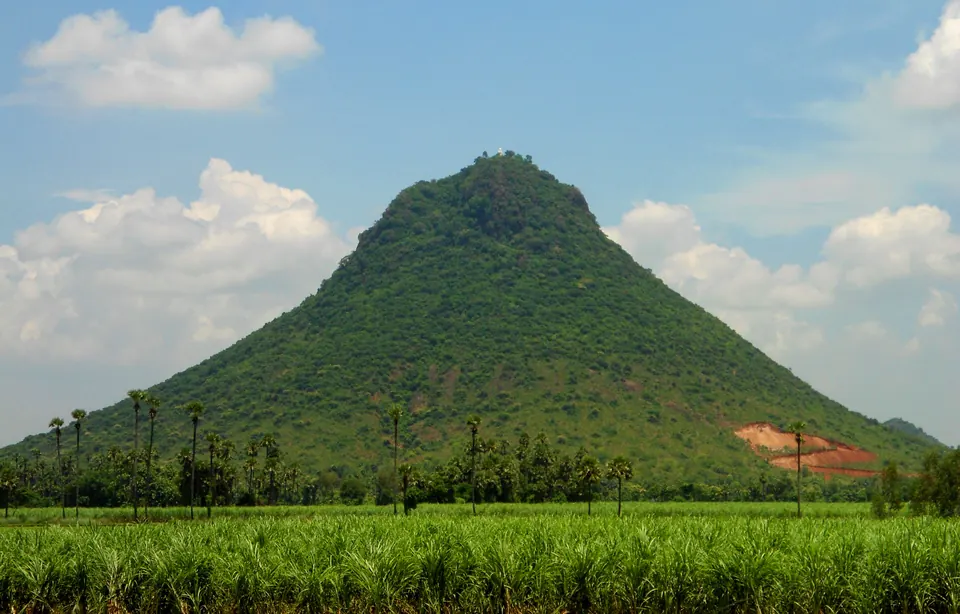
Francis’s Vizagapatam gazetteer (1907) says that Padmanabham was a village of 711 people “ten miles north-west of Bimlipatam on the bank of the Chittivalasa river”.1 On the hill above it is a small Vishnu shrine, reached by some 1,300 steps.1 A larger temple to the same god stands at the foot.1 Tradition said that Ananda Raju, Raja of Vizianagaram, improved and endowed both of them.1 See Vizianagaram.
The battle of 1794
In 1794 the Raja of Vizianagaram, Vijayarama Raju, was ordered to leave the district.23 The year before, the East India Company had sequestrated (taken over) his estate for arrears.23 He marched a short way and then “retired with his camp to Padmanabham, a village between Vizianagram and Bimlipatam”.23 This was “in quite the opposite direction to the main road to Masulipatam”.23 There troops he had dismissed came back to him.23
On 8 and 9 July scouts reported that he and his men had sworn to die sword in hand.4 They said that the Raja had distributed “food that had been offered in the temple at Padmanabham” to his chiefs.4
Early on 10 July Lieutenant-Colonel Prendergast attacked.4 After about three-quarters of an hour he reported: “The Raja was killed, with many of his followers.”4 The Company’s force lost thirteen killed and sixty-one wounded.4 Of the Raja’s men 309 were killed, and 208 of them were Rajputs.4 Forty of these lay round his body.4
Francis wrote that Padmanabham “will long be remembered as the Flodden of the Rajputs of Vizianagram”.5 Carmichael’s district manual of 1869 had used the same words.6 Flodden was a battle fought in Europe in 1513.7 In a note, Carmichael quotes lines on the dead Raja: “Knight and noble lie around him / Cold on Padmanabha’s hill”.6 See Vijayarama Raju II and East India Company.
The gazetteer’s entry on the village says that the place where the Raja fell “is pointed out in a tope just north-north-east of the village” (a tope is a grove of trees).1 The spot “is marked by a small masonry erection which is cared for by the villagers”.1
Footnotes
-
W. Francis, Madras District Gazetteers: Vizagapatam, Vol. I (1907), p. 230, s.v. Padmanabham (archive.org (opens in a new tab)). ↩ ↩2 ↩3 ↩4 ↩5 ↩6
-
Francis, Vizagapatam (1907), p. 51 (archive.org (opens in a new tab)). ↩ ↩2 ↩3 ↩4 ↩5
-
Francis, Vizagapatam (1907), p. 52 (archive.org (opens in a new tab)). ↩ ↩2 ↩3 ↩4 ↩5
-
Francis, Vizagapatam (1907), p. 53 (archive.org (opens in a new tab)). ↩ ↩2 ↩3 ↩4 ↩5 ↩6 ↩7
-
Francis, Vizagapatam (1907), p. 54 (archive.org (opens in a new tab)). ↩
-
D. F. Carmichael, A Manual of the District of Vizagapatam (1869), pp. 218–219 and note (archive.org (opens in a new tab)). ↩ ↩2
-
Ferishta, tr. John Briggs, History of the Rise of the Mahomedan Power in India, Vol. II (1829), p. 562, comparative table of events in Europe and India (archive.org (opens in a new tab)). ↩
Photos

Related
People
References
Notes (0)
Sources (3)
Spotted an error on this page? Tell us
Last updated: