Chiruvroli grant of Hambira (1461)
Copper plates found in 1941 at Nemalikallu near Ravela in the Guntur district, and edited by D. C. Sircar and K. H. V. Sarma in 1963. They are the only known copper-plate grant of Hamvira (Hambira), son of the Gajapati Kapilendra. On 4 September 1461 he gave the village of Chiruvroli on the Krishna, renamed Hambirapura, to more than a hundred Brahmins. A plate in Oriya, from another grant, was found with them.
By this copper-plate grant, Hambira-kumara, son of the Gajapati king Kapilesvara, gave the village of Chiruvroli on the Krishna to a number of Brahmins.12 The editors equated its date with 4 September 1461.1 Its donees received 106 Brahmin shares, and two shares went to the local gods.23
Discovery and the plates
Villagers of Nemalikallu dug up the five copper plates in 1941.45 The village is near Ravela, in the Sattenapalli taluk (sub-district) of the Guntur district.45 A ring with a seal bearing an elephant is said to have been found with them, but it was lost.45
The grant was noticed in the Annual Report on South Indian Epigraphy for 1941–42.45 It was published, without its Oriya part, in the Telugu journal Bharati.45 D. C. Sircar and K. H. V. Sarma edited it again in Epigraphia Indica XXXIV, with a photograph.45
Three plates, about 10½ by 6 inches, carry writing in Telugu letters on both sides.4 The fourth has four lines in Oriya on one side, and the fifth is blank.4 The fourth and fifth plates are smaller, and seem to belong to another charter.4
On the back of the first plate is the drawing of a sword.4 It stood for the king’s signature on Suryavamsi Gajapati charters, and it is repeated on the fourth and fifth plates.4 The editors found the script very close to that of the grants of Raghudeva and the Veligalani grant of Kapilesvara.4
Contents
The record has four sections:1
- Sanskrit verses on the donor and his ancestors1
- the date and boundaries, in Sanskrit verse and Telugu prose1
- the list of donees1
- a short Oriya part1
It opens with verses to Vishnu as the Boar and to Siva.1 It then praises the Sun and the great king Kapilesvara of the Solar race.1 It repeats a verse of the Veligalani grant on the terror that his drums caused at Hampi, Dhara, Gulbarga and Delhi.1 It introduces the donor, Hambira-kumara, as his son.1
The date is given twice by chronograms (dates hidden in words).1 It is Saka 1383 (Saka is an Indian way of counting years), the year Vrisha, the new moon of Bhadrapada, a Friday.1 The editors equated it with 4 September 1461.1
Hambira gave the village of Chiruvroli, on the bank of the Krishna, to a number of Brahmins, with a hamlet attached to it, and named the village after himself.12 The boundaries are given in Telugu, and Srikanta and Timmayarya drew up the charter at his order.12
The donees received 106 Brahmin shares, and two shares went to the local gods Kesavadeva and Sagaresvaradeva.23 The list on the third plate seems to record a second set of donees, added a little later.23 It is headed by the scholar Naishadhiya Aubhala, who is said to have lived at Chiruvroli with his brother Ganapati, a poet.23 The Oriya plate concerns a different village and grant.3
Place
The editors identified Chiruvroli with the present Chiruvolu, in the Divi taluk of the Krishna district.6 They identified its hamlet with a hamlet of that village.6 Some of the villages named among the boundaries still bear the same names.6 The new name Hambirapura went out of use.6
Hambira
The editors explained the name Hambira or Hamvira as a form of Hammira, from the Arabic amir (commander).13 They gathered his other records:13
- undated stone inscriptions at Zakkampudi, Kondapalli and a third village of the Krishna district13
- the dated inscription of February 1460 in the Warangal fort13
They noted that one verse calls him the bhagya-putra, the fortunate son, of Kapilesvara, and they wondered whether he was an adopted son.376 They also discussed his southern campaigns, the governorship of his son Dakshina-Kapilesvara in 1464 and the disputed succession after Kapilendra’s death.376 See Hamvira, the Warangal inscriptions and the Gajapatis.
Footnotes
-
Sircar and Sarma, “Chiruvroli Grant of Hambira”, Epigraphia Indica XXXIV (1961–62), p. 178 (archive.org (opens in a new tab)). Paraphrased. ↩ ↩2 ↩3 ↩4 ↩5 ↩6 ↩7 ↩8 ↩9 ↩10 ↩11 ↩12 ↩13 ↩14 ↩15 ↩16 ↩17 ↩18 ↩19 ↩20
-
Sircar and Sarma, “Chiruvroli Grant of Hambira”, Epigraphia Indica XXXIV (1961–62), p. 179 (archive.org (opens in a new tab)). Paraphrased. ↩ ↩2 ↩3 ↩4 ↩5 ↩6 ↩7
-
Sircar and Sarma, “Chiruvroli Grant of Hambira”, Epigraphia Indica XXXIV (1961–62), p. 180 (archive.org (opens in a new tab)). Paraphrased. ↩ ↩2 ↩3 ↩4 ↩5 ↩6 ↩7 ↩8 ↩9 ↩10 ↩11
-
D. C. Sircar and K. H. V. Sarma, “Chiruvroli Grant of Hambira, Saka 1383”, Epigraphia Indica XXXIV (1961–62), p. 177 (archive.org (opens in a new tab)). Paraphrased. ↩ ↩2 ↩3 ↩4 ↩5 ↩6 ↩7 ↩8 ↩9 ↩10 ↩11 ↩12
-
Sircar and Sarma, “Chiruvroli Grant of Hambira”, Epigraphia Indica XXXIV (1961–62), plate between pp. 184 and 185 (archive.org (opens in a new tab)). Paraphrased. ↩ ↩2 ↩3 ↩4 ↩5 ↩6
-
Sircar and Sarma, “Chiruvroli Grant of Hambira”, Epigraphia Indica XXXIV (1961–62), p. 182 (archive.org (opens in a new tab)). Paraphrased. ↩ ↩2 ↩3 ↩4 ↩5 ↩6
-
Sircar and Sarma, “Chiruvroli Grant of Hambira”, Epigraphia Indica XXXIV (1961–62), p. 181 (archive.org (opens in a new tab)). Paraphrased. ↩ ↩2
Photos
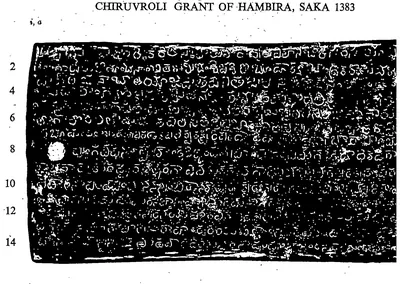 "Chiruvroli Grant of Hambira, Saka 1383", first side of the first plate (lines 1-14) (Epigraphia Indica XXXIV, between pp. 184 and 185)Inscription rubbing · 1963
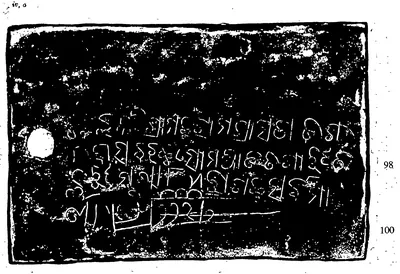 "Chiruvroli Grant of Hambira, Saka 1383": the fourth plate, four lines in Oriya with the drawn sword (Epigraphia Indica XXXIV, between pp. 184 and 185)Inscription rubbing · 1963
References
Notes (0)
Sources (1)
Spotted an error on this page? Tell us
Last updated: