Hamvira (Hambira)
Son of the Gajapati king Kapilendra and the leading general of his conquests in the Telugu and Tamil countries. He captured the fort of Warangal on 2 February 1460 and made the Chiruvroli grant on the Krishna in 1461. In 1464 his son Dakshina-Kapilesvara governed Kondavidu and the forts of the south. Ferishta writes of an 'Ambur Ray' who took the Orissan throne with Bahmani help after Kapilendra's death. This man has been identified with Hamvira, but the succession is disputed.
Hamvira, whose name is also written Hambira, Ambira and Hammira, was a son of the Gajapati king Kapilendra of Orissa.12 He was the general of his father’s campaigns in the south.12 D. C. Sircar and K. H. V. Sarma edited his only known copper-plate grant in 1963.12 They explained the name as a form of Hammira, the Indian form of the Arabic amir (commander).12 They listed the forms in which it appears in his records, among them Hamvira-kumara, Ambideva-raja, Ambiradeva-kumara-mahapatra and Kumara-Hambiradeva.12 See Kapilendra and the Gajapatis.
His parents
The Chiruvroli grant of 1461 calls Hamvira the son of the Gajapati Kapilesvara, and his inscription in the Warangal fort says the same.123 The Archaeological Department of the Nizam’s Dominions discussed the Warangal record in its report for 1934–35.3 One reading would make the conqueror an unnamed son of Kapilendra, and Ambira-deva his general.3 The Department rejected this, and concluded that the inscription names one person, the son of the king.3 Ferishta, on the other hand, calls him Ambur Ray, a cousin of the Ray of Orissa.4
A Simhachalam inscription of 1459 names a Hambira Kumara Mahapatra as the son of Saududeva Mahapatra, of the solar race.256 One verse of the Chiruvroli grant calls Hamvira the fortunate son, bhagya-putra, of Kapilesvara.256 So Sircar and Sarma thought he might have been an adopted son.256 Two inscriptions of 1464 at Munnur in the South Arcot district name Dakshina-Kapilesvara Kumara Mahapatra as the son of Hamvira.27
Warangal and the Krishna country
On 2 February 1460 Hamvira recorded on the eastern gate of the Warangal fort that he had captured it.8 On the same day his cousin Raghudeva, governor of Rajahmundry, recorded the same conquest on the western gate.8
The Nizam’s Archaeological Department suggested that the Orissan force that had rescued Devarakonda from the Bahmani army in 1459 went on to take Warangal.3 Sircar and Sarma quote a Telugu verse that credits the general Gajaravu Tippa with defeating the Muslims outside Khammam.9 He did this in the presence of “Ambaraya”, that is, Hamvira.9 See the Warangal inscriptions and Warangal Fort.
In September 1461 Hamvira gave the village of Chiruvroli, with its hamlet, on the bank of the Krishna, to more than a hundred Brahmins.11011 He renamed it Hambirapura.11011 Sircar and Sarma identified it with Chiruvolu in the Divi taluk of the Krishna district.11011 His other records, all without dates, are stone inscriptions at Zakkampudi, Kondapalli and one other village of the Krishna district.2
V. Rangacharya lists a record of the grant of the village of Yenikepadu to the Rajanarayana temple at Vijayawada (then Bezwada).12 The Gajapati prince Kumara Hambiradeva Mahapatra seems to have confirmed this grant.12 Rangacharya also lists an undated grant at Zakkampudi by Ambadeva, son of Kapilesvara.12 See the Chiruvroli grant and Vijayawada.
The southern campaigns
Sircar and Sarma summed up the Anantavaram grant of Prataparudra.2 According to it, Hamvira brought the kings of the south under control at his father’s command, and washed his sword in the southern ocean.2
The Munnur inscriptions of June 1464 record gifts made by his son Dakshina-Kapilesvara.213 They were for food offerings named after Hamvira and for the repair of temples.213 They name the forts and districts he governed, from Kondavidu, Kondapalli, Addanki and Vinukonda to Padaividu, Tiruvarur, Tiruchirappalli and Chandragiri.213 Sircar and Sarma named Gajarao (Gajaravu) Tippa and Tammaraja Basava among the Telugu generals who served under him.7
After Kapilendra’s death
Ferishta writes of AH 876 (1471–72; AH is the Islamic way of counting years).414 He says that “Ambur Ray, cousin to the Ray of Oorea, complained to Mahomed Shah”.414 His complaint was “that the Ray being dead, Mungul Ray, a bramin, his adopted son, had usurped the government in defiance of his prior claim to its inheritance”.414 With the help of the Bahmani general Nizam-ul-Mulk, Ambur Ray was placed on the throne.414 Then he helped the general to take Kondapalli and Rajahmundry.414
Wolseley Haig, in the Cambridge History of India (1928), told the same story of “Hambar”.151617 He added that Hambar later received Kondavidu from its rebellious people and called in the raja of Orissa.151617 The sultan besieged him there, and spared his life when he surrendered.151617 In Ferishta’s own account the rebel of those years was Bhimraj, and the fort was Kondapalli.18
Others read the story differently.1920 Monmohan Chakravarti, in 1900, took Ferishta’s “Ambur Rai” to be a corrupt form of a princely title given to Purushottama himself.1920 In this view Purushottama won the throne against his brothers with Bahmani help.1920 R. D. Banerji rejected the disputed succession altogether, since Purushottama’s reign is counted without a break from April 1470.2122
Sircar and Sarma noted a tradition that Purushottama was chosen as king over his elder brother Hamvira.711 They also noted a verse of the Sarasvativilasa that makes Purushottama the destroyer of Hammira.711 They thought a civil war likely, but the details uncertain.711 See Purushottama.
Evidence and disagreements
- Parentage. Son of Kapilesvara (the Chiruvroli grant; the Warangal inscription); cousin of the Orissan king (Ferishta); possibly an adopted son, if he is the Hambira of the Simhachalam record of 1459 (Sircar and Sarma).2345
- The succession of 1470–71. Hamvira took the throne with Bahmani help from a usurper, Mangal (Ferishta; Haig); “Ambur Rai” was Purushottama (Chakravarti); no disputed succession (Banerji); Hamvira lost the throne to his younger brother (the tradition cited by Sircar and Sarma).41520227
Footnotes
-
D. C. Sircar and K. H. V. Sarma, “Chiruvroli Grant of Hambira, Saka 1383”, Epigraphia Indica XXXIV (1961–62), p. 178 (archive.org (opens in a new tab)). Paraphrased. ↩ ↩2 ↩3 ↩4 ↩5 ↩6 ↩7 ↩8 ↩9
-
Sircar and Sarma, “Chiruvroli Grant of Hambira”, Epigraphia Indica XXXIV (1961–62), p. 180 (archive.org (opens in a new tab)). Paraphrased. ↩ ↩2 ↩3 ↩4 ↩5 ↩6 ↩7 ↩8 ↩9 ↩10 ↩11 ↩12 ↩13 ↩14 ↩15 ↩16 ↩17
-
Annual Report of the Archaeological Department of His Exalted Highness the Nizam’s Dominions, 1344 F. (1934-35) (1938), p. 30 (archive.org (opens in a new tab)). Paraphrased. ↩ ↩2 ↩3 ↩4 ↩5 ↩6
-
Muhammad Qasim Ferishta, tr. John Briggs, History of the Rise of the Mahomedan Power in India, Vol. II (1829), p. 487 (archive.org (opens in a new tab)). ↩ ↩2 ↩3 ↩4 ↩5 ↩6 ↩7 ↩8
-
D. C. Sircar, “Two Grants of Raghudeva”, Epigraphia Indica XXXIII (1959–60), p. 5, note 1 (archive.org (opens in a new tab)). Paraphrased. ↩ ↩2 ↩3 ↩4
-
Rangacharya, Topographical List, Vol. III (1919), p. 1684, Vizagapatam No. 168 (archive.org (opens in a new tab)). ↩ ↩2 ↩3
-
Sircar and Sarma, “Chiruvroli Grant of Hambira”, Epigraphia Indica XXXIV (1961–62), p. 181 (archive.org (opens in a new tab)). Paraphrased. ↩ ↩2 ↩3 ↩4 ↩5 ↩6
-
D. C. Sircar, “Warangal Inscription of Raghudeva, Kali Year 4561”, Epigraphia Indica XXXIII (1959–60), p. 126 (archive.org (opens in a new tab)). Paraphrased. ↩ ↩2
-
D. C. Sircar and K. H. V. Sarma, “Veligalani Grant of Kapilesvara, Saka 1380”, Epigraphia Indica XXXIII (1959–60), p. 280 (archive.org (opens in a new tab)). Paraphrased. ↩ ↩2
-
Sircar and Sarma, “Chiruvroli Grant of Hambira”, Epigraphia Indica XXXIV (1961–62), p. 179 (archive.org (opens in a new tab)). Paraphrased. ↩ ↩2 ↩3
-
Sircar and Sarma, “Chiruvroli Grant of Hambira”, Epigraphia Indica XXXIV (1961–62), p. 182 (archive.org (opens in a new tab)). Paraphrased. ↩ ↩2 ↩3 ↩4 ↩5 ↩6
-
V. Rangacharya, A Topographical List of the Inscriptions of the Madras Presidency, Vol. II (1919), p. 887, Kistna Nos. 110 and 113 (archive.org (opens in a new tab)). ↩ ↩2 ↩3
-
R. D. Banerji, History of Orissa from the Earliest Times to the British Period, Vol. I (1930), p. 297 (archive.org (opens in a new tab)). ↩ ↩2 ↩3
-
Ferishta, tr. Briggs, Vol. II (1829), p. 488 (archive.org (opens in a new tab)). ↩ ↩2 ↩3 ↩4 ↩5
-
Wolseley Haig (ed.), The Cambridge History of India, Vol. III (1928), p. 415 (archive.org (opens in a new tab)). ↩ ↩2 ↩3 ↩4
-
Haig, Cambridge History of India, Vol. III (1928), p. 417 (archive.org (opens in a new tab)). ↩ ↩2 ↩3
-
Haig, Cambridge History of India, Vol. III (1928), p. 418 (archive.org (opens in a new tab)). ↩ ↩2 ↩3
-
Ferishta, tr. Briggs, Vol. II (1829), pp. 494–497 (archive.org (opens in a new tab)). ↩
-
Monmohan Chakravarti, “The last Hindu Kings of Orissa”, Journal of the Asiatic Society of Bengal, Vol. LXIX, Part I (1900), p. 183 (archive.org (opens in a new tab)). ↩ ↩2 ↩3
-
Chakravarti, “The last Hindu Kings of Orissa”, JASB LXIX, Part I (1900), p. 184 (archive.org (opens in a new tab)). ↩ ↩2 ↩3 ↩4
-
Banerji, History of Orissa, Vol. I (1930), p. 306 (archive.org (opens in a new tab)). ↩
-
Banerji, History of Orissa, Vol. I (1930), p. 307 (archive.org (opens in a new tab)). ↩ ↩2
Photos
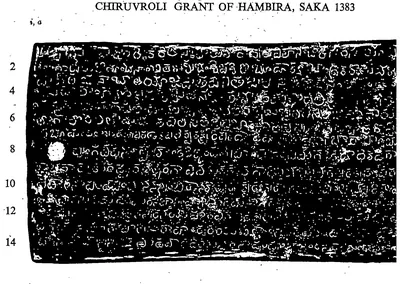 "Chiruvroli Grant of Hambira, Saka 1383", first side of the first plate (lines 1-14) (Epigraphia Indica XXXIV, between pp. 184 and 185)Inscription rubbing · 1963
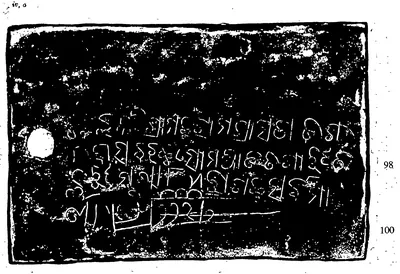 "Chiruvroli Grant of Hambira, Saka 1383": the fourth plate, four lines in Oriya with the drawn sword (Epigraphia Indica XXXIV, between pp. 184 and 185)Inscription rubbing · 1963
References
Notes (0)
Sources (9)
Spotted an error on this page? Tell us
Last updated: