Gajapatis of Orissa
The Suryavamsi kings of Orissa, 'lords of elephants', who ruled from Cuttack from 1434–35 to about 1541. Kapilendra (Kapilesvara) took the throne of the last Eastern Ganga king. He conquered the Reddi kingdoms of Rajahmundry and Kondavidu, and sent his son Hamvira and his nephew Raghudeva into Telangana, where they took Warangal in 1460. He carried his arms down the coast towards the Kaveri. His son Purushottama lost the Godavari–Krishna country to the Bahmanis and won it back. Prataparudra lost everything south of the Godavari or the Krishna to Krishnadeva Raya of Vijayanagara in 1513–19, and the coastal districts fell to Golconda in the following decades.
Swipe sideways to see the whole chart; tap a bar for details.
Each bar is a ruling power in its region; time runs left to right. Dashed = approximate dates. Select a bar for details.
Show as a list
Nayakas, Reddis & Bahmanis 1323–1518 CE
- Telangana
- Musunuri Nayakas (c. 1336–1368 CE) · Gajapatis of Orissa (c. 1459–1461 CE) · Adil Shahis of Bijapur (c. 1489–1686 CE) · Bahmani Sultanate (c. 1347–1518 CE) · Recherla Velamas (Padmanayakas) (c. 1361–1475 CE) · Shitab Khan (Sitapati) of Warangal (c. 1504–1516 CE)
- Coastal Andhra
- Eastern Gangas of Kalinga (c. 537–1434 CE) · Gajapatis of Orissa (c. 1446–1571 CE) · Haihayas of Kona and Palnadu (c. 1073–1364 CE) · Reddis of Rajahmundry (c. 1386–1448 CE) · Bahmani Sultanate (c. 1471–1489 CE) · Reddis of Kondaveedu (c. 1325–1424 CE) · Vijayanagara Empire (c. 1350–1579 CE)
- Rayalaseema
- Vijayanagara Empire (c. 1336–1646 CE) · Reddis of Kondaveedu (c. 1346–1386 CE)
Vijayanagara & the Qutb Shahis 1336–1687 CE
- Telangana
- Musunuri Nayakas (c. 1336–1368 CE) · Gajapatis of Orissa (c. 1459–1461 CE) · Adil Shahis of Bijapur (c. 1489–1686 CE) · Bahmani Sultanate (c. 1347–1518 CE) · Vijayanagara Empire (c. 1563–1565 CE) · Recherla Velamas (Padmanayakas) (c. 1361–1475 CE) · Qutb Shahis of Golconda (c. 1518–1687 CE) · Shitab Khan (Sitapati) of Warangal (c. 1504–1516 CE)
- Coastal Andhra
- Eastern Gangas of Kalinga (c. 537–1434 CE) · Gajapatis of Orissa (c. 1446–1571 CE) · Haihayas of Kona and Palnadu (c. 1073–1364 CE) · Reddis of Rajahmundry (c. 1386–1448 CE) · Bahmani Sultanate (c. 1471–1489 CE) · Qutb Shahis of Golconda (c. 1524–1687 CE) · Reddis of Kondaveedu (c. 1325–1424 CE) · Vijayanagara Empire (c. 1350–1579 CE)
- Rayalaseema
- Vijayanagara Empire (c. 1336–1646 CE) · Reddis of Kondaveedu (c. 1346–1386 CE) · Adil Shahis of Bijapur (c. 1568–1686 CE) · Qutb Shahis of Golconda (c. 1579–1687 CE)
Kingdoms and empires
Musunuri Nayakas
Open page- Coastal Andhra: c. 1325–1346 CE (c. 21 years)
Prolaya Nayaka recovered the coast from Delhi in 1325-26 and ruled from Rekapalli on the Godavari (Vilasa grant, about 1330); latest dated Musunuri records on the coast are Kapaya's Guraja grant (February 1346) and his Ganapesvaram inscription (1346-47). Partial: the Reddis of Addanki and the Korukonda chiefs held parts of the coast as Kapaya's kinsmen and subordinates
- Telangana: c. 1336–1368 CE (c. 32 years)
Kapaya Nayaka took Warangal about 1336-37 (Ferishta: 1343-44) and ruled as "lord of the Andhra country" (Pillalamarri inscription, 1357); ceded Kaulas and then Golconda (1364-65) to the Bahmanis; overthrown by the Recherla chief Anapota about 1368 (Kapaya named in the Akkalapundi grant of 1368; Anapota ruling Orugallu in July 1369)
Rulers
Capitals
Inscriptions
Sources (9)
Kingdoms and empires
Gajapatis of Orissa
Open page- Coastal Andhra: c. 1446–1571 CE (c. 125 years)
Kapilendra (Kapilesvara, r. 1434-35 to 1469-70) took the Reddi kingdom of Rajahmundry between 1444 and 1448 and held Kondavidu by 1454 through his kinsman Ganadeva; the Bahmanis took Rajahmundry and Kondapalli or Kondavidu in 1470-71 and Purushottama had recovered the Godavari-Krishna country and the Ongole taluk by 1489; the country south of the Krishna passed to Saluva Narasimha after 1470 and, with Udayagiri, Kondavidu and Kondapalli, to Krishnadeva Raya in 1513-16; Golconda took the Godavari-Krishna doab from about 1522 and Rajahmundry in 1571-72. The northern coast (Srikurmam, Simhachalam) stayed Gajapati throughout.
- Telangana: c. 1459–1461 CE (c. 2 years)
Brief: Orissan troops relieved Devarakonda from the Bahmanis in 1459, and Kapilendra's son Hamvira and nephew Raghudeva took Warangal on 2 February 1460 (two gateway inscriptions); in 1461-62 the Orissan army and the zemindars of Telangana marched on Bidar. How long Warangal was held is not recorded
- Telangana: c. 1497–1516 CE (c. 19 years)
Partial: the uplands of Khammam and the Kondapalli-Nelakondapalli country, held by Prataparudra until Krishnadeva Raya's campaigns (Banerji; Nizam's Archaeological Department)
Rulers
- Kapilendra (Kapilesvara) (c. 1434–1470 CE)
- Purushottama (Gajapati) (c. 1470–1497 CE)
- Prataparudra (Gajapati) (c. 1497–1540 CE)
- Kalua Deva (c. 1540–1541 CE)
- Kakharua Deva (c. 1541 CE)
Inscriptions (8)
Sources (10)
Sultanates
Adil Shahis of Bijapur
Open page- Telangana: c. 1489–1686 CE (c. 197 years)
After the Bahmani break-up part of Mahbubnagar district went to Bijapur (the rest to Golconda) and stayed with it until Aurangzeb annexed Bijapur in 1686; the Raichur district article likewise passes Raichur (which then included the Alampur taluk and Gadwal) from the Bahmanis to the Adil Shahis.
- Rayalaseema: c. 1568–1686 CE (c. 118 years)
Partial, the western uplands only. Adoni taken by Ali Adil Shah's general Ankus Khan in 1568 after a failed siege in 1535-37; Penukonda besieged in the 1570s (dates disputed) and taken in 1652 (Mackenzie MS); Kurnool taken from Gopala Raja early in the 17th century and governed by Abdul Wahab (d. 1618) and later deputies, Siddi Jauhar holding it as his jagir about 1660; the Bellary and Anantapur uplands held through governors and tributary poligars; Bijapur's rights there passed to Shivaji in 1677-80 (Francis); Bijapur fell to Aurangzeb on 12 September 1686, but Siddi Masud held Adoni until 1688 (Sarkar) or 1687 (Bellary gazetteer)
Rulers (9)
Capitals
Monuments
Sources (11)
Sultanates
Bahmani Sultanate
Open page- Telangana: c. 1347–1518 CE (c. 171 years)
Western Telangana from 1347 (Kaulas taken or ceded; Bhongir taken late in Bahman Shah's reign, the province of Bidar reaching east to Bhongir); Golconda ceded under Muhammad Shah I (1362 Bilgrami; 1364-65 Haig, IG); Warangal taken in AH 828 (end of 1424 per Haig, 1422 per IG, 1425 per the Kistna Manual) and the rayas of Devarakonda and Rachakonda made tributary. Partial afterwards (Telugu chiefs regained districts under Ahmad I; Devarakonda relieved by Orissa 1459; Warangal held by the Gajapatis 1460 and by Shitab Khan from 1504). Governed for Mahmud Shah by Sultan Quli from 1495-96 until his independence (1512 per Haig; 1518 per Bilgrami, from the Golconda mosque inscription of AH 924)
- Coastal Andhra: c. 1471–1489 CE (c. 18 years)
Rajahmundry and Kondapalli (Ferishta) or Kondavidu (Haig, Burhan-i Ma'asir) taken by Malik Hasan Bahri in AH 876 (1471-72), on the invitation of a claimant to the Orissan throne (the Godavari gazetteer says Purushottama ceded the two districts); Muhammad Shah III at Rajahmundry for nearly three years after his Orissa campaign of 1478, and raided Masulipatam and Kanchi in 1481; Telingana split into the provinces of Rajahmundry and Warangal; Rajahmundry still Bahmani in 1486; the Godavari-Krishna country recovered by the Gajapati Purushottama by 1489
Rulers (18)
- Ala-ud-din Hasan Bahman Shah (1347–1358 CE)
- Muhammad Shah I (1358–1375 CE)
- Mujahid Shah (1375–1378 CE)
- Daud Shah (1378 CE)
- Muhammad Shah II (1378–1397 CE)
- Ghiyas-ud-din (1397 CE)
… and 12 more
- Shams-ud-din Daud (1397 CE)
- Firuz Shah (1397–1422 CE)
- Ahmad Shah I (1422–1435 CE)
- Ala-ud-din Ahmad Shah II (1435–1458 CE)
- Humayun Shah (1458–1461 CE)
- Nizam Shah (1461–1463 CE)
- Muhammad Shah III (1463–1482 CE)
- Mahmud Shah Bahmani (1482–1518 CE)
- Ahmad Shah (c. 1518–1521 CE)
- Ala-ud-din (c. 1521–1523 CE)
- Wali-ullah Shah (c. 1523–1525 CE)
- Kalim-ullah Shah (c. 1525–1527 CE)
Inscriptions
Sources (12)
Kingdoms and empires
Vijayanagara Empire
Open page- Rayalaseema: c. 1336–1646 CE (c. 310 years)
Founded c. 1335-36; Bukka I held Penukonda and Gooty (records of 1352 and a Gooty rock inscription) and his minister built the Bukkarayasamudram tank near Anantapur in 1364; Cuddapah in the 14th century; Kurnool wholly annexed under Krishnadeva Raya. After Talikota (1565) the kings ruled from Penukonda, which held out against Bijapur in 1577 and Golconda in 1589; the country north of Penukonda was lost after Sriranga I's capture (c. 1579-80); Venkatapati II moved to Chandragiri c. 1592; Golconda held the Cuddapah district and took Chandragiri (Chittoor) in 1646. Bijapur and Golconda took most of the region piecemeal after 1565
- Coastal Andhra: c. 1350–1579 CE (c. 229 years)
Vijayanagara officers kept Guntur (Kondavidu, Vinukonda, Bellamkonda) and the governor of Udayagiri kept Nellore after Talikota; Golconda took Kondavidu in April 1579 (Kistna Manual) or 1580 (a Guntur record of 1592 cited by Sewell), though Sewell thinks Guntur was already under Muslim rule by 1576 and the Nellore Manual says the Muslims held Nellore from 1565.
- Telangana: c. 1563–1565 CE (c. 2 years)
To end the confederate invasion of Golconda, Ibrahim Qutb Shah let Rama Raja keep the forts of Ghanpur and Panagal (Mahbubnagar) until Talikota; Ferishta places this after the Kalyani campaign of the early 1560s, the Kistna Manual dates it to 1557.
Rulers (24)
- Harihara I (Vijayanagara) (c. 1336–1355 CE)
- Bukka I (Vijayanagara) (1355–1377 CE)
- Harihara II (1377–1404 CE)
- Bukka II (1404–1406 CE)
- Deva Raya I (1406–1422 CE)
- Vijaya (Bukka III) (1422 CE)
… and 18 more
- Deva Raya II (Vijayanagara) (1422–1446 CE)
- Mallikarjuna (1446–1465 CE)
- Virupaksha (1465–1485 CE)
- Saluva Narasimha (1485–1492 CE)
- Immadi Narasimha (1492–1505 CE)
- Narasa Nayaka (c. 1505 CE)
- Vira Narasimha (1505–1509 CE)
- Krishnadeva Raya (1509–1529 CE)
- Achyuta Raya (1529–1542 CE)
- Venkata I (1542 CE)
- Sadasiva (c. 1542–1569 CE)
- Tirumala (Aravidu) (c. 1569–1572 CE)
- Sriranga I (1572–1586 CE)
- Venkatapati II (Vijayanagara) (1586–1614 CE)
- Sriranga II (1614 CE)
- Rama Deva (1614–1630 CE)
- Pedda Venkata (1630–1642 CE)
- Sriranga III (c. 1642–1670 CE)
Monuments (7)
- Penukonda fort and Gagan Mahal
- Kalahastisvara temple, Srikalahasti
- Virabhadra temple, Lepakshi
- Chandragiri fort and Raja Mahal
- Gooty fort
- Narasimha temples, Ahobilam
… and 1 more
Inscriptions (14)
- Penukonda fort inscription (1354)
- Gooty rock inscription of Bukka I
- Bitragunta grant of Sangama II (1356)
- Bukkarayasamudram tank inscription (1364)
- Tirumala inscriptions of Krishnadeva Raya and his queens (1513–1514)
- Amaravati inscription of Krishnadeva Raya (1515)
… and 8 more
- Mangalagiri and Kaza pillar inscriptions (1515–1518)
- Simhachalam inscriptions of Krishnadeva Raya (1516–1519)
- Srikalahasti inscription of Krishnadeva Raya (1516)
- Kondavidu pillar inscription of Nadindla Gopa (1520)
- Lepakshi temple inscriptions of Achyuta Raya's reign (1533–1538)
- Kanuma grant of Sadasiva (1548)
- Penukonda inscription of Channappa Nayudu (1577)
- Ahobilam inscription of Sriranga I (1584)
Sources (20)
Kingdoms and empires
Recherla Velamas (Padmanayakas)
Open page- Telangana: c. 1361–1475 CE (c. 114 years)
Anapota at Rachakonda (Rajukonda) and Mada at Devarakonda after their victories of 1361 (family chronicle); Rachakonda fortified in August 1365; Warangal, Bhongir and Rachakonda ruled by July 1369 (Inavolu inscription). The rayas of Devarakonda and Rachakonda paid tribute to Ahmad Shah Bahmani after his capture of Warangal (end of 1424); Devarakonda routed a Bahmani army with Orissan help in 1459; last dated record of the Rachakonda line 1464. End about 1475 per the list of rulers in Epigraphia Telanganica; no source dates the annexation
Rulers (7)
- Singama Nayaka (Recherla) (c. 1336–1361 CE)
- Anapota Nayaka (Recherla) (c. 1361–1384 CE)
- Mada Nayaka (Recherla) (c. 1361–1384 CE)
- Singabhupala (Recherla) (c. 1384–1399 CE)
- Peda Vedagiri (Recherla) (c. 1384–1410 CE)
- Lingama Nayaka (Recherla) (c. 1427–1475 CE)
… and 1 more
- Singama Nayaka, 'Sarvajna' (Rachakonda) (c. 1430–1475 CE)
Capitals
Monuments
Inscriptions
Sources (7)
Sultanates
Qutb Shahis of Golconda
Open page- Telangana: c. 1518–1687 CE (c. 169 years)
Sultan Quli governed Telingana for the Bahmanis from 1493-95 and declared independence in 1512 (Ferishta, Haig, IG Hyderabad) or 1518 (Bilgrami, from the Golconda mosque inscription of AH 924); he took the forts of the Telugu chiefs, among them Rachakonda, Devarakonda and, from Shitab Khan, Warangal and Khammam (1519-1525 per Bilgrami). Tributary to the Mughals from 1635-36 (khutba and coins in Shah Jahan's name; two lakhs of huns a year). Hyderabad taken by the Mughals in 1656 and 1685; Golconda surrendered on 21 September 1687 (Old Style) and was annexed
- Coastal Andhra: c. 1524–1687 CE (c. 163 years)
Sultan Quli took Kondapalli and fixed the Godavari as his frontier with Orissa (Ellore ceded) some time before his 1530 campaign, and a 1524 record shows him granting villages near Kondapalli and Bezwada; the Godavari gazetteer and IG Madras date the Krishna-Godavari doab to c. 1540 or 'before 1543', and the IG Madras Kistna article to after 1565.
- Rayalaseema: c. 1579–1687 CE (c. 108 years)
Partial; the sources disagree on when Golconda's hold began. IG Madras says Kurnool and Cuddapah were overrun soon after 1565. The Kurnool Manual dates the campaigns that took Gurramkonda (1579) and Gandikota, Nandyal and Musalimadugu (c. 1590). The Cuddapah gazetteer says Golconda only turned to Cuddapah in the early 17th century and never really conquered it. Chandragiri fell to Golconda in 1646.
Rulers (8)
Capitals
Monuments (13)
Inscriptions (7)
- Epitaph of Sultan Quli, Golconda (1543)
- Makka Darwaza inscription, Golconda (1559)
- Jami Masjid inscription, Hyderabad
- Epitaph of Muhammad Quli Qutb Shah, Golconda (1612)
- Ma Saheba tank inscriptions (1625)
- Musa Burj inscription, Golconda fort (1666–67)
… and 1 more
Sources (23)
Kingdoms and empires
Shitab Khan (Sitapati) of Warangal
Open page- Telangana: c. 1504–1516 CE (c. 12 years)
Partial (Warangal, Khammam and other hill forts, with Bellamkonda south of the Krishna; probably Nalgonda). A former Bahmani officer, Shitab Khan or Sitapati, took Warangal fort from the Muslims on 21 January 1504 by his pillar inscription, and held it until Sultan Quli Qutb Shah defeated him and his Gajapati allies; the Kistna manual calls him apparently a vassal of Orissa. The end is uncertain: Sastri allows him six or seven years (to 1512), the Hyderabad archaeological report of 1925-26 dates the loss of Warangal to 1513-1516, the Kistna manual places the war after 1516, and Bilgrami gives 1519-1525
Rulers
Capitals
Monuments
Inscriptions
Sources (6)
Kingdoms and empires
Eastern Gangas of Kalinga
Open page- Coastal Andhra: c. 537–1434 CE (c. 897 years)
Partial: only the far north coast (the old Ganjam and Vizagapatam districts, now Srikakulam-Vizianagaram- Visakhapatnam), capital Kalinganagara (Mukhalingam). Earliest dated grant: Jirjingi, near Tekkali, Ganga year 39 (c. 537 on Mirashi's epoch of 498; Fleet put the early grants in the 7th century and Sewell used an epoch of 877-78; the Imperial Gazetteer, the 7th century). Later line in power from the end of the 9th century (Vizagapatam gazetteer): Vajrahasta III crowned 1038; Anantavarman Chodaganga 1078-1146, with records at Mukhalingam, Srikurmam, Simhachalam and Visakhapatnam. South of the Godavari only records and raids (Draksharama 1128-1274; Bendapudi). Ended 1434, when the minister Kapilesvara founded the Gajapati line
Rulers (15)
- Vajrahasta III (Eastern Ganga) (1038–1070 CE)
- Rajaraja I (Eastern Ganga) (1070–1078 CE)
- Anantavarman Chodaganga (c. 1078–1146 CE)
- Madhu-Kamarnava (c. 1146–1152 CE)
- Raghava (c. 1152–1166 CE)
- Rajaraja II (c. 1166–1192 CE)
… and 9 more
- Aniyanka-Bhima (c. 1192–1202 CE)
- Anangabhima III (c. 1219–1253 CE)
- Narasimha I (Eastern Ganga) (c. 1253–1256 CE)
- Bhanudeva I (c. 1256–1275 CE)
- Narasimha II (c. 1275–1306 CE)
- Bhanudeva II (c. 1306–1323 CE)
- Narasimha III (c. 1323–1346 CE)
- Bhanudeva III (c. 1346–1378 CE)
- Narasimha IV (c. 1378–1397 CE)
Capitals
Monuments
Inscriptions (8)
Sources (10)
Kingdoms and empires
Haihayas of Kona and Palnadu
Open page- Coastal Andhra: c. 1073–1364 CE (c. 291 years)
Partial. Kona chiefs of Konamandala (the Godavari delta, Amalapuram taluk), with records at Draksharama and Palakol from Saka 995 (1073) to 1364–65, dependent on the Chola–Chalukya kings and the Velanati Chodas, later on the Kakatiyas; Haihaya chiefs of the Chagi family in the Palnadu (Macherla 1111, Gurazala 1129) as feudatories of the Chalukyas of Kalyani; the Palnadu war of the ballads is undated (proposals 1080–1386).
Rulers
- Rajendra Choda I of Kona (1128 CE)
- Mummadi-Bhima II and Satya I (1135 CE)
- Bhima III (c. 1153–1168 CE)
- Mallideva of Kona (c. 1155–1207 CE)
- Ganapatideva of Kona (c. 1262–1300 CE)
- Bhima-Vallabha (1318 CE)
Inscriptions
Sources (5)
Kingdoms and empires
Reddis of Rajahmundry
Open page- Coastal Andhra: c. 1386–1448 CE (c. 62 years)
Partial: the Godavari delta and the coast north to Simhachalam, capital Rajahmundry. Kataya Vema, minister of Kumaragiri, received "the eastern country" by 1386 (Ramayya; Sewell c. 1380); after his death (c. 1414-16) Allada Reddi, then Allada's sons Allaya Vema and Virabhadra (records 1423-1437, a record of 1444). Godavari gazetteer: family in the Draksharama inscriptions until 1447; a Gajapati record of 1448 at Penugonda marks the end (Somasekhara Sarma); Kapilesvara's minister ruling at Rajahmundry in 1458
Rulers
- Kataya Vema (c. 1386–1415 CE)
- Allada Reddi (c. 1416–1420 CE)
- Allaya Vema and Virabhadra (c. 1423–1448 CE)
Capitals
Inscriptions
Sources (6)
Kingdoms and empires
Reddis of Kondaveedu
Open page- Coastal Andhra: c. 1325–1424 CE (c. 99 years)
Capital Addanki, then (from Anavema, after 1361) Kondavidu. Coast south of the Krishna and at times the Godavari delta (Anavema's grants at Vanapalli, Nadupuru, Palivela, Draksharama 1374-81). Start: Mallavaram record of 1325 (Somasekhara Sarma); the Kistna manual says 1328, the Godavari gazetteer has the earliest record in 1344. End disputed: Vijayanagara conquest by 1424 (Somasekhara Sarma), Racha Vema killed 1428 (Kistna manual), overthrown 1427 (Sewell 1884), a Gajapati conquest c. 1420 (village chronicles). From c. 1386 the Godavari country belonged to the separate Rajahmundry kingdom
- Rayalaseema: c. 1346–1386 CE (c. 40 years)
Partial: the Srisailam plateau and the Markapur taluk (records at Tripurantakam, 1346 and 1347; Anavema's Viramantapa at Srisailam, 1378); Prolaya Vema's steps at Srisailam and Ahobilam
Rulers
Capitals
Monuments
Inscriptions (8)
Sources (8)
Reigns
Each bar is one ruler’s reign; time runs left to right. c. = approximate date.
- Kapilendra (Kapilesvara)c. 1434–1470 CE · c. 36 yrs
- Purushottama (Gajapati)c. 1470–1497 CE · c. 27 yrs
- Prataparudra (Gajapati)c. 1497–1540 CE · c. 43 yrs
- Kalua Devac. 1540–1541 CE · c. 1 yr
- Kakharua Devac. 1541 CE
Reign years follow M. M. Chakravarti (1900), who worked them out from the regnal (anka) years of the inscriptions, and R. D. Banerji (1930): Kapilendra from 1434–35 to 1469–70, Purushottama from 1469–70 to 1496–97, Prataparudra from 1496–97 to about 1540; the last two kings follow the temple chronicle, which gives them a year and five months and three months. The chronicle itself, in W. W. Hunter's version, dates the three great kings 1452–1479, 1479–1504 and 1504–1532.
Family tree
The rulers and the relatives who explain the succession. Every line rests on a cited statement on a person page; the sources are listed below the tree. Select a card to open that page.
- parent and child
- marriage
- adoption
- the sources disagree (see below)
- order of succession
Generation 1
- Kapilesvara (the elder)A Nayaka; Kapilendra's grandfather
Generation 2
- Vellamamba (Velama)Named in the Veligalani grantWife of Jagesvara
- JagesvaraOwner of many elephants; died in battleSon of Kapilesvara (the elder)Husband of Vellamamba (Velama)
Generation 3
- BalaramaEldest son; died in battle with his fatherSon of Jagesvara
- MallikiWife of Parasurama
- ParasuramaYounger brother of KapilendraSon of JagesvaraHusband of Malliki
- RamaNamed only in the Dorapalem grantSon of Jagesvara
- ParvatiMother of PurushottamaWife of Kapilendra (Kapilesvara)
- 1Kapilendra (Kapilesvara)c. 1434–1470 CESon of Jagesvara and Vellamamba (Velama)Husband of Parvati
Generation 4
- RaghudevaGovernor of Rajahmundry, 1455–60Son of Parasurama and Malliki
- Rupambika or PadmavatiPrincess of Karnata or of Kanchi (tradition)
- 2Purushottamac. 1470–1497 CESon of Kapilendra (Kapilesvara) and Parvati
- Hamvira (Hambira)
Generation 5
- 3Prataparudrac. 1497–1540 CESon of Purushottama
- Dakshina-KapilesvaraGovernor of Kondavidu and the south, 1464Son of Hamvira (Hambira)
Generation 6
- VirabhadraCaptured at Kondavidu, 1515Son of Prataparudra
- 4Kalua Devac. 1540–1541 CESon of Prataparudra
- 5Kakharua Devac. 1541 CESon of Prataparudra
- Krishnadeva RayaKing of VijayanagaraHusband of Jaganmohini (Tukka)
- Jaganmohini (Tukka)Married Krishnadeva RayaDaughter of PrataparudraWife of Krishnadeva Raya
Where the sources disagree
Hamvira's parentage
Son of Kapilesvara (the Chiruvroli grant; the Warangal inscription)
- The Chiruvroli grant of 1461 calls Hamvira the son of the Gajapati Kapilesvara, and his inscription in the Warangal fort says the same. →
- D. C. Sircar and K. H. V. Sarma, "Chiruvroli Grant of Hambira, Saka 1383", Epigraphia Indica XXXIV (1961–62), p. 178 (archive.org (opens in a new tab)). Paraphrased.
- Sircar and Sarma, "Chiruvroli Grant of Hambira", Epigraphia Indica XXXIV (1961–62), p. 180 (archive.org (opens in a new tab)). Paraphrased.
- Annual Report of the Archaeological Department of His Exalted Highness the Nizam's Dominions, 1344 F. (1934-35) (1938), p. 30 (archive.org (opens in a new tab)). Paraphrased.
Cousin of the Orissan king (Ferishta)
- Ferishta, on the other hand, calls him Ambur Ray, a cousin of the Ray of Orissa. →
- Muhammad Qasim Ferishta, tr. John Briggs, History of the Rise of the Mahomedan Power in India, Vol. II (1829), p. 487 (archive.org (opens in a new tab)).
Perhaps an adopted son (Sircar and Sarma)
- A Simhachalam inscription of 1459 names a Hambira Kumara Mahapatra as the son of Saududeva Mahapatra, of the solar race. →
- Sircar and Sarma, "Chiruvroli Grant of Hambira", Epigraphia Indica XXXIV (1961–62), p. 180 (archive.org (opens in a new tab)). Paraphrased.
- D. C. Sircar, "Two Grants of Raghudeva", Epigraphia Indica XXXIII (1959–60), p. 5, note 1 (archive.org (opens in a new tab)). Paraphrased.
- Rangacharya, Topographical List, Vol. III (1919), p. 1684, Vizagapatam No. 168 (archive.org (opens in a new tab)).
Purushottama's queen
Rupambika, a princess of Karnata (the Sarasvativilasa)
- According to the introduction of the Sarasvativilasa, as Banerji reports it, Purushottama's queen was a princess of Karnata named Rupambika. →
- Banerji, History of Orissa, Vol. I (1930), p. 320 (archive.org (opens in a new tab)).
Padmavati (Oriya tradition); a princess of Conjeveram carried off by the king (the temple chronicle)
- Oriya tradition, as recorded by Tarini Charan Rath, made Purushottama the youngest son of Kapilendra. →
- Banerji, History of Orissa, Vol. I (1930), p. 319 (archive.org (opens in a new tab)).
- Banerji, History of Orissa, Vol. I (1930), p. 320 (archive.org (opens in a new tab)).
Sources for every line of the tree
- Kapilesvara (the elder) → Jagesvara (parent and child)
- According to the Raghudevapura grant of 1456, Kapilendra's grandfather, also called Kapilesvara, was a Nayaka (chief). →
- Sircar, "Two Grants of Raghudeva", Epigraphia Indica XXXIII (1959–60), p. 4 (archive.org (opens in a new tab)). Paraphrased.
- According to the Raghudevapura grant of 1456, Kapilendra's grandfather, also called Kapilesvara, was a Nayaka (chief). →
- Jagesvara → Balarama, Parasurama and Rama (parent and child)
- The same grant names Balarama as the eldest son of Jagesvara. →
- Sircar, "Two Grants of Raghudeva", Epigraphia Indica XXXIII (1959–60), p. 4 (archive.org (opens in a new tab)). Paraphrased.
- The grant makes Parasurama a younger brother of Kapilendra and the father of Raghudeva, whose mother was Malliki. →
- Sircar, "Two Grants of Raghudeva", Epigraphia Indica XXXIII (1959–60), p. 4 (archive.org (opens in a new tab)). Paraphrased.
- Sircar, "Two Grants of Raghudeva", Epigraphia Indica XXXIII (1959–60), p. 5 (archive.org (opens in a new tab)). Paraphrased.
- The Dorapalem grant of Raghudeva adds a younger brother of Parasurama named Rama. →
- Sircar, "Two Grants of Raghudeva", Epigraphia Indica XXXIII (1959–60), p. 20, the Dorapalem grant (archive.org (opens in a new tab)). Paraphrased.
- The same grant names Balarama as the eldest son of Jagesvara. →
- Jagesvara · Vellamamba (Velama) (marriage)
- The Veligalani grant of 1458 names the three parts of the gift village after Kapilendra's father Jagesvara, his mother Vellamamba and himself. →
- D. C. Sircar and K. H. V. Sarma, "Veligalani Grant of Kapilesvara, Saka 1380", Epigraphia Indica XXXIII (1959–60), p. 277 (archive.org (opens in a new tab)). Paraphrased.
- Sircar and Sarma, "Veligalani Grant of Kapilesvara", Epigraphia Indica XXXIII (1959–60), p. 278 (archive.org (opens in a new tab)). Paraphrased.
- The Veligalani grant of 1458 names the three parts of the gift village after Kapilendra's father Jagesvara, his mother Vellamamba and himself. →
- Jagesvara and Vellamamba (Velama) → Kapilendra (Kapilesvara) (parent and child)
- The Veligalani grant of 1458 names the three parts of the gift village after Kapilendra's father Jagesvara, his mother Vellamamba and himself. →
- D. C. Sircar and K. H. V. Sarma, "Veligalani Grant of Kapilesvara, Saka 1380", Epigraphia Indica XXXIII (1959–60), p. 277 (archive.org (opens in a new tab)). Paraphrased.
- Sircar and Sarma, "Veligalani Grant of Kapilesvara", Epigraphia Indica XXXIII (1959–60), p. 278 (archive.org (opens in a new tab)). Paraphrased.
- The Veligalani grant of 1458 names the three parts of the gift village after Kapilendra's father Jagesvara, his mother Vellamamba and himself. →
- Parasurama · Malliki (marriage)
- The grant makes Parasurama a younger brother of Kapilendra and the father of Raghudeva, whose mother was Malliki. →
- Sircar, "Two Grants of Raghudeva", Epigraphia Indica XXXIII (1959–60), p. 4 (archive.org (opens in a new tab)). Paraphrased.
- Sircar, "Two Grants of Raghudeva", Epigraphia Indica XXXIII (1959–60), p. 5 (archive.org (opens in a new tab)). Paraphrased.
- The grant makes Parasurama a younger brother of Kapilendra and the father of Raghudeva, whose mother was Malliki. →
- Parasurama and Malliki → Raghudeva (parent and child)
- The grant makes Parasurama a younger brother of Kapilendra and the father of Raghudeva, whose mother was Malliki. →
- Sircar, "Two Grants of Raghudeva", Epigraphia Indica XXXIII (1959–60), p. 4 (archive.org (opens in a new tab)). Paraphrased.
- Sircar, "Two Grants of Raghudeva", Epigraphia Indica XXXIII (1959–60), p. 5 (archive.org (opens in a new tab)). Paraphrased.
- The grant makes Parasurama a younger brother of Kapilendra and the father of Raghudeva, whose mother was Malliki. →
- Kapilendra (Kapilesvara) · Parvati (marriage)
- Of Kapilendra's sons the inscriptions name two: Purushottama, whose mother was Parvati, and Hamvira. →
- D. C. Sircar and K. H. V. Sarma, "Chiruvroli Grant of Hambira, Saka 1383", Epigraphia Indica XXXIV (1961–62), p. 181 (archive.org (opens in a new tab)). Paraphrased.
- Of Kapilendra's sons the inscriptions name two: Purushottama, whose mother was Parvati, and Hamvira. →
- Kapilendra (Kapilesvara) and Parvati → Purushottama (parent and child)
- Of Kapilendra's sons the inscriptions name two: Purushottama, whose mother was Parvati, and Hamvira. →
- D. C. Sircar and K. H. V. Sarma, "Chiruvroli Grant of Hambira, Saka 1383", Epigraphia Indica XXXIV (1961–62), p. 181 (archive.org (opens in a new tab)). Paraphrased.
- The Velicherla grant of Prataparudra names Purushottama as the son of Kapilesvara and the father of Prataparudra. →
- G. Ramadas, "Velicherla Grant of Prataparudra Gajapati: Saka 1432", Epigraphia Indica XXVIII (1949–50), p. 206 (archive.org (opens in a new tab)). Paraphrased.
- Of Kapilendra's sons the inscriptions name two: Purushottama, whose mother was Parvati, and Hamvira. →
- Kapilendra (Kapilesvara) → Hamvira (Hambira) (parent and child) · sources disagree
- The Chiruvroli grant of 1461 calls Hamvira the son of the Gajapati Kapilesvara, and his inscription in the Warangal fort says the same. →
- D. C. Sircar and K. H. V. Sarma, "Chiruvroli Grant of Hambira, Saka 1383", Epigraphia Indica XXXIV (1961–62), p. 178 (archive.org (opens in a new tab)). Paraphrased.
- Sircar and Sarma, "Chiruvroli Grant of Hambira", Epigraphia Indica XXXIV (1961–62), p. 180 (archive.org (opens in a new tab)). Paraphrased.
- Annual Report of the Archaeological Department of His Exalted Highness the Nizam's Dominions, 1344 F. (1934-35) (1938), p. 30 (archive.org (opens in a new tab)). Paraphrased.
- The Chiruvroli grant of 1461 calls Hamvira the son of the Gajapati Kapilesvara, and his inscription in the Warangal fort says the same. →
- Hamvira (Hambira) → Dakshina-Kapilesvara (parent and child)
- Two inscriptions of 1464 at Munnur in the South Arcot district name Dakshina-Kapilesvara Kumara Mahapatra as the son of Hamvira. →
- Sircar and Sarma, "Chiruvroli Grant of Hambira", Epigraphia Indica XXXIV (1961–62), p. 180 (archive.org (opens in a new tab)). Paraphrased.
- Sircar and Sarma, "Chiruvroli Grant of Hambira", Epigraphia Indica XXXIV (1961–62), p. 181 (archive.org (opens in a new tab)). Paraphrased.
- Two inscriptions of 1464 at Munnur in the South Arcot district name Dakshina-Kapilesvara Kumara Mahapatra as the son of Hamvira. →
- Purushottama · Rupambika or Padmavati (marriage) · sources disagree
- According to the introduction of the Sarasvativilasa, as Banerji reports it, Purushottama's queen was a princess of Karnata named Rupambika. →
- Banerji, History of Orissa, Vol. I (1930), p. 320 (archive.org (opens in a new tab)).
- According to the introduction of the Sarasvativilasa, as Banerji reports it, Purushottama's queen was a princess of Karnata named Rupambika. →
- Purushottama → Prataparudra (parent and child)
- The Velicherla grant of Prataparudra names Purushottama as the son of Kapilesvara and the father of Prataparudra. →
- G. Ramadas, "Velicherla Grant of Prataparudra Gajapati: Saka 1432", Epigraphia Indica XXVIII (1949–50), p. 206 (archive.org (opens in a new tab)). Paraphrased.
- The Velicherla grant of 1510 or 1511 traces Prataparudra's descent from Kapilesvara through his father Purushottama. →
- Ramadas, "Velicherla Grant of Prataparudra Gajapati", Epigraphia Indica XXVIII (1949–50), p. 206 (archive.org (opens in a new tab)). Paraphrased.
- The Velicherla grant of Prataparudra names Purushottama as the son of Kapilesvara and the father of Prataparudra. →
- Prataparudra → Virabhadra, Kalua Deva and Kakharua Deva (parent and child)
- Prataparudra's son Virabhadra was taken prisoner when Krishnadeva Raya captured Kondavidu in 1515. →
- Banerji, History of Orissa, Vol. I (1930), p. 324 (archive.org (opens in a new tab)).
- Krishnaswami Aiyangar, Sources of Vijayanagar History (1919), p. 133, extract from the Amuktamalyada (archive.org (opens in a new tab)).
- According to the temple chronicle, Prataparudra was succeeded by two of his sons, Kalua Deva and Kakharua Deva, whom his minister Govinda Vidyadhara murdered in turn. →
- Banerji, History of Orissa, Vol. I (1930), p. 337 (archive.org (opens in a new tab)).
- Chakravarti, "The last Hindu Kings of Orissa", JASB LXIX, Part I (1900), p. 187 (archive.org (opens in a new tab)).
- Prataparudra's son Virabhadra was taken prisoner when Krishnadeva Raya captured Kondavidu in 1515. →
- Prataparudra → Jaganmohini (Tukka) (parent and child)
- Nuniz says that Prataparudra gave Krishnadeva Raya a daughter in marriage. →
- Nuniz, in Sewell, A Forgotten Empire (1900), p. 320 (archive.org (opens in a new tab)).
- Nuniz says that Prataparudra gave Krishnadeva Raya a daughter in marriage. →
- Jaganmohini (Tukka) · Krishnadeva Raya (marriage)
- Nuniz says that Prataparudra gave Krishnadeva Raya a daughter in marriage. →
- Nuniz, in Sewell, A Forgotten Empire (1900), p. 320 (archive.org (opens in a new tab)).
- Tradition calls this princess Tukka, and ascribes to her five verses lamenting her husband's neglect. →
- Krishnaswami Aiyangar, Sources of Vijayanagar History (1919), p. 143, the Tukka Panchakam (archive.org (opens in a new tab)).
- Nuniz says that Prataparudra gave Krishnadeva Raya a daughter in marriage. →
A line from one parent only means that the cited sources name no other parent.
The Gajapatis (“lords of elephants”) of the Suryavamsa, the Solar line, ruled Orissa from Cuttack for about a century after 1434–35.1 In that year Kapilendra, also called Kapilesvara, took the throne of the last Eastern Ganga king.1 R. D. Banerji wrote in 1930 that the fall of the Gangas “was followed by a sudden accession of power of the monarchs of Kalinga and Orissa”.1 This rise, he wrote, was “unparalleled except, perhaps, in the time of Kharavela”.1
For the Telugu country their century was decisive.2 The Godavari gazetteer of 1907 records that by 1454 Kapilesvara “was recognized as suzerain as far south as Kondavid”.2 It adds that “a minister of his was ruling at Rajahmundry in 1458”.2 The Visakhapatnam (then Vizagapatam) gazetteer of the same year says that he extended his dominions “from the Ganges to the Kistna”.3 See the Eastern Gangas and Nayakas, Reddis and Bahmanis.
Telugu tradition knew the Gajapatis as one of three powers that divided the south.4 In 1872 W. W. Hunter summarised the Telugu palm-leaf manuscripts of the Mackenzie collection.4 He described how “the Lords of Elephants ruled in Orissa and the north of Madras; the Lords of Men held the country to the southward”.4 The Lords of Horses were the Muslim kings.4
The Charikonda inscription of 1427 comes from the Devarakonda kingdom of the Velama chief Lingama Nayaka.5 It already names the kingdoms of the Gajapatis, the Asvapatis (the Bahmanis) and the Narapatis (Vijayanagara).5 See Lingama Nayaka.
The sources
Four kinds of evidence are used here, and they often disagree. The first is the inscriptions.67 In Orissa the kings dated their orders by anka years, a count of the reign that skips certain numbers.67 They engraved them on the Jaya-Vijaya gate of the Jagannatha temple at Puri.67 Monmohan Chakravarti published fourteen of these records in 1893.7 He called them “the earliest known Uriya writings found in Orissa”.7
In the Telugu country there are copper-plate grants of the kings and their viceroys:89101161213
- Kondavidu (1455)8
- Raghudevapuram (1456)9
- Veligalani (1458)10
- Chiruvroli (1461)11
- Potavaram (1489)6
- Velicherla (1510 or 1511)12
There are also stone records in the temples of Srikurmam and Simhachalam and in the fort of Warangal.89101161213 Banerji complained that most of them are “votive inscriptions” (records of gifts to temples).14 From these, he said, the exact chronology of the reigns cannot be fixed.14
The second kind of evidence is the chronicle of the Jagannatha temple, the Madala Panji.1516 English readers know it through Stirling’s essay in the Asiatic Researches and Hunter’s chronicle of the kings of Orissa of 1872.1516 It gives the three great kings 1452–1479, 1479–1504 and 1504–1532.1516 Banerji followed Chakravarti’s calculations.1 He held that “all manuscripts of the Madala Panji and, therefore, modern accounts based on them, are hopelessly wrong” in the date of Kapilendra’s accession.1
The third is the Persian histories of the Bahmani sultans.171814 These are Ferishta in John Briggs’s translation, and the Burhan-i Ma’asir in J. S. King’s.1718 They speak of the “Ray of Orissa” or the “Raya of Uriya”, but rarely name him.1718 Banerji thought them “always unreliable where Hindu kingdoms are concerned”.14
The fourth is the literature of Vijayanagara.1920 This includes Sanskrit and Telugu works collected by S. Krishnaswami Aiyangar in 1919.19 It also includes the Portuguese chronicle of Fernao Nuniz, translated by Robert Sewell in 1900.20
Kapilendra’s rise
How Kapilendra came to the throne is told in several ways. The temple chronicle, in Hunter’s version, calls him “originally a common herd-boy, tending the flocks of his Brahman master, but afterwards raised to the throne”.15 Stirling wrote that the last Ganga king, Bhanudeva IV, who was childless, adopted him.21
Chakravarti read the chronicle to mean that Kapilendra won the throne with the help of the Bahmani sultan Ahmad Shah.22 The Godavari gazetteer also says that he “obtained the assistance of the Bahmani king of Kulbarga”.2
The Visakhapatnam gazetteer calls him the Ganga king’s minister.3 It says he “usurped the throne and in 1434-35 founded the Gajapati (‘lords of elephants’) dynasty of Orissa under the title of Pratapa Kapilesvara”.3 Banerji calls him “originally a Mahapatra”, a high officer.1
D. C. Sircar edited the grants of his nephew Raghudeva in 1963.23 They show that Kapilendra came of a family of chiefs.23 Their verses name his grandfather, also called Kapilesvara, as a Nayaka.23 They name his father Jagesvara as a hero who owned many elephants.23 His elder brother Balarama died in battle with his father.23 The verses credit Kapilendra with winning the throne of the Gajapati by his own valour.23 Sircar took this as a more sensible account than the herd-boy story.24
From the Veligalani grant, Sircar worked out that Kapilendra’s mother was called Vellamamba in Telugu and Velama in Oriya.25 He suggested that Kapilendra may have had Andhra blood, perhaps from the Velama community.25 But he admitted that the question could not yet be settled.25
In the Warangal inscription of Raghudeva, the family god of Kapilendra’s ancestors is Mallinatha.26 This name was popular in the Telugu country, and Sircar suggested that the family’s original home may have been there.26 See Kapilendra.
The conquest of the Reddi kingdoms
Kapilendra’s first southern conquest was the Reddi kingdom of Rajahmundry.27 Sircar dated it between 1444 and 1448.27 In 1444 an inscription at Draksharama still seems to show the Reddi king alive under the protection of Vijayanagara.27 In 1448 an inscription at Penugonda in the Tanuku taluk speaks of the rule of the Gajapati.27 The temple chronicle says that he conquered the country of Mahendra (Rajahmundry) in his fourteenth anka, about 1446–47.27
In Sircar’s account Kapilendra first subdued the chiefs of Nandapur and Viraghattam.28 With their help he attacked Rajahmundry.28 The Rajahmundry Reddis were enemies of their Kondavidu kinsmen.28 So with their help Kapilendra then took Kondavidu and the other forts to the south.28 See the Reddis of Rajahmundry and the Reddis of Kondavidu.
Kapilendra governed the conquests through members of his family.2729 His nephew Raghudeva, son of his younger brother Parasurama, was governor of the province of Rajahmundry at least from 1455–56 to 1460.2729 Raghudeva’s grant of 1456 describes the province as stretching from Simhachalam to a place it calls Giripraja.2729 Sircar took Giripraja to be Kondavidu.2729
A pillar inscription of 1458 at Tirupati in the Peddapuram taluk records that a minister of Kapilesvara was then governing Rajahmundry.30 Kondavidu was ruled by Ganadeva, called Rautaraya, a member of the king’s family.318 His inscription of 1454 at Chintapallipadu names the forts of Addanki and Vinukonda.318 His grant of 1455 calls Kapila the reigning king at “Kataka” (Cuttack).318
H. Luders edited an inscription of Krishnadeva Raya in 1901.32 He concluded that after the last Reddi grants “the country must have been occupied by the Gajapatis”.32 See the Kondavidu plates of Ganadeva, the grants of Raghudeva and Kondavidu.
The chronicle of Kondavidu that Robert Sewell summarised in 1884 tells a different story.33 It makes a Langala Gajapati rule Kondavidu after the last Reddi, from 1420 to 1431.33 Two kings of the Vijayanagara family followed until 1454, when “another Gajapati named Kapilesvara” conquered the second of them.33 Banerji read this sequence as showing that Vijayanagara had taken Kondavidu from the last Gangas, and that Kapilendra won it back.34
The 1942 gazetteer of the Nellore district says that Kapilendra subdued the Reddis and pushed his forces into the Nellore district.35 It says that Udayagiri and Kondavidu became viceroyalties (provinces under viceroys) under him and Purushottama.35
Kapilendra himself made grants in the Krishna country.3637 In April 1458, camping on the bank of the Godavari, he gave the village of Veligalani to 120 Brahmins.3637 He renamed it after himself and his parents.3637 Among its boundary villages Sircar identified Kanumuru, near the present Kapilesvarapuram, and Penamakuru, in the Krishna district.3637
A record of Saka 1387 (1465; Saka is an Indian way of counting years) in the Vijayawada (then Bezwada) taluk registers his gift of a village near Kondapalli to two temples.3839 An undated grant at Zakkampudi was made by a son of his called Ambadeva.3839 See the Veligalani grant.
Telangana: Devarakonda and Warangal
The Bahmani sultans soon met the Orissan power in the uplands.4041 The Burhan-i Ma’asir says that in the reign of Ala-ud-din Ahmad II the general Sanjar Khan was fighting “against the Uriah leader of the infidels of Telingana”.4041 It records the sultan’s remark that the Bahmanis had no more than about one hundred and fifty elephants, “whilst those infidels had nearly two hundred thousand”.4041 Banerji took the Oriya chief to be “the great Gajapati king himself”.42
In 1459 the Bahmani sultan Humayun Shah besieged the hill fort of Devarakonda.1743 Ferishta says that the defenders “applied for assistance to the Ray of Orissa”.1743 The Ray, “being tempted by offers of great sums of money sent a considerable body of troops, with several war-elephants”.1743 The Bahmani generals, attacked from both sides, were routed and pursued for eighty miles.1743
The Burhan-i Ma’asir calls the Raya of Uriya “at that time … chief of the infidels of that country”.1844 It says he sent a hundred elephants.1844 Banerji wrote that Kapilendra “marched so swiftly to the relief of Devarkonda that he caught the Musalman army unawares”.45 He wrote that the Bahmanis never again attacked Telangana in Kapilendra’s lifetime.45 The siege is told on the page on the Recherla Velamas. See also Devarakonda.
On 2 February 1460, Kapilendra’s son Hamvira and his nephew Raghudeva set up inscriptions in the fort of Warangal.464726 By the dates of the two records, both were set up on the same day.464726 Hamvira’s, on the eastern gate, records that he captured the fort.464726 Raghudeva’s, on the western gate, is in Oriya written in Telugu characters.464726 It records that he subdued the fort’s governor, and spared the lives of the governor and his soldiers.464726 Sircar took the two princes to have attacked the fort from two sides.464726
The Nizam’s Archaeological Department suggested in 1938 that the force which had relieved Devarakonda went on to take Warangal from the Bahmanis.48 A Telugu verse quoted by Sircar credits the general Gajaravu Tippa with defeating the Muslims outside Khammam, in the presence of Hamvira.49 See the Warangal inscriptions and Warangal Fort.
After Humayun’s death in 1461 the Orissan army marched on the Bahmani capital.505152 Ferishta says that “the rays of Orissa, in conjunction with the zemindars of Tulingana, invaded the kingdom by the route of Rajmundry”.505152 They went on “plundering and laying waste the country as far as Kowlas”.505152 The Ray came within ten miles of Bidar, demanding “restitution of the country of Tulingana” and tribute.505152 Then he retreated, and paid “a large sum of money” for a safe return.505152
The Burhan-i Ma’asir reports the invasion, and a Bahmani victory within ten farsakhs (Persian leagues) of the capital.5354 Wolseley Haig, in the Cambridge History of India (1928), wrote that the raja of southern Orissa paid “half a million of silver tangas” to secure his retreat.55 Banerji rejected the ransom and Haig’s account.56 To him “the only established fact” was that Kapilendra advanced within a short distance of the capital.56 Hunter, following Stirling, had put a similar campaign in 1457.57
The southern conquests
The claims of Kapilendra’s records reach much further.3658 As Sircar read it, the Veligalani grant of 1458 boasts of his war-drums.3658 It says their noise shook Hampi, pressed Dhara, put the horses of Gulbarga to flight and filled Delhi with savage women.3658 It is the first record to give him the titles Gajapati, Gaudesvara and Navakoti-Karnata-Kalavaragesvara.3658 His successors kept these titles.3658 Banerji explained the last as the claim to be “the master of ninety millions of people of Karnata” and of Gulbarga.59
A Sanskrit drama, the Gangadasa-pratapa-vilasam, describes what happened after the death of Devaraya II.60 The Bahmani sultan and the Gajapati besieged Vijayanagara, and Mallikarjuna routed them.60 The Oriya romance Kanchi-Kaveri-Pothi claims an advance to Kanchi.19
Two inscriptions of 1464 at Munnur in the South Arcot district show the conquests in the Tamil country.6131 They record gifts by Dakshina-Kapilesvara, Hamvira’s son.6131 He was governor of Kondavidu, Kondapalli, Addanki, Vinukonda, Padaividu, Tiruvarur, Tiruchirappalli and Chandragiri.6131
In 1919 H. Krishna Sastri admitted what these records establish.62 In his words, “the earlier conquest by Gajapati was not a passing inroad only but almost an occupation of the southern country”.62 It reached “right upto Tiruvarur in the Tanjore district and Trichinopoly”.62
K. H. V. Sarma and Sircar added Tamil inscriptions of 1471–73 in the Arcot country.63 These speak of the “Oriya confusion”, and of temples restored by an agent of Saluva Narasimha.63 Sircar and Sarma concluded that the occupation lasted nearly ten years.63 Banerji wrote that “except Kharavela no other king of Kalinga or Orissa had succeeded in ruling over such a wide stretch of the eastern coastland”.14
S. Krishnaswami Aiyangar wrote the Cambridge History chapter on the Hindu states.6465 He described rather a gradual extension along the coast to the Godavari, with “raids as far south as Nellore and Udayagiri”.6465 He also described a combined Bahmani and Orissan siege of Vijayanagara, which Mallikarjuna repulsed about 1450.6465
Kapilendra’s death and the disputed succession
Kapilendra’s last dated record is of December 1466.21 The second anka of his son Purushottama fell in April 1470.21 The Burhan-i Ma’asir records news that came in AH 875 (1470; AH is the Islamic way of counting years).6667 It says that “a messenger arrived from Telingana and informed the Sultan” of a death.6667 The dead man was “the Raya of Orisa, who was the principal raya of Telingana”.6667 The temple chronicle says that he died on the bank of the Krishna.5968
Who succeeded him is disputed. Ferishta says that in AH 876 “Ambur Ray, cousin to the Ray of Oorea” complained to the Bahmani sultan Muhammad Shah III.6970 He said that “the Ray being dead, Mungul Ray, a bramin, his adopted son, had usurped the government”.6970 The Bahmani general Nizam-ul-Mulk Bahri put Ambur Ray on the throne.6970 He took Kondapalli and Rajahmundry for the sultan.6970 Haig followed Ferishta, calling the rivals Hambar and Mangal.71
In 1900 Chakravarti read the temple chronicle in another way.7273 In his reading, Kapilendra’s sons fought for the throne, and Purushottama won it with Bahmani help, ceding Kondapalli and Rajahmundry.7273 He took Ferishta’s “Ambur Rai” to be a corruption of a princely title, and so a name for Purushottama himself.7273 The Godavari gazetteer and L. D. Barnett also make Purushottama pay for Bahmani help with the Telugu districts.26
Banerji rejected the whole story.7475 An inscription at Puri is dated in the second anka of Purushottama, in April 1470.7475 Purushottama reigned without a break to 1496–97.7475 The Burhan-i Ma’asir says nothing of a disputed succession.7475
Sircar and Sarma, on the other hand, noted a tradition that Purushottama was chosen over his elder brother Hamvira.6376 They noted a verse of the Sarasvativilasa that makes Purushottama the destroyer of Hammira.6376 They suggested that a civil war followed Kapilendra’s death.6376 But they concluded that the circumstances could not be determined.6376
V. Rangacharya used a Srikurmam inscription dated in Saka 1393 and Purushottama’s seventh year.77 From it he dated Purushottama’s accession to 1464–65.77 See Purushottama and Hamvira.
The loss and recovery of the coast
The Bahmanis took the Godavari country.67 The Burhan-i Ma’asir says that Nizam-ul-Mulk Bahri defeated the army of the infidels and took Rajahmundry.67 Then he took Kondavidu, “situate on the summit of an extremely high mountain”.67 Banerji noted that Ferishta has Kondapalli instead of Kondavidu.74 An inscription at Kondapalli, in Sewell’s imperfect copy, gave the date of the conquest as 1470 or 1471.78
The Orissan king soon tried to recover it.7980 Ferishta says that after a famine of two years, the garrison of Kondapalli murdered its governor.7980 They gave the fort to “Bhimraj Oorea”, who invited the Ray of Orissa to recover “his hereditary dominions in Tulingana”.7980 The Ray came with ten thousand horse and eight thousand foot, and besieged the Bahmani governor in Rajahmundry.7980 But when Muhammad Shah marched in person, the Ray retreated across the river.7980
Muhammad followed him, and “penetrated to the capital of Orissa” in AH 882.808182 He made peace only when the Ray surrendered twenty-five elephants that had belonged to the late Ray.808182 He then took Kondapalli after six months and destroyed its temple.808182 He stayed nearly three years at Rajahmundry.808182 Haig dates the invasion of Orissa to February 1478.83
The Burhan-i Ma’asir says nothing of the march to the Orissan capital.8485 But it describes a “Narsinha Raya” who waited beyond the river at Rajahmundry with 700,000 infantry and 500 elephants, and then fled.8485 Banerji identified him with Saluva Narasimha, the rising general of Vijayanagara.758687 In Banerji’s view Narasimha had taken the coast as far as the mouth of the Godavari after Kapilendra’s death.758687 Banerji thought that the war of 1474–77 cost Orissa the whole Godavari–Krishna doab.758687 See Kondapalli Fort and the Bahmanis.
The Godavari gazetteer says that the kings of Orissa recovered the district after the Bahmani kingdom broke up.88 Banerji held that Purushottama overran the Godavari–Krishna doab within six years of Muhammad Shah’s death in 1482.89 By then, he held, Purushottama had driven the Muslims from Kondavidu.89
The Kondavidu chronicle records an inscription by which Purushottama exempted the people of Kondavidu from taxes.33 The copper-plate grant of Saka 1412 (1489) gave the village of Potavaram, in the Ongole taluk, to a temple of Siva at Chadaluvada.6 See Ongole.
A record on a slab near Kondapalli names Mogalaraju-Mahapatra as his governor of that country.90 At Srikurmam his inscriptions run from 1470 to 1495.91 See the Potavaram grant and the Gajapati inscriptions at Srikurmam.
The chronicle and the Bengali biographers of Chaitanya credit Purushottama with a war against Kanchi or Vijayanagara.1573 In the chronicle the king of “Conjevaram” refused him his daughter.1573 So he invaded the south and carried her off.1573 The Chaitanya-charitamrita says that he conquered Vijayanagara and brought back a jewelled throne for Jagannatha.1573
Aiyangar noted that Purushottama’s records claim a conquest as far as Kanchi.92 He noted that Saluva Narasimha was unable to recover Udayagiri, which “remained in the possession of the raja of Orissa”.92
Prataparudra and Krishnadeva Raya
Prataparudra succeeded his father in 1496–97.9394 At his accession, Banerji says, his empire stretched from the Hughli to the Guntur district.94 The uplands of Khammam belonged to him.94
As a young prince he governed the Srikurmam country.9596 In 1510 or 1511, while holding court in the great fort of Undrakonda, he granted the village of Velicherla in the Nellore country.9596 His records at Srikurmam (1503) and Simhachalam (1510) show him master of the northern coast.9798 See Prataparudra and the Velicherla grant.
The Vijayanagara king Krishnadeva Raya took the southern half of this empire in a series of campaigns.2099 Nuniz says that Krishnadeva found in the testament (will) of an earlier king the order to take three fortresses.2099 Among them was “Odigair” (Udayagiri), which “belonged to the King of Orya”.2099 He besieged it for a year and a half and cut roads through the rocks.2099 Then he took it, and captured an aunt of the Orissan king.2099
An inscription at Vijayanagara dates his triumphant return from Udayagiri to 1513.33 Sewell, Aiyangar and Banerji put the capture in 1513 or 1512–13.100101102 But G. Ramadas, editing the Velicherla grant, argued that Prataparudra was still in the south in October 1511.103
Krishnadeva then besieged Kondavidu.99104102 He defeated the Orissan king in a battle across a river of salt water, and took the fort after two months.99104102 A pillar inscription at Mangalagiri dates its capture to 23 June 1515.99104102 Prataparudra’s son Virabhadra was taken there.99104102
Kondapalli fell after a siege of three months.104105 A wife and a son of the king were taken there, with seven of his principal captains.104105 See Udayagiri, Kondaveedu Fort and Vijayanagara and the Qutb Shahis.
The campaign ended in the north.105 Nuniz says that Krishnadeva marched on to “Symamdary”, where he halted six months and built a temple.105 There he had an insulting inscription cut, inviting the king of Orissa to battle.105
Sewell identified Symamdary with Rajahmundry.105 The Visakhapatnam gazetteer took it for Simhadri (Simhachalam).3106 The temple there still has Krishnadeva’s records of his victories and gifts, though not the insult.3106
The Telugu Rayavachakamu and other works say that Krishnadeva planted a pillar of victory at Potnuru near Simhadri.107108 The pillar, the gazetteer noted, had disappeared.109 See Potnuru and the Simhachalam temple.
Peace was made by a marriage.110 In Nuniz’s chronicle the Orissan king gave Krishnadeva a daughter, to recover his queen.110 Krishnadeva then “restored the lands on the other side of the river, and kept those on the hither side for himself”.110
The Rayavachakamu calls the princess Jaganmohini.107 It makes her father give all the country south of the Krishna as her dowry.107 Aiyangar also put the new boundary on the Krishna.111 But Banerji wrote that Prataparudra had to cede everything south of the Godavari.112 According to Banerji, in 1519 Krishnadeva gave to the Simhachalam temple some villages that the Gajapati had granted him.112
Golconda and the end
The Qutb Shahi sultans of Golconda then took the coast.113114115 A Golconda chronicle translated by Briggs tells the story.113114115 It says that Sultan Quli defeated “Raja Ramchundur, the son of Gujputty, who held his court at Condapilly”, and his nephew Vidiadry, near Palanchinur.113114115 He took Kondapalli, Eluru (then Ellore) and Rajahmundry.113114115
Then he made a treaty with “Vusnad Dew, commonly called Gujputty”.113114115 By this treaty the Godavari became the boundary between Golconda and Orissa, and the Eluru district was ceded.113114115
Banerji pointed out that there was no Orissan king named Ramachandra in these years.116117 He accepted Chakravarti’s date of about 1522 for the invasion.116117 The Nizam’s Archaeological Department thought the treaty less favourable to Golconda than it seemed.118 The forts south of the Krishna, it noted, stayed in Gajapati hands.118 See Sultan Quli and the Qutb Shahis.
Prataparudra died about 1540.119120 The chronicle knows his two sons as Kalua Deva and Kakharua Deva.119120 The minister Govinda Vidyadhara murdered them in turn.119120 He took the throne in 1541–42, and founded the short-lived Bhoi dynasty.119120
The Godavari gazetteer says that the Golconda kings finally took Rajahmundry in 1571–72.121 Then they marched north as far as Srikakulam (then Chicacole).121 Hunter dated the conquest of Rajahmundry by Ibrahim Qutb Shah’s general Malik Naib to 1571.122
Mukunda Harichandana, “an inhabitant of Telingana”, seized the Orissan throne in 1559–60.123124125 He still left an inscription at Draksharama on the Godavari.123124125 In Banerji’s reading it is dated in his eighth year.123124125
An inscription of 1604 at Simhachalam records how a chief serving Muhammad Quli Qutb Shah drove Mukunda-Bahubalendra beyond the frontier.98126 Rangacharya took him for a Telugu usurper of the Gajapati throne.98 Banerji took him for one of a line of hereditary officers of that name in the Ganjam country.126
Records in the Telugu districts
The Gajapati inscriptions in the Telugu districts include these:
- At Srikurmam there are records of Kapilendra (1452, 1455, 1460), Purushottama (1470–1495) and Prataparudra (1503).771397127128 At Mukhalingam there is an Oriya record of Kapilendra.771397127128 See the Srikurmam temple and Mukhalingam.
- At Simhachalam there are a damaged record of Kapilendra’s thirty-second year, and an Oriya record of his twenty-seventh year cut below an inscription of the Rajahmundry Reddi Allaya Vema.12913013198132 There are also a gift by Hamvira Kumara Mahapatra (1459), a record of Purushottama (1472–73) and a record of Prataparudra (1510).12913013198132
- At Tirupati near Peddapuram there is the record of 1458 naming the governor of Rajahmundry.30125 At Draksharama there is the inscription of Mukunda.30125
- At Srisailam there is a Telugu record of July 1460 sharing its slab with an Oriya record.133
- At Kondavidu there is an Oriya inscription on a pillar of a ruined temple on the hill.13490 At Kondapalli there is an Oriya record on a boulder near the fort.13490
- In the fort of Warangal are the inscriptions of Hamvira and Raghudeva of February 1460.47
Coins
V. A. Smith’s catalogue of the Indian Museum (1906) lists a gold “Gajapati or elephant pagoda”.135 It has a standing elephant on one side and a scroll on the other.135 Smith describes it as ”(?) of Orissa, (?) thirteenth century”.135 Banerji wrote that the Gajapati pagoda “with the fine arabesque on the reverse” ought to be ascribed to Kapilendra.136
In 1886 Walter Elliot had linked the gold coins with an elephant, known as “gajapati kasu”, with the elephant emblem of the Kongu kings of the south.137
Chronicle and inscription
The local histories of the Telugu country remember the Gajapatis in their own way.138139 The Nellore manual of 1873 records the tradition that the Udayagiri fort was first built by “Longula Gazapatti”.138139 It says that Kanigiri was taken about the tenth century by “Kaketa Rudrudu, of the Gazapatti family, who had the seat of their government at Cuttack”.138139 His descendants, Pratapa Rudrudu, Purushottama Rudrudu and Vira Rudrudu, held it until Krishnadeva Raya took it.138139
The Kondavidu chronicle begins its history with a Gajapati king from Orissa, Visvambaradeva, who built the first fort.140 In the Kanigiri tradition, the Pratapa Rudrudu of this Gajapati family was taken prisoner by the emperor of Delhi.139 His minister Yugandharudu freed him.139 The same story is told elsewhere of the Kakatiya king.139 See Prataparudra (Kakatiya).
Evidence and disagreements
- Kapilendra’s accession. 1434–35, from the anka dates (Chakravarti; the Godavari and Visakhapatnam gazetteers).6823 1435 (Banerji; Aiyangar).164 1434 (Haig).141 1452 (the temple chronicle in Hunter’s version).15 1454 (the Kondavidu chronicle).33 About 1429–30, from a Srikurmam record (Rangacharya).13
- How he came to the throne. A herd-boy raised by the god’s favour (the chronicle).15 Adopted by the childless Bhanudeva IV (Stirling).21 Helped by the Bahmani sultan (Chakravarti; the Godavari gazetteer).222 A minister who usurped (the Visakhapatnam gazetteer).3 A chief’s son who won by his own valour (the Raghudeva grants).23
- His death. By 1470, from the Burhan-i Ma’asir and Purushottama’s second anka in April 1470 (Banerji; Chakravarti).2168 1479 (the chronicle in Hunter’s version).15 1461 (the Kondavidu chronicle).33
- The southern conquests. An occupation reaching Tiruvarur and Tiruchirappalli for about ten years (Krishna Sastri, Banerji, Sircar and Sarma).6263 Raids along the coast to Nellore and Udayagiri, with a siege of Vijayanagara repulsed by Mallikarjuna (Aiyangar; the Gangadasa-pratapa-vilasam).6460
- Purushottama and Hamvira. A usurping adopted son, Mangal, displaced by a cousin, Ambur Ray or Hambar, with Bahmani help (Ferishta; Haig).6971 Purushottama himself, helped by the Bahmanis against his brothers (Chakravarti; the Godavari gazetteer; Barnett).7226 A peaceful succession (Banerji).75 Purushottama chosen over his elder brother Hamvira, with a probable civil war (Sircar and Sarma).63
- Kondavidu or Kondapalli in 1470–71. Kondavidu (the Burhan-i Ma’asir).67 Kondapalli (Ferishta).70
- Udayagiri. Taken in 1513 (Sewell; Banerji), in 1512–13 (Aiyangar), after a siege of a year and a half (Nuniz).10010210120
- Symamdary. Rajahmundry (Sewell).105 Simhadri or Simhachalam (the Visakhapatnam gazetteer).106
- The boundary of 1516–19. The Krishna (the Rayavachakamu; Aiyangar).107111 The Godavari (Banerji).112 Nuniz says only “the river”.110
- The Golconda war. About 1522 (Chakravarti; Banerji).117 Against a “Ramchundur, son of Gujputty” at Kondapalli (the Golconda chronicle), a king unknown to the Orissan records (Banerji).113116
Footnotes
-
R. D. Banerji, History of Orissa from the Earliest Times to the British Period, Vol. I (1930), p. 289 (archive.org (opens in a new tab)). ↩ ↩2 ↩3 ↩4 ↩5 ↩6 ↩7 ↩8
-
F. R. Hemingway, Madras District Gazetteers: Godavari, Vol. I (1907), p. 26 (archive.org (opens in a new tab)). ↩ ↩2 ↩3 ↩4 ↩5 ↩6 ↩7 ↩8
-
W. Francis, Madras District Gazetteers: Vizagapatam, Vol. I (1907), p. 28 (archive.org (opens in a new tab)). ↩ ↩2 ↩3 ↩4 ↩5 ↩6 ↩7
-
Hunter, Orissa, Vol. II (1872), p. 8 (archive.org (opens in a new tab)). ↩ ↩2 ↩3 ↩4
-
Gajjala Vasanta Lakshmi (ed.), Epigraphia Telanganica, vol. 4 (2023), p. 35, No. 19. Cite-only; paraphrased. ↩ ↩2
-
L. D. Barnett, “Potavaram Grant of Pratapa-Purushottama-deva: Saka 1412”, Epigraphia Indica XIII (1915–16), p. 156 (archive.org (opens in a new tab)). ↩ ↩2 ↩3 ↩4 ↩5 ↩6 ↩7 ↩8 ↩9
-
Monmohan Chakravarti, “Uriya Inscriptions of the 15th and 16th Centuries”, Journal of the Asiatic Society of Bengal, Vol. LXII, Part I (1893), p. 88 (archive.org (opens in a new tab)). ↩ ↩2 ↩3 ↩4 ↩5
-
E. Hultzsch, “Copper-plate Grant of Ganadeva of Kondavidu, dated Saka-Samvat 1377”, Indian Antiquary XX (1891), p. 390 (archive.org (opens in a new tab)). ↩ ↩2 ↩3 ↩4 ↩5 ↩6
-
D. C. Sircar, “Two Grants of Raghudeva”, Epigraphia Indica XXXIII (1959–60), p. 1 (archive.org (opens in a new tab)). Paraphrased. ↩ ↩2 ↩3
-
D. C. Sircar and K. H. V. Sarma, “Veligalani Grant of Kapilesvara, Saka 1380”, Epigraphia Indica XXXIII (1959–60), p. 275 (archive.org (opens in a new tab)). Paraphrased. ↩ ↩2 ↩3
-
D. C. Sircar and K. H. V. Sarma, “Chiruvroli Grant of Hambira, Saka 1383”, Epigraphia Indica XXXIV (1961–62), p. 177 (archive.org (opens in a new tab)). Paraphrased. ↩ ↩2 ↩3
-
G. Ramadas, “Velicherla Grant of Prataparudra Gajapati: Saka 1432”, Epigraphia Indica XXVIII (1949–50), p. 205 (archive.org (opens in a new tab)). Paraphrased. ↩ ↩2 ↩3
-
Rangacharya, Topographical List, Vol. I (1919), pp. 687 and 689, Ganjam Nos. 162, 191 and 195 (archive.org (opens in a new tab)). ↩ ↩2 ↩3 ↩4 ↩5
-
Banerji, History of Orissa, Vol. I (1930), p. 291 (archive.org (opens in a new tab)). ↩ ↩2 ↩3 ↩4 ↩5
-
Hunter, Orissa, Vol. II (1872), Appendix VII, p. 188 (archive.org (opens in a new tab)). ↩ ↩2 ↩3 ↩4 ↩5 ↩6 ↩7 ↩8 ↩9 ↩10 ↩11
-
Hunter, Orissa, Vol. II (1872), Appendix VII, p. 189 (archive.org (opens in a new tab)). ↩ ↩2 ↩3
-
Muhammad Qasim Ferishta, tr. John Briggs, History of the Rise of the Mahomedan Power in India, Vol. II (1829), p. 456 (archive.org (opens in a new tab)). ↩ ↩2 ↩3 ↩4 ↩5 ↩6 ↩7
-
King, History of the Bahmani Dynasty (1900), p. 83 (archive.org (opens in a new tab)). ↩ ↩2 ↩3 ↩4 ↩5
-
S. Krishnaswami Aiyangar, Sources of Vijayanagar History (1919), introduction, p. 6 (archive.org (opens in a new tab)). ↩ ↩2 ↩3
-
Fernao Nuniz, “Chronicle”, in Sewell, A Forgotten Empire (1900), p. 316 (archive.org (opens in a new tab)). ↩ ↩2 ↩3 ↩4 ↩5 ↩6 ↩7 ↩8
-
Banerji, History of Orissa, Vol. I (1930), p. 303 (archive.org (opens in a new tab)). ↩ ↩2 ↩3 ↩4 ↩5
-
Chakravarti, “The last Hindu Kings of Orissa”, JASB LXIX, Part I (1900), p. 182 (archive.org (opens in a new tab)). ↩ ↩2
-
Sircar, “Two Grants of Raghudeva”, Epigraphia Indica XXXIII (1959–60), p. 4 (archive.org (opens in a new tab)). Paraphrased. ↩ ↩2 ↩3 ↩4 ↩5 ↩6 ↩7
-
Sircar, “Two Grants of Raghudeva”, Epigraphia Indica XXXIII (1959–60), p. 6 (archive.org (opens in a new tab)). Paraphrased. ↩
-
Sircar, “Two Grants of Raghudeva”, Epigraphia Indica XXXIII (1959–60), p. 7 (archive.org (opens in a new tab)). Paraphrased. ↩ ↩2 ↩3
-
Sircar, “Warangal Inscription of Raghudeva”, Epigraphia Indica XXXIII (1959–60), p. 128 (archive.org (opens in a new tab)). Paraphrased. ↩ ↩2 ↩3 ↩4 ↩5 ↩6 ↩7 ↩8
-
Sircar, “Two Grants of Raghudeva”, Epigraphia Indica XXXIII (1959–60), p. 2 (archive.org (opens in a new tab)). Paraphrased. ↩ ↩2 ↩3 ↩4 ↩5 ↩6 ↩7 ↩8 ↩9
-
Sircar and Sarma, “Veligalani Grant of Kapilesvara”, Epigraphia Indica XXXIII (1959–60), p. 279 (archive.org (opens in a new tab)). Paraphrased. ↩ ↩2 ↩3 ↩4
-
Sircar, “Two Grants of Raghudeva”, Epigraphia Indica XXXIII (1959–60), p. 5 (archive.org (opens in a new tab)). Paraphrased. ↩ ↩2 ↩3 ↩4
-
Rangacharya, Topographical List, Vol. II (1919), p. 718, Godavari No. 58 (archive.org (opens in a new tab)). ↩ ↩2 ↩3
-
Banerji, History of Orissa, Vol. I (1930), p. 297 (archive.org (opens in a new tab)). ↩ ↩2 ↩3 ↩4 ↩5 ↩6
-
H. Luders, “Two Pillar Inscriptions of the time of Krishnaraya of Vijayanagara”, Epigraphia Indica VI (1900–01), p. 110 (archive.org (opens in a new tab)). ↩ ↩2
-
Robert Sewell, Lists of Inscriptions, and Sketch of the Dynasties of Southern India (Archaeological Survey of Southern India, Vol. II, 1884), p. 188 (archive.org (opens in a new tab)). ↩ ↩2 ↩3 ↩4 ↩5 ↩6 ↩7
-
Banerji, History of Orissa, Vol. I (1930), p. 290 (archive.org (opens in a new tab)). ↩
-
Gazetteer of the Nellore District, brought up to 1938, Vol. A (1942), p. 54 (archive.org (opens in a new tab)). Paraphrased. ↩ ↩2
-
Sircar and Sarma, “Veligalani Grant of Kapilesvara”, Epigraphia Indica XXXIII (1959–60), p. 277 (archive.org (opens in a new tab)). Paraphrased. ↩ ↩2 ↩3 ↩4 ↩5 ↩6 ↩7 ↩8 ↩9
-
Sircar and Sarma, “Veligalani Grant of Kapilesvara”, Epigraphia Indica XXXIII (1959–60), p. 285 (archive.org (opens in a new tab)). Paraphrased. ↩ ↩2 ↩3 ↩4
-
Rangacharya, Topographical List, Vol. II (1919), p. 881, Kistna No. 60 (archive.org (opens in a new tab)). ↩ ↩2
-
Rangacharya, Topographical List, Vol. II (1919), p. 887, Kistna Nos. 110 and 113 (archive.org (opens in a new tab)). ↩ ↩2
-
J. S. King, The History of the Bahmani Dynasty, founded on the Burhan-i Ma’asir (1900), p. 70 (archive.org (opens in a new tab)). ↩ ↩2 ↩3
-
King, History of the Bahmani Dynasty (1900), p. 71 (archive.org (opens in a new tab)). ↩ ↩2 ↩3
-
Banerji, History of Orissa, Vol. I (1930), p. 292 (archive.org (opens in a new tab)). ↩
-
Ferishta, tr. Briggs, Vol. II (1829), p. 457 (archive.org (opens in a new tab)). ↩ ↩2 ↩3 ↩4
-
King, History of the Bahmani Dynasty (1900), p. 84 (archive.org (opens in a new tab)). ↩ ↩2
-
Banerji, History of Orissa, Vol. I (1930), p. 293 (archive.org (opens in a new tab)). ↩ ↩2
-
Sircar, “Warangal Inscription of Raghudeva”, Epigraphia Indica XXXIII (1959–60), p. 125 (archive.org (opens in a new tab)). Paraphrased. ↩ ↩2 ↩3 ↩4 ↩5 ↩6
-
D. C. Sircar, “Warangal Inscription of Raghudeva, Kali Year 4561”, Epigraphia Indica XXXIII (1959–60), p. 126 (archive.org (opens in a new tab)). Paraphrased. ↩ ↩2 ↩3 ↩4 ↩5 ↩6 ↩7
-
Annual Report of the Archaeological Department of His Exalted Highness the Nizam’s Dominions, 1344 F. (1934-35) (1938), p. 30 (archive.org (opens in a new tab)). Paraphrased. ↩
-
Sircar and Sarma, “Veligalani Grant of Kapilesvara”, Epigraphia Indica XXXIII (1959–60), p. 280 (archive.org (opens in a new tab)). Paraphrased. ↩
-
Ferishta, tr. Briggs, Vol. II (1829), p. 466 (archive.org (opens in a new tab)). ↩ ↩2 ↩3 ↩4 ↩5
-
Ferishta, tr. Briggs, Vol. II (1829), p. 467 (archive.org (opens in a new tab)). ↩ ↩2 ↩3 ↩4 ↩5
-
Ferishta, tr. Briggs, Vol. II (1829), p. 468 (archive.org (opens in a new tab)). ↩ ↩2 ↩3 ↩4 ↩5
-
King, History of the Bahmani Dynasty (1900), p. 89 (archive.org (opens in a new tab)). ↩
-
King, History of the Bahmani Dynasty (1900), p. 90 (archive.org (opens in a new tab)). ↩
-
Haig, Cambridge History of India, Vol. III (1928), p. 412 (archive.org (opens in a new tab)). ↩
-
Banerji, History of Orissa, Vol. I (1930), p. 296 (archive.org (opens in a new tab)). ↩ ↩2
-
W. W. Hunter, Orissa, Vol. II (1872), p. 6 (archive.org (opens in a new tab)). ↩
-
Sircar and Sarma, “Veligalani Grant of Kapilesvara”, Epigraphia Indica XXXIII (1959–60), p. 278 (archive.org (opens in a new tab)). Paraphrased. ↩ ↩2 ↩3 ↩4 ↩5
-
Banerji, History of Orissa, Vol. I (1930), p. 302 (archive.org (opens in a new tab)). ↩ ↩2
-
Krishnaswami Aiyangar, Sources of Vijayanagar History (1919), p. 65, extract from the Gangadasa-pratapa-vilasam (archive.org (opens in a new tab)). ↩ ↩2 ↩3
-
Sircar and Sarma, “Chiruvroli Grant of Hambira”, Epigraphia Indica XXXIV (1961–62), p. 180 (archive.org (opens in a new tab)). Paraphrased. ↩ ↩2 ↩3
-
Banerji, History of Orissa, Vol. I (1930), p. 295, quoting the Annual Report on Epigraphy for 1919 (archive.org (opens in a new tab)). ↩ ↩2 ↩3 ↩4
-
Sircar and Sarma, “Chiruvroli Grant of Hambira”, Epigraphia Indica XXXIV (1961–62), p. 181 (archive.org (opens in a new tab)). Paraphrased. ↩ ↩2 ↩3 ↩4 ↩5 ↩6 ↩7 ↩8 ↩9
-
S. Krishnaswami Ayyangar, “Hindu States in Southern India, A.D. 1000–1565”, in Haig (ed.), Cambridge History of India, Vol. III (1928), p. 491 (archive.org (opens in a new tab)). ↩ ↩2 ↩3 ↩4 ↩5
-
Aiyangar, in Cambridge History of India, Vol. III (1928), p. 493 (archive.org (opens in a new tab)). ↩ ↩2 ↩3
-
King, History of the Bahmani Dynasty (1900), p. 103 (archive.org (opens in a new tab)). ↩ ↩2 ↩3
-
King, History of the Bahmani Dynasty (1900), p. 104 (archive.org (opens in a new tab)). ↩ ↩2 ↩3 ↩4 ↩5 ↩6 ↩7
-
Monmohan Chakravarti, “An Inscription of the time of Kapilendra Deva of Orissa, from Gopinathapura”, appendix “The last Hindu Kings of Orissa”, Journal of the Asiatic Society of Bengal, Vol. LXIX, Part I (1900), p. 181 (archive.org (opens in a new tab)). ↩ ↩2 ↩3
-
Ferishta, tr. Briggs, Vol. II (1829), p. 487 (archive.org (opens in a new tab)). ↩ ↩2 ↩3 ↩4 ↩5
-
Ferishta, tr. Briggs, Vol. II (1829), p. 488 (archive.org (opens in a new tab)). ↩ ↩2 ↩3 ↩4 ↩5
-
Haig, Cambridge History of India, Vol. III (1928), p. 415 (archive.org (opens in a new tab)). ↩ ↩2
-
Chakravarti, “The last Hindu Kings of Orissa”, JASB LXIX, Part I (1900), p. 183 (archive.org (opens in a new tab)). ↩ ↩2 ↩3 ↩4
-
Chakravarti, “The last Hindu Kings of Orissa”, JASB LXIX, Part I (1900), p. 184 (archive.org (opens in a new tab)). ↩ ↩2 ↩3 ↩4 ↩5 ↩6 ↩7
-
Banerji, History of Orissa, Vol. I (1930), p. 306 (archive.org (opens in a new tab)). ↩ ↩2 ↩3 ↩4 ↩5
-
Banerji, History of Orissa, Vol. I (1930), p. 307 (archive.org (opens in a new tab)). ↩ ↩2 ↩3 ↩4 ↩5 ↩6 ↩7 ↩8
-
Sircar and Sarma, “Chiruvroli Grant of Hambira”, Epigraphia Indica XXXIV (1961–62), p. 182 (archive.org (opens in a new tab)). Paraphrased. ↩ ↩2 ↩3 ↩4
-
V. Rangacharya, A Topographical List of the Inscriptions of the Madras Presidency, Vol. I (1919), p. 686, Ganjam No. 152 (archive.org (opens in a new tab)). ↩ ↩2 ↩3 ↩4
-
Robert Sewell, A Forgotten Empire (Vijayanagar) (1900), p. 100 (archive.org (opens in a new tab)). ↩
-
Ferishta, tr. Briggs, Vol. II (1829), p. 494 (archive.org (opens in a new tab)). ↩ ↩2 ↩3 ↩4 ↩5
-
Ferishta, tr. Briggs, Vol. II (1829), p. 495 (archive.org (opens in a new tab)). ↩ ↩2 ↩3 ↩4 ↩5 ↩6 ↩7 ↩8 ↩9
-
Ferishta, tr. Briggs, Vol. II (1829), p. 496 (archive.org (opens in a new tab)). ↩ ↩2 ↩3 ↩4
-
Ferishta, tr. Briggs, Vol. II (1829), p. 497 (archive.org (opens in a new tab)). ↩ ↩2 ↩3 ↩4
-
Haig, Cambridge History of India, Vol. III (1928), p. 417 (archive.org (opens in a new tab)). ↩
-
King, History of the Bahmani Dynasty (1900), p. 108 (archive.org (opens in a new tab)). ↩ ↩2
-
King, History of the Bahmani Dynasty (1900), p. 109 (archive.org (opens in a new tab)). ↩ ↩2
-
Banerji, History of Orissa, Vol. I (1930), p. 310 (archive.org (opens in a new tab)). ↩ ↩2 ↩3
-
Banerji, History of Orissa, Vol. I (1930), p. 313 (archive.org (opens in a new tab)). ↩ ↩2 ↩3
-
Hemingway, Godavari Gazetteer, Vol. I (1907), p. 27 (archive.org (opens in a new tab)). ↩
-
Banerji, History of Orissa, Vol. I (1930), p. 315 (archive.org (opens in a new tab)). ↩ ↩2
-
Rangacharya, Topographical List, Vol. II (1919), p. 885, Kistna Nos. 95 and 100 (archive.org (opens in a new tab)). ↩ ↩2 ↩3
-
Banerji, History of Orissa, Vol. I (1930), p. 318 (archive.org (opens in a new tab)). ↩
-
Aiyangar, in Cambridge History of India, Vol. III (1928), p. 494 (archive.org (opens in a new tab)). ↩ ↩2
-
Chakravarti, “The last Hindu Kings of Orissa”, JASB LXIX, Part I (1900), p. 185 (archive.org (opens in a new tab)). ↩
-
Banerji, History of Orissa, Vol. I (1930), p. 322 (archive.org (opens in a new tab)). ↩ ↩2 ↩3
-
Ramadas, “Velicherla Grant of Prataparudra Gajapati”, Epigraphia Indica XXVIII (1949–50), p. 208 (archive.org (opens in a new tab)). Paraphrased. ↩ ↩2
-
Ramadas, “Velicherla Grant of Prataparudra Gajapati”, Epigraphia Indica XXVIII (1949–50), p. 206 (archive.org (opens in a new tab)). Paraphrased. ↩ ↩2
-
Rangacharya, Topographical List, Vol. I (1919), p. 691, Ganjam Nos. 224–225 (archive.org (opens in a new tab)). ↩ ↩2 ↩3
-
Rangacharya, Topographical List, Vol. III (1919), p. 1686, Vizagapatam Nos. 194 and 198 (archive.org (opens in a new tab)). ↩ ↩2 ↩3 ↩4 ↩5
-
Nuniz, in Sewell, A Forgotten Empire (1900), p. 317 (archive.org (opens in a new tab)). ↩ ↩2 ↩3 ↩4 ↩5 ↩6 ↩7 ↩8 ↩9
-
Sewell, A Forgotten Empire (1900), p. 130 (archive.org (opens in a new tab)). ↩ ↩2
-
Aiyangar, in Cambridge History of India, Vol. III (1928), p. 496 (archive.org (opens in a new tab)). ↩ ↩2
-
Banerji, History of Orissa, Vol. I (1930), p. 324 (archive.org (opens in a new tab)). ↩ ↩2 ↩3 ↩4 ↩5 ↩6
-
Ramadas, “Velicherla Grant of Prataparudra Gajapati”, Epigraphia Indica XXVIII (1949–50), p. 207 (archive.org (opens in a new tab)). Paraphrased. ↩
-
Nuniz, in Sewell, A Forgotten Empire (1900), p. 318 (archive.org (opens in a new tab)). ↩ ↩2 ↩3 ↩4 ↩5 ↩6
-
Nuniz, in Sewell, A Forgotten Empire (1900), p. 319, with Sewell’s note (archive.org (opens in a new tab)). ↩ ↩2 ↩3 ↩4 ↩5 ↩6 ↩7
-
Francis, Vizagapatam Gazetteer, Vol. I (1907), p. 29 (archive.org (opens in a new tab)). ↩ ↩2 ↩3
-
Krishnaswami Aiyangar, Sources of Vijayanagar History (1919), p. 116, extract from the Rayavachakamu (archive.org (opens in a new tab)). ↩ ↩2 ↩3 ↩4
-
Krishnaswami Aiyangar, Sources of Vijayanagar History (1919), p. 133, extract from the Amuktamalyada (archive.org (opens in a new tab)). ↩
-
Francis, Vizagapatam Gazetteer, Vol. I (1907), p. 230 (archive.org (opens in a new tab)). ↩
-
Nuniz, in Sewell, A Forgotten Empire (1900), p. 320 (archive.org (opens in a new tab)). ↩ ↩2 ↩3 ↩4
-
Aiyangar, in Cambridge History of India, Vol. III (1928), p. 497 (archive.org (opens in a new tab)). ↩ ↩2
-
Banerji, History of Orissa, Vol. I (1930), p. 326 (archive.org (opens in a new tab)). ↩ ↩2 ↩3
-
Ferishta, tr. Briggs, Rise of the Mahomedan Power, Vol. III (1829), p. 362 (archive.org (opens in a new tab)). ↩ ↩2 ↩3 ↩4 ↩5 ↩6 ↩7
-
Ferishta, tr. Briggs, Vol. III (1829), p. 363 (archive.org (opens in a new tab)). ↩ ↩2 ↩3 ↩4 ↩5 ↩6
-
Ferishta, tr. Briggs, Vol. III (1829), p. 364 (archive.org (opens in a new tab)). ↩ ↩2 ↩3 ↩4 ↩5 ↩6
-
Banerji, History of Orissa, Vol. I (1930), p. 329 (archive.org (opens in a new tab)). ↩ ↩2 ↩3
-
Banerji, History of Orissa, Vol. I (1930), p. 330 (archive.org (opens in a new tab)). ↩ ↩2 ↩3
-
Annual Report of the Archaeological Department … 1934-35 (1938), p. 42 (archive.org (opens in a new tab)). Paraphrased. ↩ ↩2
-
Banerji, History of Orissa, Vol. I (1930), p. 337 (archive.org (opens in a new tab)). ↩ ↩2 ↩3 ↩4
-
Banerji, History of Orissa, Vol. I (1930), p. 338 (archive.org (opens in a new tab)). ↩ ↩2 ↩3 ↩4
-
Hemingway, Godavari Gazetteer, Vol. I (1907), p. 28 (archive.org (opens in a new tab)). ↩ ↩2
-
Hunter, Orissa, Vol. II (1872), Appendix VIII, p. 193 (archive.org (opens in a new tab)). ↩
-
Banerji, History of Orissa, Vol. I (1930), p. 341 (archive.org (opens in a new tab)). ↩ ↩2 ↩3
-
Banerji, History of Orissa, Vol. I (1930), p. 342 (archive.org (opens in a new tab)). ↩ ↩2 ↩3
-
Banerji, History of Orissa, Vol. I (1930), pp. 347–348 (archive.org (opens in a new tab)). ↩ ↩2 ↩3 ↩4 ↩5
-
Banerji, History of Orissa, Vol. I (1930), pp. 348–349 (archive.org (opens in a new tab)). ↩ ↩2
-
Rangacharya, Topographical List, Vol. I (1919), p. 693, Ganjam Nos. 243–244 (archive.org (opens in a new tab)). ↩ ↩2
-
Rangacharya, Topographical List, Vol. I (1919), p. 699, Ganjam No. 292 (archive.org (opens in a new tab)). ↩ ↩2
-
Rangacharya, Topographical List, Vol. III (1919), p. 1678, Vizagapatam No. 106 (archive.org (opens in a new tab)). ↩ ↩2
-
Rangacharya, Topographical List, Vol. III (1919), p. 1679, Vizagapatam No. 113 (archive.org (opens in a new tab)). ↩ ↩2
-
Rangacharya, Topographical List, Vol. III (1919), p. 1684, Vizagapatam No. 168 (archive.org (opens in a new tab)). ↩ ↩2
-
Rangacharya, Topographical List, Vol. III (1919), p. 1687, Vizagapatam No. 199 (archive.org (opens in a new tab)). ↩ ↩2
-
Rangacharya, Topographical List, Vol. II (1919), p. 955, Kurnool No. 466 (archive.org (opens in a new tab)). ↩
-
Rangacharya, Topographical List, Vol. II (1919), p. 771, Guntur No. 216 (archive.org (opens in a new tab)). ↩ ↩2
-
Vincent A. Smith, Catalogue of the Coins in the Indian Museum, Calcutta, Vol. I (1906), p. 318 and plate XXX, 18 (archive.org (opens in a new tab)). ↩ ↩2 ↩3
-
Banerji, History of Orissa, Vol. I (1930), p. 304 (archive.org (opens in a new tab)). ↩
-
Walter Elliot, Coins of Southern India (1886), p. 116 (archive.org (opens in a new tab)). ↩
-
John A. C. Boswell, A Manual of the Nellore District (1873), p. 424 (archive.org (opens in a new tab)). ↩ ↩2 ↩3 ↩4
-
Boswell, Manual of the Nellore District (1873), p. 431 (archive.org (opens in a new tab)). ↩ ↩2 ↩3 ↩4 ↩5 ↩6 ↩7
-
Sewell, Lists of Inscriptions, and Sketch of the Dynasties of Southern India (1884), p. 187 (archive.org (opens in a new tab)). ↩
-
Wolseley Haig (ed.), The Cambridge History of India, Vol. III (1928), p. 255 (archive.org (opens in a new tab)). ↩
Photos
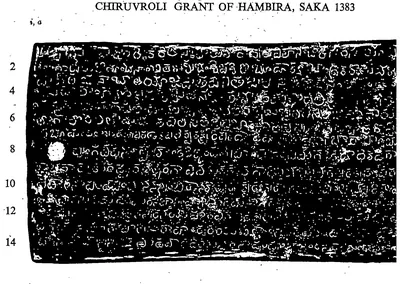 "Chiruvroli Grant of Hambira, Saka 1383", first side of the first plate (lines 1-14) (Epigraphia Indica XXXIV, between pp. 184 and 185)Inscription rubbing · 1963
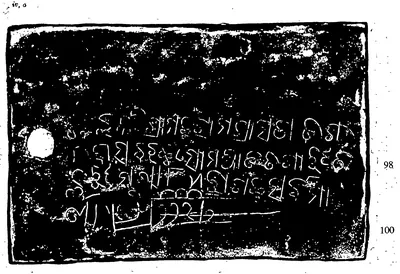 "Chiruvroli Grant of Hambira, Saka 1383": the fourth plate, four lines in Oriya with the drawn sword (Epigraphia Indica XXXIV, between pp. 184 and 185)Inscription rubbing · 1963
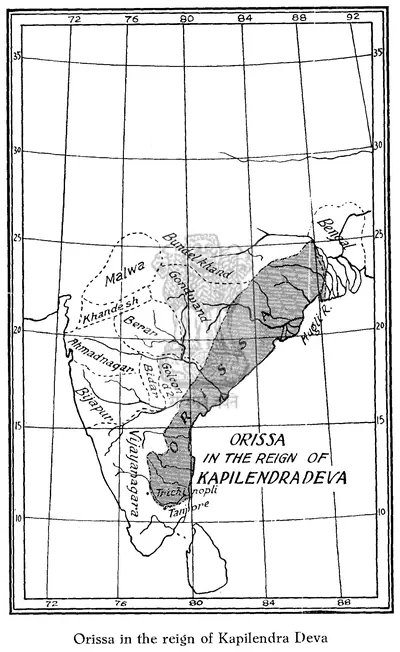 "Orissa in the reign of Kapilendra Deva": map in R. D. Banerji, History of Orissa, Vol. I (1930), facing p. 296Map · 1930
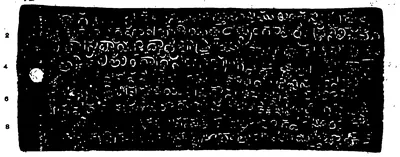 "Plates of Ganadeva of Kondavidu.—Saka-Samvat 1377", first side of the first plate (lines 1-9) (Indian Antiquary XX, plate with p. 390)Inscription rubbing · 1891
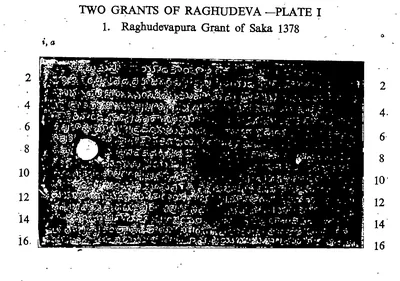 "Two Grants of Raghudeva.—Plate I. 1. Raghudevapura Grant of Saka 1378", first side of the first plate (lines 1-16) (Epigraphia Indica XXXIII, between pp. 12 and 13)Inscription rubbing · 1963
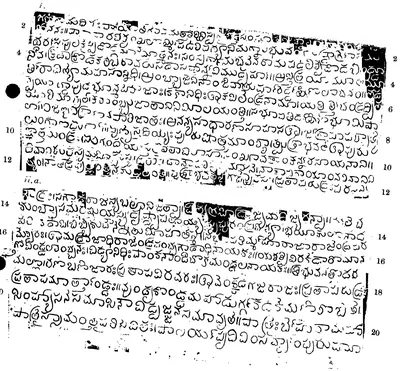 "Velicherla Grant of Prataparudra Gajapati: Saka 1432", first plate and first side of the second plate (lines 1-20) (Epigraphia Indica XXVIII, between pp. 210 and 211)Inscription rubbing · 1958
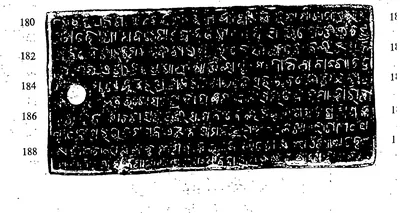 "Veligalani Grant of Kapilesvara, Saka 1380": plate face with lines 180-188, the Oriya summary (Epigraphia Indica XXXIII, plates between pp. 286 and 287)Inscription rubbing · 1963
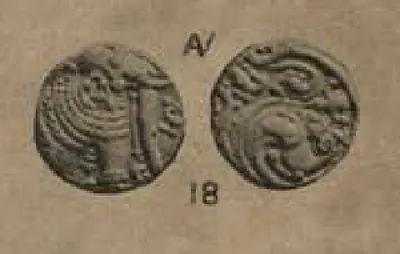 Gold "Gajapati or elephant pagoda", both sides (V. A. Smith, Catalogue of the Coins in the Indian Museum, Calcutta, Vol. I, 1906, plate XXX, 18)Coin · 1906
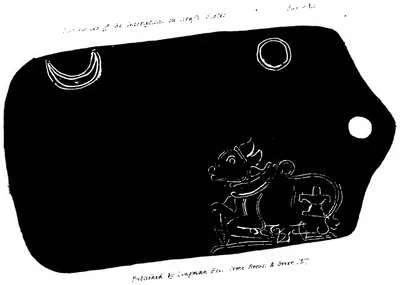 Lithograph of an emblem face of the Potavaram copper-plate grant of the Gajapati Purushottama: crescent moon, sun and the bull Nandi with a linga (Transactions of the Literary Society of Madras, Part I, 1827)Inscription rubbing · 1827
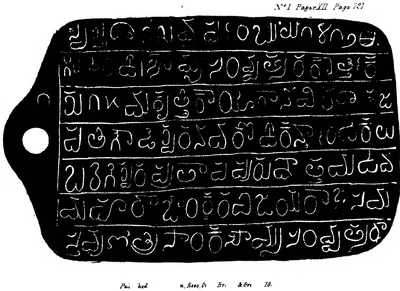 Lithograph of the first inscribed face of the Potavaram copper-plate grant of the Gajapati Purushottama, Saka 1412 (Transactions of the Literary Society of Madras, Part I, 1827)Inscription rubbing · 1827
Related
People
Kapilendra (Kapilesvara)
c. 1434–1470 CE
Founder of the Suryavamsi Gajapati dynasty of Orissa, who took the throne of the last Eastern Ganga king in 1434–35 and reigned until about 1470. He conquered the Reddi kingdoms of Rajahmundry and Kondavidu, and governed them through his nephew Raghudeva and his kinsman Ganadeva. He relieved Devarakonda from the Bahmanis in 1459, and his son Hamvira and Raghudeva took Warangal in 1460. His records credit him with conquests down the coast to the Kaveri.
Hamvira (Hambira)
c. 1459–1478 CE
Son of the Gajapati king Kapilendra and the leading general of his conquests in the Telugu and Tamil countries. He captured the fort of Warangal on 2 February 1460 and made the Chiruvroli grant on the Krishna in 1461. In 1464 his son Dakshina-Kapilesvara governed Kondavidu and the forts of the south. Ferishta writes of an 'Ambur Ray' who took the Orissan throne with Bahmani help after Kapilendra's death. This man has been identified with Hamvira, but the succession is disputed.
Purushottama (Gajapati)
c. 1470–1497 CE
Gajapati king of Orissa from 1469–70 to 1496–97, son of Kapilendra. Early in his reign the Bahmanis took Rajahmundry and Kondapalli or Kondavidu, after a disputed succession in which he may have bought their help. His attempt to recover the Godavari country in the 1470s ended with Muhammad Shah III's invasion of Orissa. But by 1489 his grants and inscriptions reach the Krishna and the Ongole country again. Orissan tradition credits him with an expedition to Kanchi and a romantic marriage.
Prataparudra (Gajapati)
c. 1497–1540 CE
Gajapati king of Orissa from 1496–97 to about 1540, son of Purushottama, and the last great king of the Suryavamsi line. At his accession his empire reached from Bengal to the Guntur and Nellore country. In 1512–19 the Vijayanagara king Krishnadeva Raya took Udayagiri, Kondavidu and Kondapalli, captured his son Virabhadra, marched to Simhachalam and married his daughter. The Qutb Shahi sultan of Golconda then took the Godavari–Krishna country. The legal digest Sarasvativilasa bears his name. He was a disciple of Chaitanya.
Inscriptions
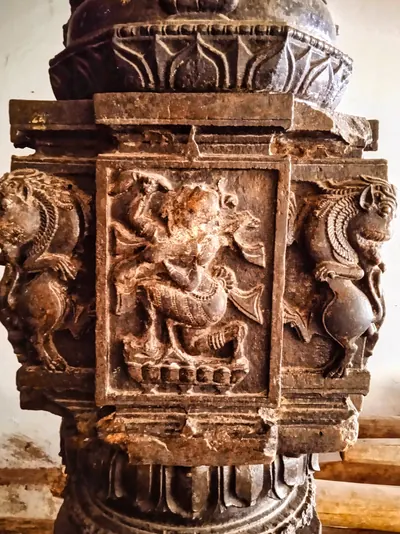
Gajapati inscriptions at Srikurmam (1452–1503)
1452–1503 CE
Short Telugu records on the black stone pillars of the Srikurmam temple. They are dated in the reigns of the Gajapati kings Kapilendra (1452, 1455, 1460), Purushottama (1470–1495) and Prataparudra (1503), and record gifts of land, lamps, images and silver vessels. They were copied in 1896 and printed in South-Indian Inscriptions V (1925). Monmohan Chakravarti and R. D. Banerji used them to fix the regnal years of the kings, and V. Rangacharya used them to argue that the kings came to the throne earlier.
Kondavidu plates of Ganadeva (1455)
c. 1455 CE
Three copper plates, sent to E. Hultzsch from the Kistna district and edited by him in 1891. They record a gift of the village of Chavali in the Repalle taluk to a number of Brahmins by Ganadeva, called Rautaraya, governor of Kondavidu. The gift was made on the day of a lunar eclipse in Saka 1377. The grant praises 'king Kapila' of the Solar race, the Gajapati of Orissa, whose capital was Cuttack. A pillar inscription of the same Ganadeva at Chintapallipadu is a year older, of April 1454.
Raghudevapuram and Dorapalem grants of Raghudeva (1455–56)
1456 CE
Two copper-plate charters of Raghudeva, nephew of the Gajapati Kapilendra and his governor at Rajahmundry. D. C. Sircar edited them in Epigraphia Indica XXXIII (1959–60): one from a set in the collection of the Andhra Historical Research Society at Rajahmundry, and one from a single plate in private hands. The Raghudevapura grant of June 1456 founded an agrahara (Brahmin village) on the Godavari for forty shares of Brahmins, and it gives the first family tree of Kapilendra's family. The broken Dorapalem grant of 1455–56 gave a village on the Godavari to a Brahmin.
Veligalani grant of Kapilesvara (1458)
1458 CE
Ten surviving plates of a copper charter whose first plate is lost, edited by D. C. Sircar and K. H. V. Sarma in 1963. By it the Gajapati Kapilendra (Kapilesvara), camping on the bank of the Godavari on the full moon of Vaisakha, Saka 1380 (27 April 1458), gave the village of Veligalani to 120 Brahmins and renamed it Kapilesvarapura. It is the only known copper-plate grant of the king himself. It has sections in Sanskrit, Telugu and Oriya, names his father and mother, and is the first to give him the titles Gajapati, Gaudesvara and Navakoti-Karnata-Kalavaragesvara.
Warangal inscriptions of Hamvira and Raghudeva (1460)
1460 CE
Two short records on gateways of the Warangal fort. Both are dated Saturday, the tenth of the bright half of Magha in the year Pramathin, 2 February 1460. They record the capture of the fort from the Bahmanis by two princes of the Gajapati house of Orissa. One was Hamvira (Ambira-deva), son of Kapilendra. The other was his cousin Raghudeva, governor of Rajahmundry, who says that he spared the lives of the Bahmani commander and his men.
Chiruvroli grant of Hambira (1461)
1461 CE
Copper plates found in 1941 at Nemalikallu near Ravela in the Guntur district, and edited by D. C. Sircar and K. H. V. Sarma in 1963. They are the only known copper-plate grant of Hamvira (Hambira), son of the Gajapati Kapilendra. On 4 September 1461 he gave the village of Chiruvroli on the Krishna, renamed Hambirapura, to more than a hundred Brahmins. A plate in Oriya, from another grant, was found with them.
Potavaram grant of Purushottama (1489)
1489 CE
A copper-plate grant known only from lithographs (printed copies) and a translation by Ram Raz, published in Madras in 1827, and edited again by L. D. Barnett in 1916. By it the Gajapati Purushottama gave the village of Potavaram, in the district of Ammanabrolu, to the god Siva of Chadaluvada, in the present Ongole country. The gift was made in Kartika of Saka 1412 (1489). Barnett read it as evidence that by 1489 Purushottama had won back much of the Telugu country lost to the Bahmani sultan Muhammad Shah.
Velicherla grant of Prataparudra Gajapati (1510 or 1511)
c. 1510 CE
Three copper plates, registered in 1920–21 when the District Munsiff of Kavali sent them to the epigraphist, and edited by G. Ramadas in 1958. They record a gift by the Gajapati Prataparudra to a Brahmin, made while he held court in the great fort of Undrakonda. He gave the village of Velicherla, east of the fort of Udayagiri in the Jaladanki country of Pakanadu. The grant is dated Saka 1432 in a chronogram (a date hidden in words). Its first editor read the date as 4 October 1510, and Ramadas as 24 October 1511. It shows the Gajapati still master of the Nellore country just before Krishnadeva Raya's campaigns.
References
Notes (0)
Sources (29)
Spotted an error on this page? Tell us
Last updated: