Garavapadu plates of Ganapatideva
A Sanskrit copper-plate grant of 12 April 1260. In it Tikka, a general and son of the Kakatiya king Ganapatideva's minister Devaraja, gave the village of Garavapadu to fifty Brahmans. It traces the Kakatiyas to Karikala Chola and names Kakati as the place where the family began.
What it is
The Garavapadu grant is cut on three copper plates held together by a ring.1 The ring is riveted into a round seal that shows the crescent and the sun, a boar facing a dagger, and a cow.1 The plates have no recorded findspot.1 They reached the epigraphy office at Madras in 1916.1 They were lent through the scholar M. Ramakrishnakavi by T. Achyuta Rao, a deputy inspector of schools, and were later acquired by the Madras Museum.1
C. R. Krishnamacharlu, the editor, noted a report that they had been found near Eluru (then Ellore).2 When he published them in 1926, this was only the second Kakatiya copper-plate charter known.34 The first was a grant of 1255 from the Nellore district, also of Ganapati’s reign.34
Language and date
The text is Sanskrit in the Telugu script of the period.1 Lines 1 to 45 contain 21 verses of prayer and narrative.1 A list of the Brahman shareholders with their gotras (clans) follows, then the boundaries of the village and the usual closing verse.1
The grant was made in Saka 1182 (Saka is an Indian way of counting years), the cyclic year Raudra, in the month Chaitra.5 The day was that of a solar eclipse in the dark fortnight.5 Krishnamacharlu worked this out, using L. D. Swamikannu Pillai’s Ephemeris, as Monday, 12 April 1260.5 There was in fact a solar eclipse on that day.5
The Kakatiya family line
After praising Ganesha, the Boar, Sarasvati and Shiva, the poem derives the dynasty from the Sun through Manu.3 In Krishnamacharlu’s translation, Kalikala-Choladeva “reached Dakshinapatha” while hunting.6 He pitched his camp at “the well-known town called Kakati”.6
Next comes Durjaya, “whose foundation (people) say that the Kakati kings, born in his race, were”.36 He is followed by Prola, his son Rudradeva, Rudradeva’s younger brother Mahadeva and Mahadeva’s son Ganapatideva.6 Mahadeva’s elephants are said to have breached the ramparts of the Sevuna (Yadava) king.6
Krishnamacharlu took the Prola of the grant to be Prola II.3 He identified the Sevuna king as Bhillama or Jaitugi I of Devagiri.3 He reasoned from this that Mahadeva’s last year was about 1197 or 1198.3
The grant
Ganapatideva’s minister Devaraja had four sons by his wife Lakshmi: Rama, Tikka, Manchaya and Betaya.5 Tikka, called “the wise and the illustrious general”, gave Garavapadu as an agrahara (Brahmin village) to fifty Brahmans learned in the Vedas.65
In fact only forty-nine Brahmans received shares.5 The fiftieth share went to the god Vallabha of Srikakolanu (Srikakulam in the Divi taluk).5 The first eleven donees belonged to the rare Yaska gotra.5 The boundaries name no neighbouring village. Krishnamacharlu listed several villages called Garapadu in the Guntur and Krishna (then Kistna) districts.2 He preferred the one in the Nuzvid taluk because of the report that the plates came from near Eluru.2
Notable points
The story that Karikala Chola fixed his camp at Kakati is not found in any other record of the dynasty, though Karikala appears as an ancestor in some.5 Krishnamacharlu used it to argue that “Kakati” was the name of a real town.5 He thought the family name came from that town, not from a family goddess as the commentator of the Prataparudriya had said.5 He also suggested that the town might be Kanker, north of Bastar, whose old names were Kakera and Kakaraya.52
The volume’s editors disagreed in a bracketed note, doubting that the study of words allowed such a derivation.2 They pointed out that tradition made the Kakatiyas descendants of Arjuna, of the Lunar race, while Karikala belonged to the Solar race.2
Krishnamacharlu also warned that the general Tikka of this grant should not be confused with two men of the same name at Nellore.5 One was the poet Tikkana, minister of Manumasiddhi.5 The other was Tikkana’s cousin, who commanded Manumasiddhi’s army.5
Editions
The plates were reviewed in the Madras Annual Report on Epigraphy for 1916-17. That report summarised the family line and the grant by Tikka, the second son of Devaraja.7 Krishnamacharlu edited the text and translation in Epigraphia Indica XVIII (1926) from ink impressions lent by the epigraphy office.2
Footnotes
-
C. R. Krishnamacharlu, “The Garavapadu Grant of Ganapatideva; Saka 1182”, Epigraphia Indica XVIII (1926), p. 346 (archive.org (opens in a new tab)). ↩ ↩2 ↩3 ↩4 ↩5 ↩6 ↩7 ↩8
-
Krishnamacharlu, “The Garavapadu Grant of Ganapatideva” (1926), p. 349, with the editors’ notes (archive.org (opens in a new tab)). ↩ ↩2 ↩3 ↩4 ↩5 ↩6 ↩7
-
Krishnamacharlu, “The Garavapadu Grant of Ganapatideva” (1926), p. 347 (archive.org (opens in a new tab)). ↩ ↩2 ↩3 ↩4 ↩5 ↩6 ↩7
-
Alan Butterworth and V. Venugopaul Chetty, A Collection of the Inscriptions on Copper-Plates and Stones in the Nellore District, Part I (1905), p. 137, copper-plate No. 17 (archive.org (opens in a new tab)). ↩ ↩2
-
Krishnamacharlu, “The Garavapadu Grant of Ganapatideva” (1926), p. 348 (archive.org (opens in a new tab)). ↩ ↩2 ↩3 ↩4 ↩5 ↩6 ↩7 ↩8 ↩9 ↩10 ↩11 ↩12 ↩13 ↩14 ↩15 ↩16
-
Krishnamacharlu, “The Garavapadu Grant of Ganapatideva” (1926), p. 354, translation of verses 11–20 (archive.org (opens in a new tab)). ↩ ↩2 ↩3 ↩4 ↩5 ↩6
-
Annual Report on Epigraphy, Southern Circle, for 1916-17 (1917), Part II, pp. 121–122, para. 30 (archive.org (opens in a new tab)). ↩
Photos
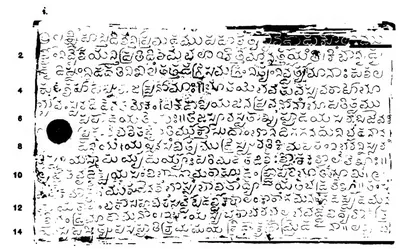 "Garavapadu Grant of Ganapatideva: Saka 1182", plate i (Epigraphia Indica XVIII, plate between pp. 350 and 351 (PDF p. 452))Inscription rubbing · 1926
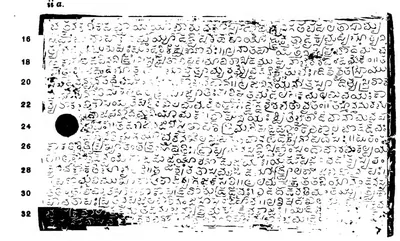 "Garavapadu Grant of Ganapatideva: Saka 1182", plate ii a (Epigraphia Indica XVIII, plate between pp. 350 and 351 (PDF p. 452))Inscription rubbing · 1926
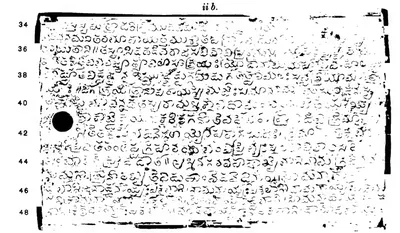 "Garavapadu Grant of Ganapatideva: Saka 1182", plate ii b (Epigraphia Indica XVIII, plate between pp. 350 and 351 (PDF p. 453))Inscription rubbing · 1926
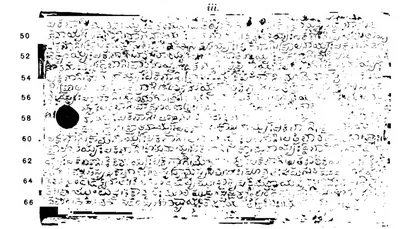 "Garavapadu Grant of Ganapatideva: Saka 1182", plate iii (Epigraphia Indica XVIII, plate between pp. 350 and 351 (PDF p. 453))Inscription rubbing · 1926
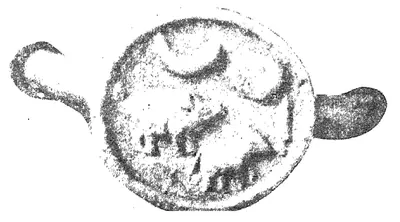 Seal of the Garavapadu grant of Ganapatideva, Saka 1182 (Epigraphia Indica XVIII, plate "Garavapadu Grant of Ganapatideva: Saka 1182")Book plate · 1926
References
Notes (0)
Sources (3)
Spotted an error on this page? Tell us
Last updated: