Bothpur tank inscription of Malyala Gunda
A Telugu and Sanskrit pillar inscription of 1259 at Bothpur in the Mahbubnagar district. It records the tanks, temples and Brahmin endowments of the general Malyala Gunda, who served Ganapatideva of Orugallu. The scholar-poet Ishvara-suri composed it. It is the record that places the Kakatiya dynasty in the fourth caste.
The pillar
The inscription is cut on a black stone pillar in the courtyard of the mosque at Bothpur, in the Mahbubnagar taluk and district.1 P. Sreenivasachar edited it in 1940 as No. 52 of his Corpus of Inscriptions in the Telingana Districts, with two plates. He identified Bothpur with the Budhapura or Budhapuri of the inscriptions.12
Another Bothpur record of the same general has the same order.3 The Telugu prose with the details of the gift comes first, and the Sanskrit poem follows it as a kind of appendix.3
The Telugu record
The opening Telugu lines say that the mahamandaleshvara (great provincial lord) Kakatiya king Ganapati was ruling from his capital Orugallu (Warangal).4 At that time the general Malyala Gunda, lord of Samkisa, sat in state.5 He was attended by ministers, priests, generals, vassals and soldiers.5 Jesters, panegyrists (praise-singers), actors, dancers, poets, debaters and musicians attended him too.5
Gunda received the poet Ishvara-suri, son of Mayurarya of the Atreya gotra (clan).5 Ishvara-suri was a master of ornate verse and of Panini’s grammar.5 Gunda gave endowments to Brahmins.5 He sent Aletappa to Varanasi and Gaya.51 At the time of an eclipse he gave Ishvara-bhatta two shares of land behind the Bas-samudra tank.51
The Sanskrit poem
The Sanskrit verses describe the four castes born from Brahma, the fourth of them great in numbers and wealth.6 In that fourth caste, the poem says, is the praiseworthy Kakatiya dynasty.6 In it were born king Prola, his son king Mahadeva, and Mahadeva’s son king Ganapati.6
By Ganapati’s favour the Malyala family held a large territory.6 Its line ran from Dannaya through the general Bacha and his wife Bachamambika to the general Gundaya.6 Gunda’s wife was Kuppambika of the Gona family.7
The poem praises the tank Gunda built near Budhapuri, the travellers who rest on its bund and the fields it waters.7 In the year Siddharthi, on the thirteenth day of the bright half of Chaitra, he named the tank Bacha-samudra after his mother.78
Gunda also built a second tank, fed by a canal from the first and named after his wife Kuppambika.8 On its bank he built a pair of temples named after his wife and himself.8 He gave Ishvara-bhatta, who composed the inscription, eleven shares of wet land behind the Kuppa-samudra and ten of dry land.8
The poem ends with a chakra-bandha, a figure of circles one inside another.81 Its letters spell out the title of the record (tadaga-sasanamu, the tank inscription), the praise of the hero Gunda and the name of the composer.81 Three sides of the pillar carry a further record of gifts of land under other canals and tanks.19
Date
The record gives Saka 1181 (Saka is an Indian way of counting years), the year Siddharthi, Chaitra, the bright thirteenth, a Thursday.101 Sreenivasachar found that the year had two months called Chaitra.101 In neither did the thirteenth fall on a Thursday, so the date is either 8 March or 7 April 1259.101
The fourth caste
Other sources, among them the court poet Vidyanatha, describe the Kakatiya kings in the language of the Kshatriya caste. P. V. Parabrahma Sastry argued that such language praised their courage as rulers and warriors.11 In his view it did not state their caste.11
He cited this Bothpur passage, with a similar one in a Vaddamanu inscription of the same general.12 He called them the most reliable evidence that the Kakatiyas were born in the fourth caste.12 He preferred them to the records that are more full of praise.12 For the dynasty, see the Kakatiyas.
The other Bothpur records
Two more records of the family were edited with this one:
- No. 51 is of Wednesday, 10 August 1272, in the reign of Rudradeva.1 It records a tank that Malyala Gunda built and named after his master Ganapati, the Ganapa-samudra, with endowments to learned Brahmins behind it.113 Its verses, also by Ishvara-suri, are so ornate that Sreenivasachar left some untranslated.1415 In his introduction he lists their tricks, such as verses written without whole classes of letters.1415
- No. 50, probably of 16 January 1277, records a Shaiva temple that Kuppambika built in her husband’s name after his death.16 Her gifts of land were made with her sons.16 It describes her as the daughter of Buddhaya of the Gona family.16
Parabrahma Sastry noted that the link between Gunda and Malyala Chaunda of the Kondaparti inscription is not known. He wrote that Gunda served both Ganapatideva and Rudramadevi and died before 1277. He identified Kuppambika’s father Buddhaya with the author of the Telugu Ranganatha Ramayana.17 He pointed to the couple’s support of learned men.17
In his survey of Kakatiya literature, Parabrahma Sastry described the chakra-bandha of the Bothpur record.18 He also described the learning of its composer, the grammarian Ishvara-bhatta.18
Editions
The three records are Nos. 50–52 of Sreenivasachar’s Corpus, Part II (1940), pp. 140–162. The dates are on p. 182 and the list entries on pp. 196–198.110
Footnotes
-
P. Sreenivasachar (ed.), A Corpus of Inscriptions in the Telingana Districts, Part II (1940), p. 197, list of inscriptions, Nos. 51–52 (archive.org (opens in a new tab)). Paraphrased. ↩ ↩2 ↩3 ↩4 ↩5 ↩6 ↩7 ↩8 ↩9 ↩10 ↩11 ↩12 ↩13
-
Sreenivasachar, Corpus, Part I (1942), p. 10 (archive.org (opens in a new tab)). Paraphrased. ↩
-
P. Sreenivasachar (ed.), A Corpus of Inscriptions in the Telingana Districts, Part I: Introduction (1942), p. 8 (archive.org (opens in a new tab)). Paraphrased. ↩ ↩2
-
Sreenivasachar, Corpus, Part II (1940), p. 157, translation of No. 52, lines 1–10 (archive.org (opens in a new tab)). Paraphrased. ↩
-
Sreenivasachar, Corpus, Part II (1940), p. 158, lines 10–47 (archive.org (opens in a new tab)). Paraphrased. ↩ ↩2 ↩3 ↩4 ↩5 ↩6 ↩7 ↩8
-
Sreenivasachar, Corpus, Part II (1940), p. 159, verses 3–16 (archive.org (opens in a new tab)). Paraphrased. ↩ ↩2 ↩3 ↩4 ↩5
-
Sreenivasachar, Corpus, Part II (1940), p. 160, verses 17–28 (archive.org (opens in a new tab)). Paraphrased. ↩ ↩2 ↩3
-
Sreenivasachar, Corpus, Part II (1940), p. 161, verses 29–34 and lines 145–158 (archive.org (opens in a new tab)). Paraphrased. ↩ ↩2 ↩3 ↩4 ↩5 ↩6
-
Sreenivasachar, Corpus, Part II (1940), p. 198, list of inscriptions, No. 52 (continued) (archive.org (opens in a new tab)). Paraphrased. ↩
-
Sreenivasachar, Corpus, Part II (1940), p. 182, appendix of dates, Nos. 39–41 (archive.org (opens in a new tab)). Paraphrased. ↩ ↩2 ↩3 ↩4
-
P. V. Parabrahma Sastry, The Kakatiyas of Warangal (1978), p. 28. ↩ ↩2
-
Parabrahma Sastry, The Kakatiyas of Warangal (1978), p. 29. ↩ ↩2 ↩3
-
Sreenivasachar, Corpus, Part II (1940), p. 150, translation of No. 51 (archive.org (opens in a new tab)). Paraphrased. ↩
-
Sreenivasachar, Corpus, Part II (1940), p. 149, translation of No. 51 (archive.org (opens in a new tab)). Paraphrased. ↩ ↩2
-
Sreenivasachar, Corpus, Part I (1942), p. 9 (archive.org (opens in a new tab)). Paraphrased. ↩ ↩2
-
Sreenivasachar, Corpus, Part II (1940), p. 196, list of inscriptions, No. 50 (archive.org (opens in a new tab)). Paraphrased. ↩ ↩2 ↩3
-
Parabrahma Sastry, The Kakatiyas of Warangal (1978), p. 151. ↩ ↩2
-
Parabrahma Sastry, The Kakatiyas of Warangal (1978), p. 293. ↩ ↩2
Photos
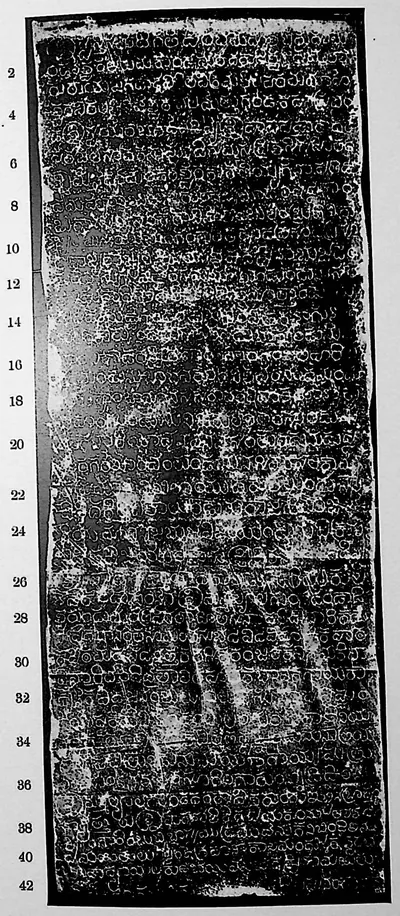 "Bothpur inscription of Malyāla Guṇḍa (dated Saka 1181)", face I (Sreenivasachar, Corpus of Inscriptions in the Telingana Districts II, Plate 48 (PDF p. 316))Inscription rubbing · 1940
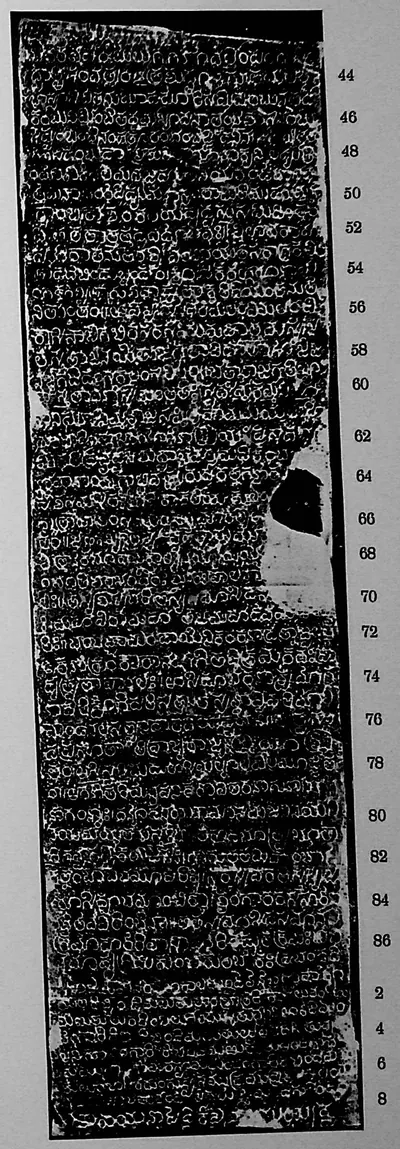 "Bothpur inscription of Malyāla Guṇḍa (dated Saka 1181)", face II (Sreenivasachar, Corpus of Inscriptions in the Telingana Districts II, Plate 48 (PDF p. 316))Inscription rubbing · 1940
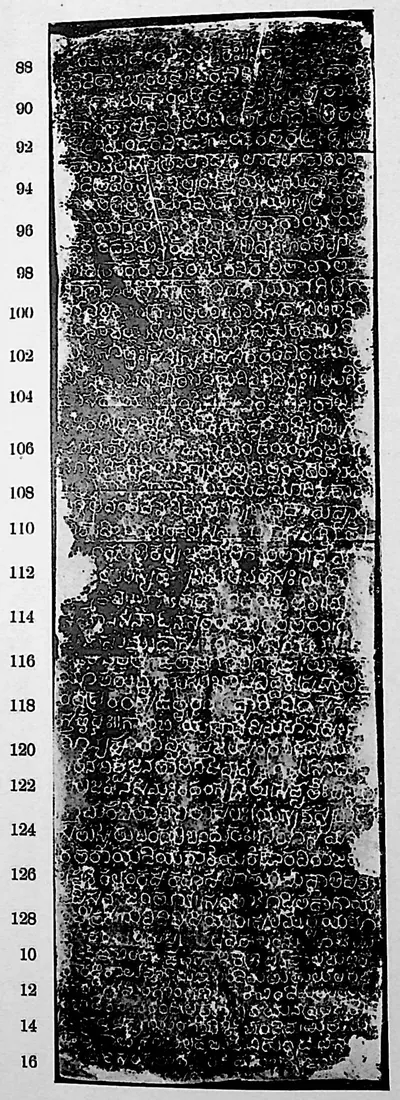 "Bothpur inscription of Malyāla Guṇḍa (dated Saka 1181)", face III (Sreenivasachar, Corpus of Inscriptions in the Telingana Districts II, Plate 49 (PDF p. 318))Inscription rubbing · 1940
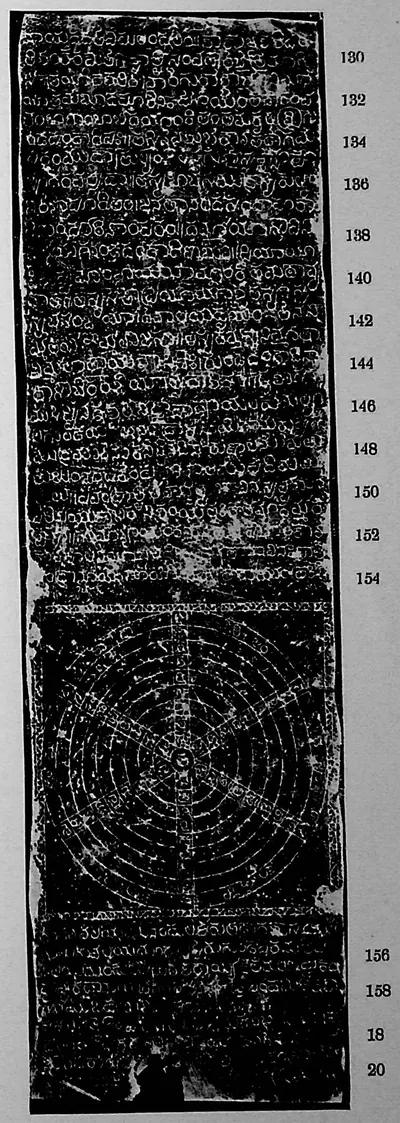 "Bothpur inscription of Malyāla Guṇḍa (dated Saka 1181)", face IV (Sreenivasachar, Corpus of Inscriptions in the Telingana Districts II, Plate 49 (PDF p. 318))Inscription rubbing · 1940
References
Notes (0)
Sources (3)
Spotted an error on this page? Tell us
Last updated: