Makka Darwaza inscription, Golconda (1559)
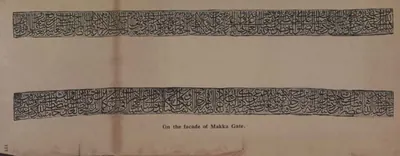
An inscription in Naskh script, more than 46 feet long, across the front of the Makka Darwaza (Mecca Gate) of Golconda fort. It records that the gate was built in AH 967 (1559), in the reign of Ibrahim Qutb Shah, who is named only as 'the namesake of the Friend of God'. It was built by the efforts of his minister Kamaluddin Husain, entitled Mustafa Khan, and the inscription was written by Muhammad of Isfahan.
The Makka Darwaza is one of the eight gates of Golconda Fort.1 Syed Ali Asgar Bilgrami says it was so named “because it faces the Mecca”.1 He describes a strong, wide gate of teak, studded with sharp iron spikes.1 The spikes were put there “with a view to protect the gate from the battering of elephants”.1
The longest inscription of the fort runs across the front of this gate.2 Bilgrami measured it at 46 ft 2 in long and 1 ft 6½ in wide.2 It is engraved “in Naskh script and Tughra style”.2 He wrote that “Notwithstanding the boldness of the letters the style is graceful and masterly”.2
The text
Bilgrami’s translation begins with a play on the picture of a fortress.31 It opens: “In the name of God, who made the word of His unity an impregnable fort, the gates of which have been opened to us through his mercy”.31
It then says that “this gate which is of fortune and fort of felicity was, verily, built during the days of the administration of the greatest of sovereigns”.31 This sovereign is “the shadow of God in the world, the namesake of Khalilul-lah (the Friend of God) (Prophet Ibrahim), Humayooni Azam Qutbshah”.31
The work was done “By the noble efforts of the pillar of his powerful empire”.1 This was a minister “better known among the people by the name of Kamaluddin Husain and entitled Mustafa Khan on account of his high rank”.1 The text ends: “In the months of the year 967 A.H. (1559 A.D.) written by Muhammad of Isphahan”.1
The king is not named outright.1 Bilgrami explains that Ibrahim Qutb Shah “has been metaphorically referred to as ‘Khalilul-lah’ which is the nom-de-plume of the Prophet Ibrahim”.1 Bilgrami published a plate of the inscription.3
Mustafa Khan and the walls of Golconda
Bilgrami adds some facts from the Qutb Shahi histories.1 The battlements and gates of Golconda, “which form a circumference of 8,000 yards were completed in the course of 9 months”.1 The work was supervised by Sayyid Kamaluddin of Ardistan, entitled Mustafa Khan, and it cost twenty lakhs.1 Mustafa Khan was also made peshwa (chief minister) and vakil (agent).1
The Golconda chronicle, translated by John Briggs, tells why the walls were built.45 The armies of Bijapur and Vijayanagara had camped near Golconda.45 After this, Ibrahim decided “to rebuild the fort of Golconda with stone and mortar”.45 The chronicle lists “The fortifications around the hill of Golconda” first among the buildings of his reign.45
The inscription is the dated record of that work.45 The chronicle also gives Mustafa Khan a share in forming the alliance that defeated Vijayanagara in 1565.6 See the Qutb Shahis.
Footnotes
-
Bilgrami, Landmarks of the Deccan (1927), p. 122 (archive.org (opens in a new tab)). ↩ ↩2 ↩3 ↩4 ↩5 ↩6 ↩7 ↩8 ↩9 ↩10 ↩11 ↩12 ↩13 ↩14 ↩15 ↩16 ↩17
-
Syed Ali Asgar Bilgrami, Landmarks of the Deccan (1927), p. 120 (archive.org (opens in a new tab)). ↩ ↩2 ↩3 ↩4
-
Bilgrami, Landmarks of the Deccan (1927), p. 121 and plate (archive.org (opens in a new tab)). ↩ ↩2 ↩3 ↩4 ↩5
-
Golconda chronicle, in Muhammad Qasim Ferishta, tr. John Briggs, History of the Rise of the Mahomedan Power in India, Vol. III (1829), p. 409 (archive.org (opens in a new tab)). ↩ ↩2 ↩3 ↩4 ↩5
-
Golconda chronicle, in Briggs, Rise of the Mahomedan Power, Vol. III (1829), p. 446 (archive.org (opens in a new tab)). ↩ ↩2 ↩3 ↩4 ↩5
-
Golconda chronicle, in Briggs, Rise of the Mahomedan Power, Vol. III (1829), p. 413 (archive.org (opens in a new tab)). ↩
Photos
References
Notes (0)
Sources (2)
Spotted an error on this page? Tell us
Last updated: