Kanuma grant of Sadasiva (1548)
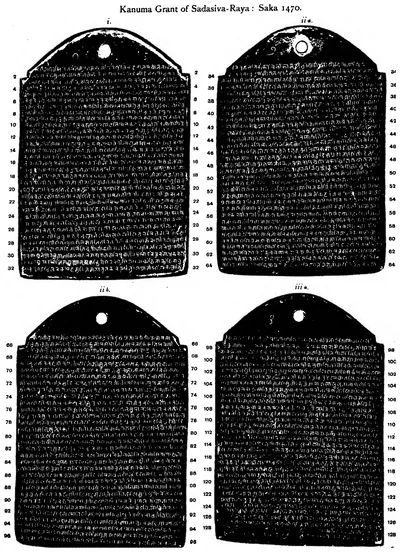
Five copper plates with a boar seal, held by the Collector of Anantapur and edited by S. V. Viswanatha in 1918. They record a gift by the Vijayanagara king Sadasiva in Saka 1470 (1548). He gave the village of Kanuma, in Mundimadugu sima of Gutti valita, to the god Chennakesava and thirty shares of Brahmans. The gift was made at the request of the chief Appalaraja, in the presence of the god Vitthalesvara on the Tungabhadra. Its editor called it the earliest copper-plate grant of Sadasiva then known.
The plates and the seal
S. V. Viswanatha edited the grant in the fourteenth volume of Epigraphia Indica.1 He wrote that “The inscription is on five copper-plates, which are bored at the top so as to admit a ring holding the plates together.”1 The plates “are in good preservation”. “They are now in the possession of the Collector of Anantapur.”1
H. Krishna Sastri had noticed them in his report on epigraphy for 1915.1 The first and last plates are inscribed on one side only, and there are 241 lines in all.1
The office of the Assistant Archaeological Superintendent for Epigraphy described the ring and seal.1 The seal “bears on a countersunk surface the following, which are the prevailing features of all Vijayanagara seals”.1 It shows the crescent and the sun at the top.1 It also shows a boar standing on a platform, facing right, with a dagger in front of it.1 At the bottom is a floral device, probably a lotus.1 The plates, ring and seal together weigh about 431 tolas.1
“The language of the inscription is Sanskrit, and the whole is in verse”.1 The exceptions are “the Telugu portions in plates Nos. 3, 4 and 5, which give the distinguishing marks of the boundaries and the signature”.1 “The characters are Nandinagari, except in the case of the signature, which is in Telugu.”1
The grant
According to Viswanatha, the inscription “records the grant of the village of Kanuma by Sadasiva-Maharaya of the Second Vijayanagara dynasty”.1 The donees were “several learned Brahmans of various gotras and sakhas” (clans and Vedic schools).1 The grant was made at the request of Appalaraja, the son of Krishnaraya and grandson of Timmaraja.1 Appalaraja was “of the Kasyapanvaya, i.e. the Solar race”.1
The gift was made in the presence of the god Vitthalesvara, on the banks of the Tungabhadra river.1 Kanuma, the record says, is in Mundimadugu sima (district), a division of Gutti valita (province).1 Half the village went to the god Chennakesava.1 The other half was divided into thirty shares for Brahmans, and two of these shares were set apart for the daily worship of the god.1
V. Rangacharya listed the plates in 1919 as “C.P. No. 9 of 1915”.2 He gives the date as Saka 1470 (Saka is an Indian way of counting years), Kilaka, Ashadha, bright fortnight 12, Sunday.2 He notes that Mundimadugu is in the Anantapur taluk.2 See Gooty.
Date and persons
The date is given in words.3 Viswanatha wrote: “Thus the record is dated in the Saka year 1470, corresponding to 1548 A.D.”3
He added that “The Saka year 1470 is the earliest date for Sadasiva that can be fixed from the copper-plate inscriptions known so far”.3 But “the earliest stone inscription of his time that has been examined is dated in the Saka year 1467”.3 He concluded: “Thus the grant is of importance, as it is the earliest of the copper-plate grants of Sadasiva yet discovered.”3
He wrote that “Among the names of personages appearing in the grant the most important is that of Ramaraja, the Karnata minister and brother-in-law of the king”.3 Of Sadasiva’s titles, he singled out Gaj-angha-ganda-bherunda.3 The title refers to the two-headed mythological bird shown carrying elephants in its talons and beaks.3 See Aliya Rama Raya and Vijayanagara.
Footnotes
-
S. V. Viswanatha, “The Kanuma Grant of Sadasiva-Raya: Saka 1470”, Epigraphia Indica XIV (1917–18), p. 341 (archive.org (opens in a new tab)). ↩ ↩2 ↩3 ↩4 ↩5 ↩6 ↩7 ↩8 ↩9 ↩10 ↩11 ↩12 ↩13 ↩14 ↩15 ↩16 ↩17 ↩18 ↩19 ↩20 ↩21 ↩22
-
V. Rangacharya, A Topographical List of the Inscriptions of the Madras Presidency, Vol. I (1919), p. 5, Anantapur No. 28 (archive.org (opens in a new tab)). ↩ ↩2 ↩3
-
Viswanatha, “The Kanuma Grant of Sadasiva-Raya”, Epigraphia Indica XIV (1917–18), p. 342 (archive.org (opens in a new tab)). ↩ ↩2 ↩3 ↩4 ↩5 ↩6 ↩7 ↩8
Photos
References
Notes (0)
Sources (2)
Spotted an error on this page? Tell us
Last updated: