Kolanupaka inscription of Rudramadevi's reign
A Sanskrit pillar inscription of December 1279 in the Somanatha temple at Kolanupaka. It gives the Kakatiya line from Prola II to the reigning queen Rudradevi (Rudramadevi). It also records a canal and temple gifts made under her Chalukya relative Indushekhara, nephew of her husband Virabhadra.
The pillar
The inscription is cut on a stone pillar standing in the Somanatha temple at Kolanupaka (Kulpak).1 In 1940 Kolanupaka was a jagir (land-grant) village in the Nalgonda district.1 P. Sreenivasachar edited the inscription as No. 25 of his Corpus of Inscriptions in the Telingana Districts, with a plate.1 It is in Sanskrit verse throughout. One verse is lost at the end of the first side, and parts of the third side are damaged.23
The Kakatiya genealogy
After opening prayers, the poem says that the Kakatiya kings were born in the line of Durjaya, who descended from Brahma.2 In this family was born king Prola.2 A lost verse probably named Prola’s son Rudra. The next verse names Rudra’s younger brother, king Mahadeva.2 Then it names Mahadeva’s son Ganapati-deva, who held the world in his hand.2
From Ganapati was born a daughter, Rudra-devi, who now rules.2 Her feet shine with the light of the crest-jewels of kings.23 The poet compares her generosity, wealth and strength with those of the gods and heroes.23 Sreenivasachar called this a clear account of the Kakatiya line from Prola II to Rudra-devi.1
The Chalukya prince and his servant
The damaged verses that follow turn to a family of the Chalukya line.3 Sreenivasachar thought they mentioned a Mahadeva, elder brother of Virabhadra.3 Mahadeva and his wife Lakkamba had a son, prince Indushekhara.3 In his list of inscriptions Sreenivasachar describes Indushekhara as the nephew, his brother’s son, of Virabhadra.1 Virabhadra was the prince-consort (queen’s husband) of the Kakatiya queen Rudra-devi.1 A servant of Indushekhara, Poti-nayaka, son of Machi-nayaka and Madachi, built a canal called Vamsha-vardhana at Kolipaka.3
The gift
The servants of the Kakati kings at Kolipaka were long-standing chiefs devoted to the god Somanatha.3 They met together and gave their consent.3 With it, Indushekhara and his minister granted land of thirty nivartanas (land measures) for the worship of the god.31 The verses divide it in detail. Shares went to Somanatha, the goddess Gauri and the god Vighneshvara, and to an astrologer and several named Brahmins and nayakas (military chiefs). Further shares paid for the offerings at the three daily services, betel, lamp oil, a thousand sevantika flowers, the priest and a watchman. Poti-nayaka gave everything that remained to the god.34
A last verse dates the gift to the year Pramadi, on the seventh day of the dark half of Pausha, at the sun’s entry into a new sign.4 It adds that Potana gave a bell-metal vessel and its stand.4 Sreenivasachar worked out the date as Wednesday, 27 December 1279, the day the sun entered Capricorn.5
Readings
Sreenivasachar translated the word phala in the description of the vessel and its stand literally, as fruit.4 So in his translation the vessel has sixty-four and the stand eighteen.4 P. V. Parabrahma Sastry took the phala of the text as the weight pala. In his reading the record gives a bronze vessel weighing 64 palas and a stand weighing 18 palas.6 He cited it for Kakatiya weights.6
Significance
The record names Ganapatideva’s daughter Rudra-devi as the reigning sovereign.2 Its verses on the Chalukya prince Indushekhara, whom Sreenivasachar calls the nephew of her husband Virabhadra, tell of her husband’s family.31 Parabrahma Sastry wrote that Ganapatideva married Rudramadevi to Virabhadra, son of the Chalukya mandalika (provincial lord) Indushekhara of Nidadavolu, to win that family as an ally. On his account Virabhadra was for a time placed in charge of Kolanupaka.78 His brother Mahadeva and Mahadeva’s son Indushekhara II served Rudramadevi and Prataparudra as governors of the Nidadavolu province.78
Editions
The text and translation are in Sreenivasachar’s Corpus, Part II (1940), pp. 82–88, with the date on p. 179 and the list entry on p. 190.251
Footnotes
-
P. Sreenivasachar (ed.), A Corpus of Inscriptions in the Telingana Districts, Part II (1940), p. 190, list of inscriptions, No. 25 (archive.org (opens in a new tab)). Paraphrased. ↩ ↩2 ↩3 ↩4 ↩5 ↩6 ↩7 ↩8 ↩9
-
Sreenivasachar, Corpus, Part II (1940), p. 86, verses 2–8 (archive.org (opens in a new tab)). Paraphrased. ↩ ↩2 ↩3 ↩4 ↩5 ↩6 ↩7 ↩8 ↩9 ↩10
-
Sreenivasachar, Corpus, Part II (1940), p. 87, verses 9–22 (archive.org (opens in a new tab)). Paraphrased. ↩ ↩2 ↩3 ↩4 ↩5 ↩6 ↩7 ↩8 ↩9 ↩10 ↩11 ↩12
-
Sreenivasachar, Corpus, Part II (1940), p. 88, verses 23–29 (archive.org (opens in a new tab)). Paraphrased. ↩ ↩2 ↩3 ↩4 ↩5
-
Sreenivasachar, Corpus, Part II (1940), p. 179, appendix of dates, No. 16 (archive.org (opens in a new tab)). Paraphrased. ↩ ↩2
-
P. V. Parabrahma Sastry, The Kakatiyas of Warangal (1978), p. 269. ↩ ↩2
-
Parabrahma Sastry, The Kakatiyas of Warangal (1978), p. 128. ↩ ↩2
-
Parabrahma Sastry, The Kakatiyas of Warangal (1978), p. 166. ↩ ↩2
Photos
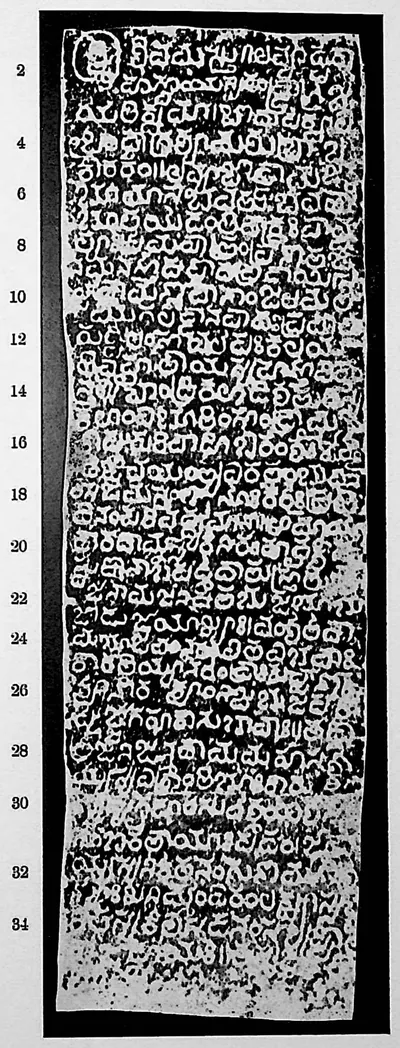 "Kulpak inscription", face I (Sreenivasachar, Corpus of Inscriptions in the Telingana Districts II, Plate 27 (PDF p. 274))Inscription rubbing · 1940
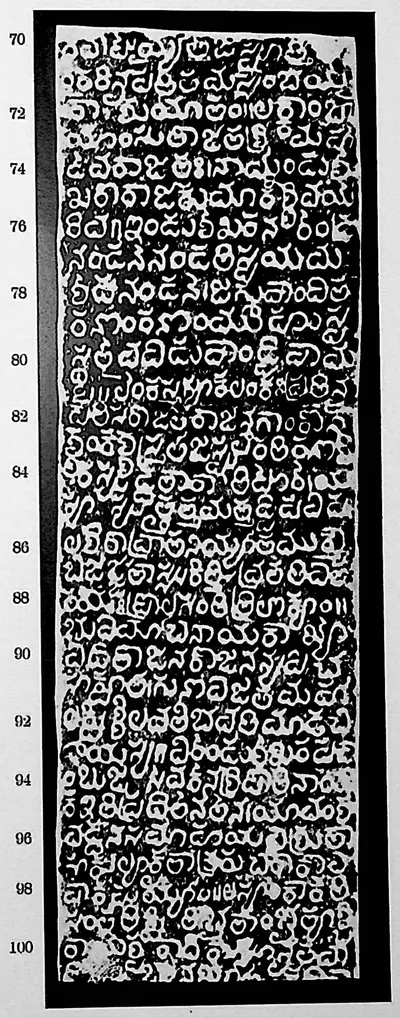 "Kulpak inscription", face I (Sreenivasachar, Corpus of Inscriptions in the Telingana Districts II, Plate 28 (PDF p. 276))Inscription rubbing · 1940
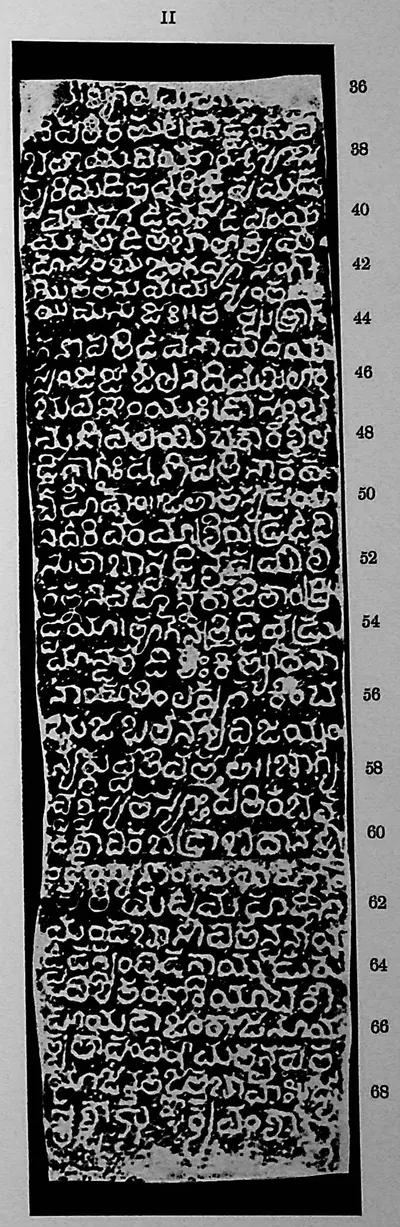 "Kulpak inscription", face II (Sreenivasachar, Corpus of Inscriptions in the Telingana Districts II, Plate 27 (PDF p. 274))Inscription rubbing · 1940
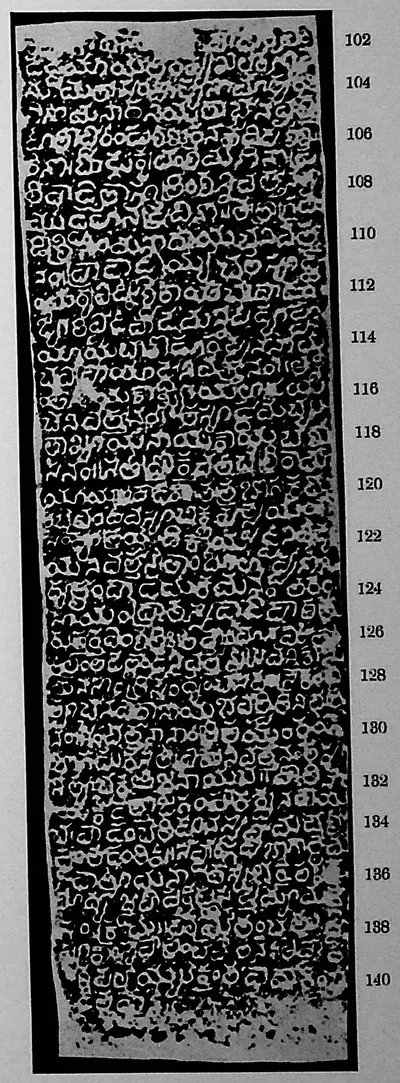 "Kulpak inscription", face II (Sreenivasachar, Corpus of Inscriptions in the Telingana Districts II, Plate 28 (PDF p. 276))Inscription rubbing · 1940
References
Notes (0)
Sources (2)
Spotted an error on this page? Tell us
Last updated: