Rudramadevi
Daughter and successor of the Kakatiya king Ganapatideva. She ruled from Orugallu (Warangal) under the masculine title Rudradeva Maharaja from about 1260. She faced rebels, the Yadavas, the Eastern Gangas and the revolt of the Kayastha Ambadeva, and died in 1289 according to the Chandupatla inscription (1294–95 in older accounts). Henry Yule and E. Hultzsch identified her with the just and beloved queen praised, without a name, by Marco Polo.
Rudramadevi was the daughter and heir of the Kakatiya king Ganapatideva.12 She ruled from Orugallu (Warangal) under the masculine name Rudradeva Maharaja.34 E. Hultzsch identified her with the queen whom Marco Polo praised, without naming her, for her justice.5
Daughter, not widow
Rudramadevi, also called Rudramba or Rudramamba, was the daughter of the Kakatiya king Ganapatideva.15 This was not always accepted. Late Telugu chronicles such as the Pratapa Charitra made her Ganapati’s wife.6 Henry Yule, annotating Marco Polo in 1903, called her Ganapati’s widow and a daughter of the king of Devagiri.7 The Imperial Gazetteer of 1909 was unsure, and wrote “wife or daughter”.8
K. P. Trivedi edited Vidyanatha’s Prataparudriya in 1909.910 He rejected the story that Ganapati had married a Devagiri princess called Rudramadevi.910 He noted that the play included in the work calls “king Rudra” the daughter of Ganapati, given a male name by him.910
Inscriptions settled the question: the Kotagiri copper plates of 1273, published in 1925, call her Ganapati’s daughter.111 The Hyderabad government noted that this confirmed “the now accepted view that she was the daughter and not the consort of that King”.111
She married Virabhadra, a prince of the Chalukya family of Nidadavolu in the Godavari region, son of the chief Indushekhara.1213 P. V. Parabrahma Sastry thought that Ganapatideva arranged the marriage to secure the loyalty of the Nidadavolu Chalukyas after his conquest of the Kolanu country.1415 He noted that Virabhadra was for a time placed in charge of Kollipaka.1415
Coming to the throne
Ganapatideva had no son and named Rudramadevi his heir.2 Parabrahma Sastry holds that she ruled jointly with her father from about 1259–60, and alone from 1262.2 An inscription at Tripurantakam dated 8 November 1261 is already dated in the second year of Rudradeva Maharaja.16 An inscription of 1269 at Durgi, however, still treats Ganapati as the ruling king and calls her pattoddhati. Parabrahma Sastry reads this word as pattoddhriti, “chosen for the throne”.2
He concludes that she was then still only the queen designate (the chosen heir), and that her father was alive.2 Robert Sewell, working from inscriptions collected before 1923, placed Ganapati’s last regnal year in 1260, and her accession then.17 N. Venkataramanayya and M. Somasekhara Sarma dated her reign from 1259.18
Her records usually call her by a masculine name, Rudradeva Maharaja. Parabrahma Sastry notes that Vidyanatha’s Prataparudriya, written at her grandson’s court, states plainly that she took the throne under that name.319 An inscription of 1276–77 at Bothpur, in the Mahbubnagar district, is dated while “the Kakatiya king Rudradeva” was ruling the earth from Orugallu.4 Hirananda Sastri compared her to Raziyya, the daughter of Iltutmish, who ruled at Delhi as Sultan.20
Her succession was opposed. The Pratapa Charitra says that two sons of Ganapati by other queens, Harihara and Murari, seized the capital. In Venkataramanayya and Somasekhara Sarma’s summary of the chronicle, she marched on the city, won over its citizens and put her half-brothers to death.221 Both histories note that these princes are known only from that late work.221 Both allow that the story may preserve the memory of a real rebellion.221
Loyal chiefs upheld her rule, among them the Kayastha brothers Jannigadeva and Tripurari and the Recherla chief Prasaditya.22 The Velama family chronicle gives Prasaditya the whole credit, and the titles Kakatiya-rajya-sthapanacharya and Raya-pitamahanka.23 But Venkataramanayya and Somasekhara Sarma found the same or similar titles borne by other commanders in inscriptions of 1275 to 1290.24
Reign
Her reign began under pressure on several fronts. At the end of Ganapati’s reign the Pandya king Jatavarman Sundara Pandya invaded the Nellore region and defeated the Kakatiya forces.2517 The Kakatiyas lost their hold on the far south.2517
For about sixteen years the Godavari region shows no Kakatiya records.26 Parabrahma Sastry blames this on pressure from the Eastern Gangas of Orissa, until her generals pushed them back.26 The Yadava king Mahadeva of Devagiri invaded and besieged Orugallu. The Pratapa Charitra says the queen fought him for fifteen days and chased him back to Devagiri. Parabrahma Sastry takes a fragmentary Kakatiya inscription found at Bidar as proof that her armies did advance into Yadava territory.27
He also identifies a carving of a woman warrior on a lion, at the Svayambhu temple in Warangal Fort, with Rudramadevi and her title raya-gaja-kesari.2829 The identification is his interpretation, since the carving is not a labelled portrait.2829
Parabrahma Sastry credits her with introducing the nayankara system.30 Under it, military chiefs (nayakas) held villages in return for keeping troops for the king.30 Her successor Prataparudra organised it more fully.30 The Velama chronicle credits the introduction to Prasaditya.23 Venkataramanayya and Somasekhara Sarma found that from her time the kingdom was run through seventy-five nayaks drawn from all classes.31
Her records show the kingdom’s ordinary business. In 1261 she granted the village of Mandadam on the Krishna to her father’s spiritual teacher, Vishveshvara Shambhu.3233 He founded a Shaiva monastery there, with a college, a feeding house and a maternity home.3233 In December 1273 her subordinate Surya of the Viryala family founded a Brahman village, Vejjalapuri, and granted it in her reign. The grant opens with praise of the queen as Ganapati’s daughter.3411
Her sister Ganapamba ruled the Kota country as a mahamandaleshvara (great provincial lord).15 From the 1270s her most dangerous subordinate was the Kayastha chief Ambadeva.3536 He built up an independent state in the south-west of the kingdom.3536 In an inscription of 1290 at Tripurantakam he claimed to have conquered all the kings of the Andhra country.3536
Marco Polo
The Venetian traveller Marco Polo described a kingdom he called “Mutfili”, without naming its rulers. Henry Yule and E. Hultzsch identified it as the Kakatiya kingdom, named after its port of Motupalli.75 Polo wrote that it had been ruled by a king, “and since his death, some forty years past, it has been under his Queen”.37 He called her “a lady of much discretion, who for the great love she bore him never would marry another husband”.37
He added that she was a lover of justice, equity and peace.37 He said she was more loved by her people than any ruler before her.37
E. Hultzsch identified Polo’s king and queen as Ganapati and his daughter Rudramba.5 He noted that Polo is thought to have visited around 1290 and dictated his book in 1298–99.5 So, Hultzsch reasoned, the “forty years” fits a reign beginning about 1260.5 Polo’s belief that she was the king’s widow belongs to the same tradition the inscriptions later corrected.137
Death
A Telugu inscription at Chandupatla near Nalgonda is dated November 1289.36 It records a gift for the merit of Rudramadevi and her general Mallikarjuna-nayaka, both of whom had already died.36 Before its discovery, historians believed she lived until 1291 or even 1295.387
Venkataramanayya and Somasekhara Sarma, writing in 1960, placed her death at the end of 1294, and Prataparudra’s accession at the beginning of 1295.31 Parabrahma Sastry suggests that she died in the war against Ambadeva, but the inscription does not say so.36 Parabrahma Sastry calls her reign a rare instance of a woman ruling as sovereign in medieval India.39
Family
She had at least two daughters, Mummadamma and Ruyyama.1340 Mummadamma married a Kakatiya prince named Mahadeva and was the mother of Prataparudra.13 Ruyyama married the minister and general Induluri Annaya.1331
Parabrahma Sastry added a third daughter, also called Rudrama, who married the Yadava prince Ellanadeva.4113 She is known from his Alapadu copper-plate grant.4113 Venkataramanayya and Somasekhara Sarma name only two daughters, Mummadamma and Ruyyamma.40
Her grandson Prataparudra, already called Kumara Rudra (Prince Rudra), succeeded her.1342 In the play included in Vidyanatha’s Prataparudriya, the god Shiva tells her in a dream to hand the kingdom to her grandson.10 She had adopted him as her son at the god’s command.10 Venkataramanayya and Somasekhara Sarma likewise wrote that she adopted him as her son and heir at Ganapatideva’s command.31
Footnotes
-
S. Hanumant Rao and Lakshmi Kanta Sastri, The Kotagiri Plates of the Reign of the Kakatiya Queen Rudramamba (1925), p. v (archive.org (opens in a new tab)). ↩ ↩2 ↩3 ↩4 ↩5
-
P. V. Parabrahma Sastry, The Kakatiyas of Warangal (1978), p. 118. ↩ ↩2 ↩3 ↩4 ↩5 ↩6 ↩7 ↩8
-
P. V. Parabrahma Sastry, The Kakatiyas of Warangal (1978), pp. 8–9. ↩ ↩2
-
P. Sreenivasachar (ed.), A Corpus of Inscriptions in the Telingana Districts, Part II (1940), No. 50, translation, p. 141 (archive.org (opens in a new tab)). ↩ ↩2
-
E. Hultzsch, “Motupalli Pillar-Inscription of Ganapatideva”, Epigraphia Indica XII (1913–14), p. 190 (archive.org (opens in a new tab)). ↩ ↩2 ↩3 ↩4 ↩5 ↩6
-
P. V. Parabrahma Sastry, The Kakatiyas of Warangal (1978), p. 11. ↩
-
Henry Yule and Henri Cordier, The Book of Ser Marco Polo, vol. II (1903), p. 362, note 1 (archive.org (opens in a new tab)). ↩ ↩2 ↩3
-
Imperial Gazetteer of India, Provincial Series: Hyderabad State (1909), p. 164 (archive.org (opens in a new tab)). ↩
-
K. P. Trivedi (ed.), The Prataparudrayasobhushana of Vidyanatha (1909), Introduction, p. xix (archive.org (opens in a new tab)). ↩ ↩2 ↩3
-
K. P. Trivedi (ed.), The Prataparudrayasobhushana of Vidyanatha (1909), Introduction, p. xiv (archive.org (opens in a new tab)). ↩ ↩2 ↩3 ↩4 ↩5
-
S. Hanumant Rao and Lakshmi Kanta Sastri, The Kotagiri Plates (1925), p. 2 (archive.org (opens in a new tab)). ↩ ↩2 ↩3
-
P. V. Parabrahma Sastry, The Kakatiyas of Warangal (1978), p. 117. ↩
-
P. V. Parabrahma Sastry, The Kakatiyas of Warangal (1978), p. 128. ↩ ↩2 ↩3 ↩4 ↩5 ↩6 ↩7
-
P. V. Parabrahma Sastry, The Kakatiyas of Warangal (1978), p. 112. ↩ ↩2
-
P. V. Parabrahma Sastry, The Kakatiyas of Warangal (1978), p. 166. ↩ ↩2 ↩3
-
Gajjala Vasanta Lakshmi (ed.), Epigraphia Telanganica, vol. 2 (2023), p. 313. ↩
-
Robert Sewell, The Historical Inscriptions of Southern India (1932), p. 154 (archive.org (opens in a new tab)). ↩ ↩2 ↩3
-
N. Venkataramanayya and M. Somasekhara Sarma, “The Kakatiyas of Warangal”, in G. Yazdani (ed.), The Early History of the Deccan, Parts VII–XI (1960), p. 620. ↩
-
Robert Sewell, The Historical Inscriptions of Southern India (1932), p. 155 (archive.org (opens in a new tab)). ↩
-
Hirananda Sastri, Shitab Khan of Warangal (1932), pp. 1–2 (archive.org (opens in a new tab)). ↩
-
N. Venkataramanayya and M. Somasekhara Sarma, “The Kakatiyas of Warangal”, in G. Yazdani (ed.), The Early History of the Deccan, Parts VII–XI (1960), pp. 621–622. ↩ ↩2 ↩3
-
P. V. Parabrahma Sastry, The Kakatiyas of Warangal (1978), p. 119. ↩
-
P. V. Parabrahma Sastry, The Kakatiyas of Warangal (1978), p. 164. ↩ ↩2
-
N. Venkataramanayya and M. Somasekhara Sarma, “The Kakatiyas of Warangal”, in G. Yazdani (ed.), The Early History of the Deccan, Parts VII–XI (1960), p. 622. ↩
-
P. V. Parabrahma Sastry, The Kakatiyas of Warangal (1978), p. 115. ↩ ↩2
-
P. V. Parabrahma Sastry, The Kakatiyas of Warangal (1978), p. 120. ↩ ↩2
-
P. V. Parabrahma Sastry, The Kakatiyas of Warangal (1978), pp. 120–121. ↩
-
P. V. Parabrahma Sastry, The Kakatiyas of Warangal (1978), pp. 121–122. ↩ ↩2
-
P. V. Parabrahma Sastry, The Kakatiyas of Warangal (1978), p. 302. ↩ ↩2
-
P. V. Parabrahma Sastry, The Kakatiyas of Warangal (1978), p. 195. ↩ ↩2 ↩3
-
N. Venkataramanayya and M. Somasekhara Sarma, “The Kakatiyas of Warangal”, in G. Yazdani (ed.), The Early History of the Deccan, Parts VII–XI (1960), p. 642. ↩ ↩2 ↩3 ↩4
-
P. V. Parabrahma Sastry, The Kakatiyas of Warangal (1978), pp. 276–277. ↩ ↩2
-
P. V. Parabrahma Sastry, The Kakatiyas of Warangal (1978), p. 292. ↩ ↩2
-
S. Hanumant Rao and Lakshmi Kanta Sastri, The Kotagiri Plates (1925), p. 7, verse 3 (archive.org (opens in a new tab)). ↩
-
P. V. Parabrahma Sastry, The Kakatiyas of Warangal (1978), pp. 122–124. ↩ ↩2 ↩3
-
P. V. Parabrahma Sastry, The Kakatiyas of Warangal (1978), pp. 125–126. ↩ ↩2 ↩3 ↩4 ↩5 ↩6
-
Henry Yule and Henri Cordier, The Book of Ser Marco Polo, vol. II (1903), pp. 359–360 (archive.org (opens in a new tab)). ↩ ↩2 ↩3 ↩4 ↩5
-
Robert Sewell, The Historical Inscriptions of Southern India (1932), p. 169 (archive.org (opens in a new tab)). ↩
-
P. V. Parabrahma Sastry, The Kakatiyas of Warangal (1978), p. 142. ↩
-
N. Venkataramanayya and M. Somasekhara Sarma, “The Kakatiyas of Warangal”, in G. Yazdani (ed.), The Early History of the Deccan, Parts VII–XI (1960), p. 641. ↩ ↩2
-
P. V. Parabrahma Sastry, The Kakatiyas of Warangal (1978), pp. 5–6. ↩ ↩2
-
P. V. Parabrahma Sastry, The Kakatiyas of Warangal (1978), p. 129. ↩
Photos
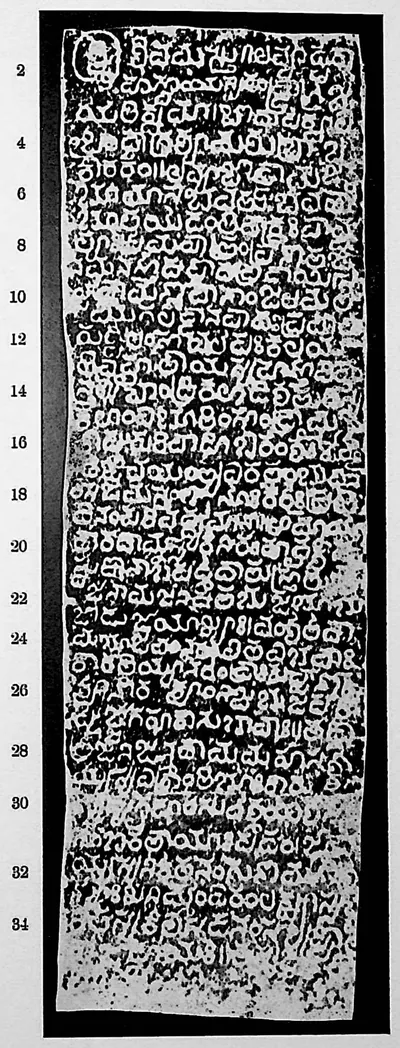 "Kulpak inscription", face I (Sreenivasachar, Corpus of Inscriptions in the Telingana Districts II, Plate 27 (PDF p. 274))Inscription rubbing · 1940
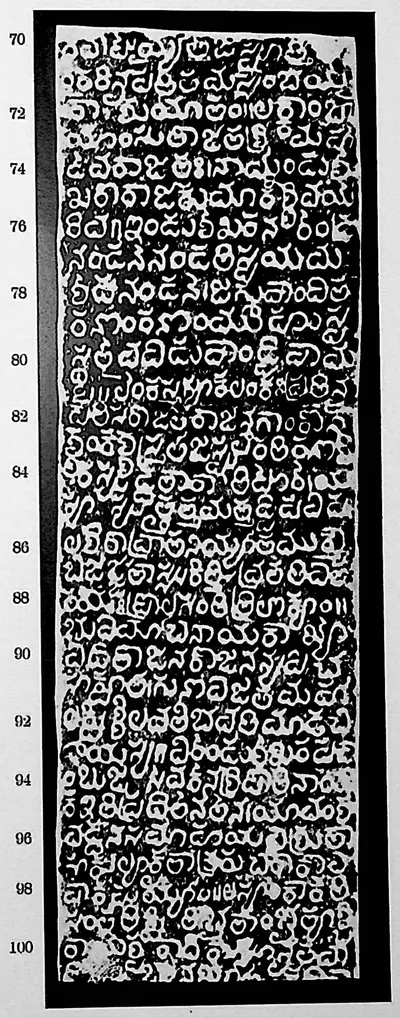 "Kulpak inscription", face I (Sreenivasachar, Corpus of Inscriptions in the Telingana Districts II, Plate 28 (PDF p. 276))Inscription rubbing · 1940
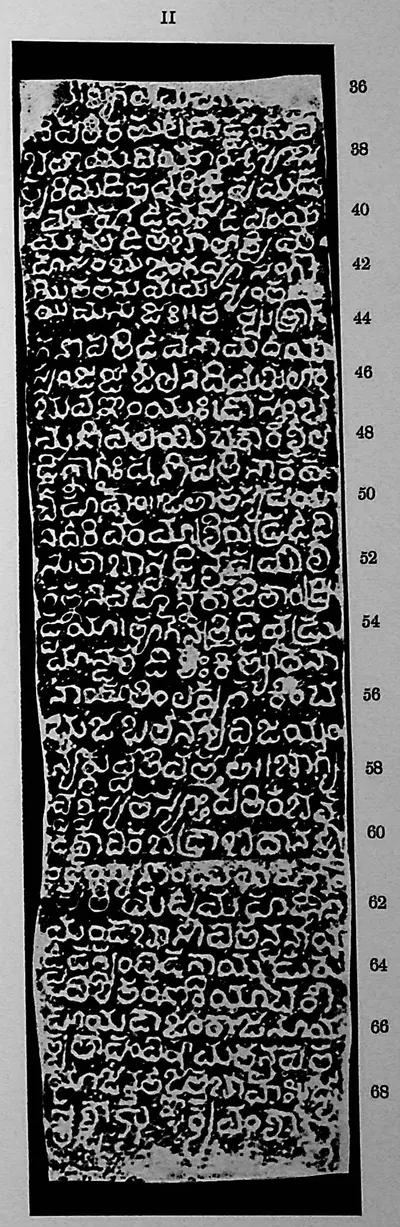 "Kulpak inscription", face II (Sreenivasachar, Corpus of Inscriptions in the Telingana Districts II, Plate 27 (PDF p. 274))Inscription rubbing · 1940
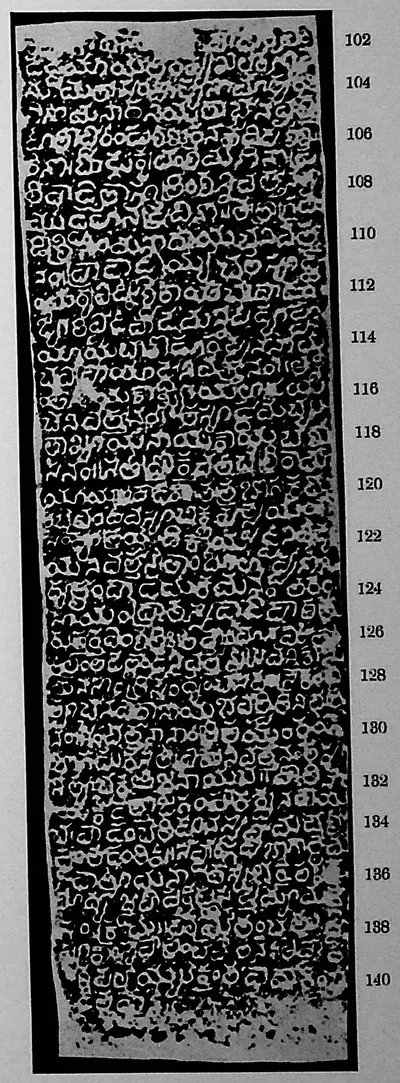 "Kulpak inscription", face II (Sreenivasachar, Corpus of Inscriptions in the Telingana Districts II, Plate 28 (PDF p. 276))Inscription rubbing · 1940
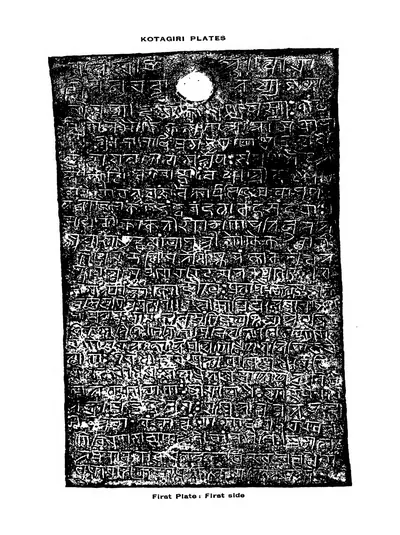 Kotagiri plates of the reign of the Kakatiya queen Rudramamba, A.D. 1273: First plate: first side (Kotagiri Plates 1925)Inscription rubbing · 1925
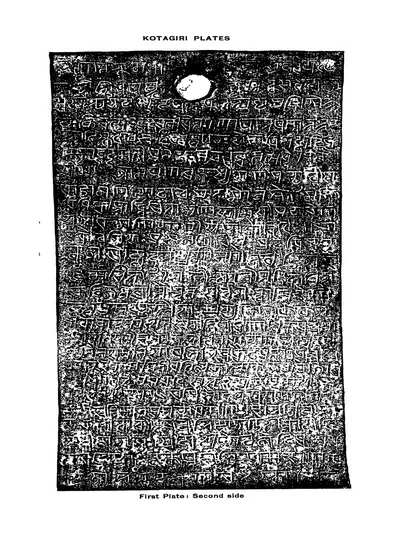 Kotagiri plates of the reign of the Kakatiya queen Rudramamba, A.D. 1273: First plate: second side (Kotagiri Plates 1925)Inscription rubbing · 1925
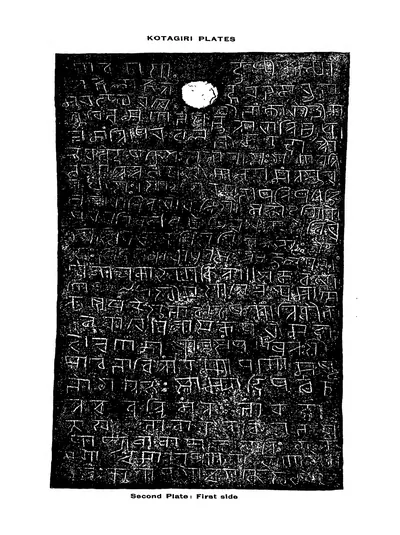 Kotagiri plates of the reign of the Kakatiya queen Rudramamba, A.D. 1273: Second plate: first side (Kotagiri Plates 1925)Inscription rubbing · 1925
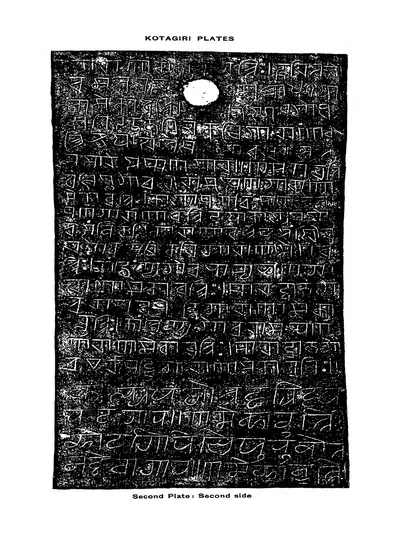 Kotagiri plates of the reign of the Kakatiya queen Rudramamba, A.D. 1273: Second plate: second side (Kotagiri Plates 1925)Inscription rubbing · 1925
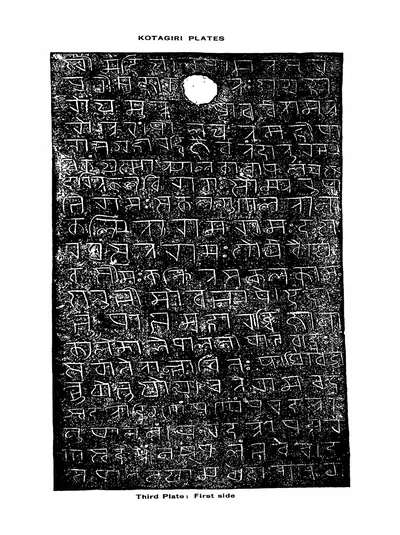 Kotagiri plates of the reign of the Kakatiya queen Rudramamba, A.D. 1273: Third plate: first side (Kotagiri Plates 1925)Inscription rubbing · 1925
Related
Dynasties

References
Notes (0)
Sources (11)
Spotted an error on this page? Tell us
Last updated: