Srikurmam inscription of Naraharitirtha
A Sanskrit inscription in Telugu letters on a black granite pillar of the Kurmesvara temple at Srikurmam, dated Saka 1203 (1281). It names the Madhva teachers Purushottama, Anandatirtha and Naraharitirtha. It says that Naraharitirtha defended Srikurmam against the Savaras and built a shrine of Yogananda-Narasimha there. It suggests that he governed the Kalinga country under the Eastern Ganga kings. H. Krishna Sastri used it and Naraharitirtha's other records to date the philosopher Madhva.
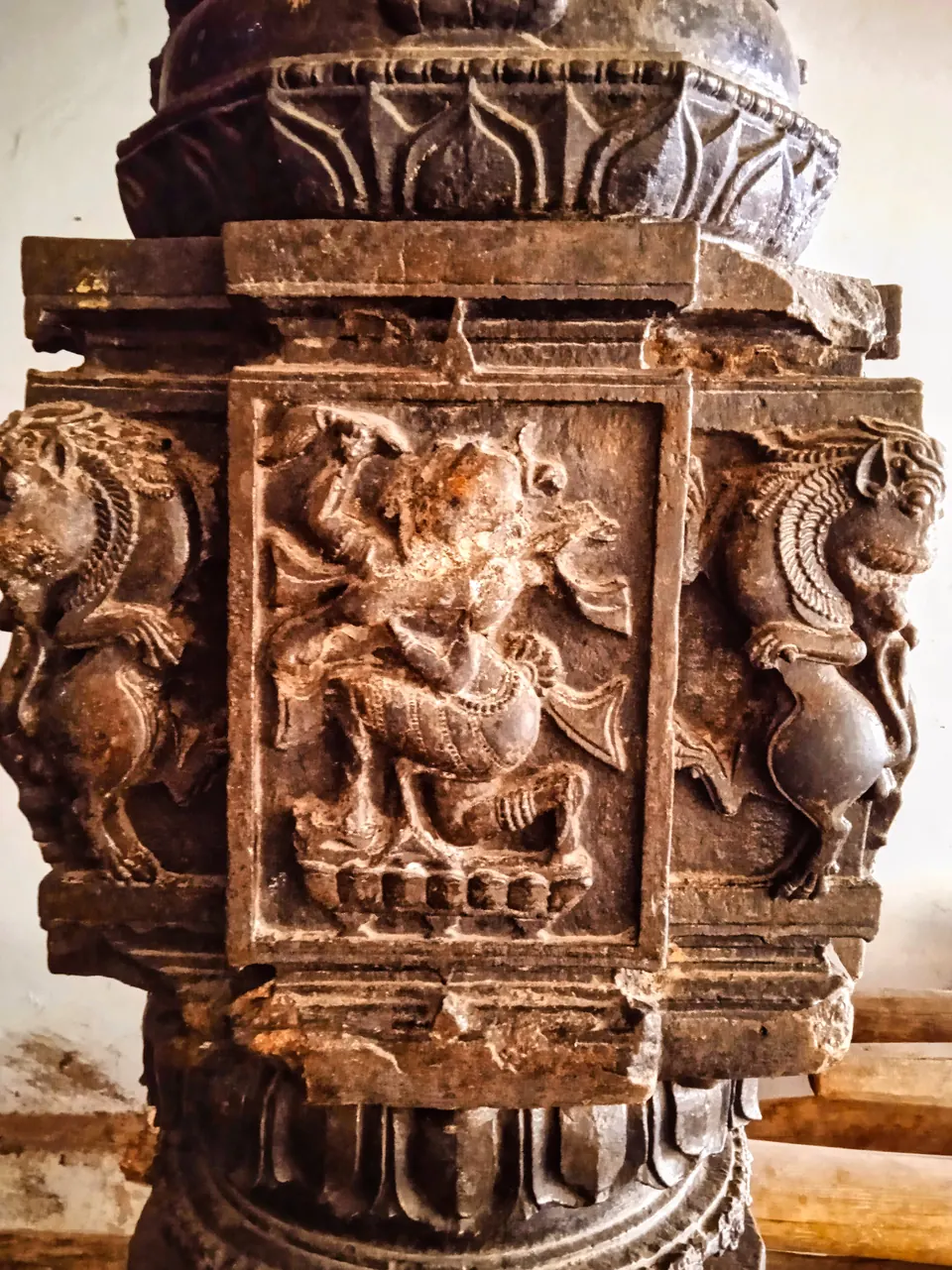
The inscription
H. Krishna Sastri described the record as being “in the Kurmesvara temple at Srikurmam in the Chicacole taluka of the Ganjam district”.1 It is inscribed “on the east and north faces of one of the black granite pillars which support the hall enclosing the temple”.1 It is “written in clear Telugu characters”.1 It has nine Sanskrit verses in various metres.1 See the Srikurmam temple.
Contents
The verses trace a line of Vaishnava teachers.1 The first is the ascetic Purushottama-mahatirtha.1 He is said to be an incarnation of Vishnu, and the author of a commentary.1 His pupil was Anandatirtha, “who explained the Vyasasutras in accordance with the principles of the Dvaita school”, that is the philosopher Madhva.1
Anandatirtha’s pupil was Naraharitirtha.1 In Krishna Sastri’s words, Naraharitirtha “seems to have been the governor of the Kalinga country (v. 6) and to have defended Srikurmam against an attack of the Sabaras” (v. 7).1 The Sabaras were the forest people of the Ganjam hills.1
In Krishna Sastri’s translation, Naraharitirtha used “an excellent sword (which is) a thunderbolt to the mountains,—the bands of Sabaras”.2 But the poet adds that he never had to strike with it.2
The last verse gives the date: Saka 1203 (Saka is an Indian way of counting years), the month of Mesha, a Wednesday in the bright fortnight.12 On that day Naraharitirtha built a temple of the god Yogananda-Nrisimha in front of the Kurmesvara temple.12 F. Kielhorn calculated that the day intended would be Saturday, 29 March 1281.2 In that case, the word for Wednesday in the date would have to be corrected to Saturday.2
Naraharitirtha in Kalinga
Krishna Sastri set the inscription beside the traditions of the Madhva mathas (religious houses).3 A hymn on Naraharitirtha tells that his master sent him to the Gajapati kingdom.3 There he ruled the Kalinga country for twelve years on behalf of an infant king.3 When the king came of age, Naraharitirtha returned the kingdom, and asked for the images of Rama and Sita as his reward.3
Krishna Sastri found that “this traditional history of Naraharitirtha’s life agrees with the statement made about him in verse 6 of the inscription”.4 It also “fully accounts for the existence in the Kalinga country of several inscriptions which record his gifts to temples”.4 These inscriptions “range between Saka-Samvat 1186 and 1215 (= A.D. 1264 and A.D. 1294)”.4 In his reading, another Srikurmam record of Saka 1186 shows that both Naraharitirtha and his father were ministers of the king.2
Besides this inscription, Krishna Sastri printed five other records of gifts by Naraharitirtha.256 They are in the temples of Srikurmam and Simhachalam, and Kielhorn calculated their dates:256
One of the Srikurmam records, of Saka 1215, is dated “in the 18th year of the victorious reign of the glorious Vira-Naranarasimhadeva”.46 Krishna Sastri took this king to be the Ganga king Narasimha II.46
V. Rangacharya summarised another record, of 3 January 1294.7 It records that Naraharitirtha set up images of Rama, Sita and Lakshmana at Srikurmam and made gifts to them.7 At Simhachalam, an inscription of Saka 1213 records his gift of four lamps on the occasion of an Ardhodaya (a rare holy day).8 Robert Sewell treated the gift at Srikurmam in 1293 as evidence that Narasimha II was then reigning over Kalinga.9
The date of Madhva
The lists of the Madhva mathas give Anandatirtha’s birth as Saka 1040 (1118).410 Krishna Sastri argued that the Saka dates in these lists were added later.410 They had been worked out from sixty-year cyclic years, and he argued that they must be pushed forward by two full cycles.410 Working back from the dates of Naraharitirtha’s inscriptions, he placed Anandatirtha’s life between 1238 and 1317.410
Rangacharya called the inscription “very important as it fixes the date of Madhvacharya and others”.7 See Religion.
Footnotes
-
H. Krishna Sastri, “Srikurmam Inscription of Naraharitirtha; Saka-Samvat 1203”, Epigraphia Indica VI (1900–01), p. 260 (archive.org (opens in a new tab)). ↩ ↩2 ↩3 ↩4 ↩5 ↩6 ↩7 ↩8 ↩9 ↩10 ↩11 ↩12 ↩13
-
Krishna Sastri, “Srikurmam Inscription of Naraharitirtha” (1901), p. 266, translation of verses 6–9 and Kielhorn’s notes (archive.org (opens in a new tab)). ↩ ↩2 ↩3 ↩4 ↩5 ↩6 ↩7 ↩8 ↩9 ↩10 ↩11
-
Krishna Sastri, “Srikurmam Inscription of Naraharitirtha” (1901), p. 261 (archive.org (opens in a new tab)). ↩ ↩2 ↩3 ↩4
-
Krishna Sastri, “Srikurmam Inscription of Naraharitirtha” (1901), p. 262 and note 5 (archive.org (opens in a new tab)). ↩ ↩2 ↩3 ↩4 ↩5 ↩6 ↩7 ↩8 ↩9
-
Krishna Sastri, “Srikurmam Inscription of Naraharitirtha” (1901), p. 267 (archive.org (opens in a new tab)). ↩ ↩2 ↩3 ↩4
-
Krishna Sastri, “Srikurmam Inscription of Naraharitirtha” (1901), p. 268 (archive.org (opens in a new tab)). ↩ ↩2 ↩3 ↩4 ↩5 ↩6
-
V. Rangacharya, A Topographical List of the Inscriptions of the Madras Presidency, Vol. I (1919), p. 687, Ganjam Nos. 168–169 (archive.org (opens in a new tab)). ↩ ↩2 ↩3
-
Rangacharya, Topographical List, Vol. III (1919), p. 1681, Vizagapatam No. 139 (archive.org (opens in a new tab)). ↩
-
Robert Sewell, The Historical Inscriptions of Southern India (1932), p. 168 (archive.org (opens in a new tab)). Paraphrased. ↩
-
Krishna Sastri, “Srikurmam Inscription of Naraharitirtha” (1901), p. 263 (archive.org (opens in a new tab)). ↩ ↩2 ↩3 ↩4
Photos
References
Notes (0)
Sources (4)
Spotted an error on this page? Tell us
Last updated: