Kotagiri plates of Viryala Sura
Three Sanskrit copper plates of 31 December 1273, found in a tank at Birkur in the Bodhan taluk. They record the gift of a new village, Vejjalapuri or Vainayakapuri, to Brahmans and a Vishnu temple by Sura of the Viryala family. Sura was a feudatory (subordinate ruler) in the reign of Rudramadevi, whom the plates call Ganapati's daughter.
Discovery
The three plates were found by chance.1 A fisherman of the Bhoi caste found them while fishing in a tank in the jagir (land-grant) village of Birkor (Birkur), in the Bodhan taluk of Nizamabad district.12 The police took them as unclaimed property.12 The District Magistrate reported them in the month of Azur, 1333 Fasli (revenue year).12
S. Hanumant Rao of the Nizam College edited them for the Archaeological Department, helped by Pandit Lakshmi Kanta Sastri.1 H. Krishna Sastri, the Government of India’s epigraphist, revised the edition.1 It appeared in 1925 as No. 6 of the Hyderabad Archaeological Series.1
The plates
The three plates are written on both sides and held together by a heavy ring.3 On the joint of the ring is a boar in relief, “the emblem of the Kakatiyas”.3 Plates, ring and seal together weigh about 465 tolas.3 At the end of the text is a figure, probably of Hanuman, holding a club and an axe, with the moon and the sun above it.3
The editors found the script close to modern Devanagari, with some differences in letter forms, and the language Sanskrit verse.3 They noted that the donees, and even the god Purushottama, are given the respectful ending -gara, the modern Telugu garu.4 They judged the poetry poor and full of strained comparisons.4
Contents
After prayers to Vishnu as the Boar and to Ganesha, the third verse praises Rudramadevi, here Rudramamba.35 It calls her the “daughter” of King Ganapati of the Kakatis, while she held the earth.35 The record then introduces the Viryala family.36 Its line runs from Rudra-bhupa to his son Ganapati, who married Vejjamba, and to their son Sura, the donor.36
Sura, a samanta (subordinate chief), was living at Kotagiri.37 There he gave a village he had founded himself, Vejjalapuri, also called Vainayakapuri, to Brahmans.37 The editors explained both names by Sura’s parents.3 One comes from Vejjamba, and the other from Ganapati, since Vinayaka is another name of Ganapati.3
The date is given in verse as Saka 1195 (Saka is an Indian way of counting years), the cyclic year Srimukha, the sixth day of the dark half of Pushya, a Sunday.37 Using Swamikannu Pillai’s Indian Ephemeris, the editors calculated it as Sunday, 31 December 1273.37 The grant describes the village as well provided with firewood, fodder and water.7 It was given with the eight rights of enjoyment and full ownership.7
Verse 14 speaks of twenty Brahmans.37 The list of holdings that follows names fifteen Brahman donees and the Vishnu temple of Purushottama at Kotagiri.37 So the editors took twenty to be the number of shares, not of donees.37 The line granting the temple’s share is in a different hand.8
Significance
The 1925 edition appeared while scholars still disagreed about whether Rudramadevi was Ganapati’s daughter or his wife. The Nizam’s government noted that the plates, which call her his daughter, further confirmed “the now accepted view”.13 They also brought to light a feudatory family not known before, the Viryalas.1
Parabrahma Sastry identified Sura’s grandfather Rudra with the Rudra of the Sambhunigudi inscription.910 He traced the Viryala family, with gaps, from the time of the early Kakatiya chief Beta I down to Rudramadevi’s reign.910 He counted Sura, with the Cheraku chiefs, among the hereditary subordinates who served as commanders of the queen’s armies.11
Editions
The plates were edited, with text and translation, in The Kotagiri Plates of the Reign of the Kakatiya Queen Rudramamba, A.D. 1273 (Hyderabad Archaeological Series No. 6, 1925).1 P. Sreenivasachar printed the text again in 1956.2 His English note gives the same Christian date, 31 December 1273, but prints the Saka year as 11[6]5, apparently a misprint for 1195.2
Footnotes
-
S. Hanumant Rao (ed.), The Kotagiri Plates of the Reign of the Kakatiya Queen Rudramamba, A.D. 1273 (Hyderabad Archaeological Series No. 6, 1925), Government resolution, p. v (archive.org (opens in a new tab)). ↩ ↩2 ↩3 ↩4 ↩5 ↩6 ↩7 ↩8 ↩9 ↩10
-
P. Sreenivasachar (ed.), A Corpus of Inscriptions in the Telingana Districts of Andhra Pradesh, Part III (1956), p. 114, No. Nb. 1 (archive.org (opens in a new tab)). Paraphrased. ↩ ↩2 ↩3 ↩4 ↩5
-
Hanumant Rao, The Kotagiri Plates (1925), p. 1 (archive.org (opens in a new tab)). ↩ ↩2 ↩3 ↩4 ↩5 ↩6 ↩7 ↩8 ↩9 ↩10 ↩11 ↩12 ↩13 ↩14 ↩15 ↩16 ↩17 ↩18 ↩19
-
Hanumant Rao, The Kotagiri Plates (1925), p. 2 (archive.org (opens in a new tab)). ↩ ↩2
-
Hanumant Rao, The Kotagiri Plates (1925), p. 7, translation, verses 1–5 (archive.org (opens in a new tab)). ↩ ↩2
-
Hanumant Rao, The Kotagiri Plates (1925), p. 8, translation, verses 6–13 (archive.org (opens in a new tab)). ↩ ↩2
-
Hanumant Rao, The Kotagiri Plates (1925), p. 9, translation, verses 14–17 (archive.org (opens in a new tab)). ↩ ↩2 ↩3 ↩4 ↩5 ↩6 ↩7 ↩8 ↩9
-
Hanumant Rao, The Kotagiri Plates (1925), p. 6, note to lines 94–97 (archive.org (opens in a new tab)). ↩
-
Parabrahma Sastry, The Kakatiyas of Warangal (1978), p. 148. ↩ ↩2
-
Parabrahma Sastry, The Kakatiyas of Warangal (1978), p. 149. ↩ ↩2
-
P. V. Parabrahma Sastry, The Kakatiyas of Warangal (1978), p. 128. ↩
Photos
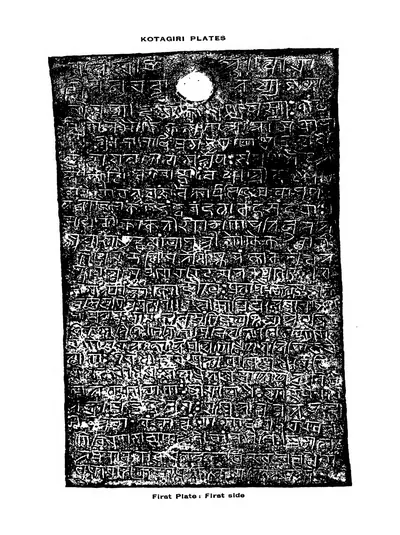 Kotagiri plates of the reign of the Kakatiya queen Rudramamba, A.D. 1273: First plate: first side (Kotagiri Plates 1925)Inscription rubbing · 1925
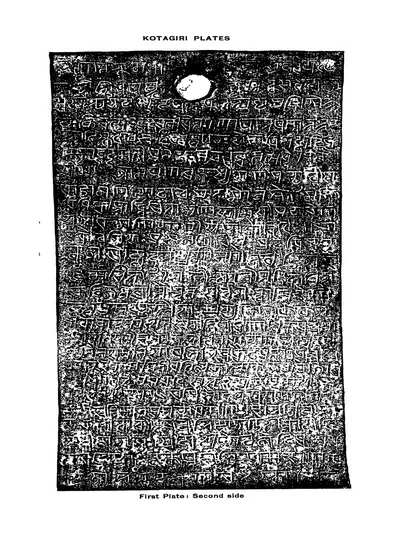 Kotagiri plates of the reign of the Kakatiya queen Rudramamba, A.D. 1273: First plate: second side (Kotagiri Plates 1925)Inscription rubbing · 1925
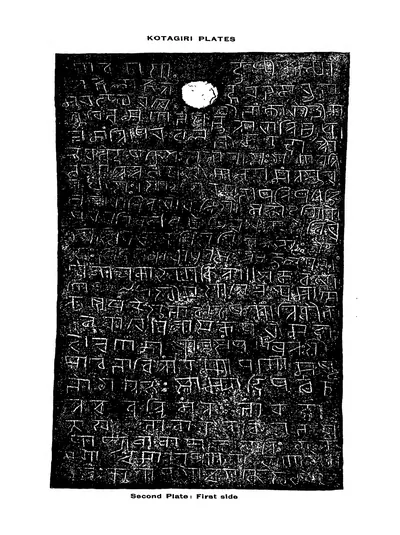 Kotagiri plates of the reign of the Kakatiya queen Rudramamba, A.D. 1273: Second plate: first side (Kotagiri Plates 1925)Inscription rubbing · 1925
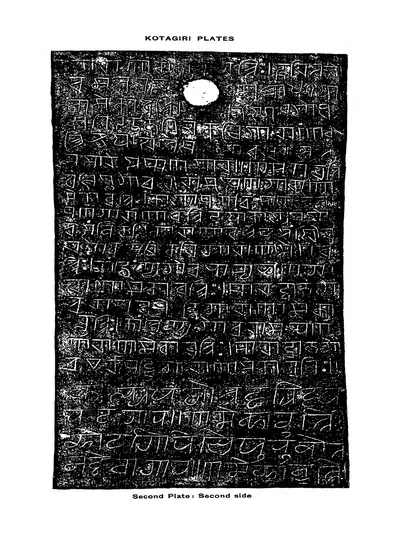 Kotagiri plates of the reign of the Kakatiya queen Rudramamba, A.D. 1273: Second plate: second side (Kotagiri Plates 1925)Inscription rubbing · 1925
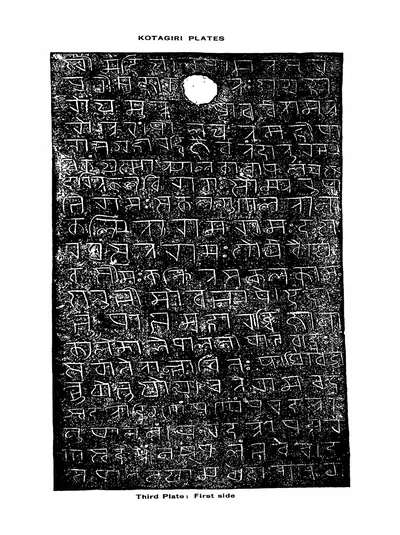 Kotagiri plates of the reign of the Kakatiya queen Rudramamba, A.D. 1273: Third plate: first side (Kotagiri Plates 1925)Inscription rubbing · 1925
References
Notes (0)
Sources (3)
Spotted an error on this page? Tell us
Last updated: