Srikurmam inscriptions of the Chalukya chiefs
Four inscriptions of 1273 to 1318 on pillars of the Kurmesvara temple at Srikurmam. They were left by chiefs who claimed descent from the Eastern Chalukya kings Vimaladitya and Rajaraja Narendra, and who served the Eastern Ganga kings. The earliest calls the chief's father a minister of Narasimha I. It also says that Rajaraja Narendra, with scholars, translated the history of the Bharata race into Telugu. E. Hultzsch took this as a confirmation, from an inscription, of the tradition of Nannaya's Telugu Mahabharata.
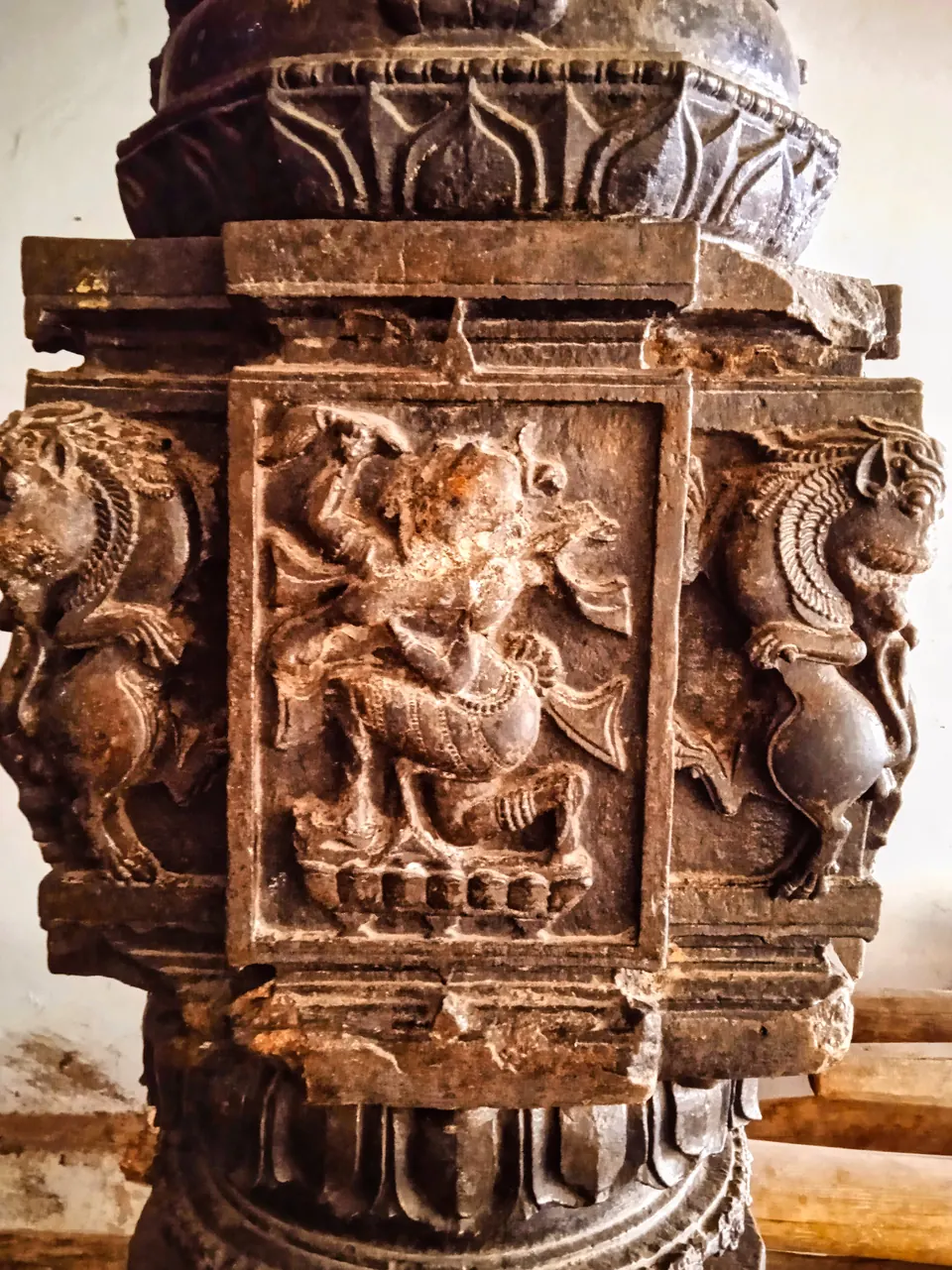
The pillars
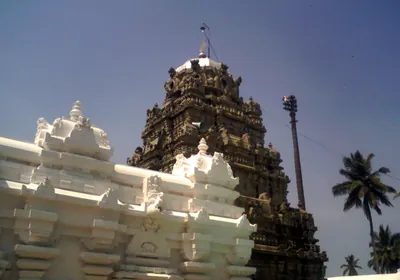
E. Hultzsch edited the four inscriptions, on four of the pillars, in Epigraphia Indica V (1898–99).12 He worked from inked copies (estampages) made by H. Krishna Sastri.12 He began by describing the Vishnu temple of Kurmesvara at Srikurmam, near Srikakulam (then Chicacole) in the Ganjam district.1 The temple “contains many inscribed pillars of hard black stone, which have successfully withstood the influence of the climate”.1 As a result, he wrote, most of their inscriptions are much better preserved than other stone records in the Telugu country.1 See the Srikurmam temple.
The chiefs
The inscriptions belong to three chiefs.1 In Hultzsch’s words, they “profess to have been descendants of the Eastern Chalukya king Vimaladitya (A.D. 1015 to 1022) and of his son Rajaraja (A.D. 1022 to 1063)”.1 The family line runs as follows:2
- A descendant of Rajaraja was Vijayaditya I.2
- His son Rajaraja “was the minister of Viranrisimha”.2
- This Rajaraja had two sons, Vijayaditya II, also called Vijayarka, and Purushottama.2
- Purushottama’s son, Jagannatha or Visvanatha, was a vassal of Virabhanudeva.12
From the dates of the records, Hultzsch identified the king whom Rajaraja served as the Ganga king Narasimha I.2 He identified the overlord of Visvanatha as the Ganga king Bhanudeva II, successor of Narasimha II.2 See Narasimha I and the Eastern Gangas.
The four records
| Date | Donor | Gift | |
|---|---|---|---|
| A | Saka 1195 (1273) | Vijayaditya II | Twenty-five cows, whose milk was to supply ghee for a lamp |
| B | Saka 1199 (1277) | Purushottama | Fifty ewes in the Sanskrit part, fifty-two in the Telugu, for a lamp |
| C | Saka 1231 (1309), third year of Jagannathadeva | Visvanatha | Forty half-pagodas (gandamada) for offerings to the god |
| D | Saka 1240 (1318) | Purushottama | A golden necklace; the verses were composed by the poet Nrisimha |
The table follows Hultzsch’s summary.2 Inscription C is dated “in the [3rd] year of the victorious reign of the glorious Jagannathadeva”, while “the glorious Virabanudeva-Jiyya was ruling”.3
F. Kielhorn found that the weekday of A did not fit Saka 1195 (Saka is an Indian way of counting years), and suggested that Monday, 23 October 1273, was meant.4 He found the date of C irregular.3
Language
Hultzsch wrote: “The alphabet of the four inscriptions is Telugu. The language of A. and D. is Sanskrit verse, and that of B. and C. Sanskrit verse and Telugu prose.”2 He published only part of C, leaving out two long passages in Telugu prose listing the offerings and the people among whom they were shared out.2
Rajaraja Narendra and the Telugu Mahabharata
The third verse of A speaks of Rajaraja, son of Vimaladitya.5 It says that he, “together with scholars, it is said, translated into Andhra (i.e. Telugu) the history of the excellent Bharata race”.5 The fourth verse says that he lived in Rajamahendrapattana.5
Hultzsch called this “an important epigraphical confirmation of the tradition”.1 By that tradition Nannayabhatta, “the first Telugu translator of the Mahabharata, wrote his work at the direction of Rajaraja of Rajamahendri”.1 Summarising inscription A in 1919, V. Rangacharya called it “very important as it confirms the traditions that Nannaya Bhatta first translated the Mahabharata in Rajaraja Narendra’s court”.6 See Nannaya and Rajaraja Narendra.
Where the sources disagree
- Vimaladitya’s dates. Hultzsch, writing in 1899, gave Vimaladitya’s reign as 1015 to 1022.1 In 1901 V. Venkayya’s edition of the Ranastipundi grant fixed his coronation at 10 May 1011.7 Venkayya suggested that the later records counted Vimaladitya’s reign only from about 1015, when he may have come back from the Chola country.8
Footnotes
-
E. Hultzsch, “Four Pillar Inscriptions of Eastern Chalukya Chiefs at Srikurmam”, Epigraphia Indica V (1898–99), p. 31 (archive.org (opens in a new tab)). ↩ ↩2 ↩3 ↩4 ↩5 ↩6 ↩7 ↩8 ↩9 ↩10 ↩11
-
Hultzsch, “Four Pillar Inscriptions at Srikurmam” (1899), p. 32 and notes (archive.org (opens in a new tab)). ↩ ↩2 ↩3 ↩4 ↩5 ↩6 ↩7 ↩8 ↩9 ↩10 ↩11 ↩12
-
Hultzsch, “Four Pillar Inscriptions at Srikurmam” (1899), p. 36, translation of C and Kielhorn’s note (archive.org (opens in a new tab)). ↩ ↩2
-
Hultzsch, “Four Pillar Inscriptions at Srikurmam” (1899), p. 34, translation of A, verses 6–10, and Kielhorn’s note (archive.org (opens in a new tab)). ↩
-
Hultzsch, “Four Pillar Inscriptions at Srikurmam” (1899), p. 33, translation of A, verses 1–4 (archive.org (opens in a new tab)). ↩ ↩2 ↩3
-
V. Rangacharya, A Topographical List of the Inscriptions of the Madras Presidency, Vol. I (1919), p. 689, Ganjam No. 230 (archive.org (opens in a new tab)). ↩
-
V. Venkayya, “Ranastipundi Grant of Vimaladitya”, Epigraphia Indica VI (1900–01), p. 349, with F. Kielhorn’s note on the date (archive.org (opens in a new tab)). ↩
-
Venkayya, “Ranastipundi Grant of Vimaladitya” (1901), p. 350 (archive.org (opens in a new tab)). ↩
Photos
References
Notes (0)
Sources (3)
Spotted an error on this page? Tell us
Last updated: