Srirangam inscription of Prataparudra
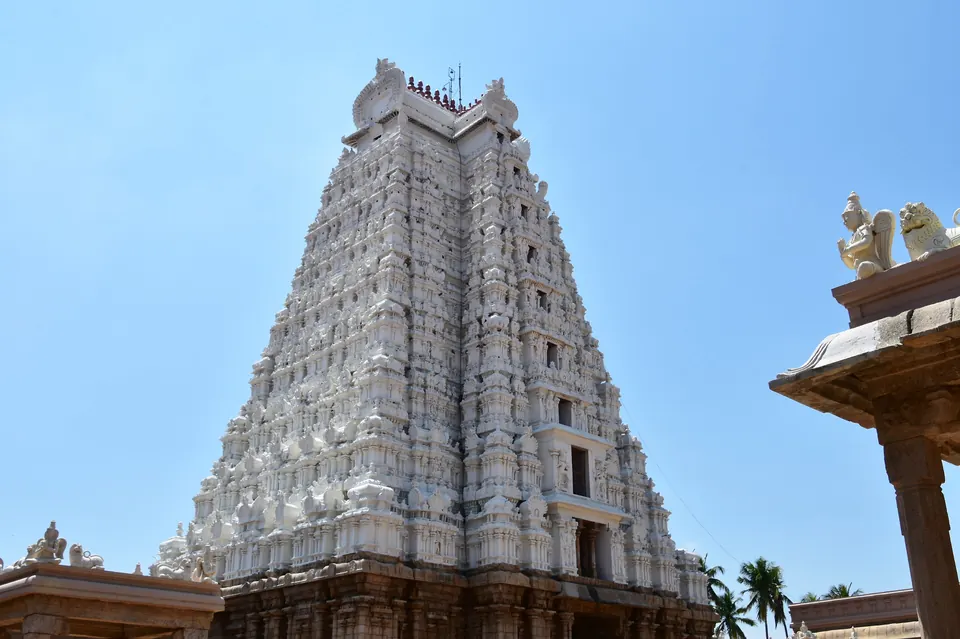
A Telugu inscription in Grantha script of 28 March 1317 in the Ranganatha temple at Srirangam. It records that Prataparudra's general Devari-nayaka defeated Vira-Pandya and the Kerala king Ravivarman Kulasekhara at Tiruvadikunram. He then put Sundara-Pandya back on his throne.
What it is
The inscription is on the south wall of the Chandana-mandapa in the Ranganatha temple at Srirangam, in the old Tiruchirappalli (then Trichinopoly) district.1 It is damaged.1 Lines 17 and 18, which held the details of the gift, are lost for good.1 The rest was recovered after the lime plaster left by centuries of whitewashing was carefully removed.1 The soft granite tends to flake.1
The record matters because it shows the Kakatiya king Prataparudra taking part in a war in the Tamil country.1 The editor called it the second war of Pandya succession.1
Language and date
The language is Telugu, but the script is Grantha, the script better known in that region.1 The date is Saka 1239 (Saka is an Indian way of counting years), the cyclic year Pingala, the fourteenth tithi (lunar day) of Chaitra, a Monday, with an eclipse of the moon.1 The editor, V. Venkatasubba Ayyar, gave the equivalent as Monday, 28 March 1317.1
A seven-line duplicate of part of the text is in the Jambukesvara temple at Tiruvanaikkaval, close to Srirangam.1 E. Hultzsch had already noted, in 1892, a fragment of Prataparudra’s time in the Jambukesvara temple.2 It is on the west wall of the second enclosure, in the Telugu language and the Grantha script.2
Contents
The record opens while the mahamandalesvara (great provincial lord) Kakatiya Prataparudradeva-Maharaja was ruling from his capital Orugallu (Warangal).3 Devari-nayaka, the king’s chief, was the son of Machaya-nayaka.1 He carried the titles Kakataraya-sthapanacharya and Svamidrohara-ganda.4 The editor read the first title as showing that Devari-nayaka was known as the rescuer of the Kakatiya kingdom.4
Devari-nayaka led an expedition against the “five Pandyas” (Pancha-Pandya) in the south.3 At the battlefield of Tiruvadikunram he faced their elephants and routed Vira-Pandya and Malaiyala Tiruvadi Kulasekhara.13 He seized their elephants and wealth and installed Sundara-Pandya at Viradhavalam.3 To mark the victory he gave land, or perhaps a village, as a tax-free gift to last as long as the moon and the sun.13 The gift was evidently to the Ranganatha temple.13
Interpretation
Venkatasubba Ayyar identified the two Pandyas with Jatavarman Vira-Pandya and Jatavarman Sundara-Pandya, half-brothers who had fallen out. The Muslim historians Wassaf and Amir Khusrau also describe their rivalry.1 The record is dated 1317.51 So, he argued, Malik Kafur’s raid of 1310 was a general plundering campaign, not a move in the Pandya quarrel.51
He identified the Kerala king with Ravivarman Kulasekhara of Quilon.64 This king had crowned himself in the Pandya country, and after this defeat he is not heard of again.64
In Venkatasubba Ayyar’s reading, Prataparudra took the chance to restore Kakatiya power in the south, which had been lost after Ganapati’s time.6 He sent the generals Muppidi-nayaka and Devari-nayaka.6 Another inscription, at Mallam in the Nellore district, records that Muppidi-nayaka conquered the Pandya king.6 It adds that he passed through Nellore on his way back to Orugallu.6 After the Kakatiya army withdrew, Vira-Pandya seems to have recovered, for his rule was accepted near Kanchipuram in 1318.7
The donor
Devari-nayaka’s father Machaya-nayaka was an important officer of the Kakatiya court.4 He held the post of gajasahini (master of the elephants).4 Devari-nayaka himself governed the country around Macherla (Mahadevicherla) in Saka 1237. An inscription at Darsi in the Nellore district praises him.4 He is recorded again in Saka 1241, at Durgi, making a gift in Prataparudra’s reign.4 In the editor’s account, Prataparudra ruled at Warangal from Saka 1215 to 1248, and Kakatiya power reached its height under him.4
Footnotes
-
V. Venkatasubba Ayyar, “Srirangam Inscription of Kakatiya Prataparudra; Saka 1239”, Epigraphia Indica XXVII (1956), p. 304 (archive.org (opens in a new tab)). Paraphrased. ↩ ↩2 ↩3 ↩4 ↩5 ↩6 ↩7 ↩8 ↩9 ↩10 ↩11 ↩12 ↩13 ↩14 ↩15 ↩16 ↩17 ↩18
-
E. Hultzsch, “Ekamranatha Inscription of Ganapati”, Indian Antiquary XXI (1892), p. 200 (archive.org (opens in a new tab)). ↩ ↩2
-
Venkatasubba Ayyar, “Srirangam Inscription of Kakatiya Prataparudra” (1956), p. 312, text and translation (archive.org (opens in a new tab)). Paraphrased. ↩ ↩2 ↩3 ↩4 ↩5 ↩6
-
Venkatasubba Ayyar, “Srirangam Inscription of Kakatiya Prataparudra” (1956), p. 310 (archive.org (opens in a new tab)). Paraphrased. ↩ ↩2 ↩3 ↩4 ↩5 ↩6 ↩7 ↩8 ↩9
-
Venkatasubba Ayyar, “Srirangam Inscription of Kakatiya Prataparudra” (1956), p. 305 (archive.org (opens in a new tab)). Paraphrased. ↩ ↩2
-
Venkatasubba Ayyar, “Srirangam Inscription of Kakatiya Prataparudra” (1956), p. 308 (archive.org (opens in a new tab)). Paraphrased. ↩ ↩2 ↩3 ↩4 ↩5 ↩6
-
Venkatasubba Ayyar, “Srirangam Inscription of Kakatiya Prataparudra” (1956), p. 307 (archive.org (opens in a new tab)). Paraphrased. ↩
Photos
References
Notes (0)
Sources (2)
Spotted an error on this page? Tell us
Last updated: