Vilasa grant of Prolaya Nayaka
A Sanskrit copper-plate charter of about 1330, in Telugu script. In it the Musunuri chief Prolaya Nayaka gives the village of Vilasa in the Kona country, on the Godavari, to the scholar Vennaya. Its opening is the only account from the Telugu country, written at the time, of Prataparudra's death on the way to Delhi. It also tells of the Delhi occupation, of Prolaya's war to free the land and of his capital at Rekapalli.
By this charter of about 1330, the Musunuri chief Prolaya Nayaka gave the village of Vilasa, on the Godavari, to a scholar.12 Its opening tells how Prataparudra died on the way to Delhi, how the Turushkas (Turks) oppressed the country, and how Prolaya drove them out.31 It is the only record that names Prolaya’s capital.142
The plates
The grant was found at Kandarada, near Pithapuram in the East Godavari district, nearly a century before it was published.5 Hundi Venkata Rao Pantulu and his business partner, a Vaisya, were digging for a brick kiln.5 They dug up fourteen copper plates on a ring and divided them, seven each.5
The partner’s share and the ring were melted down to make vessels.5 The other seven plates carry this grant complete.5 They stayed in the finder’s family until his great-grandson handed them to M. Somasekhara Sarma for publication.5
The plates were noticed as No. 5 of Appendix A in the Annual Report on Epigraphy for 1938–39.5 They were later kept in the Government Museum, Madras.5 N. Venkataramanayya and Somasekhara Sarma published them in Epigraphia Indica XXXII (1957–58), from inked impressions.5 See Prolaya Nayaka.
The plates are thick, with raised rims, and are numbered on their inner sides.56 The first plate is written on its inner side only, and the other six on both sides.56 The ring that held them is lost.56
The editors found the writing neat and deep.6 They thought it unusually handsome for a grant of the early post-Kakatiya period.6 The script is the Telugu script of the first half of the fourteenth century, close to that of the Donepundi grant of Namaya-nayaka.6
The language is pure Sanskrit verse.6 Only the passage describing the boundaries is in Telugu, and it is less carefully engraved.6 The composer is not named, and the usual verses cursing anyone who breaks the grant are missing.6 The grant ends with the donor’s signature in Telugu.6
Contents
The grant opens with prayers to Vishnu and his boar incarnation, and an account of the creation.3 It then describes the Telugu country, Tilinga, and its kings of the solar and lunar lines.3 After them come the Kakatiyas, ruling from Ekasila (Warangal).3
The grant says that Prataparudra came into bitter conflict with “Ahammada Suratrana”, lord of the Turushkas.3 He defeated the sultan’s army seven times, but he was overcome at last.3 He was carried towards Delhi as a prisoner, and died on the way, on the bank of the Somodbhava, the Narmada.3
Next the grant describes the oppression that followed under the Turushkas.31 It then tells of the rise of Prola of the Musunuri family, of the fourth caste.31 Prola drove the Yavanas (foreigners) from their forts, and restored the Brahmins’ villages and the Vedic sacrifices.31 He ruled from Rekapalli on the Godavari, at the foot of the Malyavanta hill.31 He left the running of the state to his younger brothers, among them Kapaya-nayaka.31
The grant itself is made to Vennaya, son of Annaya, a Yajurvedin of the Bharadvaja gotra (clan).178 Vennaya accepted it unwillingly, at Prolaya’s request.178 At a lunar eclipse, Prolaya gave him Vilasa, the best of the fertile villages of the Kona country on the Godavari.178 Vennaya divided it into 108 shares and renamed it Prolavaram after the king.178 He gave the shares to learned Brahmins.178
The list of donees names the two village gods, Gautamesvara and Kesava, among the shareholders.18 Over fifty-four shares went to men of the Bharadvaja gotra.18 The editors noted the many titles of learning among the donees.18 These include two experts in the guru-tantra of the Mimamsa.18 See Vilasa and Rekapalli.
Date and importance
The grant names no year.2 The editors placed it after 1325, when the recovery of the coast began.2 They placed it before about 1336–37, when they thought Kapaya, not Prolaya, led the rising at Warangal.2 They suggested about 1330.2
They valued it chiefly for its account of the years after 1323, for these reasons:142
- it supports Shams-i Siraj Afif’s statement that Prataparudra died on his way to Delhi, and it names the place142
- it describes the Delhi occupation as a person living at the time saw it142
- it is the only record that names Prolaya’s capital142
Of the places in the grant, they could identify only Vilasa, near Amalapuram, and two of its boundary villages, Siripalle and Magam.2 They warned that its account of Prataparudra’s seven victories cannot be accepted without reserve.9
Evidence and disagreements
- The donees. The editors count 82 donees, including the two gods, in their summary and 80 in their discussion of the list.18
- Kapaya. The grant calls him one of Prolaya’s younger brothers, but Kapaya’s own grant of 1346 makes him a cousin.110
Footnotes
-
Venkataramanayya and Somasekhara Sarma, “Vilasa Grant” (1957–58), p. 242 (archive.org (opens in a new tab)). Paraphrased. ↩ ↩2 ↩3 ↩4 ↩5 ↩6 ↩7 ↩8 ↩9 ↩10 ↩11 ↩12 ↩13 ↩14 ↩15 ↩16 ↩17 ↩18 ↩19 ↩20 ↩21 ↩22 ↩23
-
Venkataramanayya and Somasekhara Sarma, “Vilasa Grant” (1957–58), p. 256 (archive.org (opens in a new tab)). Paraphrased. ↩ ↩2 ↩3 ↩4 ↩5 ↩6 ↩7 ↩8 ↩9 ↩10 ↩11
-
Venkataramanayya and Somasekhara Sarma, “Vilasa Grant” (1957–58), p. 241 (archive.org (opens in a new tab)). Paraphrased. ↩ ↩2 ↩3 ↩4 ↩5 ↩6 ↩7 ↩8 ↩9 ↩10 ↩11 ↩12
-
Venkataramanayya and Somasekhara Sarma, “Vilasa Grant” (1957–58), p. 248 (archive.org (opens in a new tab)). Paraphrased. ↩ ↩2 ↩3 ↩4 ↩5
-
N. Venkataramanayya and M. Somasekhara Sarma, “Vilasa Grant of Prolaya-nayaka”, Epigraphia Indica XXXII (1957–58), p. 239 (archive.org (opens in a new tab)). Paraphrased. ↩ ↩2 ↩3 ↩4 ↩5 ↩6 ↩7 ↩8 ↩9 ↩10 ↩11 ↩12
-
Venkataramanayya and Somasekhara Sarma, “Vilasa Grant” (1957–58), p. 240 (archive.org (opens in a new tab)). Paraphrased. ↩ ↩2 ↩3 ↩4 ↩5 ↩6 ↩7 ↩8 ↩9 ↩10
-
Venkataramanayya and Somasekhara Sarma, “Vilasa Grant” (1957–58), p. 254 (archive.org (opens in a new tab)). Paraphrased. ↩ ↩2 ↩3 ↩4 ↩5
-
Venkataramanayya and Somasekhara Sarma, “Vilasa Grant” (1957–58), p. 255 (archive.org (opens in a new tab)). Paraphrased. ↩ ↩2 ↩3 ↩4 ↩5 ↩6 ↩7 ↩8 ↩9 ↩10
-
Venkataramanayya and Somasekhara Sarma, “Vilasa Grant” (1957–58), p. 247 (archive.org (opens in a new tab)). Paraphrased. ↩
-
Venkataramanayya and Somasekhara Sarma, “Vilasa Grant” (1957–58), p. 250 (archive.org (opens in a new tab)). Paraphrased. ↩
Photos
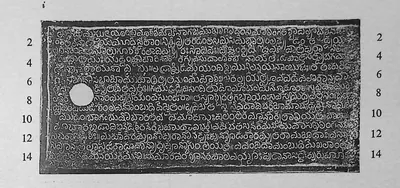 "Vilasa Grant of Prolaya-nayaka", plate i (Epigraphia Indica XXXII, plate between pp. 260 and 261, PDF p. 363 of the archive.org scan kmm-0149-epigraphia-indica-1962)Inscription rubbing · 1959
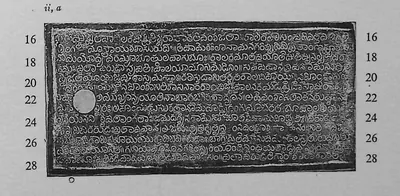 "Vilasa Grant of Prolaya-nayaka", plate ii, a (Epigraphia Indica XXXII, plate between pp. 260 and 261, PDF p. 363)Inscription rubbing · 1959
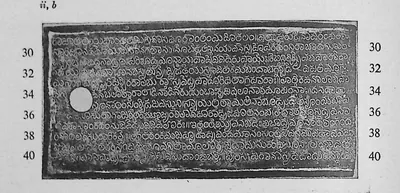 "Vilasa Grant of Prolaya-nayaka", plate ii, b (Epigraphia Indica XXXII, plate between pp. 260 and 261, PDF p. 364)Inscription rubbing · 1959
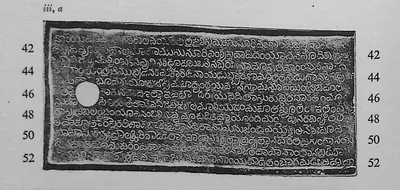 "Vilasa Grant of Prolaya-nayaka", plate iii, a (Epigraphia Indica XXXII, plate between pp. 260 and 261, PDF p. 364)Inscription rubbing · 1959
References
Notes (0)
Sources (1)
Spotted an error on this page? Tell us
Last updated: