Prataparudra
Last Kakatiya king (r. 1289–c. 1323; 1295–1323 in older accounts) and grandson of Rudramadevi. He crushed the Kayastha revolt, reorganised the nayankara military system, and paid tribute to Delhi after the sieges of 1310 and 1318. He was captured when Ulugh Khan took Warangal in the 1320s. Later warrior families remembered him as the king who raised them to rank.
Prataparudra was a grandson of Queen Rudramadevi and her heir on the Kakatiya throne.12 In Parabrahma Sastry’s account, he met the Delhi armies in the field no fewer than seven times.3 Ulugh Khan finally captured him when Warangal fell.4 Later warrior families remembered him as the king who raised them to high rank.56
Family and coming to the throne
Prataparudra was the son of Mummadamma, eldest daughter of Queen Rudramadevi, and of a Kakatiya prince named Mahadeva.17 The play included in Vidyanatha’s Prataparudriya, written at his court, gives the same parents.89 In it the god Shiva tells Rudramadevi in a dream to hand the kingdom to this grandson, whom she had adopted as her son.89 Venkataramanayya and Somasekhara Sarma also wrote that Rudramadevi adopted him as her son and heir at Ganapatideva’s command.2
He was often called Kumara Rudradeva (“Prince Rudradeva”), and the name stayed in use long after he became king.10 He acted for his grandmother in government before her death. Copper plates issued in his own name in September 1289, two months before the queen died, already describe his reign in terms of full rule.710 The 1992 volume of Nalgonda district inscriptions dates the first reference to him as heir to an inscription of 1269.11
After the Chandupatla inscription showed that Rudramadevi died in November 1289, P. V. Parabrahma Sastry dated his reign from 1289. Earlier historians had placed his accession in 1292 or 1295.10122 N. Venkataramanayya and M. Somasekhara Sarma, writing in 1960, placed it at the beginning of 1295, when he was about thirty-five years old.2
Muslim historians called him Laddar Deo.1312 Henry Yule gives Ferishta’s form of the name as “Luddur Deo”.12
Restoring the kingdom
Prataparudra’s first task was the revolt of the Kayastha chief Ambadeva, who had made himself independent in the south-west of the kingdom.10 Parabrahma Sastry records that he reorganised the nayankara system.1014 Under this system, nayakas (military chiefs) held land in return for keeping troops for the king.1014
In 1291 his generals, among them his kinsman Induluri Annaya, drove Ambadeva from Tripurantakam.1516 Further campaigns went against Nellore and against the Yadavas in the Raichur doab (the land between two rivers).17 There, in 1294, a Kakatiya subordinate captured Raichur and Adoni.17
Records of his reign describe him as lord of nine lakh (900,000) archers.143 The late chronicles give his army as 900,000 foot soldiers, 20,000 horsemen and 100 elephants.143 Parabrahma Sastry reports these figures as boasts and chronicle tradition.143
The nayakas in tradition and in the inscriptions
The sixteenth-century Pratapa Charitra tells how Prataparudra found that nobles of many castes had been made nayakas under Ganapati.1819 Instead he chose seventy-seven men of the seventy-seven Padmanayaka clans.1819 He gave each a bastion (tower) of the stone wall of Warangal, and divided a portion of his kingdom among them.1819
Twentieth-century historians identified these Padmanayakas with the Velamas.2014 Parabrahma Sastry doubted that all were Velamas, since nayakas and lenkas (sworn followers) of other groups, including Reddis, appear in the inscriptions.14
Venkataramanayya and Somasekhara Sarma accepted that the tradition had a basis in fact.2 But they found that the nayankaras were held by men of all classes, and that there were seventy-five rather than seventy-seven.2 They also found no evidence that these chiefs defended the capital.2
Cynthia Talbot pointed out that the chronicle itself never calls the Padmanayakas Velamas.215 She argued that neither name was a warrior identity in Kakatiya times.215 In her view, the Padmanayaka identity arose two centuries or more after 1323, among warrior families who traced their rise to Prataparudra.215
Wars with Delhi
The Delhi Sultanate’s first expedition against Warangal, sent by Ala-ud-din Khalji, failed. Barani says the army arrived in the rainy season, could do nothing, and returned much reduced.2223 Parabrahma Sastry dates this invasion to 1303. Following the chronicle Velugotivari-vamsavali, he says that the Kakatiya commanders, the Velama chief Venna, son of Recherla Prasaditya, and Potugamti Maili, checked it at Upparapalli. In his account, Prataparudra met the Delhi armies in the field no fewer than seven times.3 More than once, he says, Prataparudra bought peace with heavy tribute.3
In 1309–10 Malik Kafur besieged Warangal.2425 Amir Khusrau and Barani describe the storming of the outer mud wall, after which “Rai Laddar Deo” asked for peace. He gave up a great treasure, with a hundred elephants and seven thousand horses, and promised a yearly tribute.2425 Parabrahma Sastry dates the start of this siege to 19 January 1310, and says that it lasted twenty-five days.153
Prataparudra then sent troops south, and in 1316, by Robert Sewell’s account, his general Muppidi Nayaka took Kanchi (Kanchipuram).26 Parabrahma Sastry records further Kakatiya campaigns against the Pandyas and against Kampili.27
In 1318 Sultan Mubarak Shah’s general Khusrau Khan came to Warangal to demand tribute, and Prataparudra gave up five districts.2827 He promised a yearly tribute of a hundred elephants, twelve thousand horses, and gold and jewels.2827
The fall of Warangal
Ghiyas-ud-din Tughluq sent his son Ulugh Khan, later Sultan Muhammad bin Tughluq, against Warangal. Barani dates this campaign to 721 AH (1321 CE).29 The first siege collapsed when false rumours of the Sultan’s death set off a mutiny in Ulugh Khan’s camp.30 The defenders then rushed out and plundered the camp.30
Parabrahma Sastry prefers the account of the contemporary historian Isami.31 He says the first siege lasted six months.31 Ulugh Khan returned with fresh troops, took the fortress of Bidar on the way, and captured Warangal. Prataparudra, “with all his rais and mukaddims, their wives and children” (his chiefs and headmen and their families), fell into his hands and was sent to Delhi. Barani adds that the name of Arangal (Warangal) was changed to Sultanpur.4
Parabrahma Sastry, following Isami, places the final siege in 1323.32 He says it lasted five months, and ended when the city’s grain ran out.32 The Imperial Gazetteer gives 1321 for the end of Kakatiya power.22
Prataparudra did not reach Delhi. According to the Vilasa grant of about 1330, he died on the banks of the Narmada on the way there. A Reddi copper-plate grant of 1423 says that he chose to depart to the world of the gods.33 Parabrahma Sastry reads this as suicide, or a death he asked for.33
Hirananda Sastri gave his latest certain date as Saka 1246 (1323–24; Saka is an Indian way of counting years).34 He thought Prataparudra probably died in 1325.34 The Pratapa Charitra names his chief queen as Visalakshi, and an inscription at Yelgedu in the Karimnagar district names another queen, Lakshmidevi. Some records call men such as Juttaya-lenka Gonka Reddi his sons.33 But Parabrahma Sastry explains them as close and favoured subordinates.33
Claimed successors and the Bastar tradition
Sewell and the Imperial Gazetteer name successors, Krishna or Virabhadra.3536 But Hirananda Sastri noted that no inscriptions of them exist.34 The Pratapa Charitra says that his son Virabhadra was crowned by his brother Annamadeva, who then withdrew to the north-east. Parabrahma Sastry called the coronation story groundless.33
Venkataramanayya and Somasekhara Sarma suggested that the chronicler had confused him with the Gajapati king Prataparudra of Orissa, whose son Virabhadra was a famous warrior.37 They also explained Ferishta’s “Kishan Nayak”, called a son of Prataparudra, as the Musunuri chief Kapaya Nayaka.37
The rajas of Bastar, in central India, claimed descent from Annamaraja, called a brother of “Kakati Prataparudra”.386 The claim is made in an inscription of Samvat 1760 (1702–03) at Dantewara.386 It traces ten generations from him, and says that he fled from Warangal to Bastar before the Muslims.386
Its editor Hira Lal thought ten generations too few for four centuries.39 He suggested that Annamaraja was the brother of a later Prataparudra.39
Venkataramanayya and Somasekhara Sarma wrote in one place that no contemporary record knows of Annamadeva.240 In another place they wrote that Prataparudra “certainly had” such a brother.240 Parabrahma Sastry thought the claim needed further examination.33 Talbot suggested that the founder of the Bastar family was a Telugu warrior who knew the Kakatiya legends.6
Court and culture
Prataparudra’s court was a centre of learning. Vidyanatha’s Prataparudriya (or Prataparudra-yasho-bhushana) was written there and is still studied.41 It is a Sanskrit treatise on poetics (the art of poetry), and its example verses all praise the king.41 A poet named Narasimha left verses on the Ekashila rock and the gateways of Warangal Fort.42
Parabrahma Sastry made the Telugu Shaiva poet Palkuriki Somanatha his contemporary.434410 A Jain poet, Appayarya, dated a work to the reign of Kumara Rudradeva in 1319.434410
Parabrahma Sastry notes that his title daya-gaja-kesari is stamped on the seal of a copper-plate grant.45 The same title also appears on coins, which can therefore be assigned to him.45
Memory
Talbot found that Prataparudra, more than his great-grandfather Ganapatideva, dominated later Telugu memory of the dynasty.56 Warrior families of later centuries credited him with raising humble fighters to high rank.56 They saw in his reign, when the Delhi armies first came, the beginning of their own world.56
Footnotes
-
P. V. Parabrahma Sastry, The Kakatiyas of Warangal (1978), p. 128. ↩ ↩2
-
N. Venkataramanayya and M. Somasekhara Sarma, “The Kakatiyas of Warangal”, in G. Yazdani (ed.), The Early History of the Deccan, Parts VII–XI (1960), p. 642. ↩ ↩2 ↩3 ↩4 ↩5 ↩6 ↩7 ↩8 ↩9
-
P. V. Parabrahma Sastry, The Kakatiyas of Warangal (1978), p. 132. ↩ ↩2 ↩3 ↩4 ↩5 ↩6 ↩7
-
H. M. Elliot and John Dowson, The History of India as Told by Its Own Historians, vol. III (1871), p. 233 (archive.org (opens in a new tab)). ↩ ↩2
-
Cynthia Talbot, Precolonial India in Practice: Society, Region, and Identity in Medieval Andhra (2001), p. 192. ↩ ↩2 ↩3 ↩4 ↩5 ↩6 ↩7
-
Cynthia Talbot, Precolonial India in Practice: Society, Region, and Identity in Medieval Andhra (2001), p. 193. ↩ ↩2 ↩3 ↩4 ↩5 ↩6 ↩7 ↩8
-
Gajjala Vasanta Lakshmi (ed.), Epigraphia Telanganica, vol. 3 (2023), pp. 79–80. ↩ ↩2
-
K. P. Trivedi (ed.), The Prataparudrayasobhushana of Vidyanatha (1909), Introduction, p. xiii (archive.org (opens in a new tab)). ↩ ↩2
-
K. P. Trivedi (ed.), The Prataparudrayasobhushana of Vidyanatha (1909), Introduction, p. xiv (archive.org (opens in a new tab)). ↩ ↩2
-
P. V. Parabrahma Sastry, The Kakatiyas of Warangal (1978), p. 129. ↩ ↩2 ↩3 ↩4 ↩5 ↩6 ↩7 ↩8
-
P. V. Parabrahma Sastry (ed.), Inscriptions of Andhra Pradesh: Nalgonda District, vol. I (1992), p. xii. ↩
-
Henry Yule and Henri Cordier, The Book of Ser Marco Polo, vol. II (1903), p. 362, note 1 (archive.org (opens in a new tab)). ↩ ↩2 ↩3
-
H. M. Elliot and John Dowson, The History of India as Told by Its Own Historians, vol. III (1871), p. 201 (archive.org (opens in a new tab)). ↩
-
P. V. Parabrahma Sastry, The Kakatiyas of Warangal (1978), p. 195. ↩ ↩2 ↩3 ↩4 ↩5 ↩6 ↩7
-
P. V. Parabrahma Sastry, The Kakatiyas of Warangal (1978), p. 130. ↩ ↩2
-
N. Venkataramanayya and M. Somasekhara Sarma, “The Kakatiyas of Warangal”, in G. Yazdani (ed.), The Early History of the Deccan, Parts VII–XI (1960), p. 635. ↩
-
P. V. Parabrahma Sastry, The Kakatiyas of Warangal (1978), pp. 130–131. ↩ ↩2
-
Cynthia Talbot, Precolonial India in Practice: Society, Region, and Identity in Medieval Andhra (2001), p. 187. ↩ ↩2 ↩3
-
Cynthia Talbot, Precolonial India in Practice: Society, Region, and Identity in Medieval Andhra (2001), p. 188. ↩ ↩2 ↩3
-
Cynthia Talbot, Precolonial India in Practice: Society, Region, and Identity in Medieval Andhra (2001), p. 190. ↩
-
Cynthia Talbot, Precolonial India in Practice: Society, Region, and Identity in Medieval Andhra (2001), p. 191. ↩ ↩2 ↩3
-
Imperial Gazetteer of India, Provincial Series: Hyderabad State (1909), p. 11 (archive.org (opens in a new tab)). ↩ ↩2
-
H. M. Elliot and John Dowson, The History of India as Told by Its Own Historians, vol. III (1871), p. 189 (archive.org (opens in a new tab)). ↩
-
H. M. Elliot and John Dowson, The History of India as Told by Its Own Historians, vol. III (1871), pp. 83–84 (archive.org (opens in a new tab)). ↩ ↩2
-
H. M. Elliot and John Dowson, The History of India as Told by Its Own Historians, vol. III (1871), pp. 202–203 (archive.org (opens in a new tab)). ↩ ↩2
-
Robert Sewell, The Historical Inscriptions of Southern India (1932), p. 179 (archive.org (opens in a new tab)). ↩
-
P. V. Parabrahma Sastry, The Kakatiyas of Warangal (1978), pp. 133–135. ↩ ↩2 ↩3
-
H. M. Elliot and John Dowson, The History of India as Told by Its Own Historians, vol. III (1871), pp. 560–561 (archive.org (opens in a new tab)). ↩ ↩2
-
H. M. Elliot and John Dowson, The History of India as Told by Its Own Historians, vol. III (1871), p. 231 (archive.org (opens in a new tab)). ↩
-
H. M. Elliot and John Dowson, The History of India as Told by Its Own Historians, vol. III (1871), p. 232 (archive.org (opens in a new tab)). ↩ ↩2
-
P. V. Parabrahma Sastry, The Kakatiyas of Warangal (1978), pp. 136–138. ↩ ↩2
-
P. V. Parabrahma Sastry, The Kakatiyas of Warangal (1978), pp. 138–139. ↩ ↩2
-
P. V. Parabrahma Sastry, The Kakatiyas of Warangal (1978), p. 140. ↩ ↩2 ↩3 ↩4 ↩5 ↩6
-
Hirananda Sastri, Shitab Khan of Warangal (1932), p. 2 (archive.org (opens in a new tab)). ↩ ↩2 ↩3
-
Robert Sewell, The Historical Inscriptions of Southern India (1932), p. 182 (archive.org (opens in a new tab)). ↩
-
Imperial Gazetteer of India, Provincial Series: Hyderabad State (1909), p. 164 (archive.org (opens in a new tab)). ↩
-
N. Venkataramanayya and M. Somasekhara Sarma, “The Kakatiyas of Warangal”, in G. Yazdani (ed.), The Early History of the Deccan, Parts VII–XI (1960), p. 658. ↩ ↩2
-
Hira Lal, “Dantewara Sanskrit and Hindi Inscriptions of Dikpaladeva; Samvat 1760”, Epigraphia Indica XII (1913–14), p. 243 (archive.org (opens in a new tab)). ↩ ↩2 ↩3
-
Hira Lal, “Dantewara Sanskrit and Hindi Inscriptions of Dikpaladeva” (1913–14), p. 244 (archive.org (opens in a new tab)). ↩ ↩2
-
N. Venkataramanayya and M. Somasekhara Sarma, “The Kakatiyas of Warangal”, in G. Yazdani (ed.), The Early History of the Deccan, Parts VII–XI (1960), p. 659. ↩ ↩2
-
P. V. Parabrahma Sastry, The Kakatiyas of Warangal (1978), p. 294. ↩ ↩2
-
P. V. Parabrahma Sastry, The Kakatiyas of Warangal (1978), p. 295. ↩
-
P. V. Parabrahma Sastry, The Kakatiyas of Warangal (1978), p. 299. ↩ ↩2
-
P. V. Parabrahma Sastry, The Kakatiyas of Warangal (1978), p. 273. ↩ ↩2
-
P. V. Parabrahma Sastry, The Kakatiyas of Warangal (1978), p. 6. ↩ ↩2
Photos
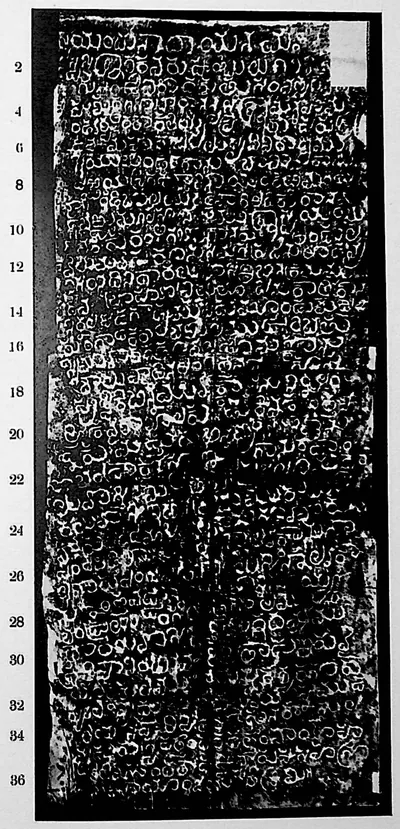 "Mēllacheruvu inscription" (Sreenivasachar, Corpus of Inscriptions in the Telingana Districts II, Plate 29 (PDF p. 278))Inscription rubbing · 1940
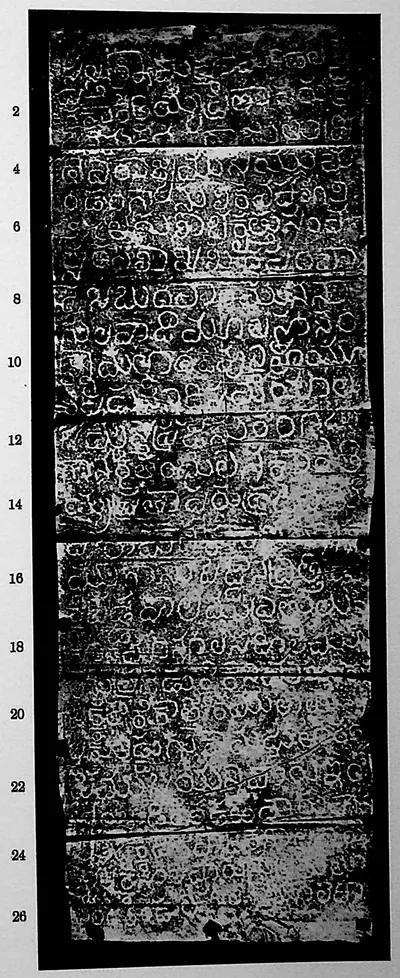 "Nāgulapāḍu inscription of Saka 1225" (Sreenivasachar, Corpus of Inscriptions in the Telingana Districts II, Plate 31 (PDF p. 282))Inscription rubbing · 1940
Related
Dynasties

References
Notes (0)
Sources (12)
Spotted an error on this page? Tell us
Last updated: