Lesson 9
Kalinga script and Odia
On the northern coast of the Telugu country, in the old Vizagapatam and Ganjam districts, inscriptions can look unfamiliar even to someone who reads early Telugu. Some are in the Kalinga script of the Eastern Ganga kings, and some, later, in Oriya (Odia).12 This short lesson shows what each looks like and walks you through the opening of one Ganga copper-plate grant.
The Kalinga script of the Ganga kings
G. H. Ojha’s Bharatiya Prachin Lipimala (1918) calls it the Kalinga script. It is found in the grants that the Ganga kings issued from Kalinganagara, in the country between Chicacole (Srikakulam) and Ganjam, from about the 7th to about the 11th century.1 The earliest such grant then known was one of the Eastern Ganga king Devendravarman, dated in year 87 of the Ganga era.1
What makes it look different?
- Box heads. In the early grants the tops of the letters are little boxes, filled in, as in the box-headed script of Central India, and several letters are built from right angles.1
- A mixed alphabet. In the later grants the letters lose their right angles and become rounded, like the western and Telugu-Kannada scripts. Telugu-Kannada forms are mixed with some Grantha and Nagari ones.1
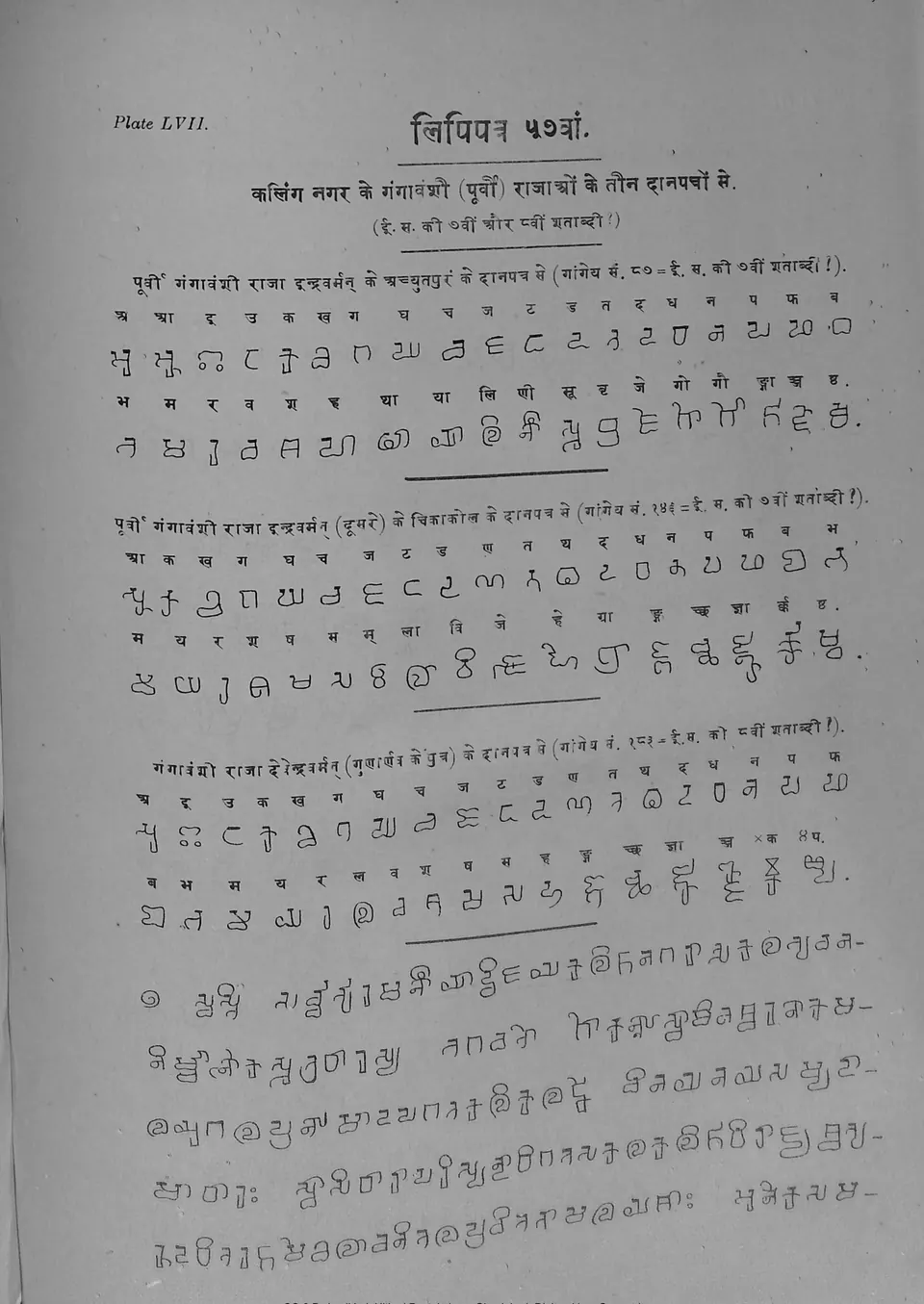
Ojha’s Plate 57 takes its letters from three grants: the Achyutapuram plates of the Eastern Ganga king Indravarman, the Chicacole plates of Indravarman II, and a grant of Devendravarman.3 In the Achyutapuram plates the heads are filled boxes, and a, ā, ka and ra are right-angled. The na is like the Nagari letter, and the rest are close to Telugu-Kannada. In the Chicacole plates the heads are square and filled, and ma has the Grantha shape.3
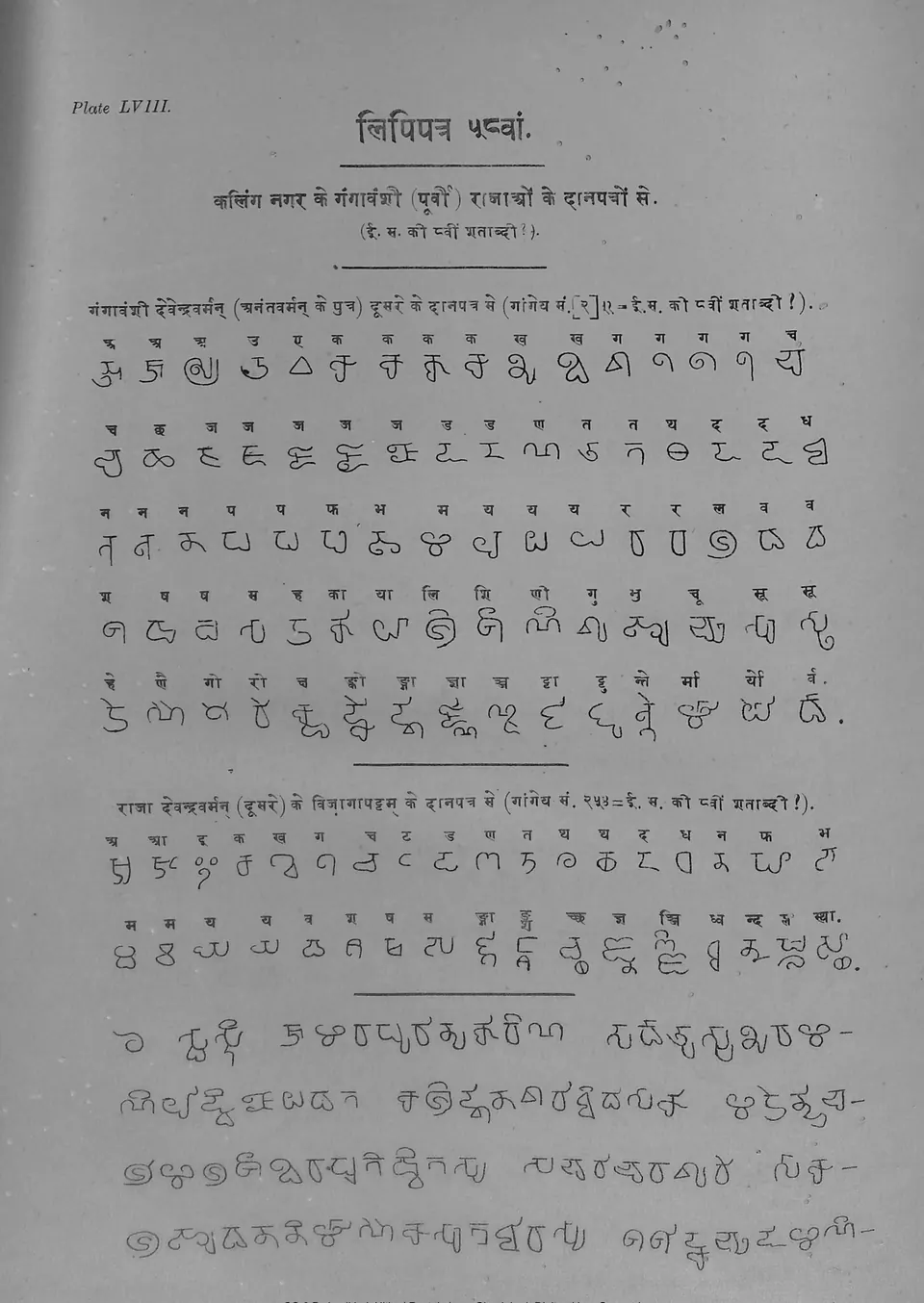
Plate 58 comes from two grants of Devendravarman II, son of Anantavarman. In the first, a is written in three ways, two of them Nagari and the third in Telugu-Kannada style. Some forms of u, e, ga, ja, ta, da and na also follow Nagari.4
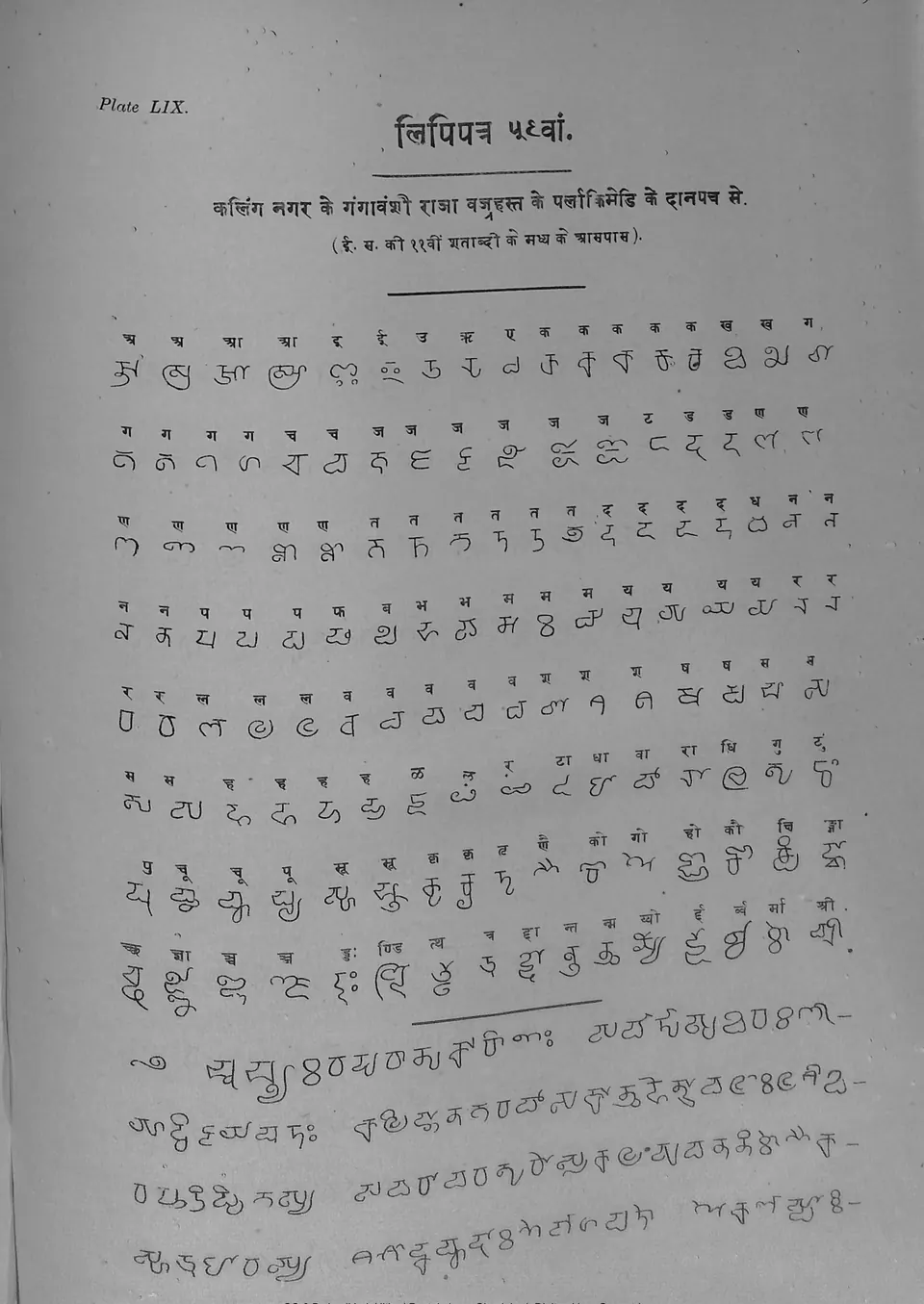
Plate 59 shows the most mixed of all, the Parlakimedi plates of the Ganga king Vajrahasta. Ojha thought the writer knew many northern and southern scripts and mixed them on purpose to show off his skill. When F. Kielhorn edited the grant he counted roughly 730 letters, of which 320 were in Nagari and 410 in southern scripts.5 Among the southern letters most were Telugu-Kannada, and only a few were Grantha.5
A real grant: the Achyutapuram plates
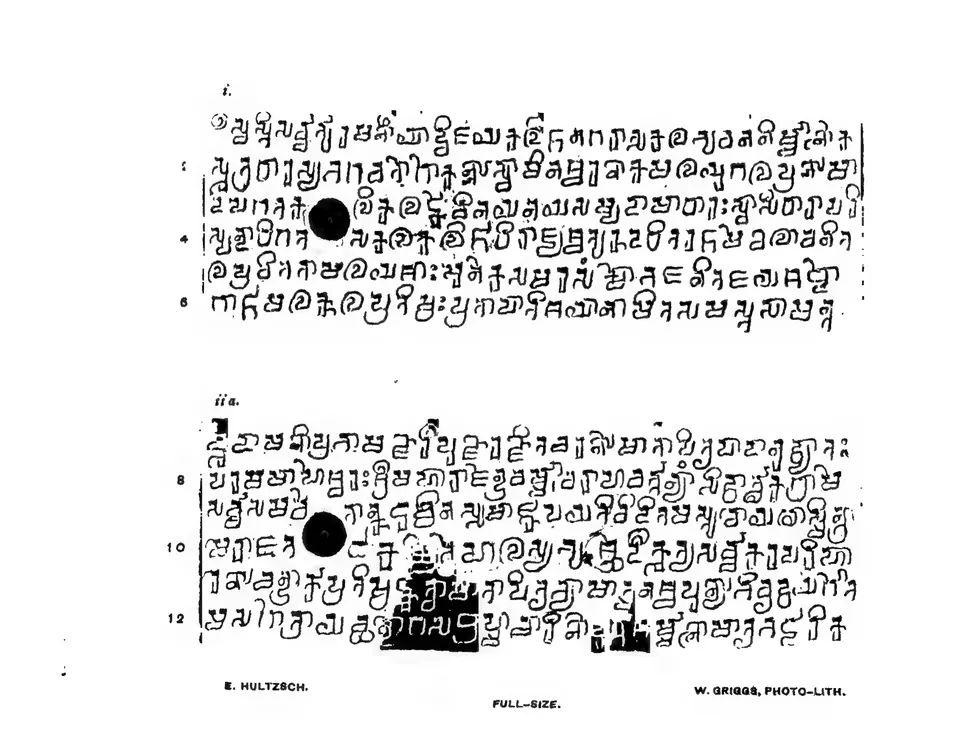
When E. Hultzsch edited the Achyutapuram plates in Epigraphia Indica III, they belonged to Mallapragada Surya Prakasa Rao of Achyutapuram, near Mukhalingam in Ganjam district.6 There are three plates, still strung on their ring, whose ends are fixed in a small oval seal. The language is nearly correct Sanskrit, mostly in prose.6 The grant records a gift of land made at Kalinganagara by Maharaja Indravarman, of the Ganga family, to a Brahmin.6
Look at the date. Hultzsch read it as “the eighty-seventh year (in words and numerical symbols) of the reign, on the new-moon of Chaitra”.6 Ojha, writing later, counted the years of these Ganga grants in a Ganga era instead (for example “Gangeya samvat 87” for Devendravarman).1 The same number can be read in different ways, so always check how an editor counts the years; see Dates and eras.
The end of the grant shows how the land was marked out: “In the east, the bund (pali) of the Rajatataka; in the south, the same; in the west, three ant-hills in succession”.7 Compare the boundary clauses in Parts of an inscription.
Worked example: the first line
Ojha printed the opening lines of the Achyutapuram plates in Nagari letters under his Plate 57. The first line reads:3
ओं स्वस्ति सर्व्वर्तुरमणीयाद्विजयकलिङ्गनगरात्सकलभुवन-
In Roman letters: oṃ svasti sarvvartu-ramaṇīyād vijaya-kaliṅganagarāt sakala-bhuvana-.
Hultzsch’s translation of the same words is: “Om. Hail! From the victorious (city of) Kalinganagara, which is pleasant in all seasons”.8
Now find them on the plate:
- The first sign. Line 1 of the first plate (marked i.) begins with a curled sign. This is oṃ, which both Ojha and Hultzsch put first.38
- The greeting. The next few letters are svasti, “Hail!”.8
- The place. vijaya-kaliṅganagarāt means “from the victorious (city of) Kalinganagara”.8 The grant names the place where it was made, Kalinganagara, in its very first line.6
- Count the letters. The plate image is printed full size, so each letter on it is as large as on the copper itself.9
Odia (Oriya)
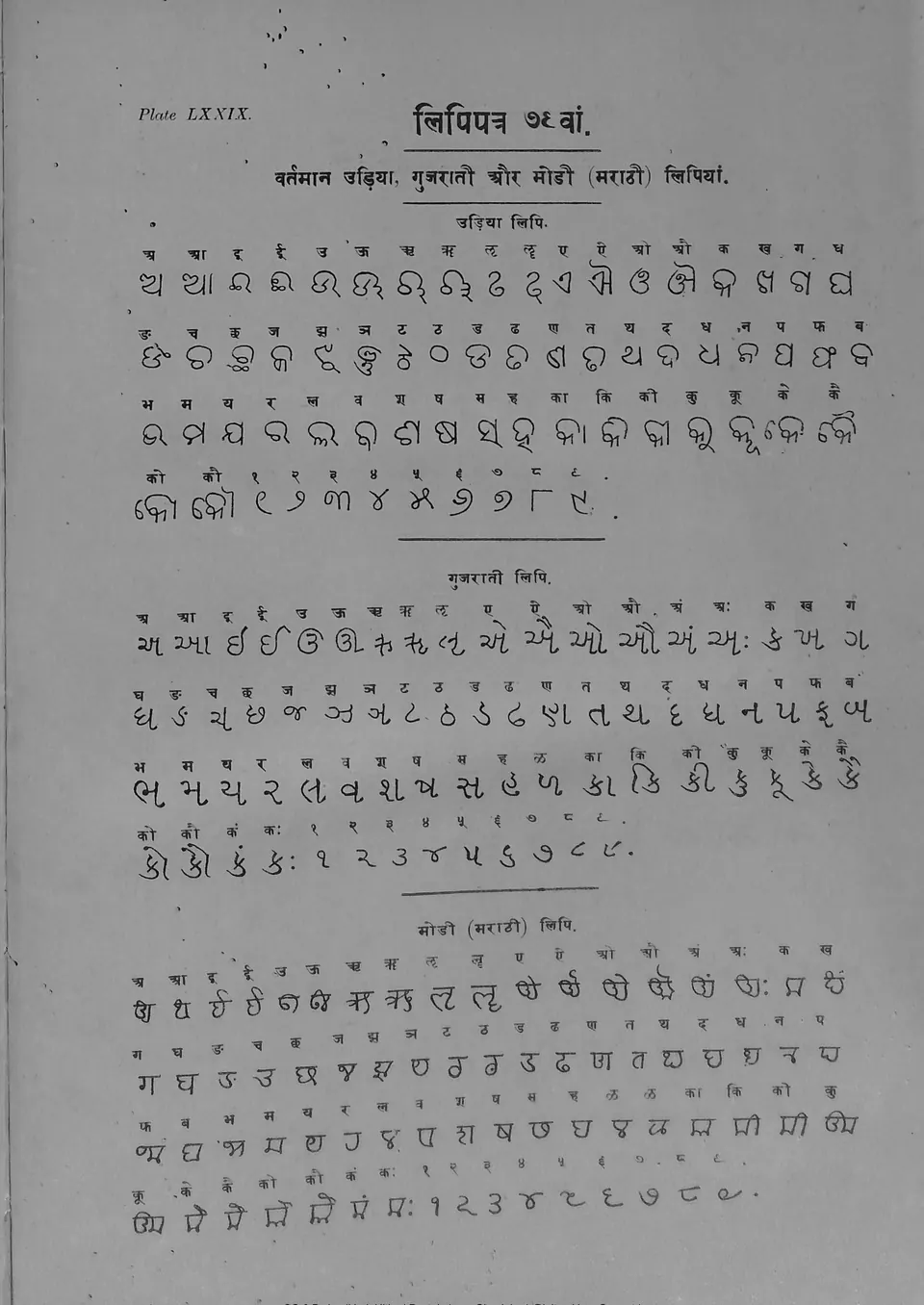
The modern Oriya script, Ojha says, seems to have come from old Bengali. The vowel letters e, ai, o and au are the same as in modern Bengali, and the vowel signs are written in the Bengali way.10 What makes Oriya look so different at first sight is quick writing with the pen, and the long, rounded heads of the letters, whose right-hand end curves down. Without those heads, he says, the letters underneath are quite simple.10
Odia records do occur in the Telugu country, but they were little studied a century ago. Volume V of South-Indian Inscriptions (1925) included four Oriya records, Nos. 1006, 1119, 1152 and 1161, printed in Devanagari type. Its editor called the texts “tentative”, because no Oriya inscriptions had yet been published for comparison and few scholars could read them.11 By the volume’s own list, Nos. 1006 and 1119 fall among the inscriptions of Mukhalingam (Nos. 1005–1148), and Nos. 1152 and 1161 among those of Srikurmam (Nos. 1150–1341).12
Volume VI (1928) contained 1,215 inscriptions, of which 36 were in Oriya; the rest were 241 in Tamil, 744 in Telugu, 113 in Kanarese and 81 in Nagari and cave characters.2 Most of the volume came from Simhachalam, which alone supplied 525 inscriptions, many of them of Eastern Ganga kings.2
The Gajapati kings of Orissa also reached far south for a time. The Nellore collection notes that they held part of that district for a brief period, until Krishnadevaraya of Vijayanagara expelled them early in the 16th century.13
A note on Modi
The same Plate 79 also shows Modi, the running hand used for Marathi. Ojha says that Shivaji’s secretary Balaji Avaji reshaped the Nagari letters so they could be written fast. It is written under one long top line instead of separate heads, often a whole word or line at a time.14 In Ojha’s day it was used in the courts and in letters and accounts in Maharashtra.14 No page-cited example of a Modi record from the Telugu country has been found for this lesson.
Try it yourself
1. Ojha also printed the opening of a grant of Devendravarman II under his Plate 58:4
ओं स्वस्ति अमरपुरानुकारिण[:] सर्व्वर्तु(र्त्तु)सुखरमणीयाद्विजयवत[:] कलिङ्गा(ङ्ग)नगराधिवासका[त्]
Compare it with the Achyutapuram line in the worked example. Which short word comes between sarvvartu (“all seasons”) and ramaṇīyād (“pleasant”) here, but not at Achyutapuram?3
Answer
sukha: Devendravarman II’s grant has sarvvartu-sukha-ramaṇīyād, Achyutapuram only sarvvartu-ramaṇīyād.43 Hultzsch had noticed the same gap. He compared the Achyutapuram plates with another grant of Indravarman, and found that the introduction was word for word the same except that Achyutapuram leaves out sukha after sarva-ṛtu in line 1.15
2. In Vajrahasta’s Parlakimedi plates (Plate 59), Kielhorn counted about 730 letters, 320 of them Nagari. Roughly what share of the letters is Nagari?5
Answer
About 44 per cent (320 ÷ 730), a little under half. The other 410 were southern letters, mostly Telugu-Kannada.5
Footnotes
-
Gaurishankar Hirachand Ojha, Bharatiya Prachin Lipimala (2nd ed., 1918), p. 92 (archive.org (opens in a new tab)). ↩ ↩2 ↩3 ↩4 ↩5 ↩6
-
K. V. Subrahmanya Aiyer (ed.), South-Indian Inscriptions (Texts), Vol. VI (1928), Preface (archive.org (opens in a new tab)). ↩ ↩2 ↩3
-
Ojha, Bharatiya Prachin Lipimala (1918), p. 93 and Plate 57 (archive.org (opens in a new tab); plate: archive.org (opens in a new tab)). ↩ ↩2 ↩3 ↩4 ↩5 ↩6
-
Ojha, Bharatiya Prachin Lipimala (1918), p. 93 and Plate 58 (archive.org (opens in a new tab); plate: archive.org (opens in a new tab)). ↩ ↩2 ↩3
-
Ojha, Bharatiya Prachin Lipimala (1918), p. 94 and Plate 59 (archive.org (opens in a new tab); plate: archive.org (opens in a new tab)). ↩ ↩2 ↩3 ↩4
-
E. Hultzsch, “Achyutapuram Plates of Indravarman”, Epigraphia Indica III (1895), p. 127 (archive.org (opens in a new tab)). ↩ ↩2 ↩3 ↩4 ↩5
-
Hultzsch, “Achyutapuram Plates of Indravarman” (1895), p. 129, translation of line 14 (archive.org (opens in a new tab)). ↩
-
Hultzsch, “Achyutapuram Plates of Indravarman” (1895), p. 129, translation of line 1 (archive.org (opens in a new tab)). ↩ ↩2 ↩3 ↩4
-
Hultzsch, “Achyutapuram Plates of Indravarman” (1895), plate between pp. 128 and 129, marked “Full-size” (archive.org (opens in a new tab)). ↩
-
Ojha, Bharatiya Prachin Lipimala (1918), p. 131 and Plate 79 (archive.org (opens in a new tab); plate: archive.org (opens in a new tab)). ↩ ↩2
-
H. Krishna Sastri (ed.), South-Indian Inscriptions (Texts), Vol. V (1925), Preface (archive.org (opens in a new tab)). ↩
-
Krishna Sastri (ed.), South-Indian Inscriptions, Vol. V (1925), Table of Contents, p. v (archive.org (opens in a new tab)). ↩
-
Alan Butterworth and V. Venugopaul Chetty, A Collection of the Inscriptions on Copper-Plates and Stones in the Nellore District, Part I (1905), Preface, p. vii (archive.org (opens in a new tab)). ↩
-
Ojha, Bharatiya Prachin Lipimala (1918), pp. 131–132 (archive.org (opens in a new tab), archive.org (opens in a new tab)). ↩ ↩2
-
Hultzsch, “Achyutapuram Plates of Indravarman” (1895), p. 127 and n. 4 (archive.org (opens in a new tab)). ↩
References
Notes (0)
Sources (5)
Spotted an error on this page? Tell us
Last updated: