Lesson 1
How an inscription is built
Inscriptions can look forbidding: long lines of unfamiliar letters, often without a break between words. The good news is that most of them are built from the same few parts, in much the same order. Once you know the parts, you can find your way around a record long before you can read every word. Burnell, who classified the South Indian inscriptions known in 1878, found that they “present but very little variety”.1 This lesson shows the parts and then walks through three real records from the Telugu country: a stone pillar, a set of copper plates and a short Buddhist gift record.
The rule book behind the grants
Indian law-books laid down how a king’s land grant should be written, and the oldest surviving grants follow their wording. Burnell printed the rule from the Yajnavalkya law-book with its medieval commentary. In substance, a king who gives land should have a document made on cloth or on a copper plate, marked with his seal, naming his ancestors and himself, stating the extent of the gift and describing its boundaries, with his own sign and a date.2 Bühler adds that according to the law-books every royal charter had to bear the royal seal.3 A. C. Burnell, writing in 1878, summed up the clauses that a royal grant always contains: “a) the donor’s genealogy; b) the description of the nature of the grant, the people or person on whom it is conferred, the objects for which it is made, and its conditions and date; c) imprecations on violators of the grant; d) attestations of witnesses where the grant is not autograph, but rarely.”4
Records made by private people, such as gifts to a temple cut on its walls, follow the same pattern in a shorter form. Burnell thought they were the commonest of all South Indian inscriptions, with numbers of them on the walls of almost every temple.5
The parts, one by one
1. The auspicious opening. Following an old rule that a composition should begin, and often end, with something auspicious, many inscriptions open with a sacred symbol or a word of blessing: a svastika, the word siddham (“success”), or an ornamental sign for Om.6 Then come one or more verses praising a god, often the family god of the dynasty.7
2. The family history and praise. Next comes the donor’s genealogy, often with long praise of the king and his ancestors. Burnell noticed that the early grants are simple here, naming only a few generations, while later ones grow longer and add legendary ancestors from the epics.8 He found the Eastern Chalukya grants of Vengi unusual: they list the kings in order with the number of years each reigned, which makes them valuable for history.9 Treat this part with care: Burnell warned that later genealogies could be “fictitious from beginning to end”.10
3. The gift. This is the heart of the record: who gives what, to whom and why. For land, the record usually names the village and the district, the person or temple receiving it, and the purpose, often the religious merit of the donor or of the donor’s family.411 Grants to Brahmans often list each recipient with his gotra (clan) and Vedic school, which Burnell found useful for literary history.12
4. The date. Dates may be given by an era (such as the Saka era), by the name of the year in the sixty-year cycle, by the month, fortnight, day and weekday, or simply by the year of the king’s reign.13 The commentary on the law-book expects the date of a grant and its occasion, such as an eclipse, to be recorded, and many grants were made on such days.14 The lesson Reading dates explains how to convert them.
5. The boundaries. Where a village is granted, its boundaries are set out carefully, and Burnell noticed that “the details of the grant and the boundaries are most commonly given in a vernacular language even where the rest of the grant is in Sanskrit.”15 In the Telugu country that often means a Sanskrit charter with a boundary list in Telugu.
6. The officials and witnesses. Royal grants often name the officials before whom the order was made, or witnesses to it.16 Many name the ajnapti or dutaka, the officer who carried out the king’s order.17
7. The composer, writer and engraver. Some records name the person who composed the text, the clerk who wrote it out and the craftsman who cut it, though, as Burnell put it, “there is little uniformity of practice in this respect.”18 G. Bühler found that copper-plate grants usually name only the person who drew up or wrote the document, and only rarely, and in later times, the engraver.19
8. The curse and the blessing. The last clause is usually a warning to anyone who takes back the gift, and a blessing on those who protect it. Most grants use the same stock verses, which they attribute to the sage Vyasa.20 One of them, as a modern editor translated it, says: “He who gives land rejoices in heaven for sixty thousand years; he who rescinds (grants of) land or consents to their being rescinded, will dwell in hell for the same number of years.”21 Later grants sometimes add that the offender will incur the same sin as one who kills a black cow on the banks of the Ganges.20
9. The closing. Some records end with another auspicious word, or with the king’s sign of approval in his own hand.618
Not every record has every part, and the order can change. The three examples below show how much the pattern can vary.
Example 1: the Motupalli pillar (1244–45), a royal edict on stone
The Motupalli pillar inscription of the Kakatiya king Ganapatideva is cut on the four faces of a pillar in a temple hall at the old port of Motupalli. Its editor, E. Hultzsch, numbered its 173 lines; lines 1–152 and 166–173 are in Sanskrit, and lines 152–166 are in Telugu.22
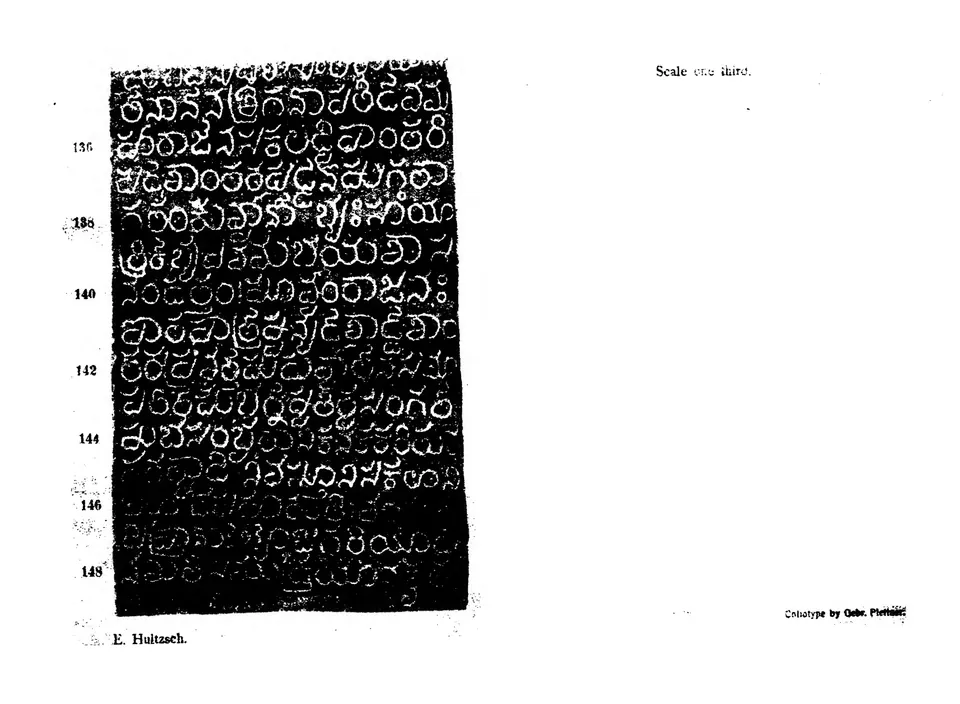
Here is how its parts line up with the list above. The line numbers are Hultzsch’s.
| Part | Lines | What it says |
|---|---|---|
| 1. Auspicious opening | 1–18 | Line 1 begins with a symbol for Om and the words svasti śrī-Svayambhūdevāya namaḥ, a salutation to Svayambhudeva, the Kakatiya family god; verses 1–4 then invoke Ganesha, Sarasvati, the moon on Shiva’s head and Vishnu’s Boar incarnation.23 |
| 2. Family history | 18–101 | Verses 5–15 give a legendary genealogy from Vishnu, the Sun and Manu down through Ikshvaku and Rama to Durjaya; verses 16–22 give the historical line from Prolaraja I to Ganapatideva.24 |
| 2. Praise | 102–134 | Verses 23–27 praise Ganapatideva “in general terms without conveying any historical information”.25 |
| 3. The gift | 135–152 | In prose: “By this glorious Mahārāja Gaṇapatidēva the following edict (assuring) safety has been granted to traders by sea”.26 |
| 3. The terms, in Telugu | 152–166 | The customs duties, beginning with one in thirty on all exports and imports.27 |
| 4. Date and setting up | 166–173 | Verses 28–29: Ganapatideva set up this edict-pillar at Motupalli in Saka 1166, the year Krodhin.27 |
Two things are worth noticing. First, the long Sanskrit poem (lines 2–134) takes up most of the pillar, while the practical business is short. Second, this is an edict, not a land grant, so there are no boundaries and no donee; Hultzsch’s summary records no curse either, for the record ends with the two verses about the setting up of the pillar.2527
The Palampet inscription of 1213 follows the same plan in verse: an opening salutation to Rudreshvara in line 1, blessings to Ganesha, Sarada, Shiva and Vishnu (verses 1–4), praise of King Ganapati (verses 5–8), the family of the donor, the general Rudra (verses 9–17), his deeds and buildings (verses 18–46), the gift and its date (verses 47–48).28 Unlike Motupalli, it then appeals to future kings and gives the stock curse: whoever takes away land “is born for sixty thousand years as a worm in dung.”29
Example 2: the Nandamapundi plates (1053), a land grant on copper
The Nandamapundi grant of the Eastern Chalukya king Rajaraja I is on five copper plates, and is in Sanskrit except for the boundaries, which are in Telugu (lines 80–88).30 F. Kielhorn’s edition gives an English rendering of the business part, so we can follow it step by step.31
- Opening and family history (lines 1–65). Lines 1–52 repeat, almost word for word, the legendary and historical genealogy found in other grants of the same king; lines 53–65 say that Rajaraja was the son of Vimaladitya and Kundavadevi and give the date of his coronation, which corresponds to 16 August 1022.32
- The king’s order (from line 65). The king calls together the cultivators of the district, headed by the rashtrakutas, and issues a command “in the presence of” his councillors, family priest, commander of the army, heir apparent, doorkeeper and chief minister.33
- The donee (lines 67–76). A family history of the poet Narayana, also called Nanni-Narayana, from his great-grandfather Kanchena of the Harita gotra.33
- The gift (to line 79). “We, (after pouring out) a stream of water, have given on the occasion of a lunar eclipse, free from all taxes, the village named Nandamapundi in your vishaya, having constituted it an agrahāra.”34
- The boundaries (lines 80–88, in Telugu). Eight points, one for each direction, such as “In the south the boundary (is) a rāva (tree) (surrounded) by palmyra trees on the margins of the fields of this village and of Nerapula.”34
- The warning and curse (lines 88–91). “Nobody shall cause any obstruction to this (grant), he who does it, becomes possessed of the five great sins”, followed by two verses of “the holy Vyāsa”.34
- The people responsible (line 92). The ajnapti (executor) is the Katakadhiraja, the author of the verses is Nanniyabhatta, and the writer is Gandacharya.34
- The date (line 93). “This order was made in the prosperous thirty-second year of (our) reign of victory.” Kielhorn worked out from the eclipse that the grant was made on Sunday, 28 November 1053.34
Compare this with Motupalli: here the genealogy is long, but the gift, the boundaries, the curse and the names of the officials are all present, just as the law-books required.431
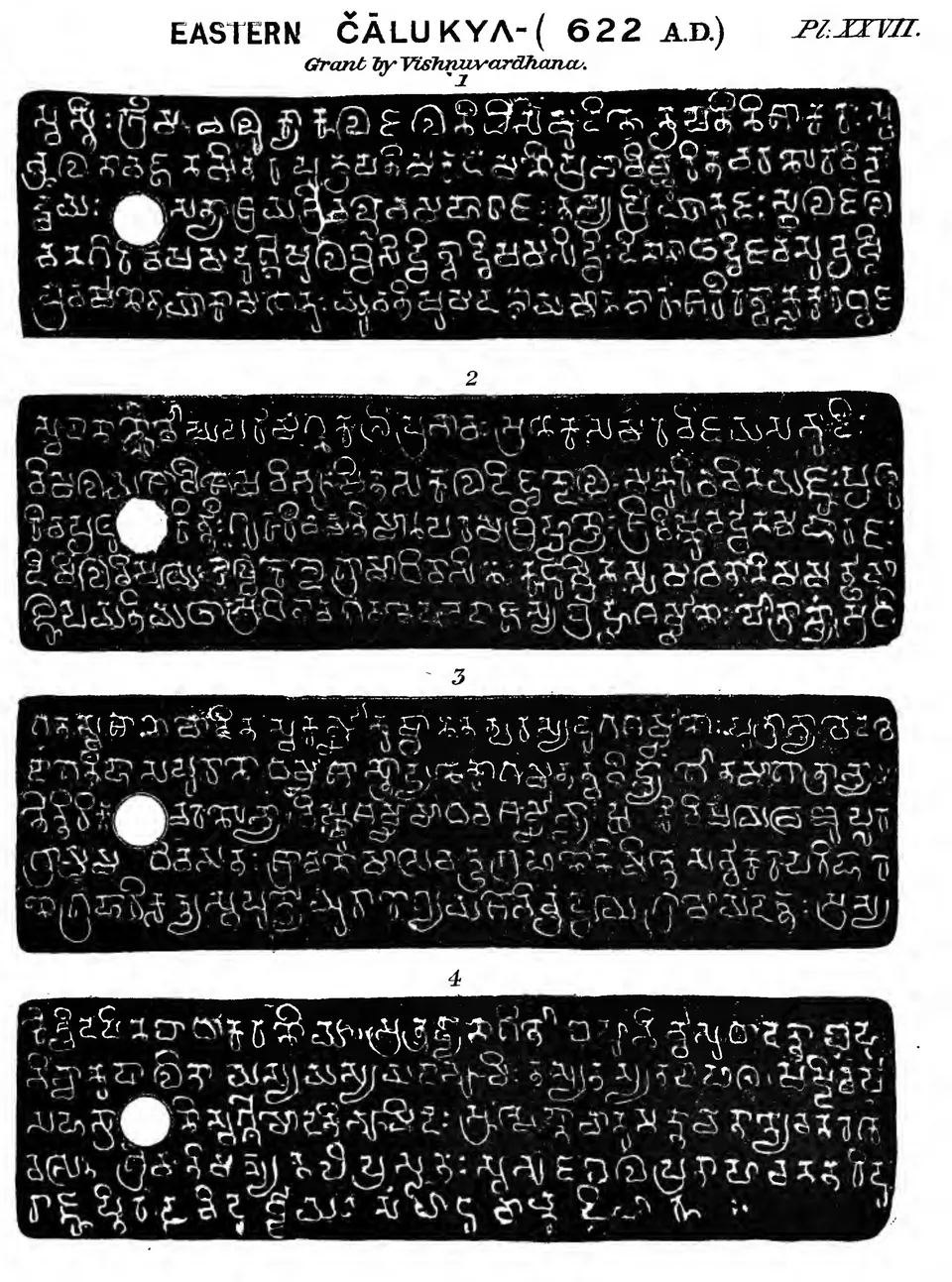
The plates above show the same pattern from four centuries earlier. Burnell printed this Eastern Chalukya grant of Vishnuvardhana, found near Vizagapatam in 1867, as a grant “correct in form according to the law-books”.35 His transliteration shows it opening with svasti, praising Vishnuvardhana, addressing the householders of a village, naming two Brahman brothers of the Gautama gotra as recipients, granting them a village on the occasion of a lunar eclipse, forbidding anyone to obstruct the gift, quoting the Vyasa verses and ending with a date in regnal years: saṃ 16; ma 4; di 15.36
Example 3: a Buddhist gift record from Nagarjunakonda (3rd century)
Short records follow the pattern too. This one is on a pillar of the Great Stupa at Nagarjunakonda, in Prakrit;37 see Nagarjunakonda inscriptions of Chamtisiri. In J. Ph. Vogel’s translation it reads:
“Success! Adoration to the Lord, etc., … the Mahādēvī Chhathisiri … the daughter of Hammasiri, the uterine sister of Mahārāja Vāsiṭhīputa Ikhāku Siri Chāṁtamūla, etc., … and (who is) the wife of Mahārāja Māḍharīputa Siri-Virapurisadata, with due regard for her mother Hammasiriṇikā and for the sake of attainment by herself of the bliss of Nirvāṇa, has erected this pillar. In the 6th year of (the reign of) King Siri-Virapurisadata, the 6th fortnight of the rainy season, the 10th day.”37
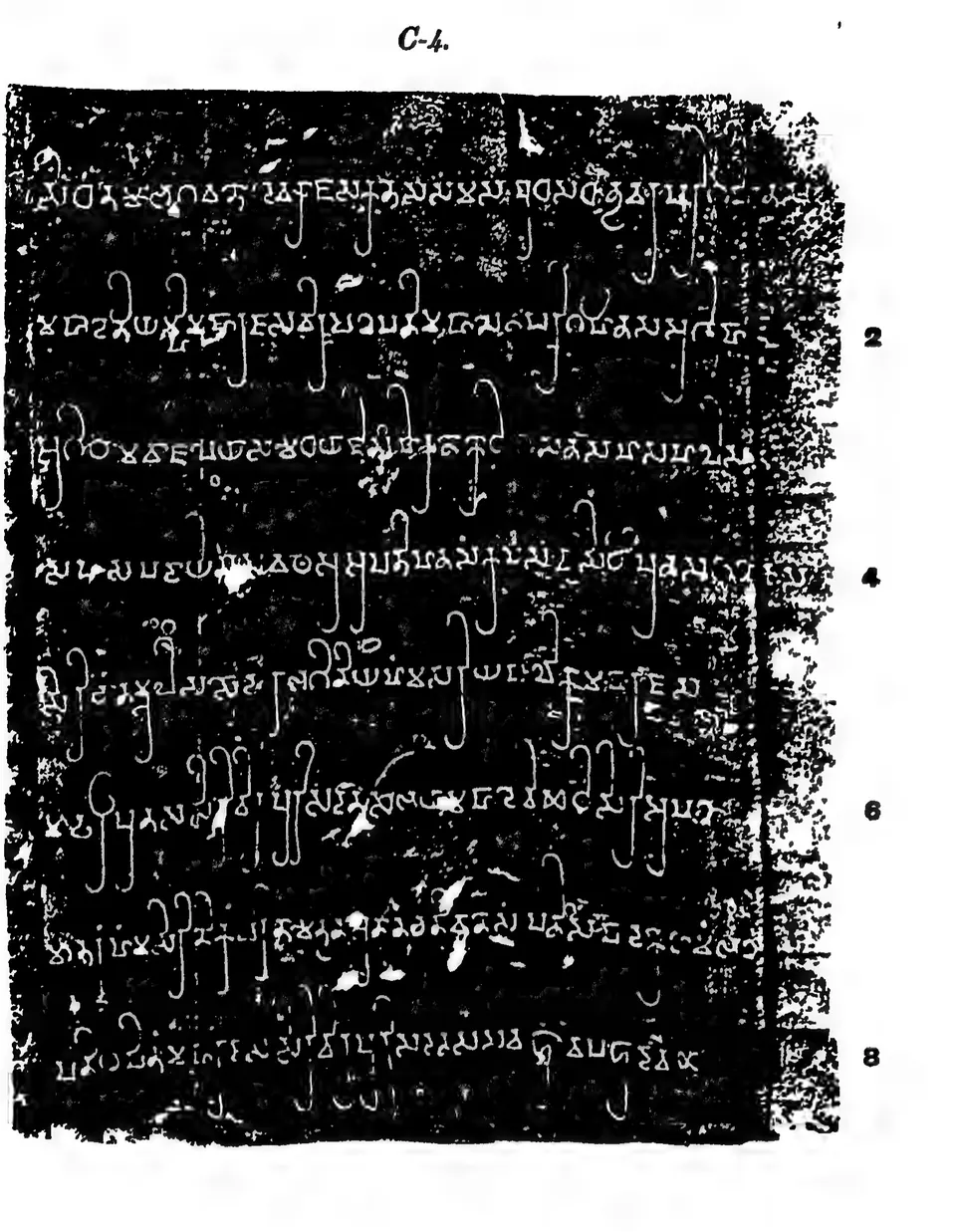
All the parts are there in miniature: the auspicious word (sidhaṃ, “success”), the invocation of the Buddha, the donor placed in her royal family, the purpose, the gift (a pillar) and the date. The date at the end of the original is written in a compressed form, sava 6 vā pa 6 dāva 10 (Vogel corrects the last word to diva).38 Bühler explains such abbreviations: sa or sava for saṃvatsara (year), va for varṣa (the rainy season), pa for pakṣa (fortnight) and diva or di for divasa (day).39
Try it yourself
The Kotagiri plates of 1273, from the reign of the Kakatiya queen Rudramadevi, are three copper plates in Sanskrit, written in letters close to modern Devanagari.40 Below are nine passages from the translation by S. Hanumant Rao, revised by H. Krishna Sastri, in a jumbled order. Match each one to a part from the list above.
- A. “In the auspicious year Śrīmukha, the month Pushya, dark fortnight, on the sixth day, Sunday, (he) gave (the village of) Vainayakapuri,”41
- B. “Hail! Let there be Prosperity! May the Varāha form (i.e. incarnation) of Achyuta protect the world”42
- C. “One holding (vritti) to the revered Bhāgavata Vishnu-Bhaṭṭopādhyāya of the Bharadvāja-gōtra; one holding to Mādhav-Appanagāru of the Gautama-gōtra; …”41
- D. “Bliss! Great Prosperity!”43
- E. “The Lord of the Kākatis (was) king Gaṇapati. To him was born a daughter Rudramāṁbā, the sole champion of the world”42
- F. “Oh! Rulers! Villages granted to Brāhmaṇs are to be protected by you for ever. This is the appeal of Rāmachandra to all future rulers.” (followed by “four of the usual imprecatory and comminatory verses”)41
- G. “with plenty of firewood, fodder and water, and was marked with the four boundaries.”41
- H. “The virtuous Vejjaṁbā … was the queen of that hero … To her, by him, was born the valorous prince Sūra”44
- I. “This Sūra-mahīpati … gave for (his) merit (the village) Vejjalapuri … with a libation of water … while residing at the well-known town of Kōṭagiri.”41
Answer
- B is the auspicious opening: a blessing invoking Vishnu’s Boar incarnation (verse 1).42
- E is the family history of the reigning sovereign (verse 3).42
- H is the donor’s own family history: Sura, son of Ganapati of the Viryala family and Vejjamba (verse 10).44
- I is the gift: the donor, the village and the occasion (verse 14).41
- A is the date (verse 15). The editors give the Saka year as 1195 and work the date out to Sunday, 31 December 1273.45
- G stands in for the boundaries: this grant only says the village was “marked with the four boundaries” without listing them (verse 16).41
- C is the list of recipients, lines 72–97, each with his gotra and number of shares.41
- F is the appeal and the curse (verse 20 and the verses after it).41
- D is the closing auspicious word, line 139.43
Notice what is missing: the Kotagiri plates name no witnesses and no engraver in these passages, which is common, as Burnell observed.18
Further reading
- A. C. Burnell, Elements of South-Indian Palaeography, 2nd ed. (1878), Chapter VI, “The formulae of the different kinds of South-Indian inscriptions”, pp. 94–123 (archive.org (opens in a new tab)).1
- G. Bühler, Indian Palaeography, tr. J. F. Fleet (1904), §36 on the arrangement, punctuation and auspicious signs of inscriptions, pp. 88–92 (archive.org (opens in a new tab)).6
- Next lesson: What inscriptions were written on.
Footnotes
-
Burnell, Elements of South-Indian Palaeography (1878), p. 94 (archive.org (opens in a new tab)). ↩ ↩2
-
A. C. Burnell, Elements of South-Indian Palaeography, 2nd ed. (1878), p. 95, quoting Yajnavalkya i. 317–319 with the commentary Mitakshara (archive.org (opens in a new tab)); p. 96 (archive.org (opens in a new tab)). ↩
-
Bühler, Indian Palaeography (1904), p. 92 (archive.org (opens in a new tab)). ↩
-
Burnell, Elements of South-Indian Palaeography (1878), p. 108 (archive.org (opens in a new tab)). ↩ ↩2 ↩3
-
Burnell, Elements of South-Indian Palaeography (1878), p. 116 (archive.org (opens in a new tab)). ↩
-
G. Bühler, Indian Palaeography, tr. J. F. Fleet, appendix to Indian Antiquary XXXIII (1904), p. 90 (archive.org (opens in a new tab)). ↩ ↩2 ↩3
-
E. Hultzsch, “Motupalli Pillar-Inscription of Ganapatideva”, Epigraphia Indica XII (1914), p. 188 (archive.org (opens in a new tab)); L. D. Barnett, Inscriptions at Palampet and Uparpalli (1919), p. 1 (archive.org (opens in a new tab)). ↩
-
Burnell, Elements of South-Indian Palaeography (1878), p. 109 (archive.org (opens in a new tab)). ↩
-
Burnell, Elements of South-Indian Palaeography (1878), p. 109 (archive.org (opens in a new tab)). ↩
-
Burnell, Elements of South-Indian Palaeography (1878), p. 115 (archive.org (opens in a new tab)). ↩
-
Burnell, Elements of South-Indian Palaeography (1878), Appendix C, p. 138, where a grant is made for the donor’s own merit, long life, health and fame (archive.org (opens in a new tab)); Vogel, Epigraphia Indica XX (1933), p. 20 (archive.org (opens in a new tab)). ↩
-
Burnell, Elements of South-Indian Palaeography (1878), p. 113 (archive.org (opens in a new tab)). ↩
-
Hultzsch, Epigraphia Indica XII (1914), p. 189 (archive.org (opens in a new tab)); Hanumant Rao, The Kotagiri Plates (1925), p. 9 (archive.org (opens in a new tab)); J. Ph. Vogel, “Prakrit Inscriptions from a Buddhist Site at Nagarjunikonda”, Epigraphia Indica XX (1933), p. 20 (archive.org (opens in a new tab)). ↩
-
Burnell, Elements of South-Indian Palaeography (1878), p. 95, on gifts of land at the moon’s quarters and at eclipses (archive.org (opens in a new tab)), and p. 96, the commentary on the date and occasion (archive.org (opens in a new tab)); Kielhorn, Epigraphia Indica IV (1897), p. 303 (archive.org (opens in a new tab)). ↩
-
Burnell, Elements of South-Indian Palaeography (1878), pp. 113–114 (archive.org (opens in a new tab)). ↩
-
Burnell, Elements of South-Indian Palaeography (1878), p. 114 (archive.org (opens in a new tab)); Kielhorn, Epigraphia Indica IV (1897), p. 302 (archive.org (opens in a new tab)). ↩
-
Kielhorn, Epigraphia Indica IV (1897), p. 303 (archive.org (opens in a new tab)); Burnell, Elements of South-Indian Palaeography (1878), p. 136, the ajnapti of a Vengi grant (archive.org (opens in a new tab)); Gaurishankar Hirachand Ojha, Bharatiya Prachin Lipimala, 2nd ed. (1918), p. 152, on the dutaka (archive.org (opens in a new tab)). ↩
-
Burnell, Elements of South-Indian Palaeography (1878), p. 114 (archive.org (opens in a new tab)). ↩ ↩2 ↩3
-
Bühler, Indian Palaeography (1904), pp. 101–102 (archive.org (opens in a new tab)). ↩
-
Burnell, Elements of South-Indian Palaeography (1878), p. 114 (archive.org (opens in a new tab)). ↩ ↩2
-
T. R. Gopte, “Vadner Plates of Buddharaja”, Epigraphia Indica XII (1914), p. 36 (archive.org (opens in a new tab)). The same verse closes the Vengi grants transliterated in Burnell, Elements of South-Indian Palaeography (1878), pp. 136, 138 (archive.org (opens in a new tab)). ↩
-
Hultzsch, Epigraphia Indica XII (1914), p. 188 (archive.org (opens in a new tab)). ↩
-
Hultzsch, Epigraphia Indica XII (1914), p. 188 (archive.org (opens in a new tab)); text, lines 1–18 and n. 10, pp. 190–191 (archive.org (opens in a new tab)). ↩
-
Hultzsch, Epigraphia Indica XII (1914), pp. 188–189 (archive.org (opens in a new tab)); text, lines 18–101, pp. 191–194 (archive.org (opens in a new tab)). ↩
-
Hultzsch, Epigraphia Indica XII (1914), p. 189 (archive.org (opens in a new tab)). ↩ ↩2
-
Hultzsch, Epigraphia Indica XII (1914), p. 196 (archive.org (opens in a new tab)). ↩
-
Hultzsch, Epigraphia Indica XII (1914), p. 197 (archive.org (opens in a new tab)). ↩ ↩2 ↩3
-
Barnett, Inscriptions at Palampet and Uparpalli (1919), pp. 1–2 (archive.org (opens in a new tab)). ↩
-
Barnett, Inscriptions at Palampet and Uparpalli (1919), p. 11, verses 49–52 (archive.org (opens in a new tab)). ↩
-
Kielhorn, Epigraphia Indica IV (1897), pp. 300–301 (archive.org (opens in a new tab)). ↩
-
Kielhorn, Epigraphia Indica IV (1897), pp. 302–303 (archive.org (opens in a new tab)). ↩ ↩2
-
Kielhorn, Epigraphia Indica IV (1897), p. 302 (archive.org (opens in a new tab)). ↩
-
Kielhorn, Epigraphia Indica IV (1897), p. 302 (archive.org (opens in a new tab)). ↩ ↩2
-
Kielhorn, Epigraphia Indica IV (1897), p. 303 (archive.org (opens in a new tab)). ↩ ↩2 ↩3 ↩4 ↩5
-
Burnell, Elements of South-Indian Palaeography (1878), Pl. XXVII (archive.org (opens in a new tab)), and Appendix C, p. 137 (archive.org (opens in a new tab)). ↩
-
Burnell, Elements of South-Indian Palaeography (1878), Appendix C, pp. 137–138 (archive.org (opens in a new tab)), with n. 3 on p. 138 crediting the reading of the date to J. F. Fleet (archive.org (opens in a new tab)). ↩
-
Vogel, Epigraphia Indica XX (1933), p. 20, ayaka-pillar inscription C 4, translation (archive.org (opens in a new tab)). ↩ ↩2
-
Vogel, Epigraphia Indica XX (1933), p. 20, ayaka-pillar inscription C 4, transcript, line 8 and note (archive.org (opens in a new tab)). ↩
-
Bühler, Indian Palaeography (1904), p. 91 (archive.org (opens in a new tab)). ↩
-
S. Hanumant Rao and Lakshmi Kanta Sastri, The Kotagiri Plates of the Reign of the Kakatiya Queen Rudramamba, A.D. 1273 (1925), p. 1 (archive.org (opens in a new tab)). ↩
-
Hanumant Rao, The Kotagiri Plates (1925), p. 9, verses 14–20 and lines 72–97 (archive.org (opens in a new tab)). ↩ ↩2 ↩3 ↩4 ↩5 ↩6 ↩7 ↩8 ↩9
-
Hanumant Rao, The Kotagiri Plates (1925), p. 7, translation of verses 1 and 3 (archive.org (opens in a new tab)). ↩ ↩2 ↩3 ↩4
-
Hanumant Rao, The Kotagiri Plates (1925), p. 10 (archive.org (opens in a new tab)). ↩ ↩2
-
Hanumant Rao, The Kotagiri Plates (1925), p. 8, verse 10 (archive.org (opens in a new tab)); summary of the family, p. 2 (archive.org (opens in a new tab)). ↩ ↩2
-
Hanumant Rao, The Kotagiri Plates (1925), p. 9 (archive.org (opens in a new tab)), and p. 2 for the equivalent date (archive.org (opens in a new tab)). ↩
References
Notes (0)
Sources (8)
Spotted an error on this page? Tell us
Last updated: