Lesson 8
Tamil and Grantha
Most inscriptions in the Telugu country are in Telugu-Kannada letters (see The script through the centuries). In the far south of the old Nellore district, though, and in a few places further north, you will meet stones written in a quite different-looking script: Tamil, often with a few letters of a second script, Grantha, mixed in.12 This lesson shows you how to recognise both, why they appear together, and how to read a short Tamil boundary clause yourself.
Where you will meet them
When Alan Butterworth and V. Venugopaul Chetty collected about 903 inscriptions of Nellore district in 1905, they marked on their map the places where Tamil inscriptions were found.1 The southern taluks were mostly Tamil: in Sulurpet only 4 of 20 inscriptions were in Telugu, in Venkatagiri 5 of 27, and in Gudur 22 of 118. Further north the balance changed: Rapur had 67 Telugu inscriptions out of 79, and Nellore taluk 64 out of 124.1 They summed it up by saying that records of the Choda or Chola chiefs were in Telugu in the north of the district and in Tamil in the south, while a few old Tamil inscriptions turned up even in “unquestionably Telugu” taluks such as Atmakur.1
Tamil had once reached much further north. A. C. Burnell wrote in 1878 that under Chola rule in the 11th and 12th centuries the Grantha-Tamil alphabet spread over the deltas of the Krishna and Godavari, and that Tamil inscriptions still existed, or had existed until lately, on some islands of the Godavari delta.3 He added that he had checked this northern spread for himself in the Nellore country.3 After the Cholas lost Kalinga in 1228 to the king of Orungal (Warangal), only Telugu inscriptions and grants appear there by the beginning of the 14th century.3
Two scripts, one language
The key fact to remember is this: Tamil script cannot write Sanskrit.
G. H. Ojha’s Bharatiya Prachin Lipimala (1918) explains why. The Tamil alphabet has only eighteen consonants. It has no separate letters for the sounds g, j, ḍ, d, b or ś: g is written with the k-letter, j and ś with the c-letter, d with t and b with p.4 Leave out the four letters that only Tamil has (ḻ, ḷ, ṟ and ṉ) and only fourteen of the Sanskrit consonants remain, so Sanskrit words cannot be written in it. When they are needed, they are written in Grantha.4
That is where Grantha gets its name. Ojha says that in the parts of the Madras Presidency where Tamil was used, Sanskrit books (granthas) were written in this script, so it came to be called the “Grantha script”.5 Burnell put it the same way: Grantha is the character that Tamil Brahmans used, and still used, to write their sacred books in Sanskrit, and the name meant a script for “books” or literary purposes.6
So a Tamil inscription is usually in Tamil letters, with Sanskrit words, names and titles slipped in using Grantha letters. Burnell noticed that most early evidence for Grantha consists of exactly such Sanskrit words in Tamil inscriptions.2
How the scripts grew
Burnell derived Grantha and Tamil from an early southern alphabet that he called “Cera”, a variety of the “cave character” that goes back to the southern Asoka alphabet. In the northern part of the Cera country this alphabet was replaced by Telugu-Kannada; further south it developed into Grantha and Tamil.7 Ojha found that early Grantha looked very like Telugu-Kannada: he invites the reader to compare the Kanchipuram inscription of the Pallava king Rajasimha on his Plate 52 with the Uruvupalli plates of Vishnugopavarman on Plate 43.5 Writing quickly with the pen, curving the upright and cross strokes, and adding small loops (granthi) at the beginning, middle or end of letters gradually made Grantha look quite different from Telugu and Kannada.5
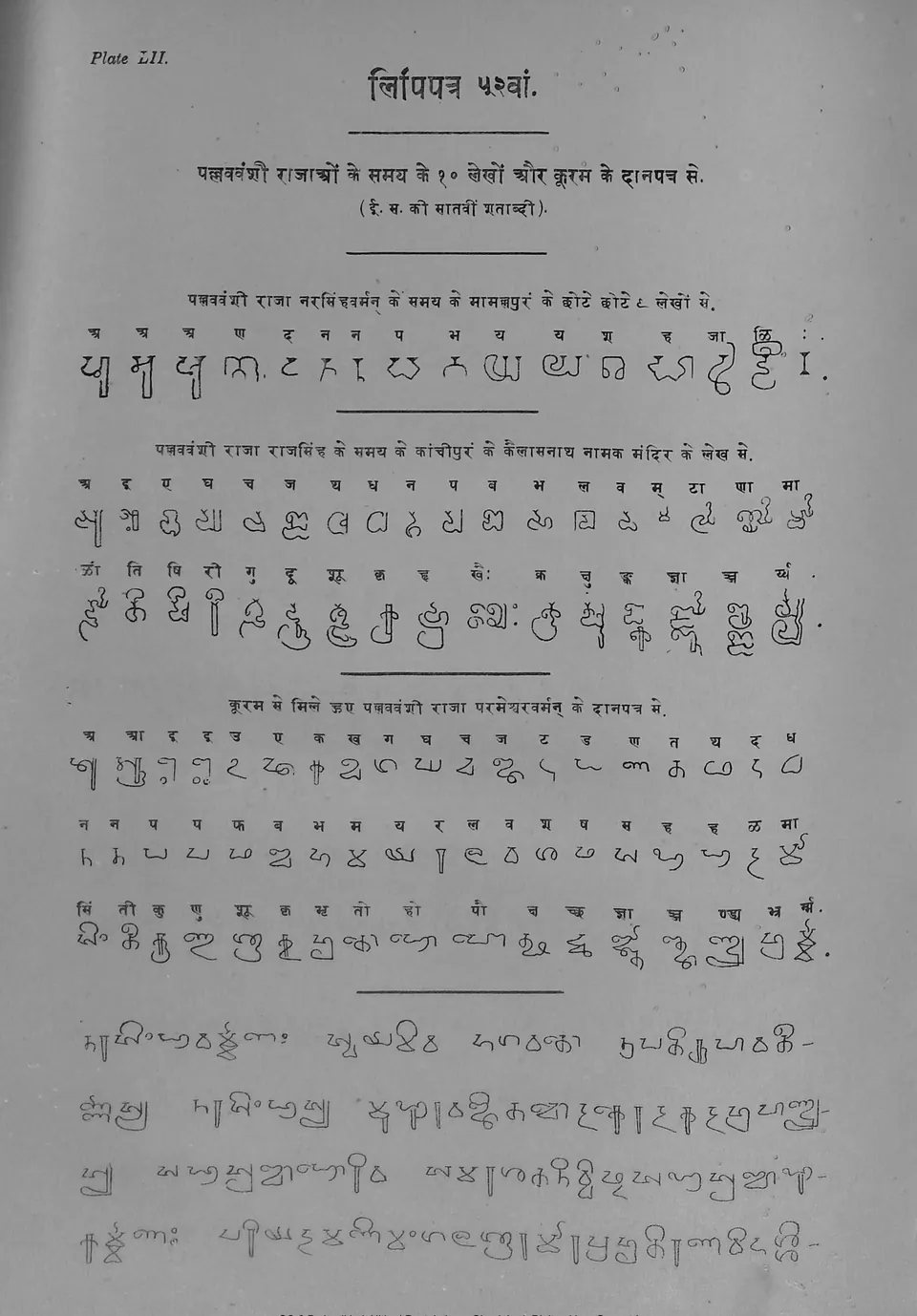
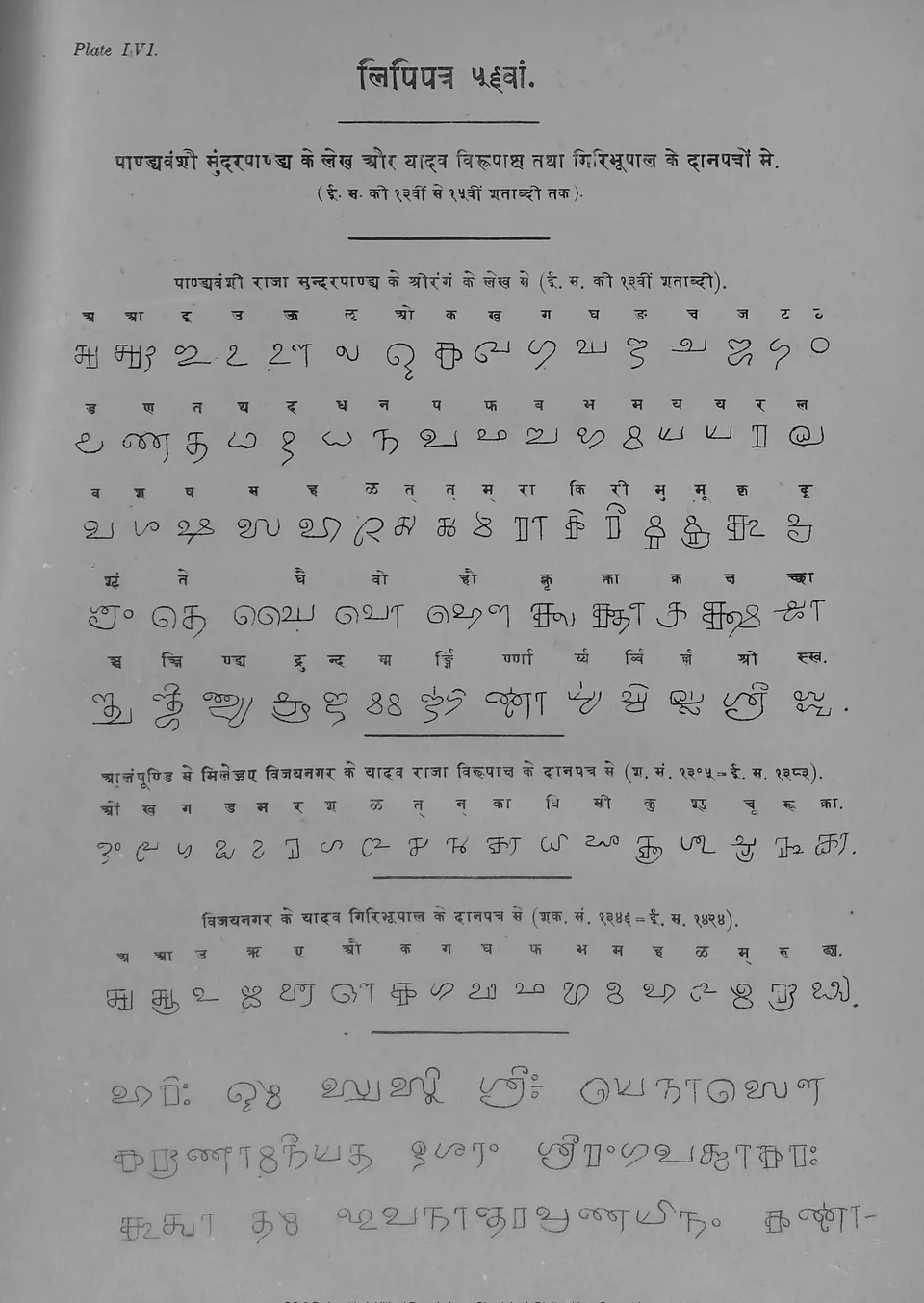
Ojha’s Plate 52 draws its letters from short inscriptions of the Pallava king Narasimhavarman at Mamallapuram, the Kailasanatha temple inscription of Rajasimha at Kanchipuram, and the Kuram plates of Parameshvaravarman.8 His Plate 56 comes from a Srirangam inscription of Sundara Pandya and two Vijayanagara grants of 1383 and 1424; most of its letters, he says, already resemble modern Grantha, which took its final form after the 14th century.9
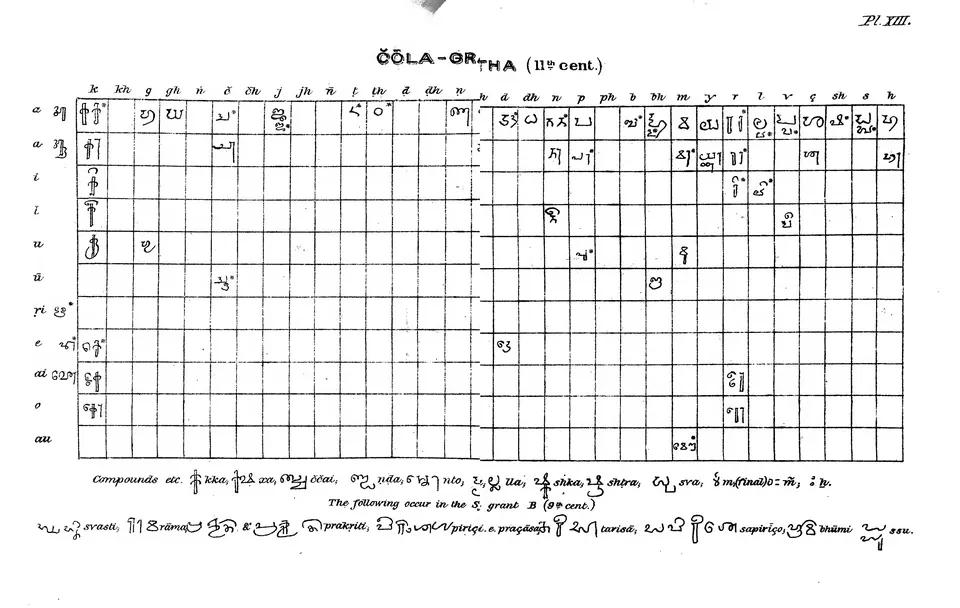
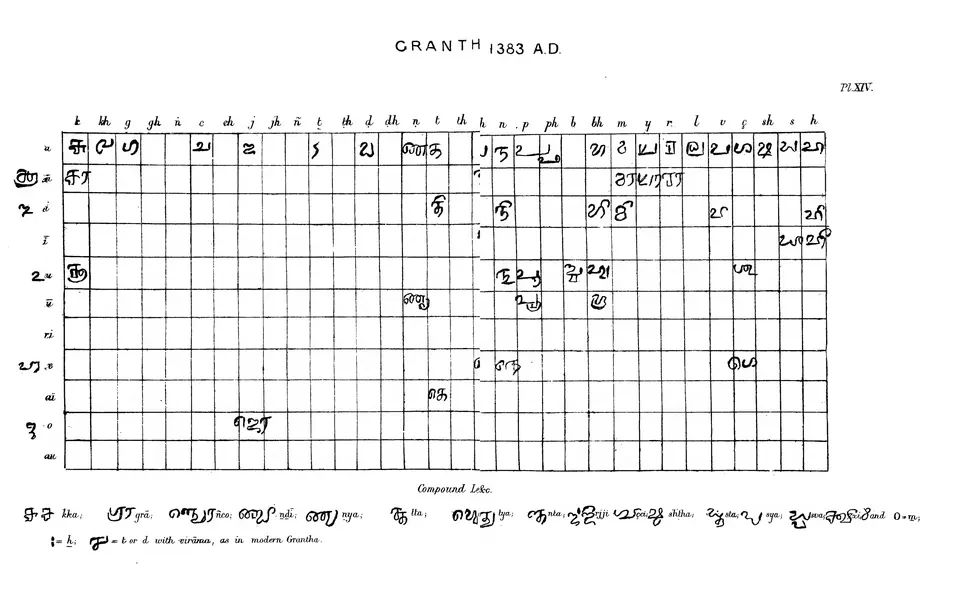
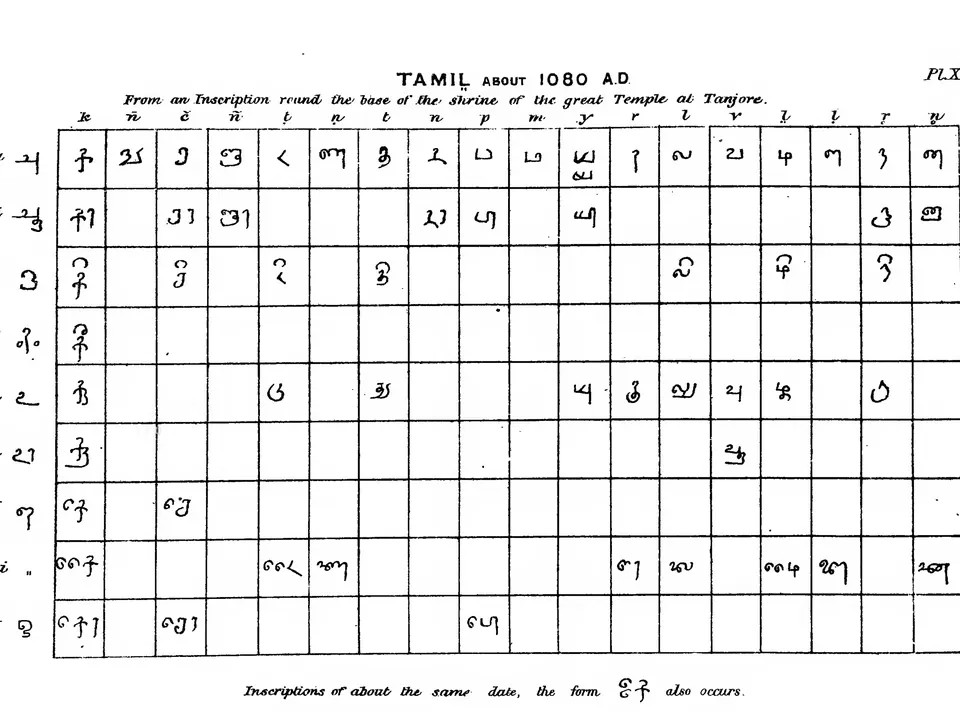
Burnell’s tables show the same story. His Plate XIII gives the Chola-period Grantha of the 11th century. Its letters come partly from the inscription round the shrine of the great temple at Tanjore, from the end of the 11th century.10 He dated the modern Grantha alphabet from about 1300.10 Burnell found few dated Sanskrit inscriptions in Grantha more than three centuries old, apart from one of 1383, the year of his Plate XIV.2
The Tamil alphabet, in Burnell’s view, was a Brahmin adaptation of Grantha letters for the sounds of the older Tamil script (the Vatteluttu), keeping from the Vatteluttu the four letters that Grantha lacked: ḻ, ḷ, ṟ and ṉ.11 The Vatteluttu itself had been used south of Tanjore and was only gradually replaced by the modern Tamil character from about the 11th century, under the Cholas.12 The earliest inscriptions in the Tamil character that Burnell knew were of the 10th century, from Conjeveram (Kanchipuram), the neighbourhood of Madras and the Kaveri delta.11
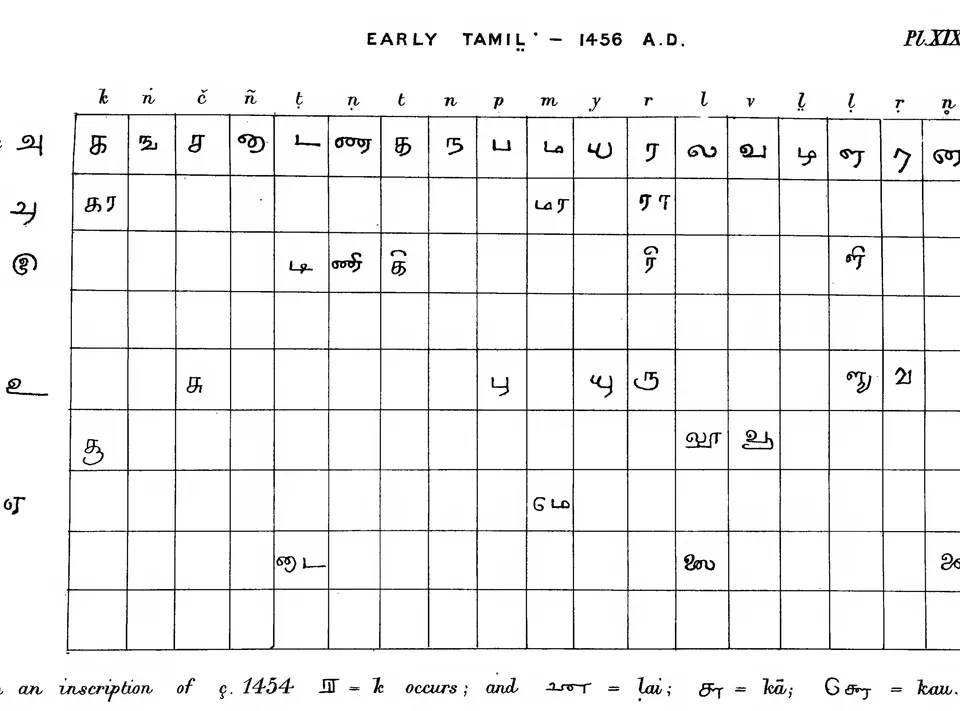
Tamil letters then changed slowly. Comparing records of 1073 and 1600, Burnell saw “very little alteration”, and he thought something close to modern Tamil had been reached by about 1350.13 Ojha’s dates are similar: some letters looked like modern Tamil by the 10th century, and most of them by about the 14th.4
How to tell Tamil, Grantha and Telugu-Kannada apart
Use these clues, in this order.
- Count the consonants. A Tamil table has only eighteen consonant columns. Burnell’s Plate XVIII (Tamil of about 1080) runs k, ṅ, c, ñ, ṭ, ṇ, t, n, p, m, y, r, l, v, then ḻ, ḷ, ṟ, ṉ, with no columns for aspirates or voiced letters.14 Grantha, like Telugu-Kannada, has the full Sanskrit set: compare the crowded table of modern Grantha in Plate XV.15
- Look at the shape. Tamil letters are angular, Telugu ones round. Burnell explained this by the way scribes held the stylus on palm leaves. In the Tamil country it rested on the end of the left thumbnail. In Malabar and the Telugu country it rested on the left side of the same thumbnail, which gives rounder letters.16 In Tamil, the curve at the top of the letters Burnell writes as k, s, t, n and r turned into an angular stroke; this feature appears in an inscription of about 1200, and k was the last letter to take its modern form, about 1500.13
- Look for loose vowel signs. In Chola-period Grantha the signs for ā, e, ai and o increasingly stand apart from their consonant instead of being joined to it. In 825 only the e-sign was clearly separate. By about 1100 ā was generally separate too.10
- Look for consonants written side by side. Tamil does not stack one consonant under another to make a conjunct; the consonants are written next to each other.4
- Do not expect the dot. Modern Tamil marks a consonant without a vowel with a dot (pulli) above it. Burnell never saw it in an inscription.13 Ojha says many records make no difference at all between a bare consonant and one with its vowel. A few mark the bare one with a dot, a curve or a slanting stroke.4
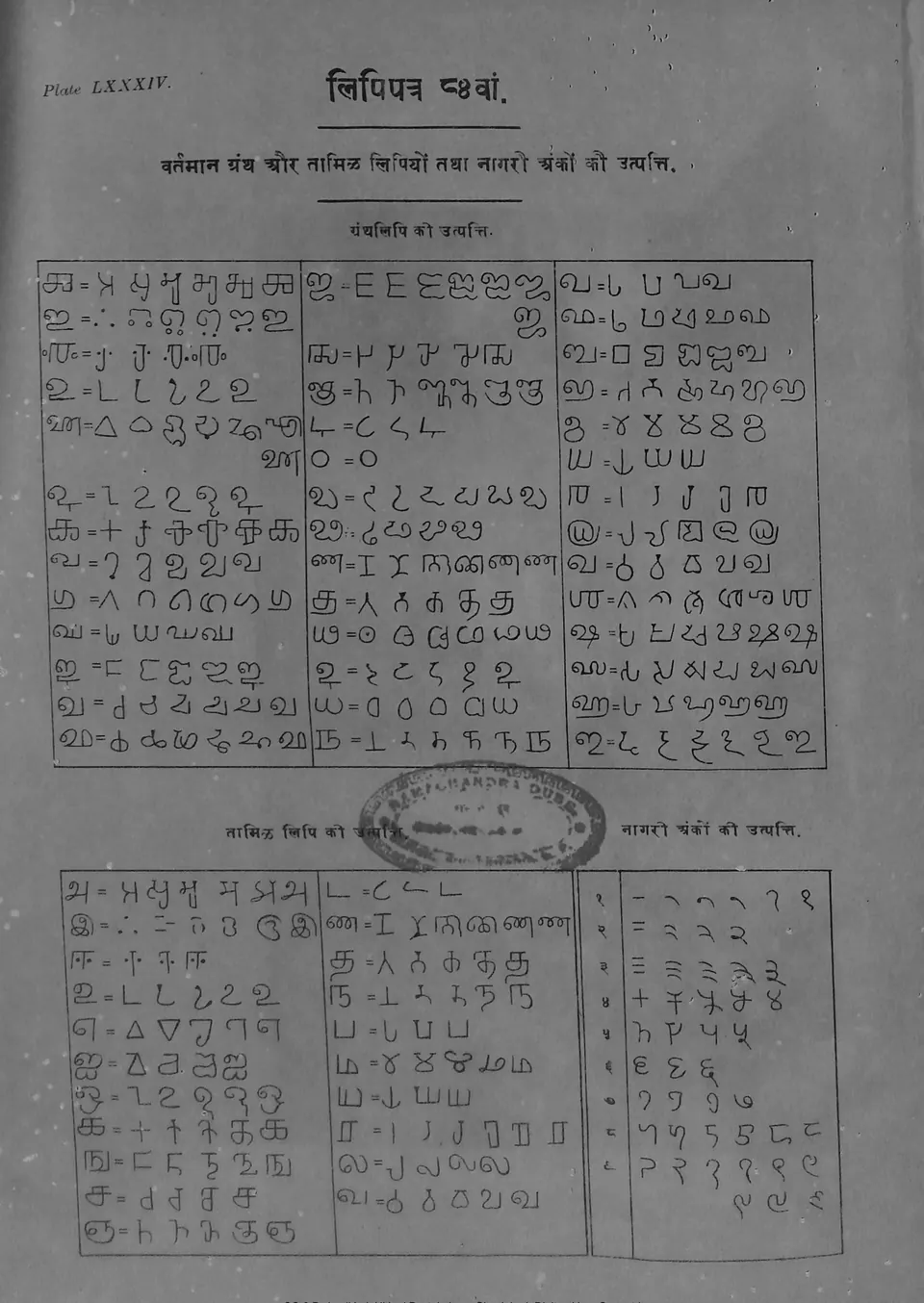
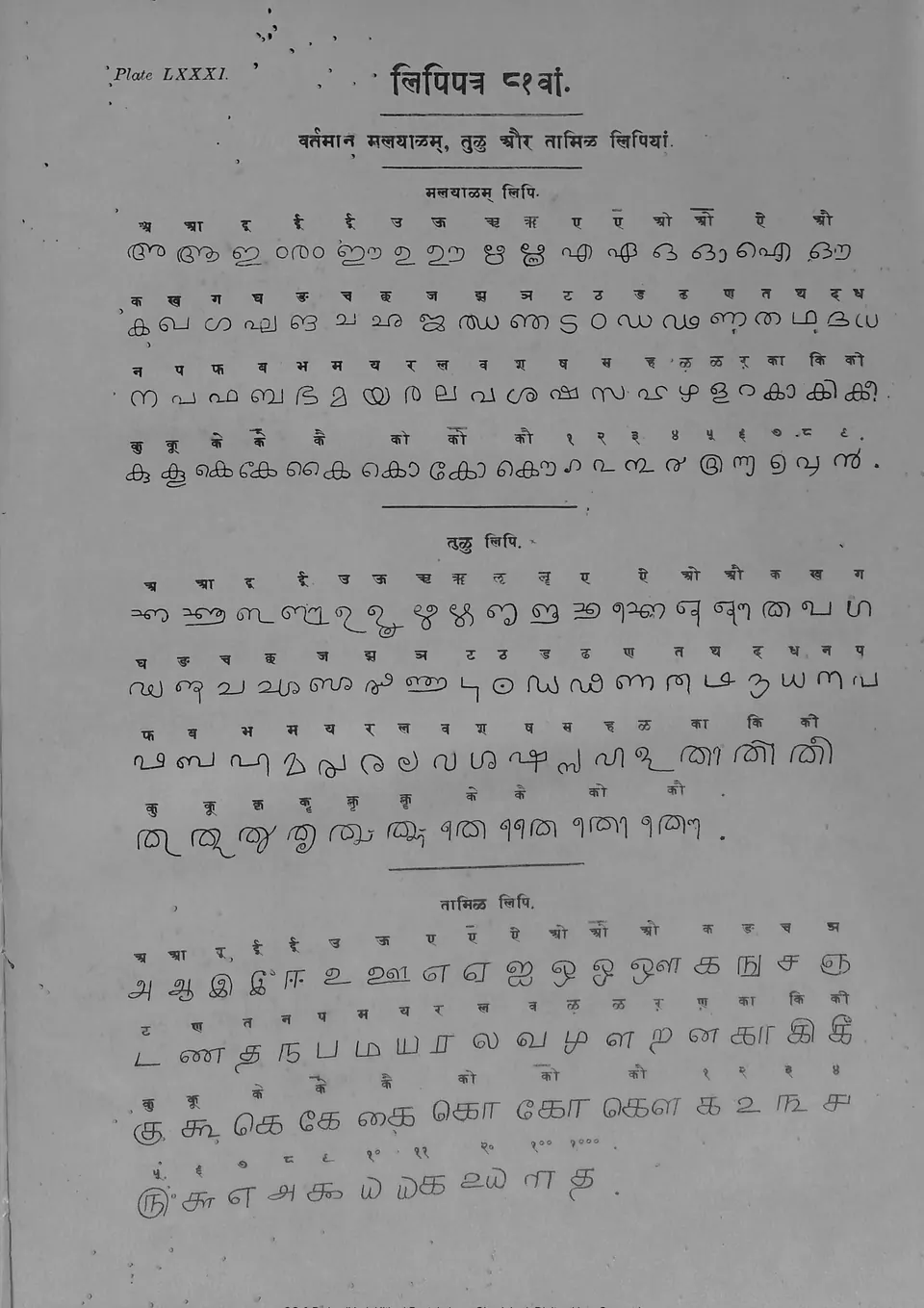
Ojha’s Plate 84 traces each Grantha and Tamil letter step by step from early forms to modern ones; his explanation begins on p. 139.17 For comparison with modern print, his Plate 81 gives the modern Tamil alphabet beside Malayalam and Tulu.
A Tamil inscription from Nellore
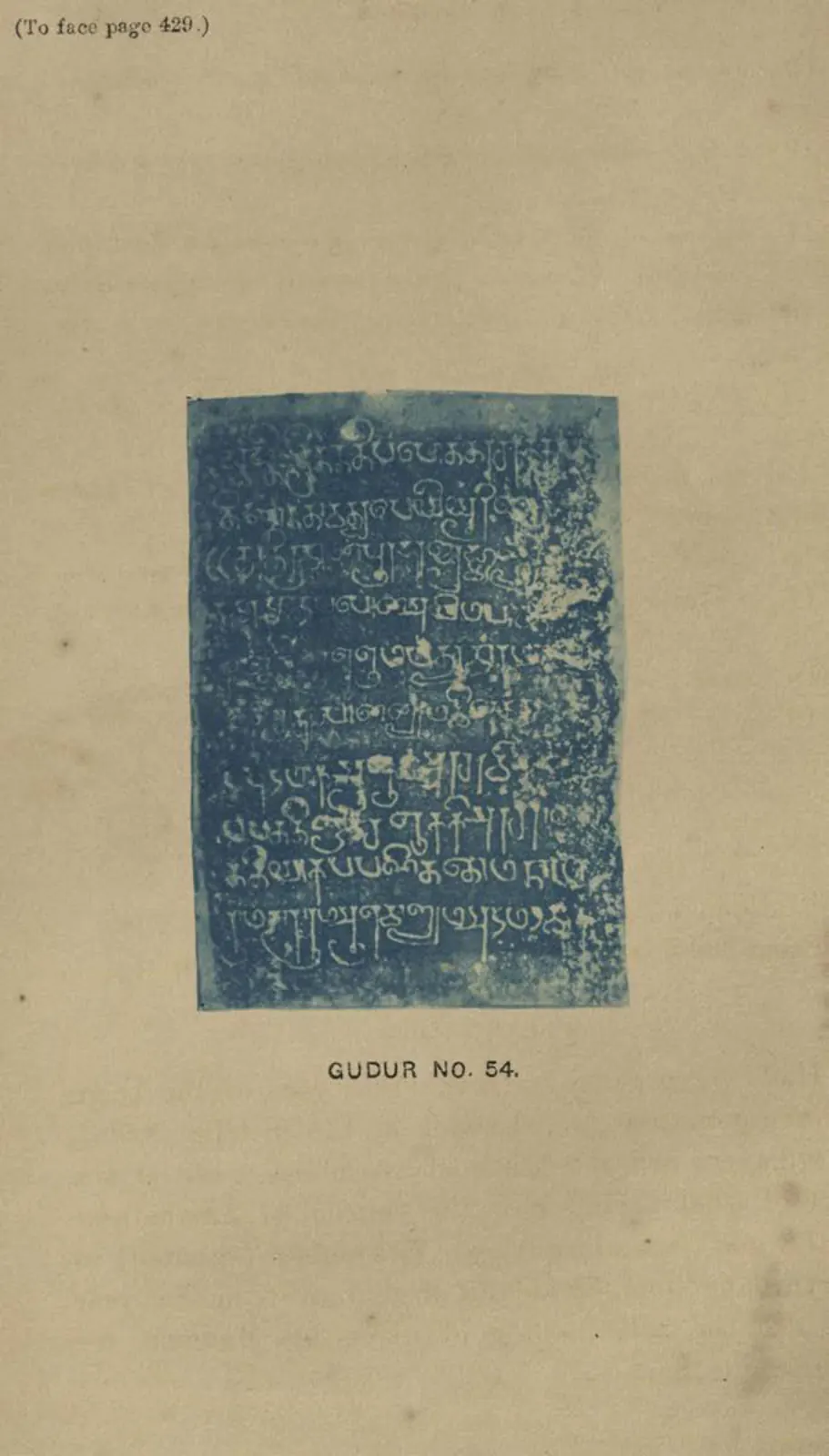
Gudur No. 54, from the floor of the Subrahmanyesvara temple at Mallam, is described in the Nellore collection as “Tamil in character of the Pallava type”.18 Its translation begins: “Hail! Prosperity! In the 15th year of the reign of Nandipottarasar”. It records gold given for the god Subrahmanya at Tiruvanbur, including gold given for lamps.18 The editors took it as evidence of a Pallava king ruling part of the district, probably in the 8th century.19 The same temple at Mallam, they noted, “is covered with Tamil inscriptions”; they summarised the rest instead of printing them, because most record only gifts of land, money and lamps.20 A second Tamil stone, Gudur No. 106 at Rattamala, is carved with emblems and ends with a salutation to the Buddha.21
The Tamil inscriptions in this collection were transcribed and translated for the editors by T. P. Krishnaswami Sastri.22 Notice that the date of Gudur No. 54 is only a year of the king’s reign. Burnell warned that most Tamil inscriptions are dated only by the year (andu) of the king’s reign, and seldom give a genealogy, so they are hard to date exactly.11 See Dates and eras.
Worked example: a Tamil boundary clause
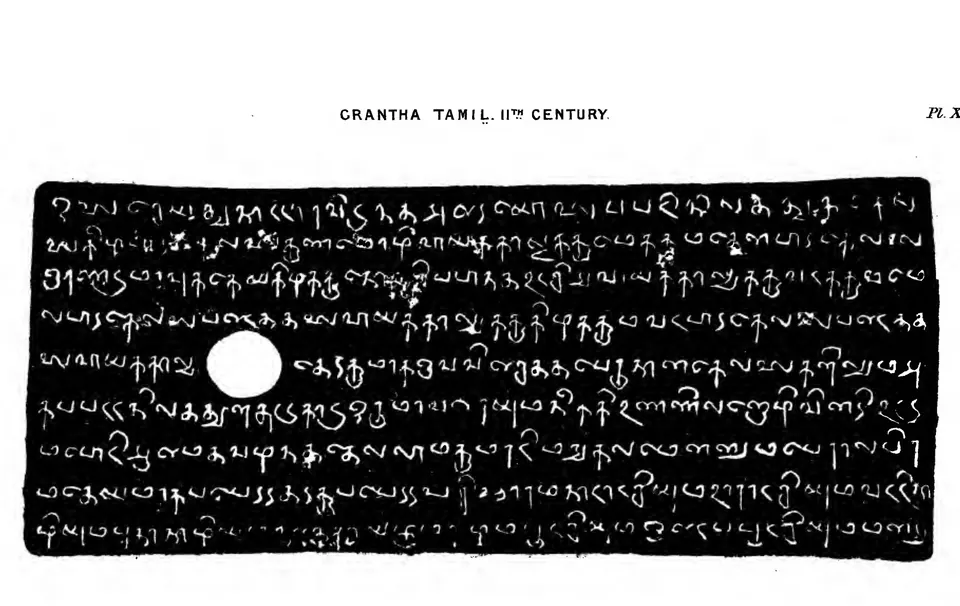
Burnell’s Plate XXXIV shows nine lines of 11th-century Grantha-Tamil. He printed it because it “illustrates the way of describing boundaries”, and gave a transliteration on p. 142.23 In grants of land, he explains, the boundaries are carefully listed, and they are usually written in the local language even when the rest of the grant is in Sanskrit.24
Here are the first lines as Burnell transliterated them (he used special letters, which we simplify a little):23
- ōlai šēyδu nāṭṭār viḍutta aṟaiyōlaippaḍi nilattukk ‘el-
- lai: kīḻpāṟk ‘ellai, kuṇamoḻivāykkālukku mē(ṟ)kkum; teṉpāṟk ‘ellai,
- …
- lpāṟk ‘ellai, maḍaittalaivāykkālukku kiḻakkum; vaḍapāṟk ‘ellai maḍaitta-
Step by step:
- Find the word that repeats. The word ‘ellai comes again and again: split across lines 1–2 (‘el-lai), twice in line 2, twice in line 4.
- Look it up. Winslow’s Tamil dictionary of 1862 gives ellai as “a limit, border, boundary”.25
- Take one phrase apart. In line 4, vaḍapāṟk ‘ellai begins with vaḍa, which Winslow gives as “northern”.26 So the phrase is “the northern boundary”, and the words after it say where that boundary runs.
- Notice the language. Burnell remarked that this inscription, like all the old Tamil inscriptions then known, is in language “much like what is now spoken”.23
Try it yourself
1. Open Burnell’s Plate XVIII (Tamil, about 1080) above. Count the consonant columns across the top. How many are there, and which kinds of sound are missing?14
Answer
There are eighteen: k, ṅ, c, ñ, ṭ, ṇ, t, n, p, m, y, r, l, v, ḻ, ḷ, ṟ, ṉ.14 There are no aspirates (kh, gh and so on) and no separate voiced letters such as g, j, d or b. That matches Ojha’s statement that Tamil has only eighteen consonants and writes g with k, j and ś with c, d with t and b with p.4
2. The Nellore editors printed Gudur No. 54 in modern Tamil type. Its first line begins ஸ்வஸ்தி ஸ்ரீ நந்திப்பொத்தரசர்க்கு, which their translation renders “Hail! Prosperity! … Nandipottarasar”.2718 The first two words are the Sanskrit greeting svasti śrī. Which script are their s-letters (ஸ, ஸ்ரீ) taken from, and why?
Answer
From Grantha. Tamil has no s or ś letter among its eighteen consonants (see Plate XVIII), so Sanskrit words are written with Grantha letters.144 The rest of the line, the king’s name with its Tamil ending, is in Tamil letters.
What this lesson cannot yet show
This lesson has page-cited examples from Nellore district only.1 The Tamil records of Chittoor and the Rayalaseema districts, and the Tamil and Grantha portions of Pallava and Chola grants found there, still need to be checked edition by edition before they can be used here.
Footnotes
-
Alan Butterworth and V. Venugopaul Chetty, A Collection of the Inscriptions on Copper-Plates and Stones in the Nellore District, Part I (1905), Preface, p. viii (archive.org (opens in a new tab)). ↩ ↩2 ↩3 ↩4 ↩5
-
Burnell, Elements of South-Indian Palaeography (1878), p. 39 (archive.org (opens in a new tab)). ↩ ↩2 ↩3
-
A. C. Burnell, Elements of South-Indian Palaeography (2nd ed., 1878), p. 46 and nn. 1–2 (archive.org (opens in a new tab)). ↩ ↩2 ↩3
-
Gaurishankar Hirachand Ojha, Bharatiya Prachin Lipimala (2nd ed., 1918), p. 95 (archive.org (opens in a new tab)). ↩ ↩2 ↩3 ↩4 ↩5 ↩6 ↩7
-
Ojha, Bharatiya Prachin Lipimala (1918), pp. 89–90 (archive.org (opens in a new tab)). ↩ ↩2 ↩3
-
Burnell, Elements of South-Indian Palaeography (1878), p. 39 (archive.org (opens in a new tab)), p. 41 (archive.org (opens in a new tab)). ↩
-
Burnell, Elements of South-Indian Palaeography (1878), p. 33 (archive.org (opens in a new tab)), p. 35 (archive.org (opens in a new tab)), p. 39 (archive.org (opens in a new tab)). ↩
-
Ojha, Bharatiya Prachin Lipimala (1918), p. 90 and Plate 52 (archive.org (opens in a new tab); plate: archive.org (opens in a new tab)). ↩
-
Ojha, Bharatiya Prachin Lipimala (1918), p. 92 and Plate 56 (archive.org (opens in a new tab); plate: archive.org (opens in a new tab)). ↩
-
Burnell, Elements of South-Indian Palaeography (1878), p. 40 and Pl. XIII (archive.org (opens in a new tab); plate: archive.org (opens in a new tab)). ↩ ↩2 ↩3
-
Burnell, Elements of South-Indian Palaeography (1878), p. 44 (archive.org (opens in a new tab)). ↩ ↩2 ↩3
-
Burnell, Elements of South-Indian Palaeography (1878), p. 47 (archive.org (opens in a new tab)). ↩
-
Burnell, Elements of South-Indian Palaeography (1878), p. 45 (archive.org (opens in a new tab)). ↩ ↩2 ↩3
-
Burnell, Elements of South-Indian Palaeography (1878), Pl. XVIII, “Tamil about 1080 A.D.” (archive.org (opens in a new tab)). ↩ ↩2 ↩3 ↩4
-
Burnell, Elements of South-Indian Palaeography (1878), Pl. XV, “Modern Grantha, 18th cent.” (archive.org (opens in a new tab)). ↩
-
Burnell, Elements of South-Indian Palaeography (1878), p. 46 (archive.org (opens in a new tab)). ↩
-
Ojha, Bharatiya Prachin Lipimala (1918), p. 139 and Plate 84 (archive.org (opens in a new tab); plate: archive.org (opens in a new tab)). ↩
-
Butterworth and Chetty, Nellore District Inscriptions (1905), p. 429, Gudur No. 54 (archive.org (opens in a new tab)); plate facing p. 429 (archive.org (opens in a new tab)). ↩ ↩2 ↩3
-
Butterworth and Chetty, Nellore District Inscriptions (1905), Preface, p. vi (archive.org (opens in a new tab)). ↩
-
Butterworth and Chetty, Nellore District Inscriptions (1905), p. 430, Gudur Nos. 55–80 (archive.org (opens in a new tab)). ↩
-
Butterworth and Chetty, Nellore District Inscriptions (1905), p. 446, Gudur No. 106 (archive.org (opens in a new tab)); plate facing p. 446 (archive.org (opens in a new tab)). ↩
-
Butterworth and Chetty, Nellore District Inscriptions (1905), Preface, p. ix (archive.org (opens in a new tab)). ↩
-
Burnell, Elements of South-Indian Palaeography (1878), p. 142, notes on Pl. XXXIV (archive.org (opens in a new tab)); Pl. XXXIV (archive.org (opens in a new tab)). ↩ ↩2 ↩3
-
Burnell, Elements of South-Indian Palaeography (1878), pp. 113–114 (archive.org (opens in a new tab)). ↩
-
Miron Winslow, A Comprehensive Tamil and English Dictionary (1862), p. 179, s.v. ellai (archive.org (opens in a new tab)). ↩
-
Winslow, A Comprehensive Tamil and English Dictionary (1862), p. 912, s.v. vaḍa (archive.org (opens in a new tab)). ↩
-
Butterworth and Chetty, Nellore District Inscriptions (1905), p. 430, text of Gudur No. 54, line 1 (archive.org (opens in a new tab)). ↩
References
Notes (0)
Sources (4)
Spotted an error on this page? Tell us
Last updated: