Lesson 7
Sanskrit charters and the Nagari script
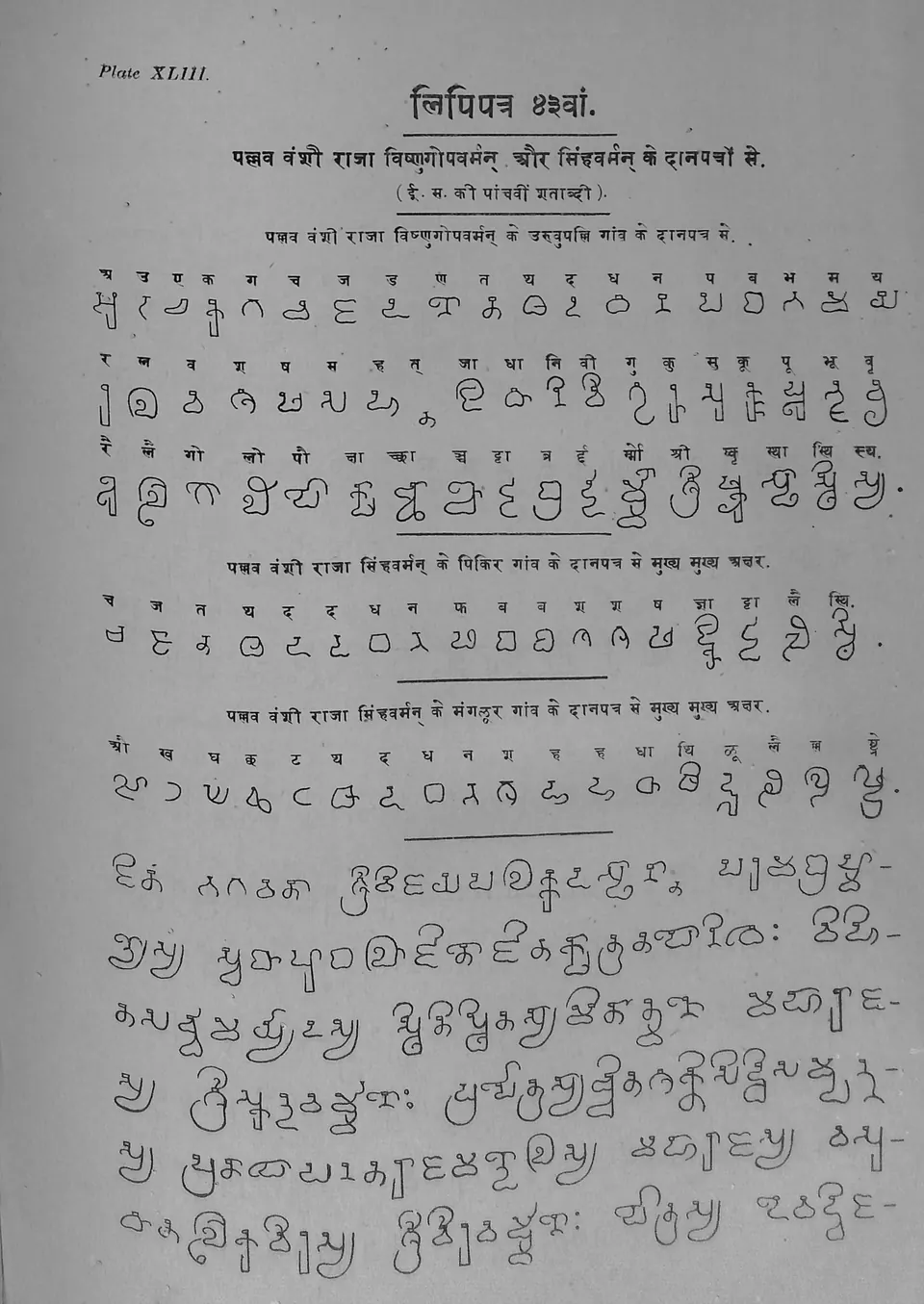
Over the early centuries CE, kings in the Telugu country began to issue their land grants in Sanskrit instead of Prakrit, and Sanskrit remained the language of royal charters for many centuries. By the time of the Eastern Chalukyas, every genuine royal grant Burnell had seen was in Sanskrit.1 Most of these charters are written in the local Telugu-Kannada script. Some later ones, especially of the Vijayanagara kings, use a form of the northern Nagari script.2 This lesson helps you with both: the Sanskrit of the charters, which local scribes spelt in their own way, and the Nagari script when you meet it.
From Prakrit to Sanskrit
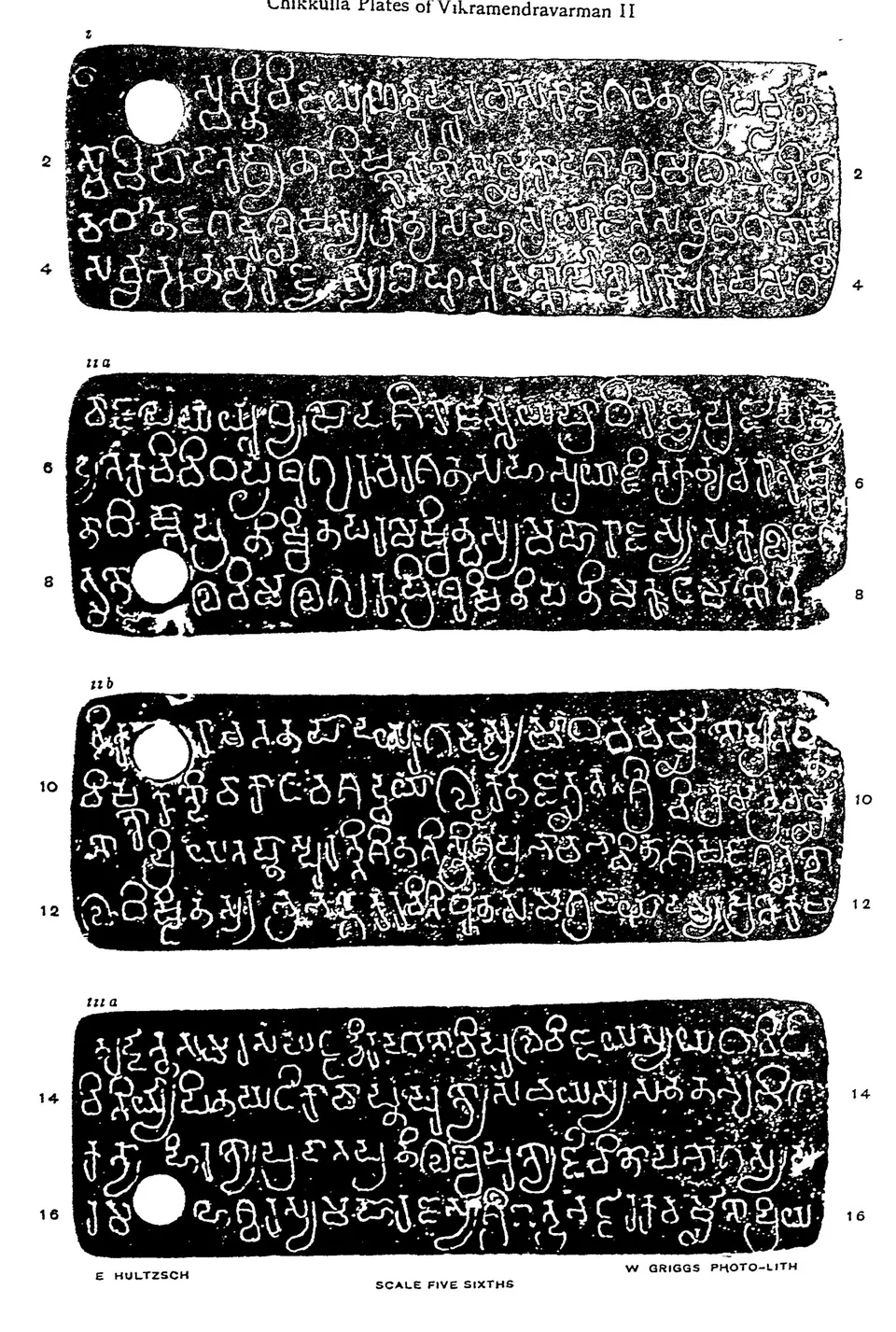
The change can be seen within a single grant. The Chikkulla plates of the Vishnukundin king Vikramendravarman II are in Sanskrit, but F. Kielhorn found the language “very incorrect” in places and “mixed with Prakrit words”: gaurava is written gārava, and the words for “fortnight” and “summer” appear in their Prakrit forms pakkha and gihma.3 He also spotted a Telugu ending. The scribe wrote saṃvassarambul for “years”, with the Telugu plural ending, and Kielhorn took this as proof that “the writer’s vernacular was Telugu”.3
By the time of the Eastern Chalukyas the change was complete. Burnell wrote that all the genuine grants of both Chalukya dynasties he had seen were in Sanskrit. He added that the later the grant, the more the scribes neglected the grammarians’ rules of spelling, “especially as regards the use of the bindu”.1 Even so, many Sanskrit charters describe the boundaries of the granted land in Telugu. Two Vijayanagara grants from Nellore, for example, give their boundaries in Telugu after Sanskrit verses.4
Spelling habits of the scribes
When you compare an inscription with its printed edition, you will see that editors print what is on the plate and give corrections in footnotes beginning “Read …”.5 Knowing the scribes’ habits makes these corrections less puzzling. Here are some that editors of grants from the Telugu country point out:
- Visarga left out. At Chikkulla “final visarga is generally omitted”.3
- Final m doubled before a vowel, as in Vishṇukuṇḍinamm=ekādaśa.3
- Odd spellings of familiar names: Chikkulla writes Triyambhaka for Tryambaka.3
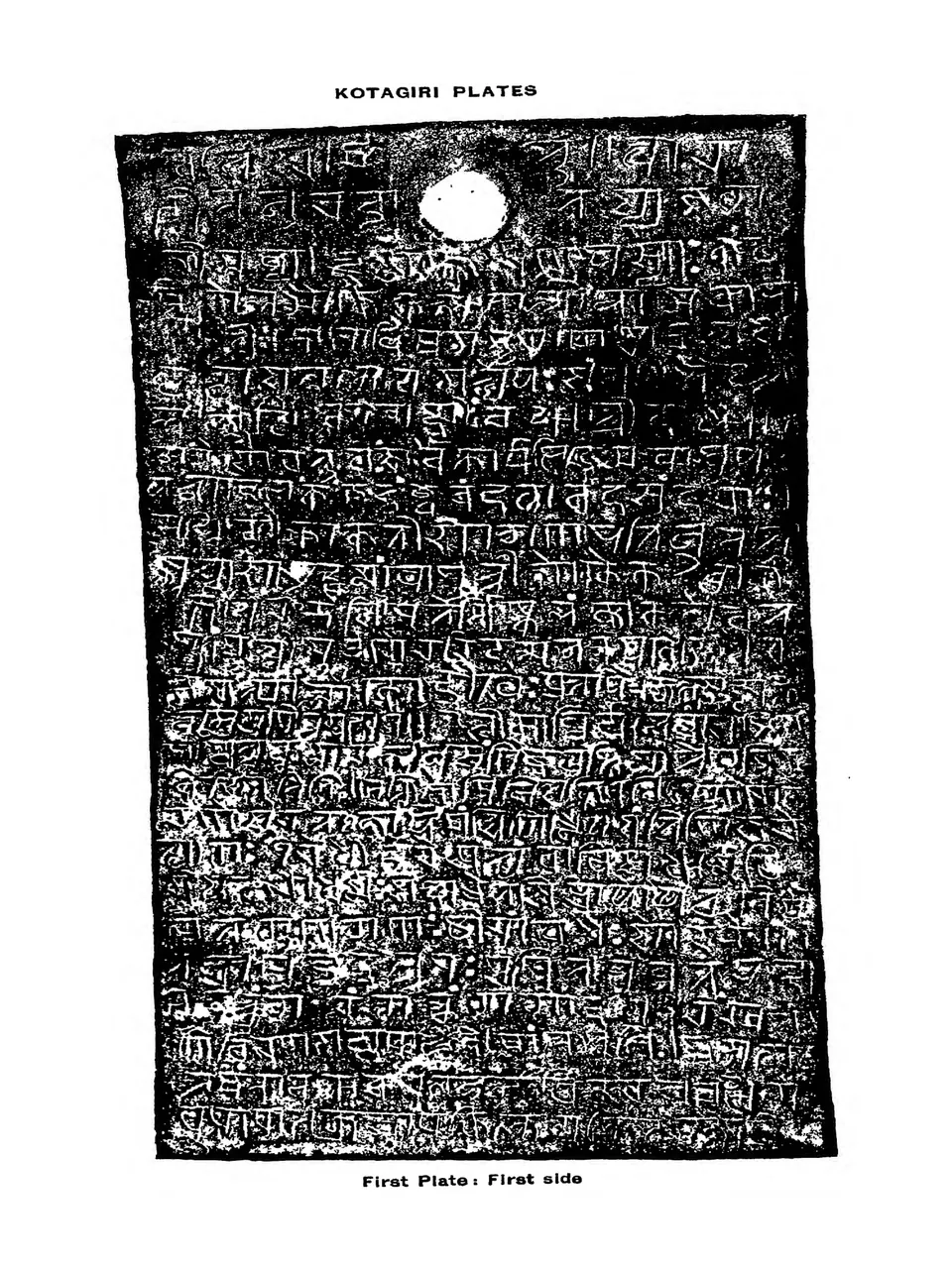
- The consonant after r doubled. The Kotagiri plates of Rudramadevi’s reign (1273) double the consonant after r in several words.6 Fleet’s text of the Hanamkonda inscription (1163) begins Śrīr=vvijayaś, with the v after r written twice.7
- ṛ written ru. In the Kotagiri plates the vowel ṛ “is throughout written ru”, except in two words.6
- Anusvara for every nasal. The Kotagiri scribe used the anusvāra (the small circle) “throughout in preference to” the proper nasal letter, as in paṃkaja.6 Burnell thought the increasingly free use of the bindu “a tolerably safe test of the age of a document”: the later the inscription, the more indiscriminate its use.8
- b and v, ś and s exchanged. Kotagiri has bibhrama for vibhrama and binaya for vinaya, and confuses ś and s.6
The editors of the Kotagiri plates listed such spellings among the “interesting characteristics in orthography” of their text.6 Habits like these tell you how scribes in the Telugu country actually wrote Sanskrit, so it pays to notice them rather than skip over them.
Worked example: the opening of the Chikkulla plates
The first line of the Chikkulla plates reads, in Kielhorn’s edition:5
Oṃ svasti [||] Vijaya-Lenḍulūra-vāsakād=bhagavataḥ Śrīparvvata-*
and he translates the opening as “Om! Hail! From his residence, the victorious Lendulura, he who meditates on the feet of the holy lord of Sriparvata”.9

Line 1 of the first plate. The white circle on the left is the hole for the ring that held the plates together.10
Read it in four steps:
- The opening symbol. Just after the ring-hole is a curling sign. Kielhorn notes that the opening Oṃ is “expressed by a symbol”, not spelt out in letters.11
- svasti. Two stacked letters: sva (sa with a small va beneath it) and sti (sa with ta beneath it and the i-sign above). Stacking consonants in this way is as old as Asoka’s edicts.12
- Vijaya-Lenḍulūra-vāsakāt, “from the residence at victorious Lendulura”. J. Ramayya, who reported the plates, identified Lendulura with Denduluru, a village on the ruins of the old city of Vengi near Eluru.13
- bhagavataḥ Śrīparvvata-: notice rvv, the consonant after r written double, one of the habits listed above.
Nagari in the Telugu country
The Nagari script came from the north. Burnell, who studied the South Indian inscriptions in Nagari, found that all but one were later than the 10th century.14 In the Deccan, he wrote, Nagari inscriptions “begin to commonly appear” when the Chalukyas of Kalyana temporarily lost power, and the feudatory families that rose against them, such as the Rashtrakutas, much used it.15 Near Jayapura, in the Ganjam district, he noted a few 10th-century inscriptions in a variety of Nagari that he thought was the origin of the Oriya alphabet (see the lesson on Odia).14
A Kakatiya grant in Nagari. The Kotagiri plates of 1273, issued in the reign of the Kakatiya queen Rudramadevi, are in Sanskrit, and their editors found that “the alphabet resembles, in a large measure, the modern Devanagari character”. They also noted differences in the shapes of some letters, among them bha, ja, ksha, la and dha.6
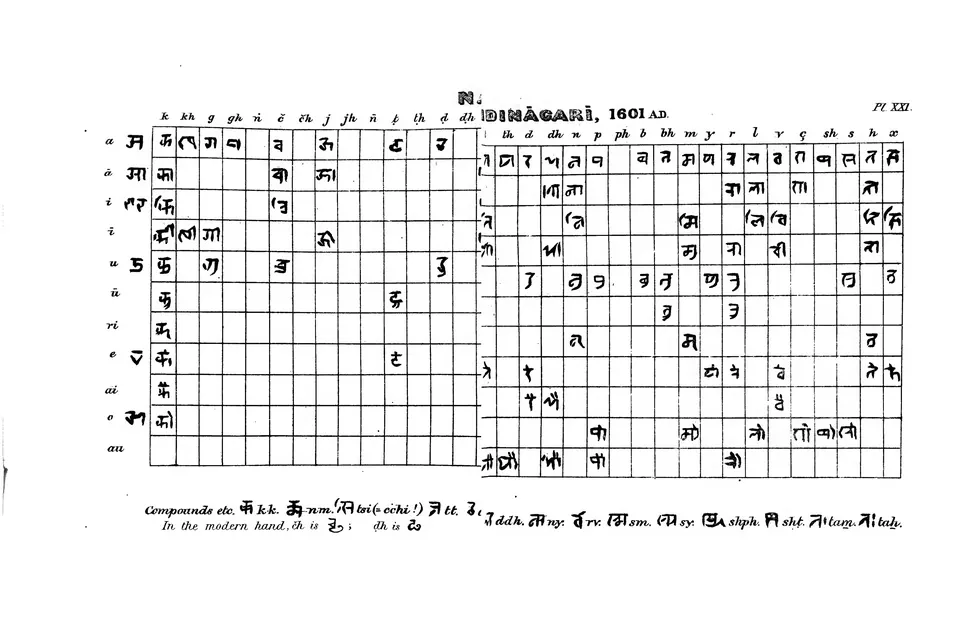
Nandinagari under Vijayanagara. The southern form of Nagari is called Nandinagari. Burnell found that the early inscriptions of the Vijayanagara dynasty are in Hala-kannada or Nandinagari, and that the latest, of the 15th and 16th centuries, are “almost exclusively” in Nandinagari.2 He called it “one of the most illegible characters in use in all India”. In his day it was the favourite script of the Madhva sect, and it was used almost only for writing on palm leaves.2 All the Nandinagari copper plates and palm-leaf manuscripts he had seen were numbered with the ordinary Telugu-Kannada numerals, and he took it to have been the official script of the Vijayanagara kingdom at the beginning of the 16th century, since the name of Krishnaraya is written in it on his coins.2 Burnell’s Plate XX gives the alphabet of a Nandinagari copper-plate grant of Harihara dated 1400, Plate XXI a Nandinagari alphabet of 1601, and Plate XXX a facsimile of a Vijayanagara grant of about 1400.16
Many Vijayanagara grants found in Nellore district are of this kind. A grant of Devaraya II dated Saka 1351 (1429–30) is “in the Nandinagari alphabet” and in Sanskrit verse.17 Several end with the words Sri Virupaksha, written “in large Canarese characters” below the Nandinagari text.18 Virupaksha is the god in whose temple “on the Tungabhadra” the Chejerla grant says it was made.19 The modern Nagari (Balbodh) hand, Burnell adds, reached the far south only with the Maratha conquest of Tanjore in the late 17th century.2
How to tell Nagari from Telugu-Kannada at a glance. Burnell derived Nandinagari from the siddhamātṛkā script of Benares and Kashmir, and quotes Al-Biruni’s description of it: the strokes are horizontal, and each letter hangs from a horizontal line drawn over it.14 So look for:
- a straight line along the top of each letter, instead of the small Telugu head-mark;
- in Nandinagari, letters that are harder to make out than in northern Nagari: Burnell blamed this slow deterioration on the practice of writing on palm leaves.14
Try it yourself
Open the image of Copper-plate No. 18 from Nellore, the Chejerla grant of Devaraya II (1428–29).20
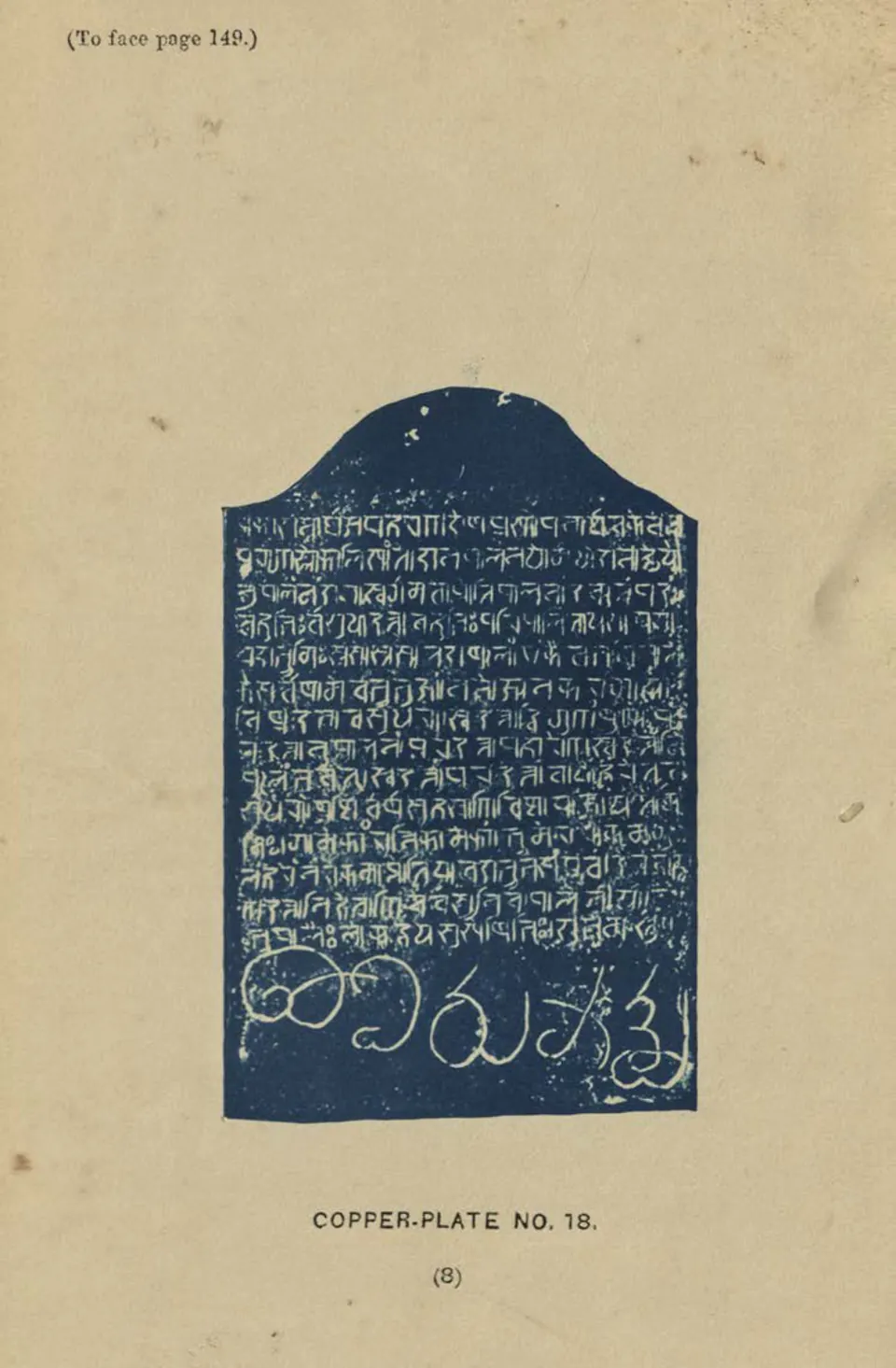
- The main text on this plate is in one script and the two large words at the bottom are in another. Which scripts are they?20
- The plates of this grant are numbered at the top. In what kind of figures would you expect the numbers to be written?
Answer
- The editors describe the characters of the grant as Nandinagari and the language as Sanskrit verse, except for the boundaries, which are in Telugu.19 The large words at the foot are the closing Sri Virupaksha: the grant “concludes with some imprecatory verses and the colophon Sri Virupaksha”.21 On similar Nellore grants the editors describe these words as written “in large Canarese characters”.18
- In Telugu figures. The editors say that “the plates are numbered at the top in Telugu figures”.19 This agrees with Burnell’s remark that Nandinagari plates and manuscripts are numbered with Telugu-Kannada numerals.2 See the lesson on numerals.
Footnotes
-
A. C. Burnell, Elements of South-Indian Palaeography, 2nd ed. (1878), p. 24 (archive.org (opens in a new tab)). ↩ ↩2
-
Burnell, Elements of South-Indian Palaeography (1878), p. 56 (archive.org (opens in a new tab)). ↩ ↩2 ↩3 ↩4 ↩5 ↩6
-
F. Kielhorn, “Chikkulla Plates of Vikramendravarman II”, Epigraphia Indica IV (1897), p. 194 (archive.org (opens in a new tab)). ↩ ↩2 ↩3 ↩4 ↩5
-
Butterworth and Venugopaul Chetty, Nellore District Inscriptions, Part I (1905), Copper-plate No. 15, p. 109 (archive.org (opens in a new tab)); Copper-plate No. 18, pp. 149–150 (archive.org (opens in a new tab)). ↩
-
Kielhorn, “Chikkulla Plates” (1897), p. 195, text line 1 (archive.org (opens in a new tab)). ↩ ↩2
-
S. Hanumant Rao and Lakshmi Kanta Sastri, The Kotagiri Plates of the Reign of the Kakatiya Queen Rudramamba, A.D. 1273 (Hyderabad Archaeological Series No. 6, 1925), p. 1 (archive.org (opens in a new tab)). ↩ ↩2 ↩3 ↩4 ↩5 ↩6
-
J. F. Fleet, “Sanskrit and Old-Canarese Inscriptions, No. CXVIII”, Indian Antiquary XI (1882), p. 12, text line 1 (archive.org (opens in a new tab)). ↩
-
Burnell, Elements of South-Indian Palaeography (1878), pp. 30–31 (archive.org (opens in a new tab)). ↩
-
Kielhorn, “Chikkulla Plates” (1897), p. 197, translation (archive.org (opens in a new tab)). ↩
-
Kielhorn, “Chikkulla Plates” (1897), plate (first plate) (archive.org (opens in a new tab)); the ring is described on p. 194 (archive.org (opens in a new tab)). ↩
-
Kielhorn, “Chikkulla Plates” (1897), p. 195, n. 6 (archive.org (opens in a new tab)). ↩
-
Burnell, Elements of South-Indian Palaeography (1878), p. 13 (archive.org (opens in a new tab)). ↩
-
Kielhorn, “Chikkulla Plates” (1897), p. 195 (archive.org (opens in a new tab)). ↩
-
Burnell, Elements of South-Indian Palaeography (1878), p. 53 and n. 1 (archive.org (opens in a new tab)). ↩ ↩2 ↩3 ↩4
-
Burnell, Elements of South-Indian Palaeography (1878), p. 54 and n. 3 (archive.org (opens in a new tab)). ↩
-
Burnell, Elements of South-Indian Palaeography (1878), Pl. XX, “Grant (on copper plates) of Harihara, d. 1400 A.D.” (archive.org (opens in a new tab)); Pl. XXI, “Nandinagari, 1601 A.D.” (archive.org (opens in a new tab)); Pl. XXX, “Vijayanagara 1400 A.D.” (archive.org (opens in a new tab)). ↩
-
Alan Butterworth and V. Venugopaul Chetty, A Collection of the Inscriptions on Copper-Plates and Stones in the Nellore District, Part I (1905), Copper-plate No. 3, p. 12 (archive.org (opens in a new tab)). ↩
-
Butterworth and Venugopaul Chetty, Nellore District Inscriptions, Part I (1905), p. 69 (archive.org (opens in a new tab)) and p. 91 (archive.org (opens in a new tab)). ↩ ↩2
-
Butterworth and Venugopaul Chetty, Nellore District Inscriptions, Part I (1905), Copper-plate No. 18, note, pp. 149–150 (archive.org (opens in a new tab)). ↩ ↩2 ↩3
-
Butterworth and Venugopaul Chetty, Nellore District Inscriptions, Part I (1905), Copper-plate No. 18, last plate, facing p. 149 (archive.org (opens in a new tab)). ↩ ↩2
-
Butterworth and Venugopaul Chetty, Nellore District Inscriptions, Part I (1905), p. 151 (archive.org (opens in a new tab)). ↩
References
Notes (0)
Sources (6)
Spotted an error on this page? Tell us
Last updated: