Tomb of Abdul Wahab, Kurnool
Two-domed tomb on the bank of the Handri at Kurnool. It was built for Abdul Wahab Khan, the Abyssinian general who took Kurnool for Bijapur early in the seventeenth century and was its first Bijapur governor. The Kurnool district manual and the Imperial Gazetteer date it to AH 1028 (1618), the year of his death.
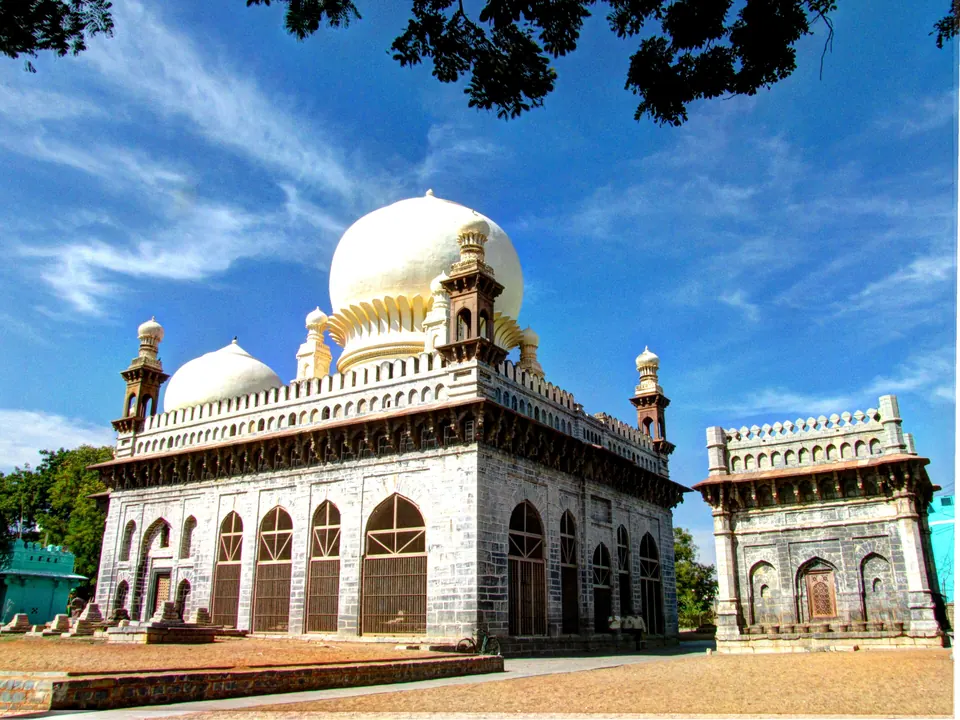
The tomb of Abdul Wahab stands on the bank of the Handri, the river that joins the Tungabhadra at Kurnool. The Manual of the Kurnool District (1886) lists it among the antiquities of the town.1 It describes the tomb of Abdul Wahab, “the first Bijapur Governor”, on the banks of the Handri.1 The tomb consists “of two domes built in 1028 Hijiri (A.D. 1618)”.1 With it the manual lists the remains of the palace of Gopala Raja, “the last Hindu ruler of Kurnool, from whom Abd-ul-wahab took the town”.1 See Abdul Wahab Khan and the Adil Shahis of Bijapur.
Builder and date
In its history chapter the manual says that Abdul Wahab died in AH 1028 (1618; AH is the Islamic way of counting years).2 He “was buried in a large dome-shaped tomb which he had built on the banks of the Handri”.2 The tomb “now attracts the attention of travellers”.2 The Imperial Gazetteer (1908) mentions the tomb of Abdul Wahab, “the first Muhammadan governor”, on the bank of the Hindri.3 It says the tomb “was built in A. D. 1618”.3 It calls the tomb “the only other antiquity in the place which deserves mention”.3
Neither source quotes an inscription on the building.21 The manual’s two statements leave open whether Abdul Wahab built the tomb in his lifetime, or whether it was finished in the year of his death.21
Footnotes
-
Narahari Gopalakristnamah Chetty, A Manual of the Kurnool District (1886), p. 225 (archive.org (opens in a new tab)). ↩ ↩2 ↩3 ↩4 ↩5 ↩6
-
Chetty, Kurnool District (1886), p. 29 (archive.org (opens in a new tab)). ↩ ↩2 ↩3 ↩4 ↩5
-
Imperial Gazetteer of India: Madras, Vol. I (1908), p. 426 (archive.org (opens in a new tab)). ↩ ↩2 ↩3
Photos
References
Notes (0)
Sources (2)
Spotted an error on this page? Tell us
Last updated: