Abdul Wahab Khan
Abyssinian general of Bijapur who took Kurnool from Gopala Raja, a grandson of Aliya Rama Raya, early in the seventeenth century. He governed it for about sixteen years as the first Bijapur governor of the town. He died in AH 1028 (1618) and is buried in the two-domed tomb on the bank of the Handri at Kurnool.
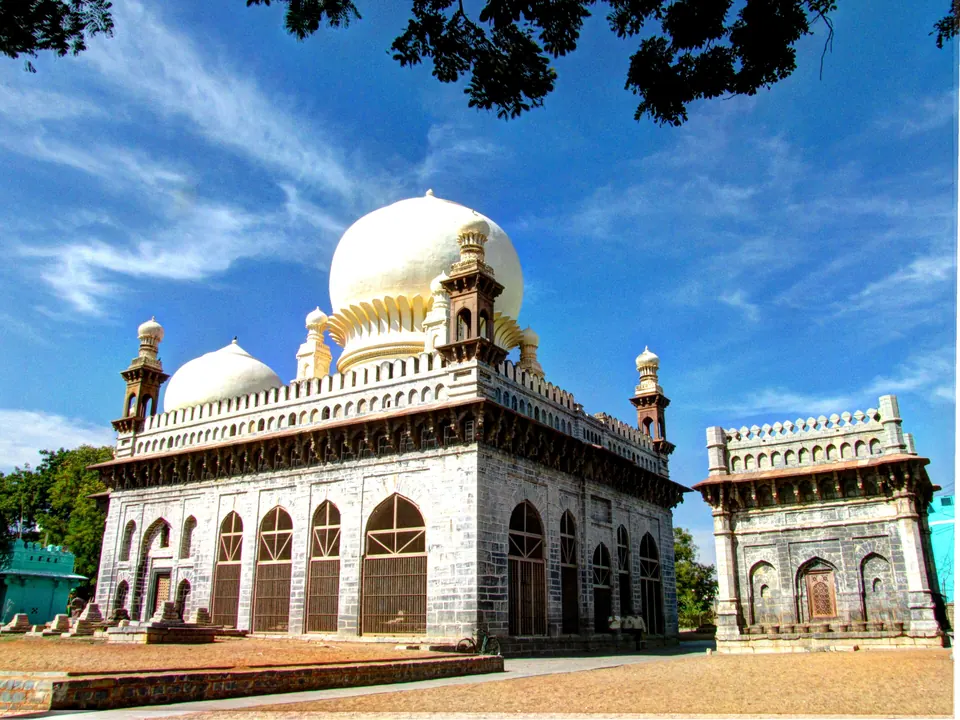
Abdul Wahab Khan is remembered at Kurnool as the man who conquered the town for Bijapur.1 He governed it for about sixteen years and died in AH 1028 (1618; AH is the Islamic way of counting years).2 He was buried in a tomb that he had built on the bank of the Handri.2
The siege of Kurnool
The Manual of the Kurnool District (1886) describes a long period of confusion after the battle of 1565.1 Then, “at the beginning of the seventeenth century”, Abdul Wahab “was deputed by the King of Bijapur, with a powerful army, to take the fort of Kurnool”.1 Henry Heras, the historian of the Aravidu dynasty (1927), placed the expedition “probably not long after” a failed Bijapur siege of Penukonda.3 Heras placed that siege in the reign of Ibrahim Adil Shah II.4 See Kurnool and the Adil Shahis of Bijapur.
The town was then held by Gopala Raja, “a grandson of Rama Raja of Talikota”.12 The manual says that he “stoutly defended the town, which was strongly fortified”.12 It adds, “He was assisted, it is said, by a force sent by Venkatapati of Penukonda”.12 But he had to give up the town.12
Gopala Raja “is said to have fled from the town through the northern gate of the fort still known as Gopal Darvaja”.12 The country was almost deserted for about three years before the people began to return.12 See Aliya Rama Raya and Venkatapati II.
Governor of Kurnool
Abdul Wahab governed as deputy for about sixteen years.2 Over time he took Betamcherla, Nandyal and Sirvel.2 Koilkuntla, then part of Gandikota, and the Cumbum and Markapur country were left to the officers of Golconda.2
The manual describes him as “an Abyssinian and a bigotted Muhammadan”.2 It says, “One of his first acts was to convert Hindu temples into mosques, which he liberally endowed.”2 It adds that he “is also said to have improved the town”.2 “The arched shops in the main bazaar streets in Kurnool are said to have been built by him.”2 According to the manual, the suburb of Jorapuram is named after Jora, his sister.5
Death and tomb
He died in AH 1028 (1618).2 He “was buried in a large dome-shaped tomb which he had built on the banks of the Handri, and which now attracts the attention of travellers”.2 His brother Muhammad succeeded him.2 After that, deputies from Bijapur governed Kurnool until 1686.2
The Imperial Gazetteer (1908) also gives 1618 for the tomb of “Abdul Wahab, the first Muhammadan governor”.6 See the tomb of Abdul Wahab, Kurnool.
Footnotes
-
Narahari Gopalakristnamah Chetty, A Manual of the Kurnool District (1886), p. 28 (archive.org (opens in a new tab)). ↩ ↩2 ↩3 ↩4 ↩5 ↩6 ↩7 ↩8 ↩9
-
Chetty, Kurnool District (1886), p. 29 (archive.org (opens in a new tab)). ↩ ↩2 ↩3 ↩4 ↩5 ↩6 ↩7 ↩8 ↩9 ↩10 ↩11 ↩12 ↩13 ↩14 ↩15 ↩16 ↩17 ↩18 ↩19
-
Henry Heras, The Aravidu Dynasty of Vijayanagara, Vol. I (1927), p. 337 and note 1 (archive.org (opens in a new tab)). ↩
-
Heras, The Aravidu Dynasty of Vijayanagara, Vol. I (1927), p. 336 (archive.org (opens in a new tab)). ↩
-
Chetty, Kurnool District (1886), p. 224 (archive.org (opens in a new tab)). ↩
-
Imperial Gazetteer of India: Madras, Vol. I (1908), p. 426 (archive.org (opens in a new tab)). ↩
Photos
References
Notes (0)
Sources (3)
Spotted an error on this page? Tell us
Last updated: