Mecca Masjid
Great stone mosque near the Charminar in Hyderabad. Sultan Muhammad Qutb Shah began it in 1617, his successors continued it, and it was completed under Aurangzeb in the 1690s. The Asaf Jahi Nizams from Nizam Ali Khan onwards are buried in its courtyard.
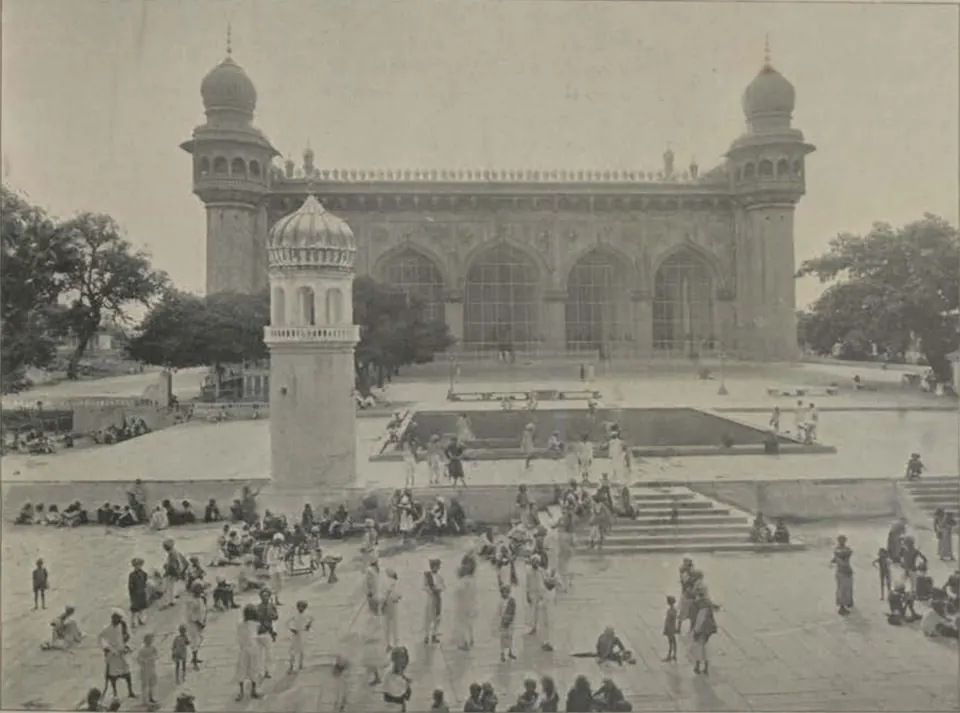
The Mecca Masjid is the largest of the Qutb Shahi mosques of Hyderabad and stands south-west of the Charminar.1 Building began under Sultan Muhammad Qutb Shah (1612–1626) and took more than seventy years. The mosque was finished only after the Mughal conquest.
Building history
According to Bilgrami, work began in AH 1027 (1617; AH is the Islamic way of counting years), under Sultan Muhammad.2 A darogha (superintendent), Mir Faizullah Beg, supervised the work, together with Chaudhri Rangaiyah, who had the title Hunarmand Khan.2 Some eight thousand masons and labourers worked on it.2
Bilgrami also repeats a story told by the Qutb Shahi historians.2 The king asked the learned men of the city to find someone who had never missed a prayer to lay the foundation stone.2 When no one came forward, he laid it himself.2 Bilgrami says Sultan Muhammad spent 40,000 huns (gold coins) on the building.3
Work went on under Abdullah and Abul Hasan.2 According to Bilgrami, the mosque was completed under Aurangzeb in AH 1104 (1692–93), seventy-seven years after it was begun.2 The Imperial Gazetteer gives the same sequence.1 An inscription on the main gate gives “the year 32” of Aurangzeb’s reign.4 Bilgrami equates this with AH 1100 (1688).4
Tavernier’s account
Tavernier, writing in Abdullah’s reign, described a great mosque that had been under construction for about fifty years.5 It would be “the grandest in all India if it should be completed”.5 He was told that the stone for its prayer niche was a single rock.5 It took five or six hundred men five years to quarry and 1,400 oxen to haul.5
He believed the work had stopped because of a warning from the king’s son-in-law and minister, a man from Mecca whom he calls the Sheikh.6 The Sheikh had warned that a great calamity would follow if the mosque were completed.6
V. Ball, Tavernier’s editor, took this mosque to be the Jami Masjid.7 But Bilgrami applies Tavernier’s account of the prayer niche to the Mecca Masjid.7 So does A. Claude Campbell’s Glimpses of the Nizam’s Dominions (1898), which quotes the same passage in an older translation.8
Where the sources disagree
Campbell gives a different building history:8
- Abdullah Qutb Shah began the mosque about 16608
- Abul Hasan continued it8
- it was finished in 1687 by Aurangzeb’s order8
This conflicts with Bilgrami and the Imperial Gazetteer, which both name Sultan Muhammad as the founder.12 It also conflicts with Tavernier’s report of a mosque already some fifty years in building during Abdullah’s reign.5
The building
The Imperial Gazetteer gives the mosque’s size as 225 feet long, 180 feet broad and 75 feet high.1 It is built entirely of stone and stands in a paved quadrangle 360 feet square.1 Fifteen arches support the roof, which carries two large domes rising 100 feet above it.1 The building can hold 10,000 worshippers.1 Bilgrami and Campbell give the same overall measurements.98
Campbell adds that the fifteen arches stand three deep.8 Each of the tall pillars inside is a single piece of granite.8 He also says the mosque is built of finely dressed gneiss (a hard stone).10 The same stone was used undressed in the massive walls of Golconda fort.10
Bilgrami describes three aisles of fifteen arches each behind five great arches on the front.9 He says the two tall minarets before the main gate and the sundial in the courtyard date from Aurangzeb’s time.9
Stones from a temple
Bilgrami reports that two long slabs by the ablution cistern were said to have come from a temple at the village of Maisaram.9 Campbell’s account agrees.8 He describes two polished stone slabs beside the central cistern, used as seats and said to have come from a Hindu temple.8
In another chapter Campbell describes Maisaram, ten miles south of Hyderabad on the Bangalore road.11 He says Aurangzeb destroyed its Hindu temples after taking Golconda.11 Aurangzeb then built a mosque there from the remains of the largest.11 Pieces of black polished basalt from that temple’s doorway, Campbell says, were carried to the Mecca Masjid, where they served as seats in the courtyard.11
The name
According to Bilgrami, Sultan Muhammad named the mosque Baitul Atiq.12 This is a name of the Kaaba, and its letters give the date AH 1023 (1614).12 The name Mecca Masjid came into use under Aurangzeb.12
Bilgrami records two explanations of the name:12
- the king had bricks made from earth brought from Mecca and set over the central arch12
- like the Kaaba, the mosque was never empty of worshippers12
Campbell gives a third: that it was named after the great mosque at Mecca, on which, he says, it was modelled.8 Bilgrami quotes a couplet presented to the king: “If the pilgrimage (going round) of noble Kaaba is not attainable to thee, come and pray in the Kaaba of the Deccan.”12 One of the rooms of the courtyard holds a relic said to be a hair of the Prophet.12
According to the Tuzuk-i-Qutbshahi manuscript cited by Bilgrami, thirty-six maunds of food were cooked and given to the poor here every day in Qutb Shahi times.12 Under Aurangzeb the allowance was cut to twelve rupees a day.12
Burial place of the Nizams
An older cemetery of the Asaf Jahi family at Atapur was given up as too far from the city.13 After that the southern part of the courtyard became the family’s burial ground.13 The Imperial Gazetteer says Nizam Ali Khan and all his successors were buried here.1 Campbell names Nizam Ali Khan as the first of the family to be buried in the quadrangle.8
Bilgrami lists the graves of these Nizams, with those of several begums:14
- Nizam Ali Khan14
- Sikandar Jah14
- Nasir-ud-daula14
- Afzal-ud-daula14
- Mahbub Ali Khan14
He gives the verse chronograms carved on the graves.14 The last of these is for Mahbub Ali Khan’s death in AH 1329 (1911).14 Marble screens with inscriptions once closed the south end of the courtyard.13 They had been taken down when the courtyard was extended, and in 1927 they had not been put back.13
Footnotes
-
Imperial Gazetteer of India: Hyderabad State (1909), p. 116 (archive.org (opens in a new tab)). ↩ ↩2 ↩3 ↩4 ↩5 ↩6 ↩7 ↩8
-
Syed Ali Asgar Bilgrami, Landmarks of the Deccan (1927), pp. 39–40 (archive.org (opens in a new tab)). ↩ ↩2 ↩3 ↩4 ↩5 ↩6 ↩7 ↩8 ↩9
-
Bilgrami, Landmarks (1927), p. 142 (archive.org (opens in a new tab)). ↩
-
Bilgrami, Landmarks (1927), p. 37 (archive.org (opens in a new tab)). ↩ ↩2
-
Jean-Baptiste Tavernier, tr. V. Ball, Travels in India, Vol. I (1889), pp. 153–154 (archive.org (opens in a new tab)). ↩ ↩2 ↩3 ↩4 ↩5
-
Tavernier, Travels in India, Vol. I (1889), p. 163 (archive.org (opens in a new tab)). ↩ ↩2
-
Tavernier, Travels in India, Vol. I (1889), p. 153, note (archive.org (opens in a new tab)); Bilgrami, Landmarks (1927), p. 41 (archive.org (opens in a new tab)). ↩ ↩2
-
A. Claude Campbell, Glimpses of the Nizam’s Dominions (1898), p. 168 (archive.org (opens in a new tab)). ↩ ↩2 ↩3 ↩4 ↩5 ↩6 ↩7 ↩8 ↩9 ↩10 ↩11 ↩12
-
Bilgrami, Landmarks (1927), pp. 40–41 (archive.org (opens in a new tab)). ↩ ↩2 ↩3 ↩4
-
Campbell, Glimpses of the Nizam’s Dominions (1898), p. 140 (archive.org (opens in a new tab)). ↩ ↩2
-
Campbell, Glimpses of the Nizam’s Dominions (1898), pp. 227, 230 (archive.org (opens in a new tab)). ↩ ↩2 ↩3 ↩4
-
Bilgrami, Landmarks (1927), p. 41 (archive.org (opens in a new tab)). ↩ ↩2 ↩3 ↩4 ↩5 ↩6 ↩7 ↩8 ↩9 ↩10
-
Bilgrami, Landmarks (1927), p. 36 (archive.org (opens in a new tab)). ↩ ↩2 ↩3 ↩4
-
Bilgrami, Landmarks (1927), pp. 36–39 (archive.org (opens in a new tab)). ↩ ↩2 ↩3 ↩4 ↩5 ↩6 ↩7 ↩8
Photos
References
Notes (0)
Sources (4)
Spotted an error on this page? Tell us
Last updated: