Bindusara
Second Maurya emperor (reigned c. 296–268 BCE), son of Chandragupta and father of Asoka. Later writers believed he carried Mauryan rule into the south. But no record says when the Telugu country came under the empire.
Bindusara was the son of Chandragupta Maurya and the father of Asoka.1 The Greeks called him Amitrochates, and E. Hultzsch took this to stand for the Sanskrit title Amitraghata, “slayer of enemies”.2
The sources disagree on the length of his reign:1
- twenty-five years in the Puranas
- twenty-eight in the chronicles of Sri Lanka
- twenty-seven in Burmese tradition1
Sewell and Hultzsch both date his reign to about 296–268 BCE.324 Vincent Smith put its beginning in 301 or 298 BCE, depending on the chronology adopted.324
Relations with the Greek kings
Smith called the arrival of an ambassador from Syria the only recorded public event of the reign.4 The Greek geographer Strabo says that Deimachos was sent to Bindusara, as Megasthenes had been sent to his father.5
The writer Athenaeus tells a story of their letters to each other. Bindusara asked Antiochus I of Syria to buy him sweet wine, dried figs and a sophist (a teacher of philosophy).2 Antiochus replied: “We shall send you dried figs and sweet wine; but it is not lawful in Greece to sell a sophist.”2 Ptolemy II of Egypt also sent an envoy, Dionysius, to an Indian king who was either Bindusara or Asoka.2
The southern expansion
Bindusara matters for the history of the Telugu country because later historians credited him with conquests in the south. Sewell wrote that he was believed to have enlarged his lands towards the south.63 Sewell added that, at any rate, he ruled northern Mysore.63 Sewell’s genealogical table says Bindusara “extended his rule far to the south”.63
Smith thought it probable that the southern provinces were added in Bindusara’s reign.74 He noted that the Tibetan historian Taranatha credited Bindusara with extending the empire southwards.74 Smith also observed that Bindusara must have been a capable ruler to hand on so large an empire to his son.8 Even so, in Smith’s words, the figure of Bindusara himself “eludes our view”.8
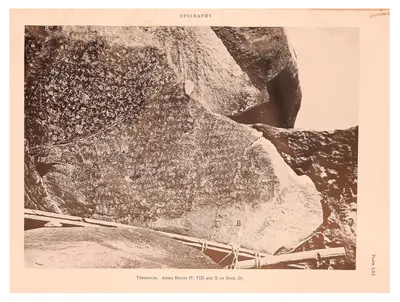
Smith knew of no record of the reign beyond the Syrian embassy.4 None of the sources used here says when the Kurnool country or any other part of the Telugu land came under Mauryan rule.4 Asoka’s edicts at Erragudi show only that the Kurnool country was Mauryan in Asoka’s own reign.9
Succession
According to Sewell, Bindusara’s death was followed by a struggle among his sons, which Asoka won.6 Asoka was crowned four years later.6 Smith accepted the delay in the coronation but found no independent evidence of a struggle.10
Footnotes
-
E. Hultzsch, Corpus Inscriptionum Indicarum, Vol. I: Inscriptions of Asoka (1925), p. xxxii (archive.org (opens in a new tab)). ↩ ↩2 ↩3
-
Hultzsch, Inscriptions of Asoka (1925), p. xxxv (archive.org (opens in a new tab)). ↩ ↩2 ↩3 ↩4 ↩5 ↩6
-
Sewell, Historical Inscriptions of Southern India (1932), p. 320 (archive.org (opens in a new tab)). ↩ ↩2 ↩3 ↩4 ↩5
-
Vincent A. Smith, Asoka, the Buddhist Emperor of India, 3rd ed. (1920), p. 18 and n. 1 (archive.org (opens in a new tab)). ↩ ↩2 ↩3 ↩4 ↩5 ↩6 ↩7
-
Hultzsch, Inscriptions of Asoka (1925), pp. xxxiv–xxxv (archive.org (opens in a new tab)). ↩
-
Robert Sewell, The Historical Inscriptions of Southern India (1932), p. 6 (archive.org (opens in a new tab)). ↩ ↩2 ↩3 ↩4 ↩5
-
Smith, Asoka (1920), p. 80 (archive.org (opens in a new tab)). ↩ ↩2
-
Smith, Asoka (1920), p. 105 (archive.org (opens in a new tab)). ↩ ↩2
-
D. R. Sahni, “The Yerragudi Rock Edicts of Asoka”, Annual Report of the Archaeological Survey of India 1928–29 (1933), p. 167 (archive.org (opens in a new tab)). ↩
-
Smith, Asoka (1920), p. 20 (archive.org (opens in a new tab)). ↩
Related
Dynasties
References
Notes (0)
Sources (4)
Spotted an error on this page? Tell us
Last updated: